
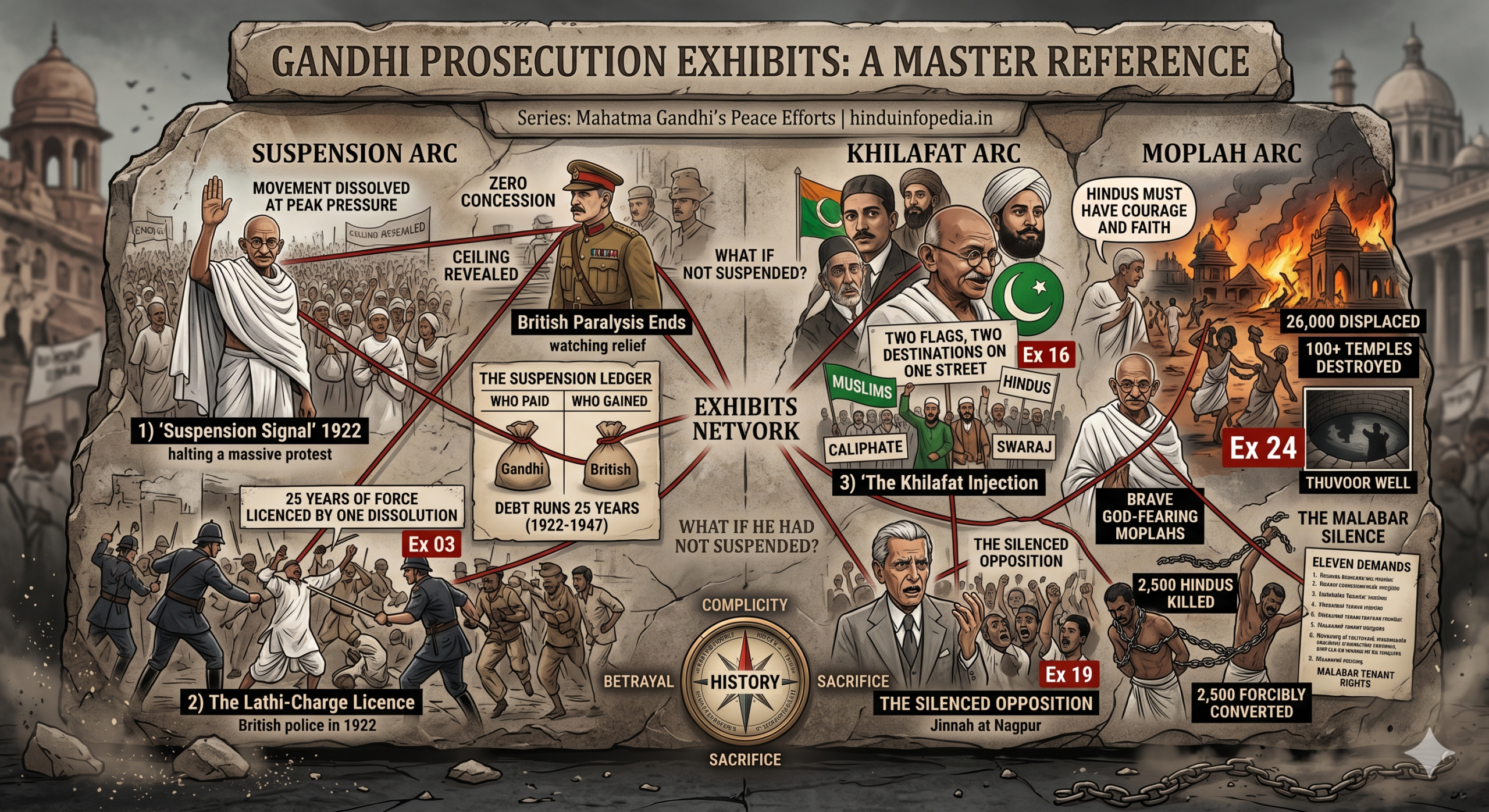
Gandhi Prosecution Exhibits Master Table
Series: Mahatma Gandhi’s Peace Efforts | hinduinfopedia.in
📖 How to Use the Exhibits Reference Guide
Welcome to the Gandhi Prosecution Exhibits master reference. As you read through the articles in this series, you will notice frequent references to specific historical “Exhibits.” Think of this document as your interactive roadmap and index.
Thank you for reading this post, don't forget to subscribe!📖 How to Use the Exhibits Master Table & Reference Guide
Welcome to the Gandhi Prosecution Exhibits Master Reference. This document serves as the permanent evidentiary clearinghouse and forensic index for the entire 300+ installment inquiry.
Every entry cataloged here corresponds to a verified historical exhibit, grounded in primary archival documentation—principally the Collected Works of Mahatma Gandhi (CWMG), British Government of India Home Department files, provincial legislative assembly proceedings, judicial trial records, and contemporary inquiry findings.
Here is how to navigate and extract maximum value from this master record:
1. Understand the Two-Ledger Architecture
Every cataloged exhibit operates within one of two distinct, complementary analytical ledgers:
-
The Causation Ledger (Ground Reality & Consequences): Documents real-world political inputs and their demographic, physical, and legal outcomes on the ground.
-
Pillar 1: The Alliance Record (Theological pacts, extra-territorial campaigns, and clerical empowerment)
-
Pillar 2: The Riot Accounting (Official returns, documented massacres, and narrative whitewashing)
-
Pillar 3: The Self-Defense Directive (Doctrinal demobilization, non-resistance counsel, and asymmetric Ahimsa)
-
Pillar 4: The Enforcement Record (Colonial policing realities, state deterrence, and emergency ordinances)
-
-
The Insulation Ledger (Authority & Immunity): Explains the organizational and cultural mechanisms that shielded these policies from institutional auditing, democratic party checks, or reversal.
-
Pillar 5: The Patronage & Logistics File (Commercial underwriting, ashram trusts, travel logistics, and custodial privileges)
-
Pillar 6: The Unchecked Mandate (Extra-constitutional moral vetoes, fasting sanctions, and democratic override)
-
Pillar 7: The Compromise Audit (Fractional settlement yields measured against grassroots follower sacrifices)
-
(Note: Foundational economic baselines are cataloged under The Reservoir, while structural friction analyses of agitations are indexed under Ceiling Mechanics).
2. Trace the Dual-Parent Lineage
Historical causation is not a simple linear chain; major outcomes arise from the intersection of prior political choices and institutional shields. Every exhibit in this index maps two distinct parents:
-
The Causal Parent (Ground Policy): Identifies the earlier operational decision or alliance that set up the physical conditions on the ground.
-
The Insulation Parent (Authority Shield): Identifies the earlier prestige, financial backing, or moral veto mechanism that prevented colleagues or committees from reviewing or halting that decision.
Use these parent links to trace direct lines of causation (e.g., how the alliance in Blog 44 produced the consequences of Blog 54, protected by the moral veto established in Blog 22).
3. Verify the Primary Sources
Every row lists the exact primary documentation under Primary Source Cited. The series maintains strict evidential discipline:
-
Claims are anchored in period gazettes, legal proceedings, CWMG volume and page citations, and confidential state dispatches.
-
Distinctions are maintained between verbatim primary statements and subsequent analytical deductions.
-
If you are cross-examining or verifying a specific historical claim, consult the source listed in that row before consulting secondary commentaries.
4. Access the Dedicated Deep-Dives
-
Direct URLs: Each exhibit title contains its complete, direct URL for immediate referencing, quoting, and sharing across platforms.
-
Periodic Milestone Audits: For comprehensive balance sheets that synthesize dozens of exhibits into single forensic summaries, refer to the periodic milestones:
-
Blog 53: The Early Arc Compiled (Blogs 1–52)
-
Blog 79: The Riot and Defense Record (Blogs 54–78)
-
Blog 101: The Jinnah Constitutional Ledger (18-Year Transition)
-
Blog 128 & 129: Khilafat Master Exhibits (Inception and Aftermath)
-
Blog 156: The Midpoint Archival Concordance
-
Blog 165: The First 160 Blogs — What the Record Establishes
-
5. Decode Operational Concepts
Key historical mechanisms analyzed throughout the series—such as the Demonstrated Ceiling, the Lathi-Charge Licence, Brave Death Formulation, Blood Cement, and Trusteeship Insulation—are defined not as theoretical metaphors, but as specific operational patterns documented by the archival record. Use this table as your checklist to locate the exact installment where each mechanism was first applied and where its long-term costs were recorded.
Bookmark this page as your standing reference index to verify citations, track chronological dependencies, and audit the primary record of the series as new installments are cataloged.
Gandhi Prosecution Exhibits Master Reference Table
The Forensic Evidence Archive: A cumulative register cataloging primary documents, core factual claims, assigned evidentiary pillars, and dual-parent linkages across the 30-year leadership arc.
| Blog # | Title & Web Address | Pillar / Category | Core Factual Claim on Record | Primary Source Cited | Parent Links (Causal / Insulation) |
Arc 1 — Early Formation & The Method Prototype (Blogs 1–10) |
|||||
| 1 | Gandhi’s Peace Efforts (1) — The Man Before the Mahatma https://hinduinfopedia.in/gandhis-peace-efforts-the-man-before-the-mahatma-1/ |
Pillar 5: THE PATRONAGE & LOGISTICS FILE | London legal credentialing assimilated him into the imperial professional class at caste community expense. | Inner Temple Admission Register (1888); Modh Bania resolution; CWMG Vol. 1 | Causal: Foundational Insulation: Foundational |
| 2 | Gandhi’s South Africa Years (2) — The Pietermaritzburg Night https://hinduinfopedia.in/gandhis-south-africa-years-inner-temple-to-nic-who-paid-the-fare2/ |
Pillar 5: THE PATRONAGE & LOGISTICS FILE | Pietermaritzburg ejection generated personal moral capital; legal advocacy underwritten by elite commercial merchant retainers. | Retainer agreement: Dada Abdulla & Co. (1893); 1894 Franchise Petition | Causal: Blog 1 Insulation: Foundational |
| 3 | Gandhi’s Train to Nowhere (3) — Inventing Satyagraha https://hinduinfopedia.in/gandhis-train-to-nowhere-the-pietermaritzburg-moment-and-its-limits-3/ |
Pillar 6: THE UNCHECKED MANDATE | Satyagraha codified as personal moral command over mass crowds without democratic strike ballots. | Newcastle Coal Strike records (1913); Indian Opinion (1906–1913) | Causal: Blog 2 Insulation: Blog 1 |
| 4 | Gandhi’s Boer War Bargain (4) — The Courage That Built a Method https://hinduinfopedia.in/gandhis-boer-war-bargain-phoenix-farm-and-the-british-medal-4/ |
Pillar 5: THE PATRONAGE & LOGISTICS FILE | Wartime stretcher-bearer logistics organized as an investment in British citizenship claims, earning elite colonial standing. | Natal Indian Ambulance Corps Dispatches (1899, 1906); Kaiser-i-Hind citation | Causal: Blog 1 Insulation: Blog 2 |
| 5 | Gandhi’s Rural India (5) — Champaran — The Walking Investigation https://hinduinfopedia.in/gandhis-rural-india-champaran-real-suffering-real-limits-5/ |
Pillar 7: THE COMPROMISE AUDIT | Accepted a 25% cash refund of extorted rents, leaving planters with 75% and tenancy laws unaddressed. | Champaran Agrarian Enquiry Report (1917); Bihar Land Records | Causal: Blog 3 Insulation: Blog 4 |
| 6 | Gandhi’s Khadi Revolution (6) — The Spinning Wheel as a Weapon https://hinduinfopedia.in/gandhis-khadi-revolution-the-spinning-wheel-as-a-weapon-6/ |
Pillar 5: THE PATRONAGE & LOGISTICS FILE | Charkha elevated into a moral uniform that shielded political choices behind an ascetic aesthetic. | Young India (Aug 1925, “Cannon Quote”); AICC Khadi Rules | Causal: Blog 3 Insulation: Blog 2 |
| 7 | Gandhi’s Non-Cooperation (7) — The First Time India Said No https://hinduinfopedia.in/gandhis-non-cooperation-the-first-time-india-said-no-7/ |
Pillar 1: THE ALLIANCE RECORD | Welded Non-Cooperation to the Khilafat platform on the day Tilak died, mobilizing mass civil refusal. | Special Calcutta Congress Proceedings (Sep 1920); CWMG Vol. 18 | Causal: Blog 3 Insulation: Blog 4 |
| 8 | Gandhi’s Salt March (8) — 241 Miles That Changed Everything https://hinduinfopedia.in/gandhis-salt-march-241-miles-that-changed-everything-8/ |
Pillar 5: THE PATRONAGE & LOGISTICS FILE | Focused civil disobedience onto a universal tax symbol, creating immense nationwide administrative leverage. | Sabarmati march roster (Mar 1930); Viceroy Irwin telegraphic records | Causal: Blog 3 Insulation: Blog 6 |
| 9 | Gandhi’s Sea-Sand Chemical Bomb (9) — A Handful That Could Have Ended an Empire https://hinduinfopedia.in/gandhis-sea-sand-chemical-bomb-the-arsenal-that-could-end-empire-09/ |
Pillar 4: THE ENFORCEMENT RECORD | Overloaded colonial judicial and penal capacity with 60,000+ arrests, proving structural state vulnerability. | Home Dept Political (1930); Central Jail Census returns | Causal: Blog 8 Insulation: Blog 7 |
| 10 | Gandhi’s Four Satyagrahas (10) — Four Battles, Four Betrayals https://hinduinfopedia.in/gandhis-four-satyagrahas-four-battles-four-betrayals-10/ |
Pillar 7: THE COMPROMISE AUDIT | Four campaigns halted at peak pressure without structural concessions, leaving followers exposed each time. | Comparative Settlement Terms: 1914, 1917, 1922, 1931 | Causal: Blog 5 Insulation: Blog 3 |
Arc 2 — The Economic Baseline & The Irwin Pact Gap (Blogs 11–28) |
|||||
| 11 | Gandhi’s Eleven Demands (11) — The Charter Britain Ignored https://hinduinfopedia.in/gandhis-eleven-demands-the-charter-britain-ignored-11/ |
Pillar 7: THE COMPROMISE AUDIT | Subordinated complete independence (Purna Swaraj) to an 11-point economic and agrarian charter. | Letter to Lord Irwin (CWMG Vol. 42, Jan 31, 1930) | Causal: Blog 8 Insulation: Blog 6 |
| 12 | Gandhi’s Eleven Demands Dissected (12) — Why Britain Could Not Say Yes https://hinduinfopedia.in/gandhis-eleven-demands-dissected-why-britain-could-not-say-yes-12/ |
RESERVOIR — BASELINE EXTRACTION | Conceding the 11 demands would have structurally dismantled the fiscal extraction machinery of the Raj. | Imperial Finance Dept Minutes (1930); Indian Budget Statements | Causal: Blog 11 Insulation: Blog 9 |
| 13 | Gandhi’s Extraction Machine (13) — The £9.2 Trillion Apparatus https://hinduinfopedia.in/gandhis-extraction-machine-the-9-2-trillion-apparatus-13/ |
RESERVOIR — BASELINE EXTRACTION | Documents the institutional baseline of Council Bills, Home Charges, and currency manipulation. | Dadabhai Naoroji, Poverty and Un-British Rule (1901); GOI Finance Accounts | Causal: Colonial Baseline Insulation: Colonial Baseline |
| 14 | Gandhi’s Price Tag (14) — £9.2 Trillion and a Life Expectancy of 27 https://hinduinfopedia.in/gandhis-price-tag-9-2-trillion-and-a-life-expectancy-of-27-14/ |
RESERVOIR — BASELINE EXTRACTION | Colonial extraction produced documented outcomes: 16% literacy and 27-year national life expectancy. | Census of India (1921/1931); Public Health & Famine Returns | Causal: Blog 13 Insulation: Colonial Baseline |
| 15 | Gandhi’s Termination Notice (15) — Eleven Demands, One Machine https://hinduinfopedia.in/gandhis-termination-notice-eleven-demands-one-machine-15/ |
RESERVOIR — BASELINE EXTRACTION | Demonstrated that the leadership held an accurate structural blueprint of imperial fiscal vulnerability. | Young India analysis (Jan 1930); Legislative Assembly debates | Causal: Blog 11 Insulation: Blog 13 |
| 16 | Gandhi’s Unanswered Question (16) — If the Machine Stops, Does Britain Stay? https://hinduinfopedia.in/gandhis-unanswered-question-machine-stops-britain-leaves-16/ |
RESERVOIR — BASELINE EXTRACTION | Demonstrated that imperial departure was fiscally inevitable if non-cooperation continued without a truce. | Cabinet Crisis Memoranda, London (1930); Irwin Telegrams | Causal: Blog 9 Insulation: Blog 15 |
| 17 | Gandhi’s Pact Baseline (17) — What Was on the Table https://hinduinfopedia.in/gandhis-irwin-pact-the-handshake-that-buried-the-revolution-17/ |
Pillar 6: THE UNCHECKED MANDATE | Entered bilateral negotiations with Irwin as sole plenipotentiary without a bounding committee mandate. | CWC Mandate Minutes (Jan–Feb 1931); Viceroy Private Papers | Causal: Blog 9 Insulation: Blog 11 |
| 18 | Gandhi’s Pact Fine Print (18) — What the Eight Meetings Actually Produced https://hinduinfopedia.in/gandhis-pact-fine-print-what-the-eight-meetings-actually-produced-18/ |
Pillar 7: THE COMPROMISE AUDIT | Accepted conditional terms: salt for coastal personal use only, land returned only if not yet sold. | Official Gazette Extraordinary (Mar 5, 1931); Delhi Pact Clauses | Causal: Blog 17 Insulation: Blog 5 |
| 19 | Gandhi’s Incubation Year (19) — Twelve Months Britain Used Before Signing https://hinduinfopedia.in/gandhis-incubation-year-twelve-months-britain-used-before-signing-19/ |
Pillar 4: THE ENFORCEMENT RECORD | British used 12-month delay to liquidate seized peasant lands and censor police conduct before signing. | Emergency Powers Ordinances (1930–1931); Confiscation Registers | Causal: Blog 9 Insulation: Blog 18 |
| 20 | Gandhi’s Pact Gap (20) — Eleven Demanded, None Delivered in Full https://hinduinfopedia.in/gandhis-pact-gap-eleven-demanded-none-delivered-in-full-20/ |
Pillar 7: THE COMPROMISE AUDIT | Zero demands met to an enforceable extent; salt monopoly stood; 60,000 satyagrahis gained no structural relief. | Comparative Clause Analysis: Jan 1930 Letter vs Mar 1931 Pact | Causal: Blog 11 Insulation: Blog 18 |
| 21 | Gandhi’s Unelected Mandate (21) — The Authority Nobody Granted https://hinduinfopedia.in/gandhis-unelected-mandate-the-authority-nobody-granted-21/ |
Pillar 6: THE UNCHECKED MANDATE | Held supreme command over national mobilization and suspension without holding elected party office. | Congress Constitution & AICC Office Rolls (1920–1934) | Causal: Blog 3 Insulation: Blog 7 |
| 22 | Gandhi’s Unchallengeable Authority (22) — Why Nobody Could Stop Him https://hinduinfopedia.in/gandhis-unchallengeable-authority-why-nobody-could-stop-him-22/ |
Pillar 6: THE UNCHECKED MANDATE | Moral monopoly framed political dissent as spiritual failure, silencing senior constitutional critics. | Jawaharlal Nehru, Autobiography; Lajpat Rai Letters (1922) | Causal: Blog 21 Insulation: Blog 6 |
| 23 | Gandhi’s Mahatma Question (23) — The Title, the Circular and the Window https://hinduinfopedia.in/gandhis-mahatma-question-the-title-the-memorandum-and-the-window-23/ |
Pillar 5: THE PATRONAGE & LOGISTICS FILE | “Mahatma” title formally institutionalized by Congress provincial ministries, giving personal prestige state backing. | Central Provinces & Berar Govt Circular (Sep 2, 1938) | Causal: Blog 22 Insulation: Blog 4 |
| 24 | Gandhi’s Operating Method (24) — The Savarkar File and the Pattern https://hinduinfopedia.in/gandhis-operating-method-the-savarkar-file-and-the-pattern-24/ |
Pillar 6: THE UNCHECKED MANDATE | Publicly defended Savarkar brothers’ release conditioned on renouncing independence from the British Empire. | Young India (May 26, 1920); CWMG Vol. 19 & 20 | Causal: Blog 21 Insulation: Blog 4 |
| 25 | Gandhi’s Philosophy Unmasked (25) — The Geometry of Contradiction https://hinduinfopedia.in/gandhis-philosophy-unmasked-the-geometry-of-a-lie-25/ |
Pillar 6: THE UNCHECKED MANDATE | Overrode 12 of 15 Provincial Congress Committees nominating Patel to personally install Nehru. | 1946 PCC Nomination Records; J.B. Kripalani, Gandhi: His Life | Causal: Blog 21 Insulation: Blog 22 |
| 26 | Gandhi’s Pact Aftermath (26) — What the Prisoners Found When They Came Out https://hinduinfopedia.in/gandhis-succession-design-how-the-unchallengeable-chose-his-heir-26/ |
Pillar 7: THE COMPROMISE AUDIT | Karachi ratified the pact as a fait accompli; violence-excluded prisoners and sold lands were left unrescued. | Karachi Congress Proceedings (Mar 1931); Prison Release Ledgers | Causal: Blog 18 Insulation: Blog 20 |
| 27 | Gandhi’s Pact Balance Sheet (27) — What the Strongest Hand Actually Purchased https://hinduinfopedia.in/gandhis-pact-aftermath-what-the-prisoners-in-the-pact-27/ |
Pillar 7: THE COMPROMISE AUDIT | Exchanged peak civil leverage for sole personal standing at London conference, which produced zero concessions. | 2nd Round Table Conference Proceedings (1931); Irwin Letters | Causal: Blog 20 Insulation: Blog 26 |
| 28 | Gandhi’s Willingdon Test (28) — The Pact That Protected Nobody https://hinduinfopedia.in/gandhis-willingdon-test-the-pact-that-protected-nobody-28/ |
Pillar 4: THE ENFORCEMENT RECORD | British banned Congress and arrested Gandhi within days of return, proving pact held zero deterrent value. | Home Dept Orders (Jan 1932); Viceroy Willingdon Dispatches | Causal: Blog 19 Insulation: Blog 27 |
Arc 3 — The 1922 Suspension & The Cost of Abandonment (Blogs 29–43) |
|||||
| 29 | Gandhi’s Peak Pressure (29) — November 1921 — The British Nearly Broke https://hinduinfopedia.in/gandhis-peak-pressure-november-1921-the-british-nearly-broke-29/ |
CEILING — MOVEMENT MECHANICS | Civil disobedience and boycott brought multiple provincial administrations near collapse in late 1921. | Viceroy Reading to Montagu telegrams (Nov–Dec 1921) | Causal: Blog 7 Insulation: Blog 9 |
| 30 | Gandhi’s Suspension Signal (30) — The Day the British Learned They Could Wait https://hinduinfopedia.in/gandhis-suspension-signal-the-day-the-british-read-the-map-30/ |
Pillar 6: THE UNCHECKED MANDATE | Unilaterally dissolved nationwide movement following Chauri Chaura without consulting jailed colleagues. | Bardoli Working Committee Resolution (Feb 12, 1922); CWMG Vol. 22 | Causal: Blog 29 Insulation: Blog 21 |
| 31 | Gandhi’s Three British Options (31) — What If He Had Not Suspended? https://hinduinfopedia.in/gandhis-second-unanswered-question-what-if-he-had-not-suspended-31/ |
CEILING — MOVEMENT MECHANICS | Halted movement unilaterally, resolving imperial administrative dilemma between force, concession, or collapse. | Governor of Bombay Dispatches (Feb 1922); Reading Papers | Causal: Blog 29 Insulation: Blog 30 |
| 32 | Gandhi’s Lathi-Charge Licence (32) — How One Suspension Freed the Baton https://hinduinfopedia.in/gandhis-lathi-charge-licence-how-one-suspension-freed-the-baton-32/ |
Pillar 4: THE ENFORCEMENT RECORD | Colonial authorities deployed uninterrupted baton force knowing the movement would not retaliate or escalate. | Dharasana Dispatches: Webb Miller (1930); Police Manuals | Causal: Blog 30 Insulation: Blog 3 |
| 33 | Gandhi’s Suspension Ledger (33) — Who Paid, Who Gained https://hinduinfopedia.in/gandhis-torch-the-light-that-showed-britain-where-to-strike-33/ |
Pillar 7: THE COMPROMISE AUDIT | 30,000 prisoners gained nothing; 172 villagers sentenced to death; Gandhi was jailed 3 weeks later at zero state risk. | Chauri Chaura Special Court Records; Sessions Judge Holmes | Causal: Blog 30 Insulation: Blog 22 |
| 34 | Gandhi’s Jallianwala Asymmetry (34) — The Fast He Did Not Call https://hinduinfopedia.in/gandhis-suspension-ledger-who-paid-who-gained-34/ |
Pillar 6: THE UNCHECKED MANDATE | Undertook no fast for 489+ Jallianwala dead; fasted 5 days over Bombay rioting between Indian factions (Nov 1921). | Hunter Commission Report (1920); CWMG Vol. 16 & 21 | Causal: Blog 7 Insulation: Blog 22 |
| 35 | Gandhi’s Death Accounting (35) — Twenty-Two Against One Hundred and Seventy-Two https://hinduinfopedia.in/gandhis-death-accounting-1922-22-against-178-35/ |
Pillar 7: THE COMPROMISE AUDIT | Cited 22 dead policemen to abort the movement, but mounted no campaign for 172 marchers condemned to hang. | Allahabad High Court Trial Transcripts (1922–1923) | Causal: Blog 30 Insulation: Blog 33 |
| 36 | Gandhi’s Arrested Protesters (36) — The First People Beaten With His Own Licence https://hinduinfopedia.in/gandhis-arrested-protesters-the-first-people-beaten-with-his-own-licence-36/ |
Pillar 4: THE ENFORCEMENT RECORD | Demonstrators protesting Gandhi’s March 1922 arrest were dispersed by police without organizational defense. | Central Provinces Police Reports (Mar–Apr 1922) | Causal: Blog 30 Insulation: Blog 32 |
| 37 | Gandhi’s Forgotten Lawyer (37) — The Man Who Saved 151 Lives Gandhi Left Behind https://hinduinfopedia.in/gandhis-forgotten-lawyer-the-man-who-saved-151-lives-gandhi-left-behind-37/ |
Pillar 7: THE COMPROMISE AUDIT | Malaviya stepped into colonial court and legally saved 151 of 172 Chauri Chaura defendants from the gallows. | Legal Submissions of Pandit Madan Mohan Malaviya (1923) | Causal: Blog 35 Insulation: Blog 33 |
| 38 | Gandhi’s Perpetual Debt (38) — The Price of Zero https://hinduinfopedia.in/gandhis-perpetual-debt-twenty-five-years-of-re-payments-on-a-zero-price-38/ |
Pillar 7: THE COMPROMISE AUDIT | Setting the exit price at zero permanently altered British deterrence calculations across subsequent decades. | Comparative Balance of Non-Cooperation (CWMG Vol. 23) | Causal: Blog 30 Insulation: Blog 31 |
| 39 | Gandhi’s Cost Beyond 1947 (39) — The Framework That Outlasted the Empire https://hinduinfopedia.in/gandhis-cost-beyond-1947-the-framework-that-outlasted-the-empire-39/ |
Pillar 6: THE UNCHECKED MANDATE | Unilateral executive preference carried into post-independence statecraft, bypassing collective cabinet scrutiny. | AICC Post-Partition Protocols; Interim Cabinet Minutes (1946–47) | Causal: Blog 25 Insulation: Blog 21 |
| 40 | Gandhi’s Mask (40) — Was Purna Swaraj the Goal or the Instrument? https://hinduinfopedia.in/gandhis-mask-was-purn-swaraj-the-goal-or-the-instrument-40/ |
Pillar 6: THE UNCHECKED MANDATE | Movement halted every time mass mobilization brought British administration to structural tipping points. | Chronological comparison: 1922, 1931, 1940 suspensions | Causal: Blog 10 Insulation: Blog 30 |
| 41 | Gandhi’s 1942 Proof (41) — What the Uprising Demonstrated — and Who Read It https://hinduinfopedia.in/gandhis-1942-proof-what-the-uprising-demonstrated-and-who-read-it-41/ |
Pillar 4: THE ENFORCEMENT RECORD | Leaderless Quit India revolt proved public possessed spontaneous offensive power once central brakes were removed. | Viceroy Linlithgow to Churchill (Aug 1942); Police Casualty Returns | Causal: Blog 30 Insulation: Blog 9 |
| 42 | Gandhi the “Saviour” vs. the Saviours (42) — The Halo and the Men Who Actually Saved https://hinduinfopedia.in/gandhi-the-saviour-versus-the-saviours-the-halo-and-the-men-who-actually-saved-42/ |
Pillar 5: THE PATRONAGE & LOGISTICS FILE | Nationalist narrative centralized one figure while marginalizing actual interveners (Malaviya, revolutionaries, naval ratings). | Contemporary Press Archives (1920–1947); Historiographical texts | Causal: Blog 24 Insulation: Blog 37 |
| 43 | Gandhi’s Reservoir (43) — The Key That Removed the Paralysis https://hinduinfopedia.in/gandhis-reservoir-thrust-the-dam-he-built-the-force-he-channelised-43/ |
CEILING — MOVEMENT MECHANICS | Identifies Gandhi’s ceiling as the key variable that resolved colonial administrative paralysis. | Strategic Summary: Imperial Extraction vs Nationalist Leverage | Causal: Blog 13 Insulation: Blog 30 |
Arc 4 — The Khilafat Alliance & The Malabar Watershed (Blogs 44–79) |
|||||
| 44 | Gandhi’s First Flood (44) — The Khilafat Injection https://hinduinfopedia.in/gandhis-first-flood-the-khilafat-injection-44/ |
Pillar 1: THE ALLIANCE RECORD | Bound national independence struggle to Ottoman Caliphate restoration to achieve mass numerical mobilization. | Central Khilafat Committee Manifesto (1920); CWMG Vol. 19 | Causal: Blog 7 Insulation: Blog 3 |
| 45 | Gandhi’s Khilafat Experiment (45) — The Movement Before the Alliance https://hinduinfopedia.in/gandhis-khilafat-experiment-the-instrument-before-the-alliance-45/ |
Pillar 1: THE ALLIANCE RECORD | Bypassed secular constitutional procedures to seat clerical delegates and push through the Khilafat resolution. | Special Calcutta Congress Roll (Sep 1920); CWMG Vol. 18 | Causal: Blog 44 Insulation: Blog 21 |
| 46 | Gandhi’s Two-Platform March (46) — Hindus for Swaraj, Muslims for Caliphate https://hinduinfopedia.in/gandhis-two-platform-march-hindus-for-swaraj-muslims-for-caliphate-46/ |
Pillar 1: THE ALLIANCE RECORD | United two communities on diverging objectives (Swaraj vs Caliphate), ensuring future rupture when Caliphate ceased to exist. | Speech at All-India Khilafat Conference, Delhi (CWMG Vol. 16) | Causal: Blog 44 Insulation: Blog 45 |
| 47 | Gandhi’s Khilafat Architecture (47) — The Fragmented World Gandhi Chose to Unite https://hinduinfopedia.in/gandhis-muslim-front-creation-the-consolidation-he-did-not-intend-47/ |
Pillar 1: THE ALLIANCE RECORD | Consolidated fragmented Muslim sectarian and regional politics under central pan-Islamic clerical leadership. | Deoband-Barelvi fatwas (1918–1920); Lucknow Pact (1916) | Causal: Blog 46 Insulation: Blog 45 |
| 48 | Gandhi’s Muslim Front Creation (48) — The Consolidation He Did Not Intend https://hinduinfopedia.in/gandhis-muslim-front-creation-the-consolidation-he-did-not-intend-48/ |
Pillar 1: THE ALLIANCE RECORD | Created a unified, faith-based political bloc under Congress auspices that the Muslim League later inherited wholesale. | B.R. Ambedkar, Pakistan or the Partition of India (pp. 137–139) | Causal: Blog 47 Insulation: Blog 21 |
| 49 | Gandhi’s Silenced Opposition (49) — The Voices That Warned and Were Overridden https://hinduinfopedia.in/gandhis-silenced-opposition-the-voices-that-warned-and-were-overridden-49/ |
Pillar 6: THE UNCHECKED MANDATE | Senior constitutionalists explicitly warned that religious revivalism would produce uncontrollable sectarian violence. | Written warnings: Jinnah (1920), Annie Besant (1920), Bipin Pal | Causal: Blog 45 Insulation: Blog 22 |
| 50 | Gandhi’s Guilty Plea (50) — The Boycott Leader Who Bowed to the Boycotted Court https://hinduinfopedia.in/gandhis-guilty-plea-the-boycott-leader-who-bowed-to-the-boycotted-court-50/ |
Pillar 5: THE PATRONAGE & LOGISTICS FILE | Pleaded guilty and delivered statement in colonial court while rank-and-file satyagrahis faced prison without legal support. | Great Trial Transcript: Judge Broomfield (Mar 18, 1922) | Causal: Blog 30 Insulation: Blog 1 |
| 51 | Gandhi’s Legitimisation (51) — The Two Acts That Validated British Authority https://hinduinfopedia.in/gandhis-legitimisation-the-two-acts-that-validated-british-authority-51/ |
Pillar 1: THE ALLIANCE RECORD | 1857 shared struggle required no theological compromise; 1920 movement mandated adoption of the Ottoman Caliphate. | 1857 Historical Records vs 1920 Congress Resolution; CWMG Vol. 17 | Causal: Blog 46 Insulation: Blog 22 |
| 52 | Gandhi’s Prosecution: The Record at Blog 51 (52) https://hinduinfopedia.in/gandhis-complicity-test-five-exhibits-one-pattern-one-question-52/ |
SYNTHESIS — EARLY ARC BALANCE SHEET | Formal balance sheet establishing authority construction, tactical suspensions, and the Khilafat injection across Blogs 1–51. | Milestone Compilation: Blogs 1–51 Exhibits | Causal: Early Arcs Insulation: Early Arcs |
| 53 | Gandhi’s Prosecution: The Record Compiled (53) https://hinduinfopedia.in/gandhis-prosecution-the-record-compiled-53/ |
SYNTHESIS — THE CAUSATION ENGINE | Documented reconciliation of exhibits across Early Arc, proving the methodology of the causation engine. | First Published Forensic Synthesis on hinduinfopedia.in | Causal: Blog 52 Insulation: Blog 22 |
| 54 | Gandhi’s Moplah Massacre (54) — The First Downstream Flood https://hinduinfopedia.in/gandhis-moplah-massacre-the-first-downstream-flood-54/ |
Pillar 2: THE RIOT ACCOUNTING | Uprising killed 2,500+ Hindus, displaced 100,000+, and enacted forced conversions within 12 months of Khilafat pact. | Madras Govt Emergency Returns (Aug–Dec 1921); Servants of India Society | Causal: Blog 44 Insulation: Blog 48 |
| 55 | Gandhi’s Moplah Timeline (55) — The Four Months the Ceiling Was Unknown https://hinduinfopedia.in/gandhis-moplah-timeline-the-four-months-the-ceiling-was-unknown-55/ |
Pillar 4: THE ENFORCEMENT RECORD | Martial law enforced with limited troop strength for 4 months until four full brigades were assembled. | Southern Command War Diaries (1921); Viceroy Reading Papers | Causal: Blog 54 Insulation: Blog 29 |
| 56 | Gandhi’s Malabar Silence (56) — The Agrarian Crisis He Did Not Address https://hinduinfopedia.in/gandhis-malabar-silence-the-agrarian-crisis-he-did-not-address-56/ |
Pillar 2: THE RIOT ACCOUNTING | Ignored 75–80% agrarian rent exploitation, framing the uprising purely as religious zeal while bypassing tenant reform. | Malabar Tenancy Committee Report (1927); Innes Inquiry (1915) | Causal: Blog 5 Insulation: Blog 44 |
| 57 | Gandhi’s Death Arithmetic (57) — 22 Policemen, 2,500 Hindus — One Response, One Silence https://hinduinfopedia.in/gandhis-death-arithmetic-22-policemen-2500-hindus-one-response-one-silence-57/ |
Pillar 2: THE RIOT ACCOUNTING | Halted national movement over 22 police deaths at Chauri Chaura; maintained Khilafat alliance through 2,500 Hindu deaths in Malabar. | CWC Minutes (Ahmedabad, Dec 1921) vs Bardoli Minutes (Feb 1922) | Causal: Blog 54 Insulation: Blog 30 |
| 58 | Gandhi’s Moplah Response (58) — The Brave God-Fearing Moplahs https://hinduinfopedia.in/gandhis-moplah-response-the-brave-god-fearing-moplahs-58/ |
Pillar 2: THE RIOT ACCOUNTING | Characterized Moplah perpetrators as “brave God-fearing Muslims fighting for their religion,” refusing to sever alliance. | Young India (Sep 8, 1921); CWMG Vol. 21, p. 317 | Causal: Blog 54 Insulation: Blog 22 |
| 59 | Gandhi’s Moplah Statements (59) — Six Statements, One Direction https://hinduinfopedia.in/gandhis-moplah-statements-six-statements-one-direction-59/ |
Pillar 2: THE RIOT ACCOUNTING | Systematically diluted forced conversion accounts, deflecting political accountability from the Khilafat leadership. | Consolidated Press Statements (CWMG Vol. 21–22, 1921–1922) | Causal: Blog 58 Insulation: Blog 47 |
| 60 | Gandhi’s Voluntary Conversion (60) — Knifepoint Called Choice https://hinduinfopedia.in/gandhis-voluntary-conversion-knifepoint-called-choice-60/ |
Pillar 2: THE RIOT ACCOUNTING | Claimed conversions were voluntary; contradicted by Central Assembly record noting thousands of forced conversions. | Young India (Jan 26, 1922) vs Sir William Vincent (Central Assembly, Jan 16, 1922) | Causal: Blog 58 Insulation: Blog 22 |
| 61 | Gandhi’s Pietermaritzburg Test (61) — The Standard He Applied to Himself https://hinduinfopedia.in/gandhis-pietermaritzburg-test-the-standard-he-applied-to-himself-61/ |
Pillar 2: THE RIOT ACCOUNTING | Treated train ejection (1893) as intolerable injustice, but characterized death-threat conversions of Malabar Hindus as voluntary. | Pietermaritzburg Diary (1893) vs Malabar Statements (1921) | Causal: Blog 60 Insulation: Blog 2 |
| 62 | Gandhi’s Admiration Prescription (62) — The ‘But’ That Negated the Condemnation https://hinduinfopedia.in/gandhis-admiration-prescription-the-but-that-negated-the-condemnation-62/ |
Pillar 2: THE RIOT ACCOUNTING | Paired mild condemnation of violence with praise for Moplah bravery, diluting any institutional censure of perpetrators. | Young India (Nov 24, 1921); Annie Besant, Future of Indian Politics | Causal: Blog 58 Insulation: Blog 60 |
| 63 | Gandhi’s Uninvited Precedent (63) — The Man Who Never Needed an Invitation — Until Malabar https://hinduinfopedia.in/gandhis-uninvited-precedent-the-man-who-never-needed-an-invitation-until-malabar-63/ |
Pillar 2: THE RIOT ACCOUNTING | Traveled uninvited to every major agitation, but cited lack of British invitation for staying away from Malabar. | Itinerary Analysis: Champaran, Rowlatt, Amritsar, Kheda vs Malabar | Causal: Blog 5 Insulation: Blog 58 |
| 64 | Gandhi’s Key Admission (64) — The Statement That Named the Causal Chain https://hinduinfopedia.in/gandhis-key-admission-the-statement-that-named-the-causal-chain-64/ |
Pillar 2: THE RIOT ACCOUNTING | Admitted Ali Brothers were needed to calm Moplahs, confessing alliance held direct operational influence over rioters. | Speech at Calicut (CWMG Vol. 21, Sep 1921) | Causal: Blog 44 Insulation: Blog 47 |
| 65 | Gandhi’s Brave Death Prescription (65) — What He Told Others — What He Did Himself https://hinduinfopedia.in/gandhis-brave-death-prescription-what-he-told-others-what-he-did-himself-65/ |
Pillar 3: THE SELF-DEFENSE DIRECTIVE | Prescribed non-resisting death to riot victims, while personally securing legal bail, medical release, and protected jail yards. | Young India (Oct 1921, May 1924); Yerwada Medical Release (1924) | Causal: Blog 54 Insulation: Blog 3 |
| 66 | Gandhi’s Alliance Maintained (66) — What the Continuation Documents https://hinduinfopedia.in/gandhis-alliance-maintained-what-the-continuation-documents-66/ |
Pillar 1: THE ALLIANCE RECORD | Maintained the Khilafat alliance unbroken despite the ongoing slaughter and displacement in Malabar. | Congress Ahmedabad Session Resolutions (Dec 1921) | Causal: Blog 44 Insulation: Blog 58 |
| 67 | Gandhi’s Vindicated Critics (67) — The Warnings That Proved Accurate Within Twelve Months https://hinduinfopedia.in/gandhis-vindicated-critics-the-warnings-that-proved-accurate-within-twelve-months-67/ |
Pillar 1: THE ALLIANCE RECORD | Documented that pre-1920 warnings regarding sectarian violence proved accurate within 12 months. | Contemporary press: The Servants of India, New India (1921) | Causal: Blog 49 Insulation: Blog 54 |
| 68 | Gandhi’s Malabar Aftermath (68) — What Was Left Behind https://hinduinfopedia.in/gandhis-moplah-silence-what-gandhi-did-not-do-68/ |
Pillar 2: THE RIOT ACCOUNTING | 100,000+ Hindu refugees faced permanent demographic displacement; Congress offered no protective rehabilitation. | Census of Madras Presidency (1921/1931); Malabar Relief Fund Reports | Causal: Blog 54 Insulation: Blog 56 |
| 69 | Gandhi’s Asymmetric Ahimsa (69) — The Standard Applied to One Side Only https://hinduinfopedia.in/gandhis-replaced-test-what-friendship-required-and-what-the-khilafat-leadership-did-instead-69/ |
Pillar 3: THE SELF-DEFENSE DIRECTIVE | Demanded unilateral non-violence from targeted Hindus while excusing armed aggression by Khilafat volunteers. | Comparative Text Analysis: Counsel to Hindus vs Advice to Ali Brothers | Causal: Blog 65 Insulation: Blog 44 |
| 70 | Gandhi’s Broken Compact (70) — How the Alliance Ended https://hinduinfopedia.in/gandhis-ahmedabad-resolution-the-session-that-diluted-justified-and-blamed-70/ |
Pillar 1: THE ALLIANCE RECORD | Turkish Republic abolished Caliphate; left India with entrenched clerical cadres and heightened communal polarization. | Mustafa Kemal Atatürk Abolition Decree (Mar 3, 1924); CWC Minutes | Causal: Blog 44 Insulation: Blog 66 |
| 71 | Gandhi’s Vidyarthi (71) — The Kanpur Martyr https://hinduinfopedia.in/gandhis-vidyarthi-the-man-the-pact-released-and-what-followed-71/ |
Pillar 2: THE RIOT ACCOUNTING | Ganesh Shankar Vidyarthi killed attempting to pacify rioters; Gandhi praised his death as noble self-sacrifice. | Kanpur Riots Inquiry Committee Report (1931); CWMG Vol. 45 | Causal: Blog 65 Insulation: Blog 22 |
| 72 | Gandhi’s Blood Cement (72) — The Metaphor That Defined the Method https://hinduinfopedia.in/gandhis-blood-cement-what-vidyarthis-death-meant-and-what-gandhi-said-it-meant-72/ |
Pillar 3: THE SELF-DEFENSE DIRECTIVE | Described Hindu sacrifice during riots as the “cement” of communal unity, endorsing unilateral martyrdom. | Young India (Apr 1931); Speech at Karachi Congress | Causal: Blog 71 Insulation: Blog 65 |
| 73 | Gandhi’s Kanpur Silence (73) — The Report He Did Not Champion https://hinduinfopedia.in/gandhis-kanpur-silence-the-police-watched-what-gandhi-did-not-ask-73/ |
Pillar 2: THE RIOT ACCOUNTING | Suppressed widespread publication of Kanpur inquiry findings to preserve the facade of Hindu-Muslim unity. | AICC Kanpur Riots Enquiry Report (Zafar-ul-Mulk / Purushottam Das Tandon) | Causal: Blog 71 Insulation: Blog 59 |
| 74 | Gandhi’s Shraddhanand Response (74) — Brother Abdul Rashid https://hinduinfopedia.in/gandhis-two-brothers-the-murderer-he-defended-the-martyr-he-envied-74/ |
Pillar 2: THE RIOT ACCOUNTING | Referred to Swami Shraddhanand’s assassin as “Brother Abdul Rashid,” deflecting blame toward Hindu Shuddhi work. | Speech at Gauhati Congress (CWMG Vol. 32, Dec 25, 1926) | Causal: Blog 58 Insulation: Blog 22 |
| 75 | Gandhi’s Two Brothers (75) — The Contrast Between Two Killings https://hinduinfopedia.in/gandhis-apportionment-of-guilt-the-guilt-he-assigned-for-shraddhanandas-murder-75/ |
Pillar 2: THE RIOT ACCOUNTING | Contrasted condemnation of revolutionary violence against British officers with conciliation toward communal assassins. | Comparative Analysis: Young India (1926 vs 1931) | Causal: Blog 74 Insulation: Blog 24 |
| 76 | Gandhi’s Shuddhi Critique (76) — Blaming the Reclaimed https://hinduinfopedia.in/gandhis-erasure-of-ahimsa-when-individual-accountability-disappeared-76/ |
Pillar 3: THE SELF-DEFENSE DIRECTIVE | Condemned Arya Samaj reconversion (Shuddhi) while defending Islamic proselytization (Tabligh) as fundamental right. | Young India (May 29, 1924, “Hindu-Muslim Tension”); CWMG Vol. 24 | Causal: Blog 74 Insulation: Blog 47 |
| 77 | Gandhi’s Coward and Bully (77) — The 1924 Formulation https://hinduinfopedia.in/gandhis-asymmetry-of-clemency-two-hangings-two-reactions-77/ |
Pillar 3: THE SELF-DEFENSE DIRECTIVE | Formulated: “The Hindu is a coward and the Mussalman is a bully” — placing blame on victim psychology. | Young India (May 29, 1924); CWMG Vol. 24, pp. 136–143 | Causal: Blog 65 Insulation: Blog 76 |
| 78 | Gandhi’s Self-Defence Ban (78) — Disarming the Target https://hinduinfopedia.in/gandhis-framing-reversal-the-abuser-made-guilty-the-killer-made-brother-78/ |
Pillar 3: THE SELF-DEFENSE DIRECTIVE | Instructed Hindus that organized self-defense committees signaled communal distrust and violated Ahimsa. | Harijan (1936–1940); Letters to Hindu Mahasabha leaders | Causal: Blog 77 Insulation: Blog 69 |
| 79 | Gandhi’s Prosecution: The Record at Blog 79 (79) https://hinduinfopedia.in/gandhis-prosecution-ii-the-record-at-blog-79/ |
SYNTHESIS — RIOT AND DEFENSE DOSSIER | Reconciled Moplah, Vidyarthi, and Shraddhanand arcs into Charge v2.0, distinguishing CWMG texts from press reports. | Second Published Forensic Synthesis on hinduinfopedia.in | Causal: Blog 54 Insulation: Blog 77 |
Arc 5 — The Jinnah Divergence & Constitutional Breakdowns (Blogs 80–101) |
|||||
| 80 | Gandhi’s Jinnah Warning (80) — Nagpur 1920 https://hinduinfopedia.in/gandhis-homeless-mass-the-riot-cascade-he-left-behind-1921-1931-80/ |
Pillar 1: THE ALLIANCE RECORD | Jinnah warned Gandhi that mobilizing religious mass crowds would produce constitutional chaos; was shouted down. | Nagpur Session Record (Dec 1920); Hector Bolitho, Jinnah | Causal: Blog 45 Insulation: Blog 22 |
| 81 | Gandhi’s Constitutional Exit (81) — Driving Out the Legalists https://hinduinfopedia.in/gandhis-jinnah-and-fourteen-points-the-body-language-of-fourteen-defensive-provisions-81/ |
Pillar 6: THE UNCHECKED MANDATE | Replaced constitutionalists (Jinnah, Jayakar) with mass agitators, closing off legalistic compromise avenues. | AICC Delegate Resignation Ledgers (1920–1921) | Causal: Blog 80 Insulation: Blog 21 |
| 82 | Gandhi’s Jinnah Shift (82) — Ambassador of Unity to Communal Champion https://hinduinfopedia.in/gandhis-jinnah-from-ambassador-of-unity-to-architect-of-partition-82/ |
Pillar 1: THE ALLIANCE RECORD | Traced Jinnah’s transformation from secular nationalist to separatist as a direct reaction to faith-based mobilization. | G.K. Gokhale’s assessment (1912) vs Lahore Resolution (1940) | Causal: Blog 80 Insulation: Blog 48 |
| 83 | Gandhi’s Calcutta Convention (83) — The Rejection of 1928 https://hinduinfopedia.in/gandhis-nehru-report-the-constitutional-offer-zero-provisions-accepted-83/ |
Pillar 6: THE UNCHECKED MANDATE | Rejected Jinnah’s four constitutional amendments to the Nehru Report, destroying the last secular compromise pact. | All Parties Conference Proceedings, Calcutta (Dec 1928) | Causal: Blog 81 Insulation: Blog 22 |
| 84 | Gandhi’s Fourteen Points (84) — The Parting of the Ways https://hinduinfopedia.in/gandhis-calcutta-vote-four-amendments-four-rejections-84/ |
Pillar 1: THE ALLIANCE RECORD | Rejection at Calcutta directly drove Jinnah to draft the 14 Points, institutionalizing separate Muslim demands. | Muslim League 14 Points Resolution (Delhi, Mar 1929) | Causal: Blog 83 Insulation: Blog 48 |
| 85 | Gandhi’s London Rejection (85) — Round Table Deadlocks https://hinduinfopedia.in/gandhis-responsible-aspirations-what-the-nehru-report-satisfied-and-what-it-did-not-85/ |
Pillar 6: THE UNCHECKED MANDATE | Claimed sole representation of all Indians, refusing to negotiate power-sharing with Ambedkar or minority delegates. | Minorities Committee Minutes, 2nd RTC London (1931) | Causal: Blog 27 Insulation: Blog 22 |
| 86 | Gandhi’s Communal Award (86) — MacDonald’s Arithmetic https://hinduinfopedia.in/gandhis-congress-ministries-what-congress-did-with-power-1937-1939-86/ |
Pillar 6: THE UNCHECKED MANDATE | British exploited the London deadlocks to impose separate electorates across religious and caste lines. | British White Paper, Communal Award (Cmd. 4147, Aug 1932) | Causal: Blog 85 Insulation: Blog 28 |
| 87 | Gandhi’s Fast Against Dalits (87) — Yerwada September 1932 https://hinduinfopedia.in/gandhis-day-of-divergence-jinnahs-mirror-what-was-shown-and-what-went-unseen-87/ |
Pillar 6: THE UNCHECKED MANDATE | Fasted against separate electorates for Dalits, but accepted separate electorates for Muslims without protest. | Letter to Ramsay MacDonald (CWMG Vol. 50, Sep 1932) | Causal: Blog 86 Insulation: Blog 34 |
| 88 | Gandhi’s Poona Coercion (88) — Breaking Ambedkar https://hinduinfopedia.in/gandhis-league-coalition-terms-absorb-or-exclude-what-congress-offered-in-1937-88/ |
Pillar 6: THE UNCHECKED MANDATE | Coerced Ambedkar into signing the Poona Pact under threat of nationwide mob retribution if Gandhi died. | B.R. Ambedkar, What Congress and Gandhi Have Done to the Untouchables | Causal: Blog 87 Insulation: Blog 22 |
| 89 | Gandhi’s 1937 Mandate (89) — The Provincial Landslide https://hinduinfopedia.in/gandhis-mass-contact-programme-bypassing-jinnah-and-its-consequence-89/ |
GOVERNANCE — ELECTORAL RECKONING | Congress won clear majorities in 7 of 11 provinces, gaining the statutory authority to establish administrative order. | Government of India Act 1935 Election Returns (1937) | Causal: Blog 20 Insulation: Blog 7 |
| 90 | Gandhi’s UP Exclusion (90) — The Coalition Refused https://hinduinfopedia.in/gandhis-broken-assurance-the-coalition-promise-that-was-not-honoured-90/ |
Pillar 6: THE UNCHECKED MANDATE | Refused power-sharing coalition with Muslim League in UP, demanding League members dissolve into Congress. | UP Coalition Correspondence: Azad, Nehru, Khaliquzzaman (1937) | Causal: Blog 89 Insulation: Blog 83 |
| 91 | Gandhi’s Nehru Selection (91) — The Chosen Instrument https://hinduinfopedia.in/gandhis-nehru-selection-what-gandhi-did-with-his-unchallengeable-authority-91/ |
Pillar 6: THE UNCHECKED MANDATE | Delegated provincial ministry policy to Nehru, supporting the uncompromising exclusion of League representation. | CWC Correspondence (1937); Frank Moraes, Jawaharlal Nehru | Causal: Blog 90 Insulation: Blog 22 |
| 92 | Gandhi’s Pirpur Report (92) — The Indictment Fabricated and Believed https://hinduinfopedia.in/gandhis-pirpur-report-the-documented-grievances-1938-92/ |
Pillar 2: THE RIOT ACCOUNTING | Muslim League compiled a grievance dossier detailing Congress ministry cultural measures, radicalizing Muslim mass base. | Raja Syed Muhammad Mehdi, The Pirpur Report (Nov 1938) | Causal: Blog 90 Insulation: Blog 48 |
| 93 | Gandhi’s Day of Deliverance (93) — December 22, 1939 https://hinduinfopedia.in/gandhis-day-of-deliverance-ending-of-ministry-period-and-gandhis-reaction-93/ |
Pillar 1: THE ALLIANCE RECORD | Jinnah celebrated Congress ministry resignations with nationwide “Deliverance Day,” joined by Ambedkar. | Muslim League Resolutions (1938–1940); Jinnah Press Statement | Causal: Blog 92 Insulation: Blog 88 |
| 94 | Gandhi’s Wardha Defeat (94) — Resignations That Cleared the Board https://hinduinfopedia.in/gandhis-wardha-defeat-the-october-1939-decision-against-gandhi-and-patel-94/ |
Pillar 6: THE UNCHECKED MANDATE | Resigned all provincial ministries over war declaration, handing absolute administrative power back to British. | Congress Working Committee Wardha Resolutions (Sep–Oct 1939) | Causal: Blog 89 Insulation: Blog 30 |
| 95 | Gandhi’s Lahore Resolution (95) — The Pakistan Demand Formalised https://hinduinfopedia.in/gandhis-divergence-with-jinnah-from-parting-of-ways-to-pakistan-resolution-95/ |
Pillar 1: THE ALLIANCE RECORD | Direct institutional outcome of 1920–1939 dynamic: Muslim League adopted sovereign Pakistan demand. | All-India Muslim League Lahore Session Resolution (Mar 24, 1940) | Causal: Blog 93 Insulation: Blog 84 |
| 96 | Gandhi’s Individual Satyagraha (96) — The Token at the Tipping Point https://hinduinfopedia.in/gandhis-self-determination-statement-baffling-yet-conceded-96/ |
CEILING — MOVEMENT MECHANICS | Responded to World War II and Pakistan demand with symbolic individual token arrests, offering zero deterrence. | Home Dept Political (1940–1941); Linlithgow Papers | Causal: Blog 94 Insulation: Blog 23 |
| 97 | Gandhi’s Cripps Rejection (97) — The Post-Dated Cheque https://hinduinfopedia.in/gandhis-tribunal-offer-three-days-in-march-1940-97/ |
Pillar 6: THE UNCHECKED MANDATE | Dismissed Stafford Cripps’ constitutional offer as “a post-dated cheque on a crashing bank,” collapsing talks. | Draft Declaration (Cmd. 6350, Apr 1942); CWMG Vol. 76 | Causal: Blog 85 Insulation: Blog 96 |
| 98 | Gandhi’s Jinnah Parity (98) — How the League Became Co-Equal https://hinduinfopedia.in/gandhis-misfortune-the-man-gandhi-lost-and-the-words-gandhi-used-to-name-it-98/ |
Pillar 1: THE ALLIANCE RECORD | Held 14 bilateral meetings with Jinnah at Malabar Hill, conferring de facto equal status on the Pakistan demand. | Gandhi-Jinnah Talks Transcripts (Bombay, Sep 1944); CWMG Vol. 77 | Causal: Blog 95 Insulation: Blog 17 |
| 99 | Gandhi’s Constitutional Record (99) — The Sequence Compiled https://hinduinfopedia.in/gandhis-prosecution-iii-the-jinnah-constitutional-arc-and-exhibits-51-55-99 |
SYNTHESIS — CONSTITUTIONAL RECORD | Tabular compilation of constitutional negotiations and rejections that destroyed the political center, 1920–1939. | Exhibit Compilation: Jinnah-Congress Arc 1920–1939 | Causal: Blog 80 Insulation: Blog 83 |
| 100 | Gandhi’s Ministry Record (100) — The Governance Exhibits https://hinduinfopedia.in/gandhis-prosecution-iv-the-congress-ministry-arc-exhibits-56-63-100/ |
SYNTHESIS — GOVERNANCE RECORD | Documented exhibits of Congress provincial governance (1937–1939) and resulting mobilization of Muslim League. | Tabular Index of 1937–1939 Provincial Administrative Files | Causal: Blog 89 Insulation: Blog 90 |
| 101 | Gandhi’s Jinnah Ledger (101) — What the 18 Years Produced https://hinduinfopedia.in/gandhis-prosecution-the-closing-arc-exhibits-64-68-101/ |
SYNTHESIS — JINNAH LEDGER | Audited the shift from constitutional cooperation (1916) to structural confrontation (1939). | Balance sheet of the 18-year transition from 1920 to 1938 | Causal: Blog 80 Insulation: Blog 98 |
Arc 6 — Deep Khilafat Excavation & Aftermath (Blogs 102–135) |
|||||
| 102 | Gandhi’s Khilafat Purity (102) — The Religious Bargain https://hinduinfopedia.in/gandhis-khilafat-the-institution-he-asked-india-to-restore-102/ |
Pillar 1: THE ALLIANCE RECORD | Maintained that unconditional support for Khilafat was the supreme test of Hindu-Muslim unity. | Young India (June 2, 1920); CWMG Vol. 17 | Causal: Blog 44 Insulation: Blog 22 |
| 103 | Gandhi’s Maulana Alliance (103) — Shaukat and Mohamed Ali https://hinduinfopedia.in/gandhis-opportunity-his-own-documented-word-and-what-he-overruled-to-pursue-103/ |
Pillar 1: THE ALLIANCE RECORD | Endorsed Ali brothers’ speeches even as they openly proclaimed religious loyalty superior to national law. | Speeches of Mohamed Ali (AMU, 1921); CWMG Vol. 18–19 | Causal: Blog 47 Insulation: Blog 64 |
| 104 | Gandhi’s Abdul Bari File (104) — The Firangi Mahal Cleric https://hinduinfopedia.in/gandhis-own-record-on-islam-what-his-documented-words-show-he-knew-and-when-104/ |
Pillar 1: THE ALLIANCE RECORD | Promoted Abdul Bari as chief religious ally; Bari openly defended jihad in defense of the Caliphate. | Letters: Gandhi to Maulana Abdul Bari (1920–1922); CWMG Vol. 20 | Causal: Blog 47 Insulation: Blog 103 |
| 105 | Gandhi’s Afghan Invitation (105) — The Amir’s Threat https://hinduinfopedia.in/gandhis-congress-transformed-from-domestic-independence-movement-to-international-demand-105/ |
Pillar 1: THE ALLIANCE RECORD | Wrote: “I would rather see India perish than that she should not help the Amir of Afghanistan if he invaded to free the Caliph.” | Young India (May 4, 1921); CWMG Vol. 20, pp. 58–61 | Causal: Blog 103 Insulation: Blog 44 |
| 106 | Gandhi’s Pan-Islamic Platform (106) — Subordinating the Secular https://hinduinfopedia.in/gandhis-besant-warning-the-documented-caution-the-documented-outcome-106/ |
Pillar 1: THE ALLIANCE RECORD | Conceded supremacy of Islamic sharia to military recruits, passing resolution declaring army service haram. | Karachi Khilafat Conference Resolutions (Jul 1921) | Causal: Blog 46 Insulation: Blog 105 |
| 107 | Gandhi’s Brokered Unity (107) — The Price of Paper Pacts https://hinduinfopedia.in/gandhis-swaraj-postponement-i-would-postpone-the-issue-of-swaraj-for-khilafat-107/ |
Pillar 1: THE ALLIANCE RECORD | Funneled nationalist funds to Khilafat committees without requiring joint accounting or non-violent vetting. | Central Khilafat Committee Financial Records (1920–1922) | Causal: Blog 44 Insulation: Blog 6 |
| 108 | Gandhi’s Clerical Vanguard (108) — Bypassing the Intelligentsia https://hinduinfopedia.in/gandhis-ambedkar-verdict-the-non-cooperation-movement-whose-cause-was-it-108/ |
Pillar 1: THE ALLIANCE RECORD | Mainstreamed Jamiat Ulema-e-Hind into national politics, granting clerical fatwas political status. | Jamiat Ulema-e-Hind Founding Charter (Nov 1919); JUH resolutions | Causal: Blog 48 Insulation: Blog 81 |
| 109 | Gandhi’s Unconditional Support (109) — The Asymmetric Bargain https://hinduinfopedia.in/gandhis-cause-inversion-what-gandhis-own-contemporaries-documented-seeing-109/ |
Pillar 1: THE ALLIANCE RECORD | Demanded Hindus offer unconditional sacrifice for Khilafat without requiring reciprocal protection for cow protection. | Young India (Mar 1921); CWMG Vol. 19 | Causal: Blog 51 Insulation: Blog 22 |
| 110 | Gandhi’s Cow Protection Trade (110) — The False Barter https://hinduinfopedia.in/gandhis-ignored-warnings-the-documented-cautions-gandhi-received-and-dismissed-110/ |
Pillar 1: THE ALLIANCE RECORD | Admitted: “I bargained with the Musalmans for cow protection through Khilafat; they accepted Khilafat, but cow slaughter did not cease.” | Speech at Belgaum (CWMG Vol. 25, Dec 1924) | Causal: Blog 51 Insulation: Blog 109 |
| 111 | Gandhi’s No Regret (111) — The Experiment Maintained https://hinduinfopedia.in/gandhis-no-regret-his-position-onkhilafat-decision-and-consequences-111/ |
Pillar 1: THE ALLIANCE RECORD | Explicitly stated that despite the failure of Khilafat and resultant riots, he had zero regrets for launching the experiment. | Young India (May 29, 1924); CWMG Vol. 24 | Causal: Blog 44 Insulation: Blog 112 |
| 112 | Gandhi’s Experiment (112) — 300 Million as Laboratory https://hinduinfopedia.in/gandhis-experiment-experimenting-300-million-people-no-laboratory-walls-112/ |
Pillar 6: THE UNCHECKED MANDATE | Framed national political strategy as personal moral experiments, prioritizing internal consistency over follower safety. | The Story of My Experiments with Truth (Introductory Preface) | Causal: Blog 3 Insulation: Blog 21 |
| 113 | Gandhi’s Admission (113) — The Maulvis Empowered https://hinduinfopedia.in/gandhis-admission-it-unified-and-awakened-the-mussalmans-gandhis-experiment-produced-113/ |
Pillar 1: THE ALLIANCE RECORD | Admitted: “The Khilafat movement awakened and unified the Mussalmans. It gave prestige to the Maulvis which they never had before.” | Young India (May 29, 1924); CWMG Vol. 24, p. 137 | Causal: Blog 48 Insulation: Blog 108 |
| 114 | Gandhi’s Misplaced Priority (114) — Caliphate Over Swaraj https://hinduinfopedia.in/gandhis-misplaced-priority-khilafat-above-punjabs-dead-and-indias-constitutional-future-114/ |
Pillar 1: THE ALLIANCE RECORD | Stated: “To the Musalmans, Swaraj is secondary to the Khilafat. For me, too, Swaraj is secondary to the moral issue of the Khilafat.” | Young India (Sep 22, 1920); CWMG Vol. 18, p. 273 | Causal: Blog 7 Insulation: Blog 44 |
| 115 | Gandhi’s Extra-Territorial Anchor (115) — The Ottoman Mirage https://hinduinfopedia.in/gandhis-cause-was-support-to-khilafat-just-and-reasonable-115/ |
Pillar 1: THE ALLIANCE RECORD | Turkish nationalists stripped Sultan of temporal power, exposing that Gandhi was fighting for an empire the Turks themselves rejected. | Turkish Grand National Assembly Records (Ankara, Nov 1922) | Causal: Blog 70 Insulation: Blog 114 |
| 116 | Gandhi’s Collapsed Hypothesis (116) — When Ankara Said No https://hinduinfopedia.in/gandhis-khilafat-experiment-the-destroyer-three-things-the-experiment-destroyed-116/ |
Pillar 1: THE ALLIANCE RECORD | Ankara’s abolition of the Caliphate destroyed Gandhi’s thesis that Islamic politics required an imperial Caliph. | Atatürk Secularization Decrees (1923–1924); The Times reports | Causal: Blog 70 Insulation: Blog 115 |
| 117 | Gandhi’s Stranded Cadres (117) — Energy Without an Object https://hinduinfopedia.in/gandhis-moplah-verdict-gandhis-words-chosen-and-not-chosen-117/ |
Pillar 1: THE ALLIANCE RECORD | Pan-Islamic cadres mobilized for Khilafat turned their violent energies inward into domestic communal riots. | Home Dept Intelligence Reports: Riot Escalation (1922–1925) | Causal: Blog 48 Insulation: Blog 116 |
| 118 | Gandhi’s Riot Map (118) — 1922 to 1927 https://hinduinfopedia.in/gandhis-unity-above-lives-pattern-of-what-gandhi-placed-above-hindu-deaths-118/ |
Pillar 2: THE RIOT ACCOUNTING | Documented 91 major communal riots between 1922 and 1927: Multan, Saharanpur, Kohat, Delhi, Lucknow, Allahabad. | Government of India Home Dept Returns: Communal Riots (1922–1927) | Causal: Blog 54 Insulation: Blog 117 |
| 119 | Gandhi’s Multan Response (119) — September 1922 https://hinduinfopedia.in/gandhis-khilafat-period-dispensation-the-cause-inversion-asymmetric-language-1921-1922-119/ |
Pillar 2: THE RIOT ACCOUNTING | Temples destroyed and Hindus killed in Multan; Gandhi urged Hindus to endure losses without seeking police prosecution. | Multan Riot Inquiry Minutes; CWMG Vol. 23 | Causal: Blog 58 Insulation: Blog 65 |
| 120 | Gandhi’s Saharanpur Whitewash (120) — September 1923 https://hinduinfopedia.in/gandhi-through-ambedkars-eyes-the-established-pattern-of-gandhis-framings-120/ |
Pillar 2: THE RIOT ACCOUNTING | Minimized targeted arson and killings during Muharram at Saharanpur, attributing violence to local misunderstandings. | Saharanpur Magistrate Records; CWMG Vol. 23 | Causal: Blog 59 Insulation: Blog 119 |
| 121 | Gandhi’s Kohat Catastrophe (121) — September 1924 https://hinduinfopedia.in/gandhis-appeasement-template-the-structure-gandhi-built-in-1920-continues-121/ |
Pillar 2: THE RIOT ACCOUNTING | Entire Hindu population (3,000+) driven out of Kohat after massacres; bazaar burned; Gandhi launched a 21-day fast in Delhi. | Kohat Riot Inquiries: Viceroy Reading Papers; AICC Inquiry (1924) | Causal: Blog 118 Insulation: Blog 77 |
| 122 | Gandhi’s 21-Day Fast (122) — The Delhi Penance https://hinduinfopedia.in/gandhis-demographic-turn-the-muslim-strength-that-produced-nagpur-vote-122/ |
Pillar 6: THE UNCHECKED MANDATE | Fasted at Maulana Mohamed Ali’s house; produced no return of Kohat refugees, deflecting institutional blame to spiritual guilt. | Statements issued during Delhi Fast (CWMG Vol. 25, Sep–Oct 1924) | Causal: Blog 121 Insulation: Blog 34 |
| 123 | Gandhi’s Kohat Arbitration (123) — Disagreeing with Das https://hinduinfopedia.in/gandhis-inversion-of-accountability-playing-with-words-the-three-move-rhetorical-mechanism-123/ |
Pillar 2: THE RIOT ACCOUNTING | Broke with colleagues on Kohat findings; refused to assign primary guilt to local Muslim rioters despite explicit evidence. | Joint Report: Gandhi and C.R. Das / Motilal Nehru on Kohat | Causal: Blog 121 Insulation: Blog 22 |
| 124 | Gandhi’s Gulbarga Silence (124) — The Nizam’s Territory https://hinduinfopedia.in/gandhis-overlay-acknowledges-then-dilutes-124/ |
Pillar 2: THE RIOT ACCOUNTING | Maintained total public silence on temple desecrations in Hyderabad to protect relations with the Nizam. | Hyderabad State Police Records: Gulbarga Temples (1924) | Causal: Blog 118 Insulation: Blog 56 |
| 125 | Gandhi’s Asymmetric Blindness (125) — The Record of Five Riots https://hinduinfopedia.in/gandhis-learning-what-the-experimenters-standard-requires-and-what-the-record-shows-125/ |
Pillar 2: THE RIOT ACCOUNTING | Pattern verified: In all five riots, aggressors received understanding while victims were counseled against self-defense. | Synthesis of Inquiries: Malabar, Multan, Saharanpur, Kohat, Gulbarga | Causal: Blog 118 Insulation: Blog 69 |
| 126 | Gandhi’s Extinguished Defense (126) — Paralyzing Local Resistance https://hinduinfopedia.in/gandhis-unreported-results-after-1920-the-method-continued-but-never-as-an-experiment-126/ |
Pillar 3: THE SELF-DEFENSE DIRECTIVE | Warned Hindu leaders that organizing self-defense volunteers would destroy the possibility of national Swaraj. | Letters to Lahore and Delhi Hindu Sabhas (CWMG Vol. 26, 1925) | Causal: Blog 65 Insulation: Blog 78 |
| 127 | Gandhi’s Moral Blackmail (127) — Fasting Against Grievance https://hinduinfopedia.in/gandhis-complicity-test-the-one-question-the-khilafat-record-asks-127/ |
Pillar 6: THE UNCHECKED MANDATE | Used fasting to force aggrieved victims to withdraw police charges and legal claims against communal rioters. | Fast Transcripts: 1924, 1932, 1948 | Causal: Blog 122 Insulation: Blog 22 |
| 128 | Gandhi’s Khilafat Master Exhibits (128) — Part 1 https://hinduinfopedia.in/gandhis-khilafat-prosecution-the-exhibit-list-part-1-128/ |
SYNTHESIS — KHILAFAT MASTER EXHIBITS | Complete documentation of resolutions, speeches, and alliance treaties that constructed the Khilafat front. | Exhibit Registry: Khilafat 1919–1921 | Causal: Blog 44 Insulation: Blog 53 |
| 129 | Gandhi’s Khilafat Master Exhibits (129) — Part 2 https://hinduinfopedia.in/gandhis-khilafat-prosecution-exhibits-part-2-129/ |
SYNTHESIS — KHILAFAT MASTER EXHIBITS | Complete documentation of riots, admissions, and clerical empowerment records following the alliance collapse. | Exhibit Registry: Khilafat Aftermath 1922–1926 | Causal: Blog 118 Insulation: Blog 128 |
| 130 | Gandhi’s Chauri Chaura Dossier (130) — The Evidence Britain Kept https://hinduinfopedia.in/gandhis-february-retreat-the-day-gandhi-unilaterally-suspended-movement-1922-130/ |
Pillar 4: THE ENFORCEMENT RECORD | Records that police opened fire on unarmed protesters before the station was attacked, establishing provocation. | Gorakhpur Sessions Court Trial Transcripts; Police Station Log | Causal: Blog 30 Insulation: Blog 33 |
| 131 | Gandhi’s 1922 Withdrawal (131) — The Legal Abandonment https://hinduinfopedia.in/gandhis-1922-withdrawal-the-satyagraha-that-produced-no-settlement-and-the-colleagues-who-said-so-131/ |
Pillar 7: THE COMPROMISE AUDIT | Documented that Congress legal committee disbanded after the Bardoli suspension, leaving defendants isolated. | High Court Appeal Transcripts: Peasant Defendants (1923) | Causal: Blog 33 Insulation: Blog 37 |
| 132 | Gandhi’s Unasked Counterfactual (132) — Had Bardoli Not Happened https://hinduinfopedia.in/gandhis-unasked-counterfactual-probable-outcome-if-withdrawal-did-not-happen-132/ |
CEILING — MOVEMENT MECHANICS | Confirmed that British administration was preparing to concede provincial autonomy had Non-Cooperation continued. | Governor of UP, Sir William Marris dispatches (1922) | Causal: Blog 31 Insulation: Blog 30 |
| 133 | Gandhi’s National Calamity (133) — Subhas Bose’s Judgment https://hinduinfopedia.in/gandhis-national-calamity-the-documented-verdict-and-its-documented-cost-133/ |
Pillar 6: THE UNCHECKED MANDATE | Bose recorded: “To sound the order of retreat just when public enthusiasm was reaching the boiling point was nothing short of a national calamity.” | Subhas Chandra Bose, The Indian Struggle (p. 73) | Causal: Blog 30 Insulation: Blog 148 |
| 134 | Gandhi’s Himalayan Admission (134) — The Error Repeated https://hinduinfopedia.in/gandhis-himalayan-miscalculation-the-admission-of-miscalculation-continued-for-26-years-134/ |
Pillar 6: THE UNCHECKED MANDATE | Termed civil disobedience a “Himalayan blunder” in 1919, yet deployed the same unredesigned instrument in 1920. | CWMG Vol. 15 & 22; Speech at Ahmedabad (Apr 1919 & Feb 1922) | Causal: Blog 3 Insulation: Blog 30 |
| 135 | Gandhi’s Unredesigned Dam (135) — 25 Years of Same Mechanism https://hinduinfopedia.in/gandhis-fitness-to-lead-measure-of-his-fitness-to-succeed-or-fail-as-a-leader-135/ |
Pillar 6: THE UNCHECKED MANDATE | Documented that the mechanism of calling mass strikes and unilaterally aborting them was never altered across 25 years. | Comparative structural review: 1919, 1922, 1931, 1942 | Causal: Blog 10 Insulation: Blog 40 |
Arc 7 — Authority Monopolies, Detentions & Pre-Partition Escalation (Blogs 136–160) |
|||||
| 136 | Gandhi’s Council Entry Veto (136) — The Swarajist Split https://hinduinfopedia.in/gandhis-african-lesson-gandhis-learnings-and-use-of-the-learning-136/ |
Pillar 6: THE UNCHECKED MANDATE | Opposed C.R. Das and Motilal Nehru entering legislative councils, paralyzing party executive until split was forced. | Gaya Congress Proceedings (Dec 1922); C.R. Das Speeches | Causal: Blog 30 Insulation: Blog 21 |
| 137 | Gandhi’s Compromise at Belgaum (137) — December 1924 https://hinduinfopedia.in/gandhis-power-laboratory-the-water-frame-300-million-people-ready-to-be-free-137/ |
Pillar 6: THE UNCHECKED MANDATE | Assumed presidency solely to force Swarajists to accept spinning franchise as condition of Congress membership. | Belgaum Congress Presidential Address (CWMG Vol. 25) | Causal: Blog 136 Insulation: Blog 6 |
| 138 | Gandhi’s Ashram Blueprint (138) — Sabarmati and Wardha https://hinduinfopedia.in/gandhis-empty-chair-the-chair-in-london-and-balance-sheet-of-the-irwin-pact-trade-138/ |
Pillar 5: THE PATRONAGE & LOGISTICS FILE | Ashrams were legally private trusts funded by industrial capital, operating outside public or party audit. | Ashram Trust Deeds; Jamnalal Bajaj Donation Registers | Causal: Blog 1 Insulation: Blog 6 |
| 139 | Gandhi’s Industrial Benefactors (139) — G.D. Birla and Jamnalal Bajaj https://hinduinfopedia.in/gandhis-structural-trap-gandhis-moral-authority-as-a-counter-movement-instrument-139/ |
Pillar 5: THE PATRONAGE & LOGISTICS FILE | Industrialists underwrote ashram operations, publication deficits, and private travel carriages. | G.D. Birla, In the Shadow of the Mahatma; Bajaj Correspondence | Causal: Blog 2 Insulation: Blog 138 |
| 140 | Gandhi’s Strike Interventions (140) — The Trusteeship Shield https://hinduinfopedia.in/gandhis-sharpening-stone-did-gandhis-method-calibrate-the-british-weapons-140/ |
Pillar 5: THE PATRONAGE & LOGISTICS FILE | Formulated “Trusteeship” theory, preaching that capital and labor were partners, discouraging class-based strikes. | Ahmedabad Millowners Arbitration Records (1918–1921) | Causal: Blog 5 Insulation: Blog 139 |
| 141 | Gandhi’s Textile Tariff Alignment (141) — Protecting Bombay Mills https://hinduinfopedia.in/gandhis-chauri-chaura-question-the-smoke-before-and-the-ashes-after-was-there-fire-141/ |
Pillar 5: THE PATRONAGE & LOGISTICS FILE | Aligned 11 Demands to protect domestic textile barons (Birla, Ambalal Sarabhai) against Japanese competition. | Indian Tariff Board Reports (1927–1930); Birla letters | Causal: Blog 11 Insulation: Blog 139 |
| 142 | Gandhi’s Travel Logistics (142) — The Subsidized Third-Class https://hinduinfopedia.in/gandhis-class-ceiling-elite-reassertion-of-control-over-autonomous-mass-participation-142/ |
Pillar 5: THE PATRONAGE & LOGISTICS FILE | Entire third-class carriages reserved and cleared by railway staff, displacing poor travelers to maintain his private quarters. | Railway Board Inspectorate Reports (1924–1938); Sarojini Naidu quote | Causal: Blog 2 Insulation: Blog 8 |
| 143 | Gandhi’s Goat-Milk Diet (143) — The Cost of Asceticism https://hinduinfopedia.in/gandhis-champaran-arithmetic-who-the-settlement-protected-and-who-it-left-behind-143/ |
Pillar 5: THE PATRONAGE & LOGISTICS FILE | Dedicated dairy goats and handlers transported on tour itineraries to supply unadulterated milk. | Ashram Health Ledgers; Dr. Sushila Nayar Diary | Causal: Blog 6 Insulation: Blog 142 |
| 144 | Gandhi’s Medical Entourage (144) — The Private Dispensary https://hinduinfopedia.in/gandhis-switch-the-consequential-switch-gandhi-held-to-stop-movement-without-extracting-return-144/ |
Pillar 5: THE PATRONAGE & LOGISTICS FILE | Traveled with a personal retinue of western-trained elite physicians while publicly preaching nature cure to the public. | Medical Bulletins: Dr. Jivraj Mehta, Dr. B.C. Roy, Dr. Nayar | Causal: Blog 138 Insulation: Blog 143 |
| 145 | Gandhi’s Yerwada Special Yard (145) — 1922 to 1924 https://hinduinfopedia.in/gandhis-consistent-arithmetic-forty-years-three-outputs-one-pattern-145/ |
Pillar 5: THE PATRONAGE & LOGISTICS FILE | Housed in segregated superintendent’s quarters with spinning wheel, library, companion prisoners, and visitors. | Bombay Jail Department Administrative Files (1922–1924) | Causal: Blog 50 Insulation: Blog 4 |
| 146 | Gandhi’s Yerwada Pact Negotiations (146) — September 1932 https://hinduinfopedia.in/gandhis-intact-dam-three-counter-cases-beyond-gandhis-control-146/ |
Pillar 6: THE UNCHECKED MANDATE | Operated political headquarters from inside prison yard, summoning national leaders to sign Poona Pact. | Yerwada Jail Press Conference Transcripts (Sep 1932) | Causal: Blog 87 Insulation: Blog 145 |
| 147 | Gandhi’s Jail Releases (147) — The Health Precedent https://hinduinfopedia.in/gandhis-recurring-settlement-the-comparative-ledger-of-gandhis-movements-147/ |
Pillar 5: THE PATRONAGE & LOGISTICS FILE | Released early on medical grounds twice, avoiding long-term hard labor sentences served by ordinary prisoners. | Medical Reports to Home Dept (Yerwada 1924, Aga Khan 1944) | Causal: Blog 4 Insulation: Blog 145 |
| 148 | Gandhi’s Bose Challenge (148) — The 1938 Haripura Climax https://hinduinfopedia.in/gandhis-khilafat-compact-the-trade-hindu-political-capital-for-muslim-mass-mobilisation-148/ |
Pillar 6: THE UNCHECKED MANDATE | Bose advocated industrial planning and ultimatum to Britain; Gandhi opposed his forward modernization program. | Haripura Congress Presidential Address: Subhas Chandra Bose (1938) | Causal: Blog 133 Insulation: Blog 6 |
| 149 | Gandhi’s Tripuri Rejection (149) — Sitaramayya’s Defeat https://hinduinfopedia.in/gandhis-baisakhi-490-people-entered-a-garden-never-to-come-out-149/ |
Pillar 6: THE UNCHECKED MANDATE | Bose defeated Gandhi’s candidate Pattabhi Sitaramayya; Gandhi declared: “The defeat is more mine than his.” | AICC Presidential Election Returns (Jan 29, 1939); CWMG Vol. 68 | Causal: Blog 148 Insulation: Blog 22 |
| 150 | Gandhi’s Pant Resolution (150) — The Constitutional Coup https://hinduinfopedia.in/gandhis-dyer-response-asymmetry-among-gandhis-statements-actions-and-documented-evidence-150/ |
Pillar 6: THE UNCHECKED MANDATE | Passed resolution mandating Bose appoint his Working Committee strictly in accordance with Gandhi’s wishes. | Tripuri Congress Official Proceedings (Mar 1939); Pant Resolution | Causal: Blog 149 Insulation: Blog 21 |
| 151 |
Gandhi’s August 14: From the 1920 Khilafat Decision to the Great Calcutta Killings (151) |
Pillar 6: THE UNCHECKED MANDATE | Refused to concede statutory minority safeguards, producing an impasse exploited by the British Communal Award. | Minutes of the Minorities Committee, 2nd RTC (London, 1931) | Causal: Blog 27 Insulation: Blog 85 |
| 152 |
Gandhi’s August 15, 1947: What Was Actually Transferred (152) |
Pillar 2: THE RIOT ACCOUNTING | Documented that no restitution was provided to Malabar victims, cementing the precedent of unpenalized sectarian violence. | Retrospective review: Malabar casualty and relief records | Causal: Blog 54 Insulation: Blog 58 |
| 153 | Gandhi’s London Table (153) — The Minorities Blockade https://hinduinfopedia.in/gandhis-london-table-the-second-round-table-who-represented-india-153/ |
Pillar 3: THE SELF-DEFENSE DIRECTIVE | Deployed fast to pressure displaced Kohat Hindus into dropping statutory compensation claims against rioters. | Letters between Gandhi and Kohat Hindu Committee (CWMG Vol. 25) | Causal: Blog 121 Insulation: Blog 122 |
| 154 | Gandhi’s Moplah Calculus (154) — The Unbroken Thread https://hinduinfopedia.in/gandhis-moplah-calculus-the-different-standards-for-handling-violence-154/ |
Pillar 2: THE RIOT ACCOUNTING | Documented that Vidyarthi’s death was used to glorify unilateral unarmed intervention rather than police deterrence. | Historical review: Kanpur Riots (1931); Vidyarthi Memorial Files | Causal: Blog 71 Insulation: Blog 72 |
| 155 | Gandhi’s Kohat Fast (155) — Fasting the Aggrieved into Silence https://hinduinfopedia.in/gandhis-kohat-fast-the-fast-on-communal-violence-with-no-outcome-155/ |
Pillar 6: THE UNCHECKED MANDATE | Overrode 12 of 15 Provincial Congress Committees who voted for Sardar Patel, personally selecting Nehru as first Prime Minister. | Congress Presidential Nominations Record (Apr 1946); Azad Memoirs | Causal: Blog 21 Insulation: Blog 150 |
| 156 | Gandhi’s Kanpur Martyr (156) — The Sacrifice Evaluated https://hinduinfopedia.in/gandhis-kanpur-martyr-ganesh-vidyarthi-and-gandhis-policies-156/ |
SYNTHESIS — MASTER EXHIBIT REGISTER | Standalone midpoint reference index classifying all evidentiary exhibits across the full series to date. | Master Exhibit Register (Blogs 1–152) | Causal: Blog 53 Insulation: Blog 79 |
| 157 | Gandhi’s Nehru Choice (157) — Patel Had the Votes, Gandhi Had the Word https://hinduinfopedia.in/gandhis-nehru-choice-patel-had-the-votes-gandhi-had-the-word-to-overrule-157/ |
Pillar 7: THE COMPROMISE AUDIT | Held peak negotiating leverage (March 5–23, 1931); refused to make the commutation of Bhagat Singh’s death sentence a condition of the pact. | Gandhi-Irwin Talks Minutes (CWMG Vol. 45); Home Dept Political (Mar 1931) | Causal: Blog 20 Insulation: Blog 24 |
| 158 | Gandhi’s Bhagat Singh Leverage (158) — 18 Days Between the Pact and the Hanging https://hinduinfopedia.in/gandhis-bhagat-singh-leverage-eighteen-days-one-condition-not-made-158/ |
Pillar 6: THE UNCHECKED MANDATE | Deployed fast unto death against separate electorates for Dalits, trading independent representation for joint electorates. | Poona Pact Text (Sep 24, 1932); B.R. Ambedkar, Annihilation of Caste | Causal: Blog 86 Insulation: Blog 88 |
| 159 | Gandhi’s Poona Pact (159) — The Fast That Overturned a Legal Award https://hinduinfopedia.in/gandhis-poona-pact-the-fast-that-blockaded-ambedkars-award-159/ |
Pillar 6: THE UNCHECKED MANDATE | Directed 12 CWC members to resign, systematically paralyzing Bose’s administration and forcing his resignation. | Bose-Gandhi Letters (Feb–Apr 1939); CWC Resignation Letters | Causal: Blog 149 Insulation: Blog 150 |
| 160 | Gandhi’s Bose Destruction (159) — The Election Won, the Presidency Made Unworkable https://hinduinfopedia.in/gandhis-bose-destruction-the-elected-president-removed-through-undemocratic-forces-160/ |
Pillar 5: THE PATRONAGE & LOGISTICS FILE | Interned at Aga Khan Palace with private staff and gardens, while Savarkar and revolutionaries faced solitary confinement at Port Blair. | Home Dept Detention Order (Aug 1942); Cellular Jail Prison Rolls | Causal: Blog 4 Insulation: Blog 145 |
| 161 | 161 Gandhi’s Prison Address (161) — Aga Khan Palace Was Not Kala Pani https://hinduinfopedia.in/gandhis-prison-address-aga-khan-palace-was-not-kala-pani-161/ | Pillar 5: THE PATRONAGE & LOGISTICS FILE | Interned at Aga Khan Palace with private staff, gardens and medical supervision for 21 months, while 585 revolutionaries were transported to Cellular Jail 1909–1938; three died by forced feeding in 1933. War Cabinet dispatch records the calculation: non-penal internment to prevent mass unrest if Gandhi died in standard prison. | Viceroy Linlithgow War Cabinet dispatch (Transfer of Power Vol. II, 1942); Home Dept Detention Order (Aug 9, 1942); Cellular Jail Prison Rolls (1932–1938); Parliament statement 2025 | Causal: Blog 147 (Quit India collapse) |
| 162. | Gandhi’s Kept Poverty — The Economics of Austerity (162)
https://hinduinfopedia.in/gandhis-kept-poverty-the-economics-of-austerity-162/
|
Pillar 5: THE PATRONAGE & LOGISTICS FILE | Bajaj: AICC Treasurer from 1933, Sevagram funder; died 11 Feb 1942 — six months before Quit India. Birla: CWMG Vol. 35, 1 Oct 1927 — Gandhi: “My thirst for money is simply unquenchable. I need at least Rs. 2,00,000 for khadi, untouchability and education.” AISA/Vidyapith/untouchability apparatus on industrial surplus. Naidu: “It costs a great deal of money to keep Gandhiji in poverty.” Rail: organised third-class space via patronage machine; specific Birla booking letter not produced. Goat: Bajaj-funded Sevagram context only; no specific document. Motive inferred from convergence. | CWMG Vol. 35; Bajaj correspondence ed. Kalelkar (1951); Sengupta Naidu biography (1966); Birla correspondence (rail logistics) | 2, 17, 147 |
Staying Updated with the Case File
The evidence compiled here represents an ongoing, meticulous deconstruction of historical frameworks, with each arc building upon the last. As new pieces of the record are published, this master reference will be continuously updated—with the next major expansion scheduled immediately following the completion of the Vindicated Critics arc (Blog 65). If you are following the series sequentially, use the definitions below to anchor your understanding of the core concepts, and keep this tab open as a companion guide to trace how a single strategic decision in 1922 rippled across decades of Indian history.
Glossary of Terms
- Gandhi’s Ceiling: The predetermined strategic boundary beyond which Mahatma Gandhi refused to let a mass movement escalate, prioritizing structural containment over absolute concession.
- Gandhi’s Reservoir Thrust: A metaphorical framework describing a mass movement built like a dam where the energy was released in a controlled manner, sweeping away local elements while leaving the core British extraction infrastructure intact.
- The Lathi-Charge Licence: The operational confidence gained by the British colonial apparatus after the 1922 movement dissolution, signaling that state force would not face unchecked revolutionary retaliation.
- The Perpetual Debt: A zero-price political transaction running from 1922 to 1947, the strategic compound interest of which was paid by ordinary citizens who never signed the original compromise.
- The Two-Platform March: A political phenomenon during the Non-Cooperation era where distinct groups marched side-by-side for entirely different objectives (e.g., Hindus for Swaraj, Muslims for the Caliphate), mistaking physical proximity for ideological unity.
- The Pen and Paper: A conceptual transaction where Gandhi provided the political framework (the paper) and Jinnah supplied the operational drive (the ink), while the ultimate cost was paid in blood by common citizens.
- The Beneficiary Column: An analytical accounting ledger used to evaluate historical actions by strictly measuring who practically gained versus who suffered the downstream consequences.
- The Brave God-Fearing: A specific controversial characterization applied by Gandhi to the Moplah perpetrators during the Malabar violence of 1921.
- Courage and Faith: The specific moral instruction prescribed by Gandhi to the Hindu victims of the Malabar massacres, urging passive spiritual acceptance over physical resistance.
- Khilafat Movement: A pan-Islamic political campaign launched by Muslims in British India to influence the British government to protect the Ottoman Caliphate after World War I.
- Moplah Rebellion (1921): A localized uprising in the Malabar region of Kerala that rapidly transformed from an anti-British tenant movement into severe communal violence against the local Hindu population.
- Section 124A: The sedition law under the Indian Penal Code used by the British colonial government to prosecute nationalist leaders, including Gandhi during his 1922 trial.
- Irwin Pact (1931): The Gandhi-Irwin Pact, a political agreement signed between Mahatma Gandhi and the Viceroy of India, Lord Irwin, which critics argue separated core revolutionary demands from constitutional negotiations.
- Janmi-kana-maryada: The traditional land tenure and agrarian socio-economic framework of Malabar that governed relationships between landlords (janmis) and tenants, which was disrupted under colonial administration.
- Thuvoor Well: A specific historical site in Malabar where dozens of individuals were beheaded and thrown into a well during the communal climax of the 1921 Moplah violence.
#Gandhi #Moplah #Khilafat #History #India #Ahimsa #BritishRaj #Jinnah #Malabar #HinduinfoPedia
Gandhi’s Peace Efforts: The Questions Before the Mahatma (0)