
Gandhi’s Malabar Coverup: Managed Narrative Through Young India (197)
भारत / GB
Part 197: Mahatma Gandhi’s Peace Efforts | Series Index
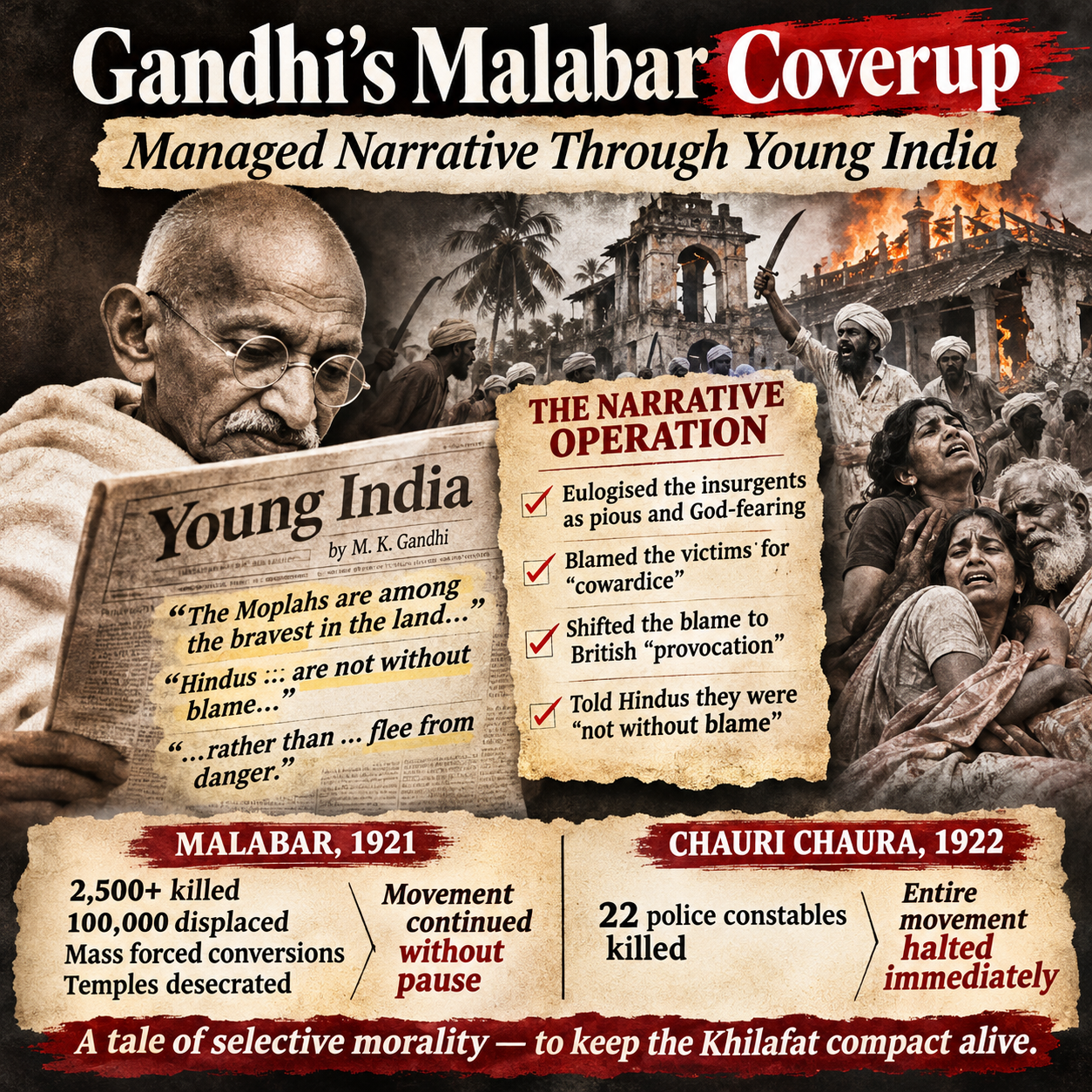
The previous blog documented what the apparatus produced: the August 1921 Malabar detonation, over 2,500 dead across military action and civilian violence, 100,000 displaced, mass forced conversions, and desecrated temples. This blog documents the rhetorical operation that followed. The bodies in Ernad were still unburied when the public relations machinery began to spin. This is the forensic record of how Gandhi managed the narrative in Young India.
Thank you for reading this post, don't forget to subscribe!THE MANAGED NARRATIVE — THE RHETORICAL RECORD
The posture: When news of the Malabar massacres reached the national press, Gandhi did not offer an unvarnished moral condemnation of the perpetrators. Instead, he constructed a dual-track response in Young India: paying lip service to non-violence while systematically excusing, deflecting, and rationalising the atrocities to protect the Khilafat coalition at all costs.
The mechanism: The insurgents were eulogised as pious, God-fearing men fighting for their faith; the victims were chastised for their “cowardice” in fleeing rather than dying without resistance; the blame was shifted to British “provocation” and false rumours; and Hindu society was told it was “not without blame” for past neglect.
The consequence: While the killing of 22 police constables at Chauri Chaura five months later brought the entire national movement to an immediate halt, the communal slaughter and mass forced conversions in Malabar did not pause the Non-Cooperation machinery for a single afternoon. The narrative was managed so the compact could survive.
The Anatomy of Gandhi’s “Condemnation”
The conventional defence of Gandhi rests on the premise that he condemned the Moplah violence unequivocally. The actual textual record in Young India (collected in CWMG, Volumes 21 and 22) demonstrates a completely different forensic reality: a superficial, nominal disapproval systematically counterbalanced by ideological exoneration and moral victim-blaming.
When Gandhi addressed the uprising in Young India (notably in his articles “A Rural Scene”, “The Moplahs”, and subsequent September–October commentary), his denunciation of the violence was invariably paired with an admiration for the perpetrators’ religious conviction. Gandhi wrote of the rioters:
“The Moplahs are among the bravest in the land. They are god-fearing… They are a fine, brave, god-fearing people, but they are illiterate and have been kept under check by the rod rather than by love. They are fighting for what they consider as religion, and in the manner they consider as religious.”
This framing radically redefined mass murder, temple desecration, and forced conversions. By elevating jihadist violence into misplaced piety, Gandhi transformed a catastrophic communal pogrom into an understandable spiritual excess. The condemnation of the act was eviscerated by the moral romanticisation of the actor.
Blaming the Victim: The Charge of “Cowardice”
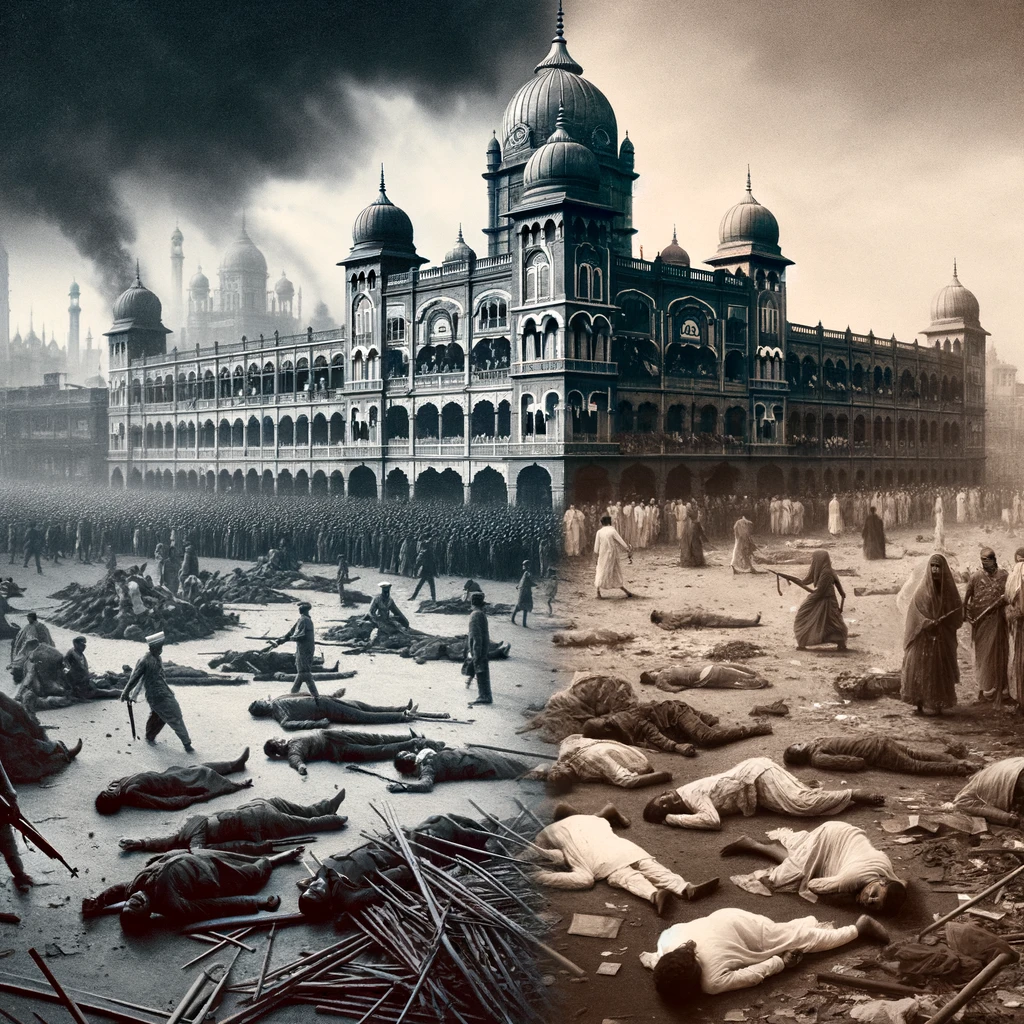
As thousands of destitute Hindu refugees streamed into relief camps in Calicut, Gandhi turned his moral pulpit not against the armed mobs wielding war knives, but against the unarmed victims who had fled for their lives. In Young India on 20 October 1921 (“The Meaning of the Moplah Rising”), he delivered an extraordinary lecture on spiritual duty:
“I want both the Hindus and Mussulmans to cultivate the cool courage to die without killing. But if one has not that courage, I want him to cultivate the art of killing and being killed, rather than in a cowardly manner flee from danger.”
The burden of failure was thus transferred from the aggressor to the slaughtered. The Hindu who had his home burned, his family butchered, and was forced at knife-point to choose between conversion or death was indicted for a deficiency of courage. Months later, as the displaced remained unable to return to their confiscated lands, Gandhi closed the circle of culpability in Young India (26 January 1922, “Hindus and Moplahs”):
“Hindus must find out the causes of Moplah fanaticism. They will find that they are not without blame. They have hitherto not cared for the Moplah. They have either treated him as a serf or dreaded him.”
The Reframing: British Provocation and “False Reports”
To preserve the operational continuity of the Non-Cooperation Movement, Gandhi systematically anchored the root cause of the rebellion in British administrative treachery. The police raid on the Tirurangadi mosque and the attempted arrest of Ali Musaliar were elevated to the sole catalysts of the explosion.
This framing achieved two crucial political objectives simultaneously:
- Preservation of the Khilafat Pact: By presenting the Moplahs as victims of diabolical imperial entrapment and provocation, Gandhi insulated the central Khilafat leadership — specifically the Ali brothers — from ideological complicity.
- Denial of Systematic Jihad: It reduced months of militarised preparation, weapons manufacturing, and the open proclamation of a Khilafat kingdom under Ali Musaliar and Variankunnath Kunjahammed Haji to an unguided, reactive outburst against bureaucratic oppression.
The apparatus Gandhi had built, mobilised, and legitimated was scrubbed from the equation. The British official became the sole villain; the rioter became an exploited believer; the Hindu victim became an embarrassing casualty who lacked the fortitude to die quietly.
The Contemporary Rebuttal: Besant and Sankaran Nair
Contemporaries who were not bound to the Simla compact refused to participate in this managed silence. Dr. Annie Besant, writing relentlessly in New India throughout the autumn of 1921, directly exposed the human reality that Gandhi sought to obscure:
“Malabar has taught us what Islamic rule still means, and we do not want to see another specimen of the Khilafat Raj in India… Men who would not accord a face-covering to a Hindu woman tore the clothes off living Hindu women, stripped them naked, and drove them through the streets.”
Sir C. Sankaran Nair, former President of the Indian National Congress and former member of the Viceroy’s Executive Council, dissected Gandhi’s rhetorical evasions in his devastating 1922 indictment, Gandhi and Anarchy. Sankaran Nair documented that Gandhi’s refusal to squarely condemn the atrocities was a calculated political sacrifice:
“It is impossible to believe that Mr. Gandhi and his followers did not know that this agitation would lead to bloodshed… The Mahomedans considered that they were justified in killing the Hindus because they did not assist them in establishing the Khilafat Kingdom. Mr. Gandhi’s attitude has been one of tacit condonation.”
When Maulana Hasrat Mohani publicly defended the forced conversions as legitimate acts of Islamic warfare against those who failed to support the Khilafat, Gandhi softly characterized the Maulana’s stance as merely being “frank to a fault” and exhibiting “a travesty of religion and morality,” while continuing to treat him as an indispensable comrade in the anti-imperial struggle.
The Suppression of the Warning Record
What makes the Young India coverage a deliberate coverup rather than naive misjudgment is the absolute suppression of the warning record documented in Blogs 193 through 195. Throughout the autumn of 1921, Gandhi never admitted to his readers that:
- Channel One — Gandhi’s Own Published Words: Gandhi’s Young India articles of 23 February and 9 March 1921 responded directly to Section 144 orders in Ernad and Walluvanad. He had read the district administration’s alarm and published his dismissal of it as imperialist divide-and-rule.
- Channel Two — Congress Ground Reports: K.P. Kesava Menon and K. Madhavan Nair had explicitly reported to the Congress hierarchy that local Khilafat committees had discarded Ahimsa, were stockpiling arms, and were preaching that violence in defence of the Caliphate was a Quranic obligation not bound by Gandhi’s prohibition.
- Channel Three — The Public Press: Dr. Annie Besant had repeatedly sounded alarms in New India throughout spring 1921, naming the danger and addressing Gandhi by name. Sir C. Sankaran Nair’s contemporaneous writings made the identical warning in the national political press.
- Channel Four — Simla: Viceroy Lord Reading had confronted Gandhi directly in May 1921 with verbatim CID transcripts of the Ali brothers’ incitement to armed jihad. Gandhi read the transcripts, conceded their gravity, and brokered a narrow retraction to shield them from prosecution, leaving the local Malabar apparatus untouched.
None of these four channels ever appeared in Young India. A reader relying solely on Gandhi’s publications was led to believe that the rebellion was an unforeseen tragedy provoked entirely by local British magistrates, rather than the catastrophic realization of warnings Gandhi had actively dismissed for six months.
The Verdict
Gandhi’s Malabar detonation was not, from the perspective of the Non-Cooperation Movement’s leadership, a reason to stop. It was treated merely as a communal inconvenience—Moplah violence against Hindus—that could be nominally deplored in Young India, rationalized away, and contained as a local aberration. The movement’s operational continuity after August 1921 is itself a document. It records whose deaths, and whose suffering, fell within the scope of the guarantee Gandhi had given Reading.
The asymmetric morality of the campaign remains preserved in the historical timeline: over 2,500 dead and 100,000 displaced in Malabar did not merit a single day’s pause in civil disobedience; the death of 22 policemen at Chauri Chaura five months later brought the entire national apparatus to an instant halt.

Invitation To Defence
The textual record of Gandhi’s statements on the Malabar rebellion is drawn verbatim from his own published writings in Young India and Navjivan between September 1921 and January 1922. The contemporary exposures of this rhetorical whitewash are preserved in Annie Besant’s New India dispatches, Sir C. Sankaran Nair’s Gandhi and Anarchy (1922), and Dr. B.R. Ambedkar’s forensic analysis in Pakistan or the Partition of India (1940). We invite the defence to demonstrate where Gandhi ever issued an unconditioned moral condemnation of the Malabar perpetrators, or explain why mass communal atrocities in Kerala did not suspend the movement while Chauri Chaura did.
The bodies in Ernad and Walluvanad were explained away as the acts of ‘brave God-fearing’ men fighting for their faith. The victims were chastised for cowardice and informed they were ‘not without blame’. The Non-Cooperation Movement marched on without missing a beat. But why was this grotesque rhetorical contortion necessary? Why could Gandhi not simply condemn the slaughter of innocent citizens? The answer lies not in his psychology, but in the theological compact he had signed before the first shot was fired.
← Part 196 | Series Index | Exhibits Table | Forensic Archive | Part 198 →
Feature Image: Click here to view the image.
Videos
Glossary of Terms
1. Gandhi’s Malabar Coverup: An analytical phrase used in this blog to describe Gandhi’s handling of the Malabar uprising through selective condemnation, praise for the insurgents, explanations based on British provocation, and criticism directed at Hindu society.
2. Managed Narrative: A presentation of events in which selected explanations, statements and interpretations are emphasised to protect a particular political position or alliance.
3. Moplah Uprising: The violent rebellion that erupted in Malabar in August nineteen twenty-one, involving Moplah insurgents, British authorities and widespread violence against Hindu civilians.
4. Khilafat Compact: The political understanding between Gandhi’s Non-Cooperation campaign and the Khilafat leadership, which sought to unite sections of Hindu and Muslim political mobilisation against British rule.
5. Young India: An English-language journal edited and published under Mahatma Gandhi’s leadership, through which he communicated his political views and responses to contemporary events, including the Malabar uprising.
6. Non-Cooperation Movement: A nationwide political campaign led by Mahatma Gandhi against British colonial rule, encouraging Indians to withdraw cooperation from British institutions and authorities.
7. Forced Conversions: Religious conversions imposed through threats, intimidation or physical coercion rather than voluntary personal choice. The term is used in connection with reported atrocities during the Malabar uprising.
8. Tirurangadi Mosque Incident: The police action at the Tirurangadi mosque and the attempted arrest of Ali Musaliar in August nineteen twenty-one, which became a major point in Gandhi’s explanation of the uprising.
9. Ali Musaliar: A prominent religious figure associated with the Malabar uprising and the proclamation of Khilafat authority in the region.
10. Variankunnath Kunjahammed Haji: A prominent leader associated with the Malabar rebellion who participated in the establishment of the insurgent Khilafat administration.
11. Ernad and Walluvanad: Two historical regions of Malabar in present-day Kerala that experienced extensive violence during the nineteen twenty-one uprising.
12. Tacit Condonation: Indirect or unspoken acceptance of an action through silence, insufficient opposition or failure to condemn it unequivocally. Sir C. Sankaran Nair used this expression to criticise Gandhi’s response to the Malabar violence.
13. Gandhi and Anarchy: A book published by Sir C. Sankaran Nair in nineteen twenty-two, criticising Gandhi’s political methods and examining the consequences of his political leadership.
14. Chauri Chaura Incident: An incident in February nineteen twenty-two in which a crowd killed twenty-two policemen by setting fire to a police station, prompting Gandhi to suspend the Non-Cooperation Movement.
15. Victim-Blaming: The practice of placing responsibility or moral criticism upon victims for their response to violence rather than concentrating primarily on the actions of the perpetrators. The term describes a central criticism of Gandhi’s statements about Hindu victims in Malabar.
#Gandhi #Malabar #Moplah #Khilafat #YoungIndia #IndianHistory #ChauriChaura #HinduHistory #HinduinfoPedia
Scan Through The Entire Series at