
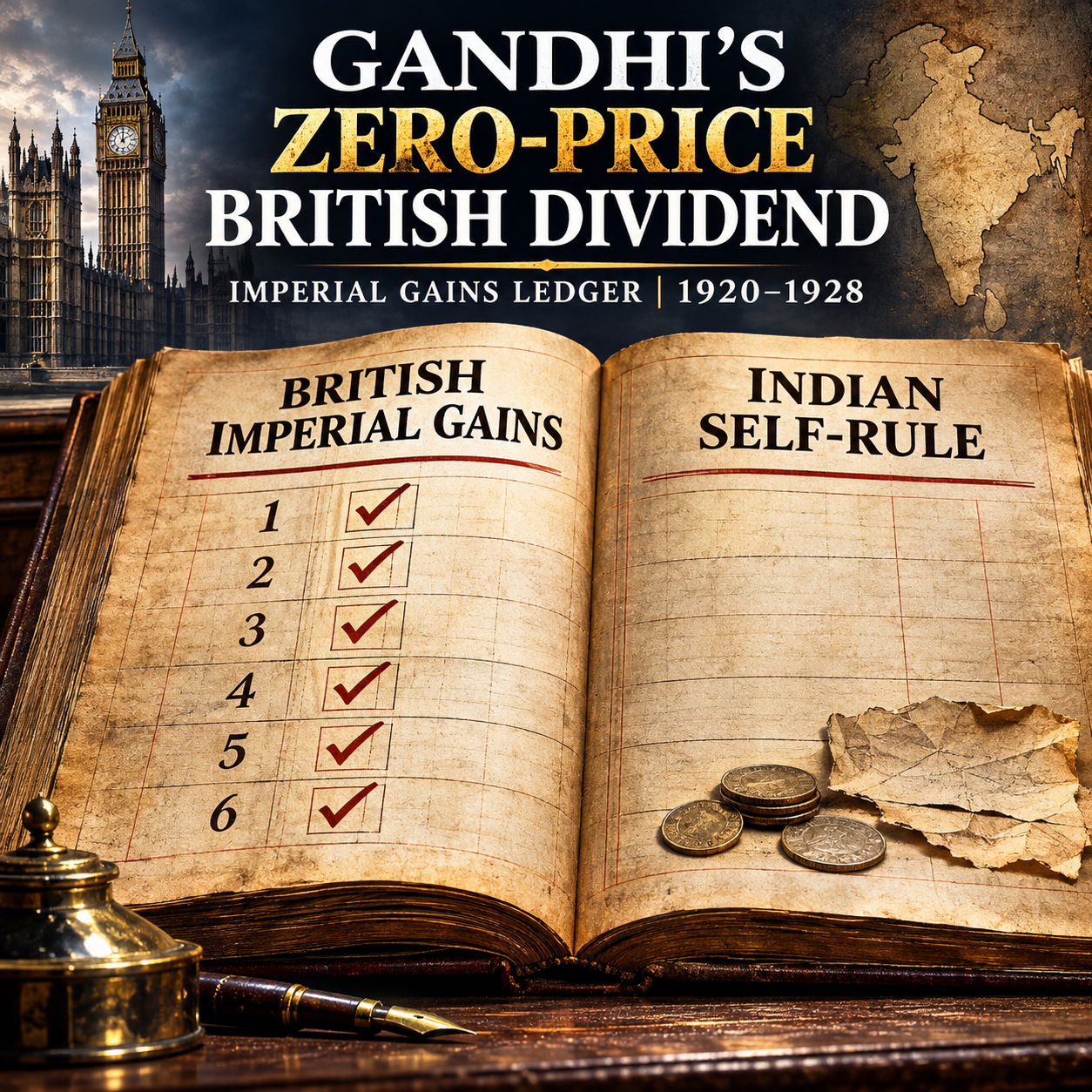
Gandhi’s Zero-Price British Dividend: Imperial Gains Ledger 1920–1928 (212)
भारत / GB
Part 212: Mahatma Gandhi’s Peace Efforts (Closing Synthesis: The Khilafat Compact & Constructive Retreat, 1919–1928) | Series Index
Blog 211 documented Gandhi’s constructive interregnum — the four-year moratorium from February 1924 to December 1928 during which Gandhi kept mass anti-British civil disobedience off the table across the exact unexpired span of his March 1922 sentence. This closing blog of The Khilafat Compact & Constructive Retreat (1919–1928) names the six concrete political, parliamentary, and fiscal gains Britain harvested by opening Yerwada Prison’s gates in February 1924 — and settles the complete four-party account between the British colonial state, Gandhi, the Khilafat clerical bloc, and the Indian rank-and-file from 1920 to 1928.
Thank you for reading this post, don't forget to subscribe!THE ARITHMETIC OF THE DIVIDEND
The Action Taken: Between December 1919 and December 1928, four parties participated in the Congress-Khilafat alliance and its aftermath. After holding Gandhi through his 12 January 1924 emergency appendectomy until the eve of the Central Legislative Assembly debate, the British colonial state released him on 5 February 1924 while conceding zero constitutional reforms; Gandhi staked his moral authority; the Khilafat clerical bloc staked the Ottoman Caliphate cause; and the Indian rank-and-file staked their freedom, careers, and the Tilak Swaraj Fund. By December 1928, London and two domestic actors closed in structural surplus while the Indian rank-and-file absorbed the entire loss.
Who Paid the Price: Thirty thousand volunteers imprisoned during Non-Cooperation without general amnesty while millions lost their property and resources; the Tilak Swaraj Fund spent on an Islamic religious agitation; No-Changers who abandoned councils and careers only to see their mandate dissolved at Belgaum; Kohat riot victims whose demand for justice was eclipsed; and Indian civic unity fractured by embedding a tested clerical street-coercion machinery inside Congress’s constitution.
Why This Matters: The 1920–1928 arc delivered no Swaraj, no Caliphate, and no British constitutional concession. Instead, it delivered six concrete administrative dividends to the British Raj at zero political cost, while locking a clerical veto bloc and a personal loyalty filter into the Indian National Congress.
What the 1919–1928 Arc Established
Across Blogs 200 to 211 — spanning The Khilafat Compact & Constructive Retreat (1919–1928) — the primary documentary record traced a continuous eight-year arc: from the December 1919 Amritsar alliance and the December 1920 Nagpur Constitution embedding the Khilafat-ulama bloc inside Congress, through the unilateral February 1922 Bardoli suspension, the March 1924 Ankara abolition of the Ottoman Caliphate, the December 1924 Belgaum compromise, and the four-year constructive interregnum ending at Calcutta in December 1928.
Examined together, those twelve chapters expose Gandhi’s zero-price British dividend: an eight-year political cycle in which the imperial government extracted maximum administrative stability without conceding a single reform, while Gandhi and the Khilafat clerical bloc consolidated internal institutional control at the full expense of the Indian rank-and-file and the majority community of British India, the Hindus.
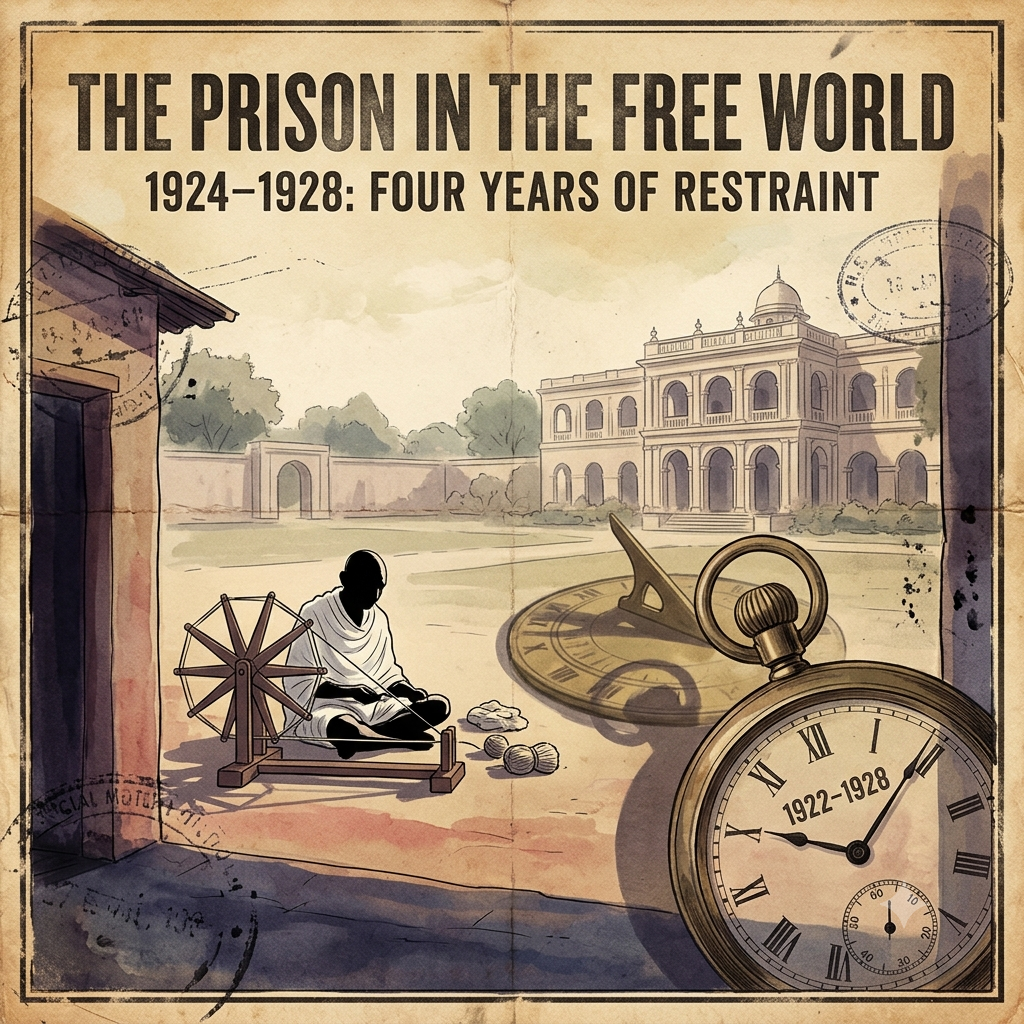
The British Colonial State Ledger: Six Concrete Imperial Gains
In constitutional terms, the British colonial state staked nothing between December 1919 and December 1928: the 1919 Montagu-Chelmsford Act remained the ceiling of reform, the November 1927 Simon Commission excluded every Indian, and the December 1928 Calcutta resolution was a self-imposed Congress grace period until 31 December 1929 rather than a British pledge. Yet by remitting Gandhi’s unexpired sentence on medical grounds on 5 February 1924 under Section 401 of the Code of Criminal Procedure, Viceroy Lord Reading’s Government actively harvested six concrete gains:
- Neutralising the Swarajist Legislative Offensive: Returning Gandhi to public life in February 1924 fractured the 45-member Swarajist bloc in the Central Legislative Assembly, diverting C. R. Das and Motilal Nehru into eight months of internal negotiations with Gandhi instead of deadlocking Viceroy Reading’s budgets.
- Erasing Martyrdom Risk and Pre-empting the Assembly Debate Without Granting Amnesty: Rather than releasing Gandhi before his 12 January 1924 emergency appendectomy, the Raj kept him in custody through surgery and waited until 5 February 1924 — on the very eve of the Central Legislative Assembly debate demanding his release — thereby preventing an uncontrollable prison-death crisis and robbing legislators of a parliamentary victory while leaving thousands of rank-and-file Non-Cooperation prisoners behind bars without political amnesty.
- Turning the Raj from Defendant into Communal Arbiter While Diverting Attention from Kohat Justice: Following Ankara’s abolition of the Caliphate in March 1924 and the September 1924 Kohat riots, Gandhi’s 21-day Delhi unity fast diverted national attention away from both Swaraj and the plight of the Kohat victims onto anxiety over his own survival — eliminating sustained political pressure for justice or restitution for the displaced victims while allowing British officials to step back as indispensable peacekeepers over a divided society.
- Containing Alternative Resistance as Youth Turned Revolutionary: Following the 1922 Bardoli collapse, militant youth rejected Gandhi’s inaction and formed the Hindustan Republican Association (1924), carried out the Kakori action (1925), and built the HSRA (1928) — while Gandhi himself admitted in Young India (June 1927) and to Jawaharlal Nehru (17 January 1928) that his word was no longer heeded. Yet Gandhi actively contained this parallel resistance by publicly condemning martyrs like Gopinath Saha (June 1924), denying revolutionary youth Congress legitimacy and moral backing.
- Securing Uninterrupted Revenue by Trapping Congressmen in Trivial Issues While Expanding Sabarmati: Simultaneously, Gandhi trapped Congressmen inside trivial internal routines — monthly yarn quotas, khadi rules, and organizational loyalty tests — while soliciting industrialist grants from patrons like G. D. Birla and Ambalal Sarabhai to expand his permanent Sabarmati Ashram estate, preventing Swarajist Assembly budget defeats from ever connecting to a district-level no-tax campaign and allowing Delhi to collect land revenue and salt duty uninterrupted across 1924–1928.
- Insulating the All-White Simon Commission Until 1930: Even after London appointed an all-white statutory commission in November 1927 and police fatally assaulted Lala Lajpat Rai in October 1928, Gandhi prevented nationwide civil disobedience and used his December 1928 Calcutta compromise to buy Britain another year — securing six total years of immunity (1922–1928) before the 1930 Salt March.
Measured from Simla and Whitehall, Gandhi’s zero-price British dividend closed at maximum imperial surplus: six acute governance problems solved at zero constitutional cost.
The Gandhi Ledger
Gandhi staked his moral primacy, reorganised Congress at Nagpur into a centralised Working Committee hierarchy, directed thirty thousand volunteers into British prisons while millions of others lost their property and resources, and exercised unilateral authority at Bardoli in February 1922 to halt Non-Cooperation without a Congress session vote.
By December 1928, his ledger closed in permanent institutional surplus. He had secured his sole Congress presidency at Belgaum in 1924, installed a personal compliance filter via the charkha quota (repealed at Patna in September 1925 only after screening out non-compliant members), expanded his Sabarmati Ashram infrastructure through millionaire grants, and returned at Calcutta in December 1928 to defeat Complete Independence by 1,350 votes to 973. Alongside Gandhi’s zero-price British dividend, Gandhi’s own ledger closed with personal primacy intact and organizational control locked in.
The Khilafat Clerical Bloc Ledger
The Khilafat clerical bloc contributed Muslim mass mobilization and religious networks behind the restoration of the Ottoman Caliphate — generating street turnout at a scale Congress alone had not achieved, while forging and field-testing a lethal street-mobilization and riot-contagion machinery across Malabar and northern India.
When Turkey’s Grand National Assembly abolished the Caliphate on 3 March 1924, the stated cause vanished, yet the bloc’s institutional gains and tested street-coercion machinery inside India remained intact. Just as Gandhi’s zero-price British dividend required no constitutional concession, the clerical bloc’s surplus required no survival of the Caliphate: the Nagpur 1920 constitutional amendments and co-located sessions had embedded its leaders inside Congress’s deliberative machinery, giving religious grievance politics a permanent veto long after Ankara extinguished the office.
The Indian Rank-and-File Ledger
The Indian rank-and-file bore every non-recoverable cost of the eight-year cycle across four distinct betrayals:
- First, their national mobilization was harnessed to an external Islamic religious cause whose theological framework sanctioned violence against non-believers — especially Hindus — and financed directly out of the Tilak Swaraj Fund raised in the name of Indian self-rule;
- Second, Gandhi kept the Swaraj cause enslaved to Khilafat demands, subordinately binding India’s freedom to the fate of the Ottoman Caliphate;
- Third, through his exclusive May 1921 Simla understanding with Viceroy Lord Reading, Gandhi retained the unilateral switch to shut off the movement at Bardoli in February 1922 after thirty thousand volunteers had gone to prison and millions had lost their property and careers;
- Fourth, upon his February 1924 release, he actively subverted the freedom struggle from within by condemning revolutionary youth, trapping Congressmen in trivial spinning quotas, and shelving mass agitation.
In return, their ledger closed in total deficit. No Swaraj arrived, no Caliphate survived, No-Changers watched their boycott mandate surrendered at Belgaum, and communities absorbed the communal carnage of Malabar (1921), Kohat (1924), and northern India (1924–1926). The mirror image of Gandhi’s zero-price British dividend was the Indian rank-and-file’s uncompensated ruin: maximum sacrifice yielding zero constitutional return, zero justice for riot victims, and zero accounting.
What the Balance Sheet Proves
Gandhi’s zero-price British dividend exposes the structural asymmetry at the core of the 1920–1928 arc: three parties — the British colonial state, Gandhi, and the Khilafat clerical bloc — each exited in strategic or institutional surplus, while the fourth party — the Indian rank-and-file — absorbed the entire cost. Even as Gandhi admitted to Jawaharlal Nehru in January 1928 that vast differences separated them and youth turned toward revolutionary resistance outside Congress, Gandhi contained militant youth through public condemnation while trapping Congressmen in trivial spinning and organizational routines — preserving British administrative stability while deferring the rank-and-file’s demand for immediate Swaraj.
The historical record does not require speculation about private motives; the institutional outcomes speak for themselves. Before The Communal Contagion & Malabar Prototype arc turns to the riot wave unleashed by this architecture, the record invites any defender of the 1920–1928 strategy to show a single tangible gain delivered to the Indian public that matched the six imperial gains collected by London.
Modern Parallel
A zero-price dividend recurs whenever mass political mobilization is built around symbols the leadership does not audit, funded by followers whose sacrifices the leadership does not share, and settled through closed compromises that entrench internal control. When every retreat is framed as moral victory, external adversaries enjoy uninterrupted stability, the leadership retains permanent authority, and the rank-and-file absorbs the deficit without recourse.
Invitation To Defence
The December 1920 Nagpur Constitution, the February 1922 Bardoli suspension, the 5 February 1924 Section 401 medical release order, the December 1924 Belgaum Pact, the September 1925 Patna repeal, and the December 1928 Calcutta Dominion Status compromise are all established primary documents. The defence is invited to identify any constitutional concession extracted from Britain between December 1919 and December 1928, or any benefit gained by the Indian rank-and-file that outweighed the six concrete advantages secured by the British Raj following Gandhi’s February 1924 release.
Between December 1919 and December 1928, four parties participated in the Congress-Khilafat arc. The British Raj harvested six concrete parliamentary, fiscal, and intelligence gains from Gandhi’s February 1924 release without conceding a single reform; Gandhi locked in personal primacy, Sabarmati infrastructure, and a loyalty filter; the Khilafat clerical bloc kept its constitutional foothold inside Congress after Ankara abolished the Caliphate; and the Indian rank-and-file — thirty thousand imprisoned and the Tilak Swaraj Fund spent — received zero Swaraj and zero accounting. Gandhi’s zero-price British dividend records an eight-year transaction settled at full cost to Indian followers and zero cost to imperial rule.
Feature Image: Click here to view the image.
Videos
Glossary of Terms
1. Zero-Price British Dividend: A coined phrase describing the six political, parliamentary and administrative advantages that the British colonial government allegedly secured between 1920 and 1928 without granting constitutional reforms or concessions to India.
2. Imperial Gains Ledger: The accounting framework used in the blog to examine the benefits obtained by the British colonial state against the sacrifices and losses borne by Indian political workers.
3. Khilafat Compact: The political understanding between Congress leadership and the Khilafat movement that connected India’s freedom struggle with the restoration of the Ottoman Caliphate.
4. Constructive Interregnum: The four-year period from February 1924 to December 1928 during which Gandhi kept mass civil disobedience suspended while concentrating on constructive programmes and Congress organisation.
5. Indian Rank-and-File: Ordinary Congress volunteers, political workers and supporters who participated in the freedom movement and bore its imprisonment, financial and organisational costs.
6. Swarajist Bloc: The group of Congress leaders, including C. R. Das and Motilal Nehru, who entered legislative councils to oppose British policies from within the colonial legislative system.
7. Central Legislative Assembly: The principal legislative institution of British India in which elected Indian representatives debated government policies, budgets and political questions.
8. Section 401 of the Code of Criminal Procedure: The legal provision under which the British Government remitted Gandhi’s remaining prison sentence on medical grounds on 5 February 1924.
9. Montagu-Chelmsford Reforms: The constitutional reforms introduced under the Government of India Act of 1919, which established a limited system of Indian participation in provincial administration.
10. Simon Commission: The British statutory commission appointed in November 1927 to review constitutional reforms in India. Its exclusion of Indian members generated widespread political opposition.
11. Tilak Swaraj Fund: A fund established in 1921 in the name of Bal Gangadhar Tilak to finance the national movement and its campaign for Indian self-government.
12. No-Changers: Congress members who opposed entering legislative councils and preferred constructive programmes outside the colonial legislative institutions.
13. Clerical Veto Bloc: A coined expression describing the institutional influence attributed in the blog to Khilafat religious leadership within Congress’s political and deliberative structure.
14. Street-Coercion Machinery: A coined expression referring to the organised mass mobilisation and street-pressure mechanisms that the blog associates with the Khilafat movement and subsequent communal disturbances.
15. Constitutional Concession: A formal political or administrative reform granted by the colonial government in response to demands for greater Indian participation or self-government.
#Gandhi #BritishRaj #IndianHistory #FreedomStruggle #KhilafatMovement #Swaraj #Congress #Colonialism #BritishEmpire #HinduinfoPedia
Scan Through The Entire Series at
Refer to Various Arks Referred to in the Blog
Gandhi’s Zero-Price British Dividend: Imperial Gains Ledger 1920–1928 (212)