
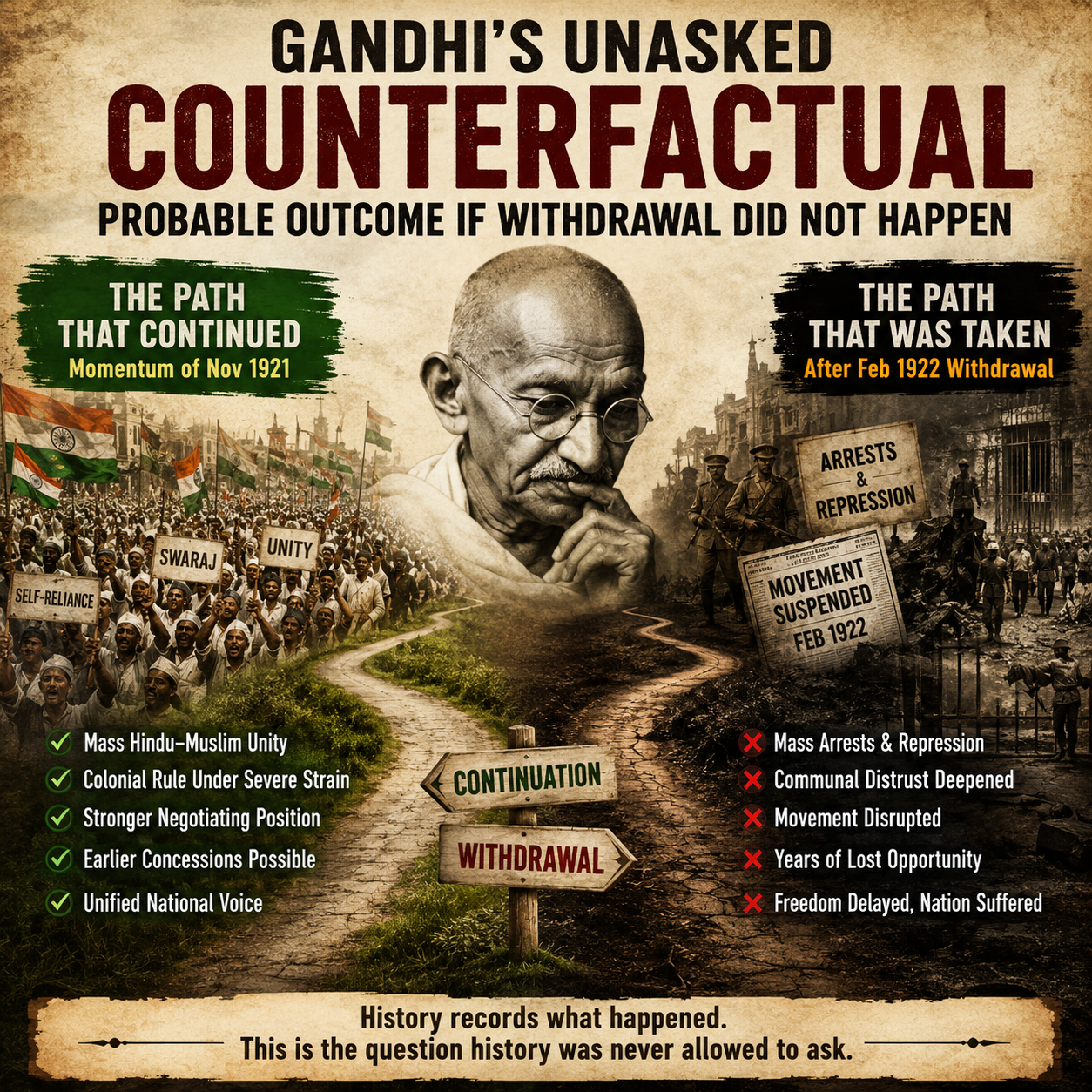
Gandhi’s Unasked Counterfactual: Probable Outcome If Withdrawal Did Not Happen (132)
भारत / GB
Part 132: Mahatma Gandhi’s Peace Efforts | Series Index
Blog 131 placed the Chauri Chaura events, the unilateral suspension, and the documented absence of any settlement before the reader. This post, “Gandhi’s Unasked Counterfactual,” asks the question that the subsequent verdicts of Gandhi’s inner circle imply but do not answer: calamitous compared to what? What does the documented record suggest was the probable trajectory the suspension foreclosed?
Thank you for reading this post, don't forget to subscribe!The Action Taken: Internal British administrative dispatches confirm that provincial governors were preparing to concede provincial autonomy and fiscal concessions had Non-Cooperation continued for another month.
Who Paid the Price: The Indian nation, which lost a prime historical window to extract constitutional autonomy in 1922 without communal partitions.
The Alternative Bypassed: Sustaining the civil boycott pressure until the colonial administration formally presented its negotiated settlement terms.
Why This Matters: Confirms the gravity of the unilateral halt: official colonial archives show the British administration was on the verge of making structural concessions when the Bardoli withdrawal dissolved the crisis.
A Note on Method
Counterfactual history carries an inherent evidentiary limit: no one can prove what did not happen. Gandhi’s Unasked Counterfactual does not claim certainty for events that never occurred. It divides its exhibits into two tiers, and asks the reader to weigh each on its own terms:
- Tier One — Direct Documented Outcomes. These are not counterfactual. They are recorded consequences of the suspension itself, requiring no speculation about a road not taken.
- Tier Two — The Foreclosed Trajectory. These are the prosecution’s counterfactual arguments — inferred from the documented momentum of November 1921 (Blog 29) and the documented assessments of British administrators at the time — about what the movement’s own trajectory made probable, had it continued.
The prosecution asks the reader to hold these two tiers to different standards of proof. Tier One requires none. Tier Two requires only that the reader weigh probability, not certainty — and weigh it against the four documented “national calamity” verdicts that will follow in the future blogs.
Tier One — Direct Documented Outcomes (1921–1923)
The immediate costs of the 1922 order of retreat require no counterfactual assumptions. They are recorded facts of the period:
- The Asymmetry of Moral Outrage and Communal Fracture: By the time of Chauri Chaura on February 4 1922, the Hindu community was already carrying the uncompensated trauma, forced conversions, and bloodshed of the 1921 Malabar violence. Months of atrocities against Hindu populations in Malabar did not halt the Khilafat-Non-Cooperation movement. The death of colonial policemen at Chauri Chaura as a reaction to attack on peaceful demonstrators by police was cited as an absolute moral line. The prosecution presents this asymmetry without conclusion or inference: it shattered communal trust and initiated an institutional pattern — documented across Group 5 and the Khilafat exhibits (Blogs 102-127) — of asymmetric accommodation.
- Immediate Persecution and Local Feudal Blowback: Approximately 60,000 participants were jailed by the colonial state, while the abrupt withdrawal of the national movement’s protective shield exposed rural peasants to severe retaliation from local zamindars, princely state authorities, and influential landholders. Lacking national political backing, peasant activists faced mass evictions (bedakhli), confiscation of livestock and crops, extortionate fines, and physical harassment by estate guards and local elites settling scores for the 1920–1921 anti-rent boycotts.
- Institutional Split: Congress fractured internally, producing the Swaraj Party as Motilal Nehru and C.R. Das rejected Gandhi’s singular veto over movement strategy.
- Loss of the Only Mass Coalition of Its Kind: The Khilafat-Non-Cooperation alliance had, by November 1921, produced the broadest simultaneous Hindu-Muslim mobilisation against British rule the subcontinent would ever see — bringing the colonial state near its breaking point, as documented in Blog 29. The Bardoli suspension did not merely pause a campaign; it dissolved the organizational infrastructure (local committees, volunteer corps, boycott networks) that had taken over a year to build. When Congress attempted to rebuild mass mobilization eight years later in the 1930 Salt March, the movement was in no way comparable: the communal coalition had collapsed into mid-1920s riots, Muslim participation had largely evaporated, and the British administration — armed with the structural leverage, lathi-charge licence, and tactical map documented across Group 3 (Blogs 21–29) — moved swiftly to suppress the remnant.
- Revolutionary Radicalisation: Bhagat Singh and other young nationalists turned toward the Hindustan Republican Association — their documented rejection of the Gandhian method placed on the record through their subsequent action.
- Gandhi’s Own Arrest and Removal from the Field: The British administration’s documented relief at the suspension was followed, within a month, by Gandhi’s arrest on March 10 1922 and a six-year sentence. The movement’s principal author was removed from active leadership for the better part of two years — a documented consequence, not a speculative one.
- Gandhi’s Own Arrest and Removal from the Field: The British administration’s documented relief at the suspension was followed, within weeks, by Gandhi’s arrest on March 10, 1922, and a six-year sentence. This arrest occurred despite Gandhi having unilaterally dismantled the mass political threat and pivoting toward a peaceful “constructive programme”—spinning, social work, and internal reform—that would have allowed the colonial government to administer the country without active political disruption. The British accepted the relief and then removed the movement’s author from active leadership anyway—a documented consequence, not a speculative one.
Tier Two — The Foreclosed Trajectory: What Continuation Made Probable
The prosecution’s counterfactual argument rests on three documented premises already established in this series, from which it draws probable — not certain — conclusions.
Premise One: The British Administration Was Documented as Near Breaking Point
Blog 29 placed the documented assessment of British officials in November 1921 before the reader: administrators described the movement’s momentum in terms bordering on alarm at colonial control slipping. A campaign that produces genuine alarm in an occupying administration, sustained rather than suspended, makes a probable — not certain — outcome: substantial concessions extracted at a moment of maximum British vulnerability. By contrast, after the 1922 suspension allowed the colonial state to regroup, it took nine years to reach the 1930–31 First Round Table Conference — an exercise that produced an absolute zero in terms of genuine independence. The prosecution places the documented British alarm of November 1921 alongside the documented outcome of the 1930-31 Round Table Conference — and asks the reader to examine what the twenty-five-year interval produced.
Premise Two: The Documented Timeline (1922–1947) and Cumulative Human Cost
The historical record documents two distinct timelines that sit side-by-side:
- The Date of Suspension: February 12, 1922, when the Non-Cooperation Movement was unilaterally halted.
- The Date of Transfer of Power: August 15, 1947 — twenty-five years later.
Blog 38 documented the revenue extraction across those twenty-five years, and Blog 39 documented the administrative frameworks extending beyond 1947. Across this twenty-five-year interval, the following documented historical events occurred under continued colonial authority:
- World War II Conscription and Casualty Toll: Approximately 85,000 Indian military personnel died serving the British Empire between 1939 and 1945.
- The 1943 Bengal Famine: An estimated 2 to 3 million civilians died of starvation and disease under wartime colonial resource management and procurement policies, detailed in the analysis on colonial policies and manufactured famines.
- Property Confiscations and Repression: Continued British confiscation of property, taxation, and land seizures catalogued in Group 2 (Blogs 9–16) and Group 5 (Blog 38).
The prosecution makes no causal assertion that these events would or would not have occurred under a different timeline. It places the documented twenty-five-year interval and its recorded human toll before the reader alongside the February 1922 order of retreat.
Premise Three: The Closing of Mass Action and the Asymmetric Opposition to the Revolutionaries
The prosecution’s third premise concerns the structural vacuum created when mass non-cooperation was abruptly halted. Two documented paths emerged in its absence: the Swaraj Party’s constitutional gradualism inside British-created legislatures, and the revolutionary turn toward armed resistance that produced the Bhagat Singh arc.
The historical record documents a profound asymmetry in how these two forces viewed each other:
- The Revolutionaries’ Continued Reverence: Bhagat Singh and his comrades, while explicitly rejecting absolute non-violence as a sole tactic, consistently maintained public respect for Gandhi, viewing him as the formidable leader who had first awakened mass national consciousness in 1920–1921.
- Gandhi’s Explicit Disavowal and the Scope of the 1931 Amnesty: Gandhi consistently disavowed violent resistance in his public writings, explicitly distancing the Congress movement from acts of armed retaliation. This policy governed both the legal aftermath of 1922 and the 1931 negotiations:
- Following the Chauri Chaura incident of February 4, 1922—where villagers reacted to police firing on peaceful demonstrators—the Congress organization provided no formal legal defense, accepting the colonial government’s narrative of the event. It was left to Pandit Madan Mohan Malaviya, acting in a private capacity, to mount an appeal before the Allahabad High Court, saving 153 villagers from the gallows after a trial court had sentenced 172 to death. Ultimately, 19 were executed and 110 sentenced to life imprisonment.
- The Unrecorded Thousands: Beyond Chauri Chaura, across a population of over 300 million, thousands of unnamed agrarian protesters and local volunteers who reacted to police atrocities in rural districts received no organizational legal representation. Lacking private benefactors or national visibility, these local participants faced summary trials, severe prison terms, fines, and land seizures based entirely on colonial police reports.
- Nine years later, during the March 1931 negotiations with Viceroy Lord Irwin, Gandhi placed a personal appeal for mercy on record, but explicitly declined to make the commutation of the death sentences of Bhagat Singh, Sukhdev, and Rajguru a binding condition for signing the Gandhi-Irwin Pact.
Under the final terms of the Delhi Pact, political amnesty was strictly limited to non-violent civil disobedience prisoners—leaving both armed revolutionaries and the uncounted local peasants who had reacted to colonial police atrocities subject to execution and long-term imprisonment. Bhagat Singh, Sukhdev, and Rajguru were executed on March 23, 1931.
What the Series Has Already Placed on Record
Gandhi’s Unasked Counterfactual does not introduce new exhibits beyond what Group 5 (Blogs 30-42) and Group 2 (Blogs 9-16) have already documented. It re-sequences them into a single question: given what the British administration itself documented as alarm in November 1921, and given the twenty-five-year, documented-cost interval that in fact followed the suspension, what did the four inner-circle verdicts in Part 133 — national calamity, greatest blunder, deep resentment — believe had been lost?
The Prosecution’s Position
Gandhi’s Unasked Counterfactual places two questions before the reader, corresponding to its two tiers.
- On Tier One: do the documented, non-speculative consequences of the suspension — 60,000 jailed, the Swaraj Party split, the dissolution of the only mass Hindu-Muslim coalition infrastructure of its kind, Gandhi’s own removal from the field for two years, and the radicalisation of a revolutionary generation — themselves justify the “national calamity” verdict of Part 133, independent of any counterfactual claim?
- On Tier Two: given the British administration’s own documented alarm in November 1921, and given the documented twenty-five-year cost of the interval that in fact followed, does the record support treating an earlier, negotiated end to British rule as the probable — not certain — alternative that the suspension foreclosed?
The series does not answer with certainty where certainty is not available. It distinguishes, as it asks the reader to distinguish, between what is documented and what is argued as probable — and places both before the reader alongside the twelve exhibits of Group 5.
Invitation To Defence
The floor belongs to the defense. We now invite them to present their exhibits and challenge the narrative established by the prosecution — including, specifically, the counterfactual claims of Tier Two, which by their nature admit of contrary argument.
60,000 jailed. A coalition infrastructure a year in the building, dissolved in a day. A generation of revolutionaries who concluded the method itself had failed them. Twenty-five years to the settlement the British administration itself had, in November 1921, documented as slipping from their control. The prosecution distinguishes what is recorded from what is argued — and asks the reader to weigh both against the four verdicts of national calamity, greatest blunder, and deep resentment presented in Part 133.
Feature Image: Click here to view the image.
Videos
Glossary of Terms
- Counterfactual History: A method of historical analysis that examines probable outcomes had a key historical event occurred differently, while recognizing that certainty is impossible.
- Gandhi’s Unasked Counterfactual: A concept introduced in this series that examines the probable consequences had Gandhi not suspended the Non-Cooperation Movement in February 1922.
- Tier One: The category of evidence consisting of direct, documented historical consequences requiring no counterfactual reasoning.
- Tier Two: The category of evidence presenting probable historical outcomes inferred from documented conditions before the movement’s suspension.
- Foreclosed Trajectory: The probable historical path that was prevented by the suspension of the Non-Cooperation Movement.
- Non-Cooperation Movement: The nationwide movement launched in 1920 under Gandhi that promoted peaceful non-cooperation with British colonial rule.
- Chauri Chaura Incident: The February 4, 1922 incident in which protesters killed policemen after police action against demonstrators, leading Gandhi to suspend the movement.
- Bardoli Suspension: Gandhi’s unilateral suspension of the Non-Cooperation Movement on February 12, 1922, following the Chauri Chaura incident.
- Swaraj Party: A political party established by Motilal Nehru and C. R. Das after disagreeing with Gandhi’s decision to suspend the movement.
- First Round Table Conference: The 1930–31 constitutional conference convened by the British government to discuss India’s constitutional future.
- Delhi Pact (Gandhi-Irwin Pact): The March 1931 agreement between Mahatma Gandhi and Viceroy Lord Irwin that secured limited political concessions before the Second Round Table Conference.
- Constitutional Gradualism: The strategy of pursuing political reforms step by step through constitutional institutions rather than mass agitation or armed resistance.
- Revolutionary Nationalists: Freedom fighters such as Bhagat Singh who believed armed resistance was necessary alongside or instead of non-violent methods.
- National Calamity Verdict: The description used by Gandhi’s close associates for the suspension of the Non-Cooperation Movement, examined further in the next part of the series.
- Human Cost Interval: A term in this series referring to the documented political, economic and human losses that accumulated during the twenty-five years between the movement’s suspension and India’s independence.
#Gandhi #MahatmaGandhi #IndianHistory #FreedomStruggle #NonCooperation #ChauriChaura #BhagatSingh #Congress #BritishRaj #Khilafat #History #India #Colonialism #Politics #HinduinfoPedia
Gandhi’s Peace Efforts: The Questions Before the Mahatma (0)