
Gandhi’s Tampered Fuse: How Malabar Alarm Was Disarmed (192)
भारत / GB
Part 192: Mahatma Gandhi’s Peace Efforts | Series Index
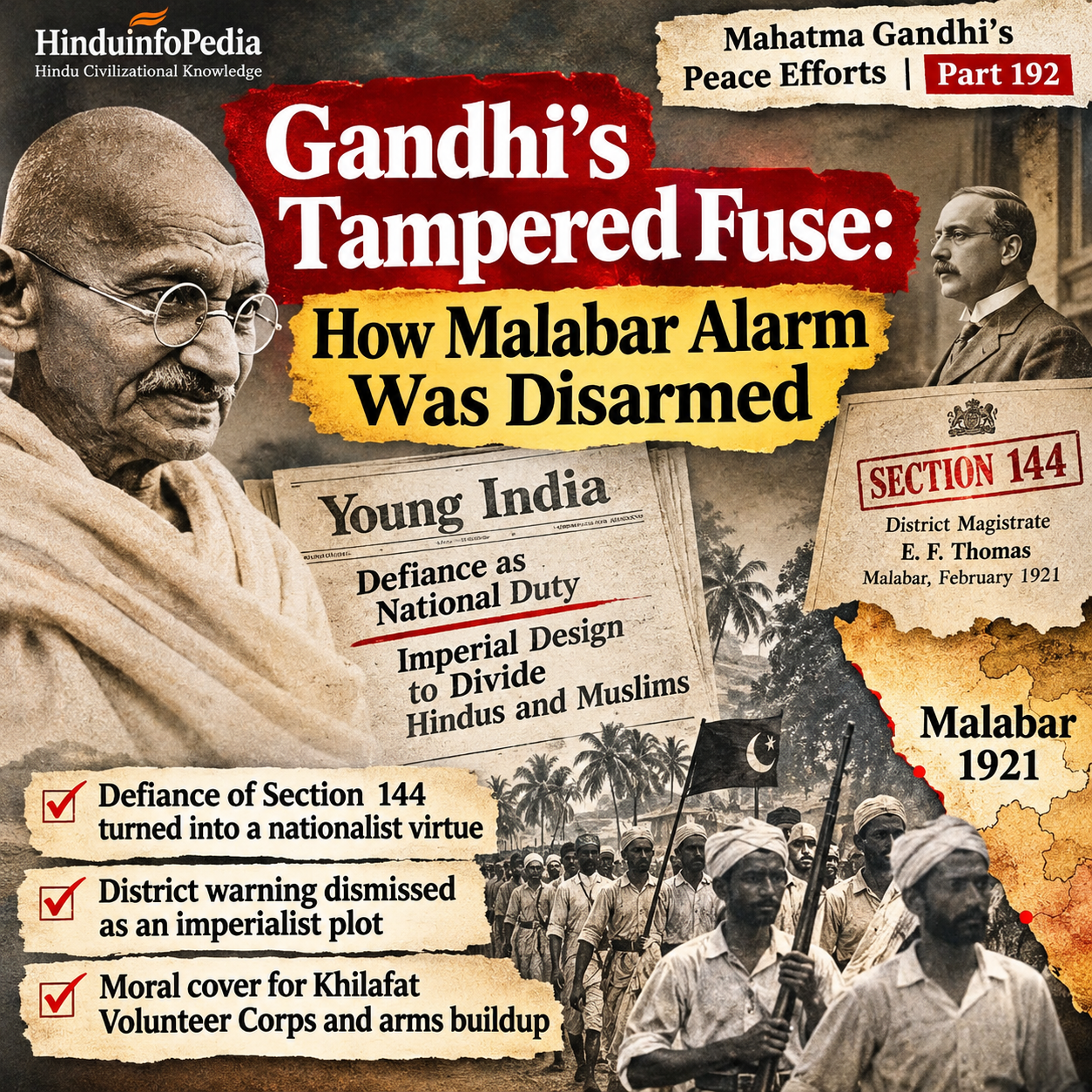
The previous blog documented the administrative paper trail — district intelligence reports logging the Ponnani pulpit transformation, Khilafat Volunteer Corps organisation in Ernad and Walluvanad, and the concealment of arms at Tirurangadi. The colonial state’s alarm about Malabar was recorded in writing from January 1921 onward. This blog documents what Gandhi did with that alarm when it reached the public domain. Gandhi’s Tampered Fuse is not a metaphor for inaction. It is a documented record of three distinct operational interventions in Young India through which he actively degraded the public’s capacity to recognise and respond to the danger the district administration had been reporting.
Thank you for reading this post, don't forget to subscribe!THE ACTIVE SHIELDING — YOUNG INDIA, FEBRUARY–MARCH 1921
The Pattern: When District Magistrate E.F. Thomas invoked Section 144 in Ernad and Walluvanad in February 1921, he was not filing a confidential intelligence memo. He was issuing a public statutory declaration that the named taluks were on the verge of armed insurrection. Gandhi responded in Young India within days. His response performed three structural functions simultaneously: it converted the deliberate defiance of a public-safety prohibition into nationalist virtue; it diagnosed the district administration’s powder-keg warning as imperialist manipulation designed to break Hindu-Muslim unity; and it granted moral immunity to a population already drilling in Khilafat Volunteer Corps formations and manufacturing war knives in the interior. Gandhi’s Tampered Fuse — the active public degradation of the Malabar alarm — is documented in his own hand.
The Lethal Exhibit: Gandhi celebrated the arrest of Yakub Hasan, K. Madhavan Nair, and U. Gopala Menon for defying Section 144. What the celebration obscured was the structural fact: Madhavan Nair was Secretary of the Malabar District Congress Committee, and Moideen Koya was a Congress organiser in Ponnani. These were not independent community figures who happened to be present. They were Gandhi’s own Congress apparatus operating simultaneously within the Khilafat Volunteer structure — the dual-mandate organisation he had endorsed at Nagpur in December 1920. When Gandhi congratulated them for defying a statutory public-safety order, he was congratulating his own machinery for resisting the state alarm that his own machinery had triggered.
Why it matters: Gandhi’s Tampered Fuse is the operational bridge between the intelligence record (Blog 191) and the knowledge receipt (Blog 193). The state’s alarm was public. Gandhi’s Congress workers were the named parties defying it. Gandhi’s response in Young India was immediate, public, and structurally consequential. By the time the Viceroy delivered his personal warning in May 1921, Gandhi had already spent three months teaching the national public that official concern about Malabar was a form of imperialist bad faith. That teaching — not any absence of warning — is what made the August 1921 explosion possible without public outcry in advance.
The State’s Public Declaration (February 1921)
Section 144 of the Criminal Procedure Code is not a tool of administrative discretion. It is a magistrate’s formal statutory instrument, issued when a named public officer has reasonable grounds to believe that an unlawful assembly is likely to cause a breach of the peace resulting in injury to persons or property. E.F. Thomas, District Magistrate of Malabar, issued Section 144 orders in Ernad and Walluvanad taluks in February 1921 specifically prohibiting Khilafat and political meetings in those taluks. The intelligence assessments underlying the magistrate’s order documented that the agitation was steadily converging upon the predominantly Hindu landowning class (jenmis) and government officials, transforming agrarian disputes into sectarian targets.
The orders were not issued against speech in the abstract. R.H. Hitchcock’s administrative history of the rebellion, compiled in 1925 from district records, establishes that by early 1921 the Tirurangadi and Ponnani areas had been the sites of reported arms concealment, that Khilafat Volunteer Corps formations had been drilling in the interior, and that tangal preachers operating from the Ponnani mosque network had been framing Caliphate defence as a religious obligation that superseded civil obedience. The Section 144 orders were the statutory response to a specific, documented public order assessment: not a general prohibition on political activity, but a targeted emergency measure in named taluks where the district administration believed an armed uprising was a credible near-term risk.
This was not a confidential assessment. The prohibition was public. The arrests of those who defied it were public. The named individuals — Yakub Hasan, Secretary of the Madras Khilafat Committee; K. Madhavan Nair, Secretary of the Malabar District Congress Committee; U. Gopala Menon, Congress organiser; and P. Moideen Koya, Ponnani Congress worker — were public figures whose arrests were reported in the Madras press. Gandhi’s Tampered Fuse was applied to a public alarm, not a secret one.
The Congress Dual Mandate — What the Arrested Men Were
The standard narration of these arrests presents the named men as a natural coalition of Hindu and Muslim leaders united in nationalist resistance to colonial prohibition. That framing is precisely what Gandhi’s Young India established — and precisely what obscures the structural reality the pipeline has been documenting since Blog 187.
K. Madhavan Nair was not simply a local leader who happened to be present at a Khilafat meeting. He was the Secretary of the Malabar District Congress Committee — the same organisational role that made him part of the provincial hierarchy reporting to the All-India Congress Committee. His participation in the Khilafat Volunteer apparatus was not incidental to his Congress role; it was structurally mandated by the dual-mandate framework Gandhi had endorsed at Nagpur in December 1920, under which Congress workers were expected to operate within and support the Khilafat Volunteer Corps as an expression of Hindu-Muslim unity.
U. Gopala Menon was a Congress organiser in the same district structure. P. Moideen Koya was a Congress-affiliated Ponnani worker whose participation in the Khilafat agitation was enabled by the same dual-mandate architecture. Yakub Hasan, Secretary of the Madras Khilafat Committee, was Gandhi’s most senior operational partner in the southern Khilafat apparatus and had been working in coordination with the Madras Congress hierarchy throughout 1920.
When E.F. Thomas arrested these men for defying his Section 144 orders, he was not arresting random agitators. He was arresting the Congress-Khilafat dual-mandate operation in Malabar — the precise organisational structure Gandhi had built, funded, and endorsed. Gandhi’s Tampered Fuse was therefore applied by a man who knew exactly who had been arrested and in what capacity. The celebration was not ignorant. It was deliberate.
Act One: Subverting Preventive Law as Virtue
Gandhi’s Young India response of 23 February 1921 performed the first structural intervention. He praised the arrested men for courting jail — presenting their deliberate defiance of a statutory public-safety order as an act of nationalist courage equivalent to the civil disobedience that had distinguished the Non-Cooperation Movement in its constitutional dimensions.
The Section 144 orders issued in Ernad and Walluvanad belonged to an entirely different reality. They were not enacted to stifle political dissent. District Magistrate E.F. Thomas invoked statutory emergency powers because the intelligence before him established that the agitation in those taluks was neither civic nor anti-colonial: it had become an aggressive, sectarian mobilization aimed directly at the local Hindu community and Hindu landholders (jenmis). Preachers were openly declaring the territory Dar-ul-Harb, Volunteer Corps cadres were drilling with concealed weapons, and tenancy disputes were being systematically converted into a religious mandate for communal retribution.
Presenting defiance of colonial legislation as nationalist virtue was a coherent political argument. Presenting defiance of the Malabar orders as the identical virtue required the reader to accept a total deception: that the arming and drilling of cadres targeting their Hindu neighbors was merely peaceful satyagraha, and that the magistrate’s emergency intervention was nothing more than imperialist malice designed to sabotage Hindu-Muslim unity.
Gandhi’s 23 February article established exactly that premise. By congratulating the arrested men for defying what he termed colonial harassment, he signaled to his national readership that the Section 144 orders were baseless. Rather than addressing the administration’s documented alarm over sectarian violence against Hindus, Gandhi dismissed the emergency intervention as imperialist bad faith concocted solely to sabotage Hindu-Muslim unity in Malabar.
Act Two: Neutralising the Alarm
The second intervention arrived on 9 March 1921 in ‘The Meaning of the Moplah’. Gandhi did not merely dismiss the district administration’s alarm; he inverted it.
He depicted the Moplah community not as an escalating sectarian threat, but as a model of dignified restraint facing official provocation. The administration’s powder-keg warning was brushed aside as imperialist divide-and-rule tactics. This sleight of hand disarmed the educated public: official warnings were no longer read as alerts of impending violence against local Hindus and landlords, but as colonial malice.
Gandhi’s Tampered Fuse thus stripped the public of the ability to judge the danger objectively. While Gandhi praised Moplah endurance, Hitchcock’s records confirm that Volunteer Corps units were actively drilling, arms were being cached near Tirurangadi, and preachers were priming congregations for jihad. Gandhi wrote this not in ignorance, but in direct rebuttal to the emergency orders issued three weeks earlier.
Act Three: Validating the Vanguard
By presenting Moplah Khilafat activity as peaceful satyagraha, Gandhi granted moral immunity to an armed cadre whose clerical leadership had already declared Malabar Dar-ul-Harb.
Crucially, Gandhi used the arrested Hindu leaders as human shields. By yoking respected Congress figures like Madhavan Nair and Gopala Menon to Yakub Hasan and Moideen Koya, he signaled to the nation that the local Hindu leadership fully endorsed the agitation. This respectable Hindu front disguised a lethal reality: the campaign was an exclusive, religiously driven mobilization whose rank-and-file explicitly rejected Ahimsa.
As Kesava Menon and Madhavan Nair later admitted in their memoirs, local Moplahs told them bluntly that violence in defense of the Caliphate was sanctified by the Quran and superseded Gandhi’s non-violence. Gandhi’s public blessing concealed this ideological rupture, assuring the country that an armed sectarian vanguard was a peaceful nationalist partner.
The Structural Consequence
Gandhi’s Tampered Fuse in February and March 1921 pre-conditioned the national mind. By teaching the country that official warnings were bad-faith imperialist propaganda, Gandhi dismantled any possibility of early public intervention.
When Lord Reading confronted Gandhi in May 1921 with the Ali brothers’ violent rhetoric, Gandhi was trapped inside the narrative he had manufactured: one where Moplahs were peaceful, Khilafat cadres were disciplined, and warnings of communal bloodshed were colonial lies.
The Reading confrontation and the subsequent Ali brothers retraction are the subject of Blog 193. What this record proves is the prior setup: when the massacre and forced conversions erupted in August 1921, the public was blindsided not because warnings were absent, but because Gandhi’s Tampered Fuse had spent seven months discrediting them. The agrarian alibi invented by the Congress Enquiry Committee in November 1921 was built directly on the false narrative Gandhi had planted that spring.
Invitation To Defence
Young India, 23 February 1921 — Gandhi celebrates the defiance of Section 144 public-safety orders in Ernad and Walluvanad. Young India, 9 March 1921 — Gandhi publishes The Meaning of the Moplah, dismissing district administration warnings as imperialist manipulation. The arrested men — Yakub Hasan, K. Madhavan Nair, U. Gopala Menon, P. Moideen Koya — are Congress apparatus operating within the Khilafat Volunteer structure under Gandhi’s Nagpur mandate. Gandhi’s Tampered Fuse converts a statutory public-safety emergency into evidence of colonial bad faith while Tirurangadi arms reports and Ponnani drilling activity continue in the district record. The floor belongs to the defence.
February and March 1921: the district magistrate invoked statutory emergency powers. Gandhi’s response in Young India performed three functions — subverting the prohibition as virtue, neutralising the alarm as bad faith, validating the drilling formations as peaceful endurance. The men he congratulated were his own Congress apparatus. The population he granted moral immunity to did not share his doctrine of non-violence and had been told by their clerical leadership that the Quran sanctioned violence in Caliphate defence. Gandhi’s Tampered Fuse is not a metaphor. It is two articles, two dates, one public record.
Feature Image: Click here to view the image.
Videos
Glossary of Terms
1. Gandhi’s Tampered Fuse: A phrase coined in this blog to describe Gandhi’s alleged public interventions in February–March 1921 that, according to the article, weakened public recognition of the administrative warnings about Malabar.
2. Section 144: A statutory provision of the Criminal Procedure Code empowering magistrates to issue preventive orders to address apprehended threats to public peace and safety. The provision was invoked in Ernad and Walluvanad in February 1921.
3. Criminal Procedure Code (CrPC): The legal framework governing criminal procedure in British India, including the preventive powers exercised by magistrates under Section 144.
4. Khilafat Volunteer Corps: An organisational structure associated with the Khilafat Movement. The blog examines its activities in Malabar and its organisational relationship with Congress workers.
5. Dual-Mandate Framework: A term used in the blog to describe the organisational arrangement under which Congress workers were expected to operate alongside and support the Khilafat Volunteer Corps, following Gandhi’s endorsement at the Nagpur Congress session in December 1920.
6. Young India: An English-language newspaper edited and published under Mahatma Gandhi’s leadership. The blog examines his articles published on 23 February and 9 March 1921 concerning the Malabar situation.
7. Moplah (Mappila): A Muslim community of the Malabar region of Kerala. The blog discusses the community in the context of the Khilafat agitation and the events preceding the 1921 rebellion.
8. Ernad and Walluvanad: Two historical taluks in the Malabar region where District Magistrate E. F. Thomas imposed Section 144 restrictions in February 1921.
9. Jenmis: Traditional Hindu landholders in Malabar. They became important targets in the agrarian and communal tensions examined in the blog.
10. Dar-ul-Harb: An Islamic jurisprudential term traditionally referring to a territory classified as outside the domain of Islamic rule. The blog discusses its alleged use by religious preachers in the Malabar agitation.
11. Satyagraha: Gandhi’s philosophy and method of non-violent resistance based on truth and moral force. The blog questions the application of this terminology to the activities surrounding the Malabar agitation.
12. Powder-Keg Warning: A descriptive expression used in the blog for the district administration’s warning that the situation in Malabar was approaching a potentially explosive state of armed insurrection.
13. Moral Immunity: A phrase used to describe the alleged legitimisation of activities or organisations by presenting them as morally justified, thereby shielding them from public criticism.
14. Human Shields: A metaphor employed in the blog to describe the alleged use of respected Hindu Congress leaders alongside Khilafat figures to create an impression of broad Hindu-Muslim political support.
15. Invitation to Defence: A concluding expression in the blog inviting examination and rebuttal of its documentary interpretation of Gandhi’s February–March 1921 interventions.
#Gandhi #Malabar #Khilafat #Moplah #IndianHistory #Congress #Section144 #YoungIndia #GandhiHistory #HinduinfoPedia
Scan Through The Entire Series at