

Gandhi’s August 14: From the 1920 Khilafat Decision to the Great Calcutta Killings (151)
भारत / GB
Part 151: Mahatma Gandhi’s Peace Efforts | Series Index
This post is scheduled for August 14 — the eve of independence, and the eve of the partition that produced Pakistan as a separate nation. The prosecution places seven documented events before the reader in sequence — from Gandhi’s 1920 Khilafat decision to the Great Calcutta Killings of August 16-19 1946. Some are directly connected. Some are part of the broader documented arc without a single unbroken causal line between them. The series does not assert that Link 1 caused Link 7 in an unbroken sequence. It places the documented events in sequence and asks the reader to examine what the arc establishes.
Thank you for reading this post, don't forget to subscribe!The Action Taken: At the Second Round Table Conference in London, Gandhi refused to recognize the independent standing of the Minorities Pact formed by Dalits, Muslims, Indian Christians, and Anglo-Indians, insisting that Congress held the exclusive mandate to represent all Indian constituencies.
Who Paid the Price: The constitutional negotiations, which dissolved in communal deadlock, directly inviting British statutory intervention.
The Alternative Bypassed: Negotiating a joint power-sharing concordat among Indian leaders in London before the conference adjourned.
Why This Matters: The unbending claim of sole representation produced complete institutional paralysis, leaving the colonial government to step into the vacuum with the Communal Award.
Seven Documented Events — Placed in Sequence
Gandhi’s August 14 places the documented arc before the reader in sequence. Each link is established — either in this series or in the documented historical record.
Link 1 — Gandhi’s 1920 Decision
September 1920, Calcutta special session: Gandhi’s Non-Cooperation/Khilafat merger formally adopted. Established across this series in Blogs 102-129. The documented decision: Congress adopted Khilafat as its primary cause. Jinnah’s constitutional dissent was overridden. The secular Lucknow Pact tradition was displaced.
Gandhi’s August 14 places this link before the reader as the documented starting point — not because it alone caused what followed, but because the prosecution places the documented arc before the reader with its documented origin.
Link 2 — The Documented Communal Consequences
The Khilafat experiment’s documented communal consequences — established across this series:
Riot frequency: 16 communal riots in 22 years before the Khilafat alliance. 72 riots in the 3 years that followed. Established in this series from historian S. Gopal’s documented data.
The Moplah rebellion 1921: documented killings, forced conversions, and temple desecrations across Malabar. Established in Blogs 54-68 (Group 7, Moplah Unrest, Moplah Conclusions) of this series.
The communal fracture that followed the Khilafat collapse: documented mid-1920s riots, the Shraddhanand murder 1926 (established in Blog 75), the documented communal deterioration across the late 1920s and 1930s.
Link 3 — The Jinnah Arc
The documented Jinnah arc — established across Blogs 81-98 of this series (The Jinnah Arc, Split Between Congress and Muslim League, Closing Arc) — placed before the reader in summary:
Jinnah’s documented departure from Congress after being overridden at Nagpur December 1920. His Fourteen Points of 1929 — the documented last constitutional offer, rejected by Congress. His documented withdrawal from active politics 1931-1934. His return and the documented reconstitution of the Muslim League as a mass organisation. His documented transformation from “Ambassador of Hindu-Muslim Unity” to the architect of a separate nation — both characterisations documented in this series from primary sources.
Link 4 — The Lahore Resolution, March 1940
The All-India Muslim League’s Lahore Resolution of March 23 1940 — documented as the formal constitutional demand for independent Muslim states in the north-western and eastern zones of British India. The Two Nation Theory formalised in documented constitutional language. The documented endpoint of the Jinnah arc established in this series.
Link 5 — The Cabinet Mission Plan Breakdown, 1946
The Cabinet Mission Plan of May 1946 — documented as the last constitutional framework that might have kept India united. The plan proposed a three-tier federal structure with provinces grouped into three sections — a documented framework that gave Muslim-majority provinces substantial autonomy within a united India.
The documented breakdown: Congress and the Muslim League both initially accepted the Plan’s framework in principle, then both found reasons to reject the specific implementation. The documented consequence: the Cabinet Mission Plan’s failure left no constitutional alternative to partition.
Link 6 — Direct Action Day, August 16 1946
The Muslim League’s documented call for Direct Action Day — August 16 1946. Jinnah’s documented statement: “We bid goodbye to constitutional methods.” The League called on Muslims across India to observe Direct Action Day to demonstrate the demand for Pakistan.
In Calcutta — where the Muslim League government of Bengal under Chief Minister H.S. Suhrawardy had declared a public holiday — the documented consequences began on August 16 1946.
Link 7 — The Great Calcutta Killings, August 16-19 1946
Gandhi’s August 14 places the documented final link before the reader. The Great Calcutta Killings — four days, August 16-19 1946. The documented death toll across sources: between 4,000 and 10,000 dead. The documented pattern: systematic communal violence across Calcutta’s mixed neighbourhoods, spreading from the initial Muslim League mobilisation into documented Hindu retaliatory violence as the days progressed.
Gandhi was at Sevagram ashram when Direct Action Day began. His documented response — established in this series — called the violence “senseless” and placed responsibility on those who would not refrain from retaliation. Gandhi arrived in Calcutta after the documented violence had already produced its documented death toll.
The Seven Documented Events — Placed Before the Reader
Gandhi’s August 14 places seven documented events before the reader in sequence. The prosecution does not assert that each event caused the next in an unbroken causal line. It places the sequence before the reader for examination.
Some connections in the sequence are directly documented: the Khilafat decision’s documented communal consequences (riot frequency data, Moplah 1921) are directly connected to the 1920 decision. The Jinnah arc is directly connected to the Nagpur override of December 1920 — Jinnah left because he was overridden. The Lahore Resolution is directly connected to the Jinnah arc.
Other connections carry external actors, independent mechanisms, and documented disruptions that the prosecution does not claim Gandhi’s 1920 decision alone produced: the Cabinet Mission breakdown involved Congress, the Muslim League, and the British government as independent actors. Direct Action Day was Jinnah’s decision, not Gandhi’s. The Great Calcutta Killings were produced by the documented actions of those who participated in them.
The prosecution places the documented sequence before the reader — acknowledging that it is an arc, not a chemical chain — and asks the reader to examine what the arc establishes about the documented decisions of 1920 and the documented events of 1946.
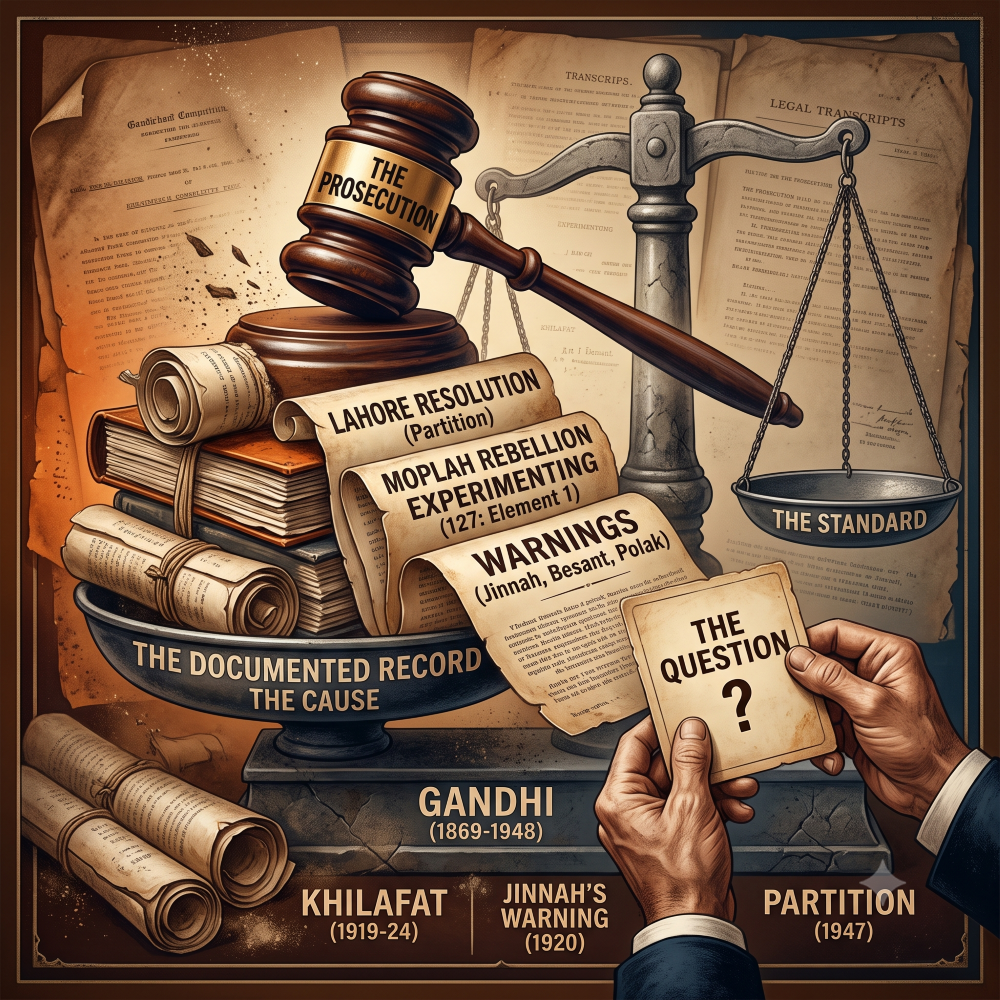
The Prosecution’s Position
Gandhi’s August 14 places three questions before the reader.
- Does the documented arc — from Gandhi’s 1920 Khilafat decision through the documented communal consequences, the Jinnah arc, the Lahore Resolution, and the Cabinet Mission breakdown — constitute a documented sequence that belongs before the reader alongside the Great Calcutta Killings of August 16-19 1946, even where some links in the arc carry independent actors and mechanisms not solely produced by the 1920 decision?
- Does the documented riot frequency — 16 riots in 22 years before 1920, 72 riots in 3 years after 1920 — placed alongside the documented endpoint of August 16 1946, belong before the reader as a documented arc across twenty-six years?
- Does the eve of August 15 1947 — independence and partition simultaneously — placed alongside the documented arc that preceded it, constitute an exhibit the reader examines alongside Gandhi’s documented 1920 decision?
The series does not answer. Gandhi’s August 14 places the documented arc before the reader. The reader will examine what the seven documented links establish — and complete the sentence.
Invitation To Defence
The floor belongs to the defense. We now invite them to present their exhibits and challenge the narrative established by the prosecution.
1920: Khilafat decision. Jinnah overridden. Lucknow Pact tradition displaced. 72 riots in 3 years. Moplah 1921. Jinnah arc. Lahore Resolution 1940. Cabinet Mission breakdown 1946. August 16 1946: Direct Action Day. August 16-19 1946: 4,000 to 10,000 dead in Calcutta. The prosecution places seven documented events before the reader in sequence — not as an unbroken causal chain, but as a documented arc across twenty-six years. August 14: the eve of independence and the eve of partition. The reader will complete the sentence.
Feature Image: Click here to view the image.
Videos
Glossary of Terms
- Gandhi’s August 14: The title and framing term of Blog 151, placing Gandhi’s 1920 Khilafat decision and the documented events leading to the Great Calcutta Killings before the reader as a historical arc.
- Khilafat Decision: Gandhi’s 1920 decision to make the Khilafat cause a principal Congress objective and merge it with the Non-Cooperation movement.
- Non-Cooperation/Khilafat Merger: The 1920 political arrangement in which the Congress Non-Cooperation programme was formally combined with the Khilafat cause.
- Documented Arc: The series’ term for a sequence of documented historical events placed together for examination without claiming that every event was directly caused by the preceding one.
- Jinnah Arc: The documented sequence tracing Jinnah’s departure from Congress after the 1920 Nagpur episode, his constitutional efforts, return to active politics, leadership of the Muslim League, and movement toward the demand for a separate nation.
- Lucknow Pact Tradition: The constitutional and political tradition associated with the 1916 Lucknow Pact and its emphasis on cooperation between the Congress and the Muslim League.
- Moplah Rebellion: The 1921 uprising in Malabar, described in the series through documented accounts of killings, forced conversions, and desecration of temples.
- Lahore Resolution: The All-India Muslim League resolution of March 23, 1940, presented in the blog as the formal constitutional demand for independent Muslim states in the north-western and eastern areas of British India.
- Two-Nation Theory: The political doctrine presented in the blog as the constitutional basis for treating Hindus and Muslims as separate nations and supporting separate political states.
- Cabinet Mission Plan: The May 1946 constitutional proposal for a three-tier federal arrangement intended to preserve a united India while giving substantial autonomy to Muslim-majority provinces.
- Direct Action Day: The Muslim League’s call for August 16, 1946, to demonstrate support for the demand for Pakistan after the breakdown of constitutional negotiations.
- Great Calcutta Killings: The four-day period of severe communal violence in Calcutta from August 16 to 19, 1946, during which various sources reported between 4,000 and 10,000 deaths.
- Prosecution’s Position: The series’ analytical framing in which documented decisions, events, consequences, and historical relationships are placed before the reader for examination rather than presented as an automatically established causal chain.
- Gandhi’s Complicity Test: A series phrase referring to the examination of Gandhi’s documented knowledge, decisions, and consequences in relation to the Khilafat episode.
- Chemical Chain: A deliberately contrasting phrase used in the blog to clarify that the documented historical arc is not being presented as an unbroken mechanical causal chain in which every event necessarily produces the next.
#Gandhi #India #Partition #Khilafat #Jinnah #Congress #MuslimLeague #Calcutta #1946 #1947 #History #HinduinfoPedia
Gandhi’s Peace Efforts: The Questions Before the Mahatma (0)