
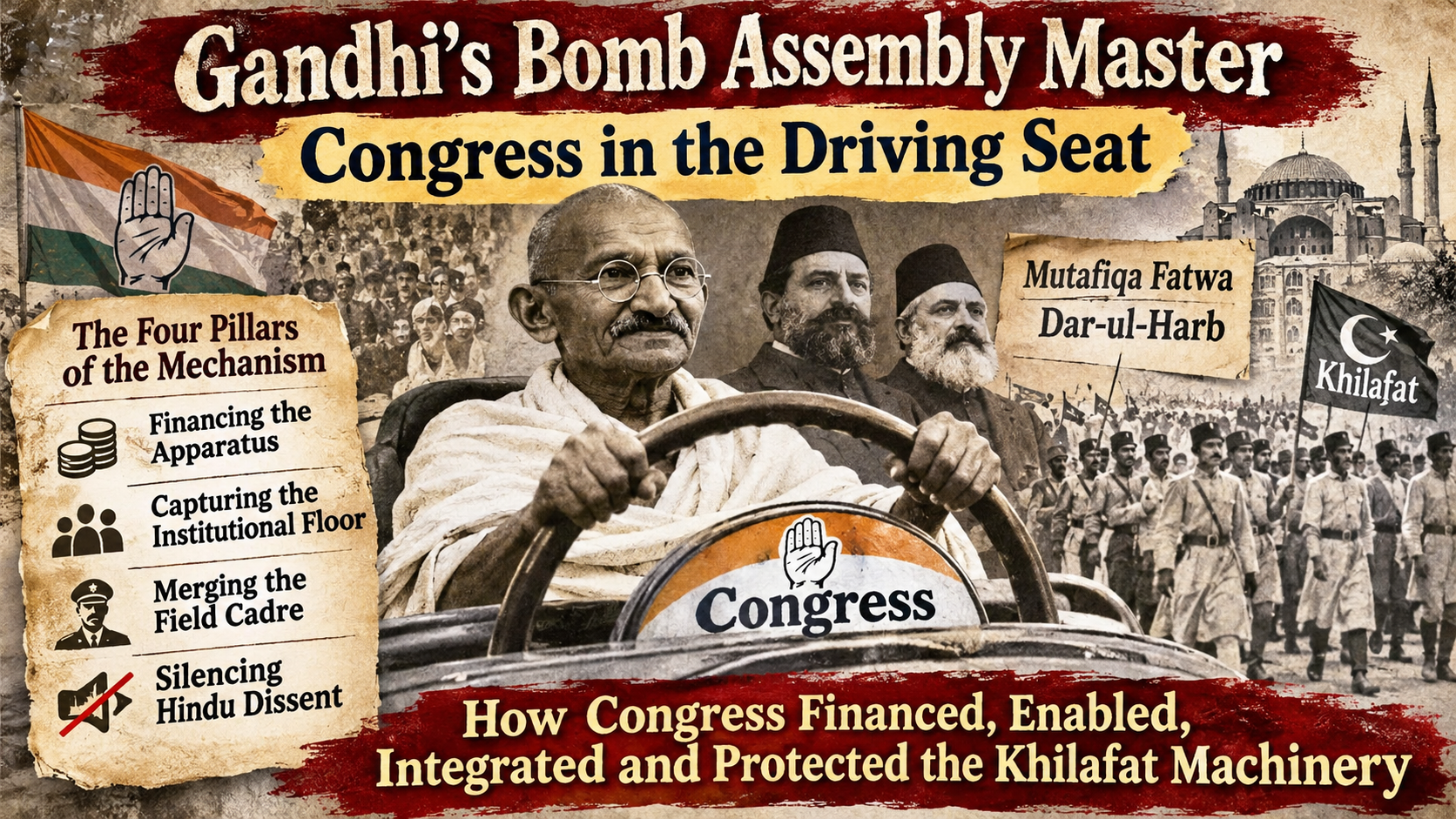
Gandhi’s Bomb Assembly Master: Congress in the Driving Seat (188)
भारत / GB
Part 188: Mahatma Gandhi’s Peace Efforts | Series Index
The previous blog placed before the reader the machine’s specifications: the Mutafiqa Fatwa classifying 315 million people’s shared land as Dar-ul-Harb; the Afghan Hijrat catastrophe as live operational proof that the doctrine was active in 1920, one year before Malabar; the extraterritorial sovereign claim subordinating India’s domestic political future to an Ottoman territorial settlement; and the parallel state apparatus — the Khilafat Fund, the uniformed Volunteer Corps, the Shariat panchayats, the Firangi Mahal clerical network. Gandhi’s bomb assembly master places before the reader what the Indian National Congress did with that machine: how it financed it, how it captured the institutional floor for it, how it merged its own field cadre with its uniformed battalions, and how it silenced every Hindu voice that raised an alarm.
Thank you for reading this post, don't forget to subscribe!THE HISTORICAL RECORD — CONGRESS IN THE DRIVING SEAT
The Pattern: The standard defence of Congress distances the institution from the Khilafat’s consequences by portraying the Ali Brothers and the ulema as unruly partners whom Congress could not control. The institutional record does not support that defence. The Indian National Congress did not stand beside the Khilafat apparatus as a well-intentioned bystander. It financed the apparatus, packed the deliberative floor to silence constitutional resistance, merged its own field infrastructure with the apparatus’s uniformed cadre, and suppressed every Hindu leader who raised an alarm — labelling internal dissent as anti-national and communal. Gandhi’s bomb assembly master places the four institutional mechanisms before the reader in the order they occurred.
The Lethal Exhibit: The four progressive stages of Non-Cooperation ratified by Congress at the Calcutta Special Session (September 1920) and the Nagpur Annual Session (December 1920) — surrender of titles, boycott of government-aided schools and courts, resignation from civil and military service, non-payment of taxes — mirrored the operative stages codified in the Mutafiqa Fatwa under Tark-e-Mawalat exactly. Gandhi named the programme Asahayog. The Jamiat Ulema-e-Hind named the identical programme Tark-e-Mawalat. Congress adopted the fatwa’s terms as its official political agenda, provided the national network to execute them, and collected the money to fund them.
Why it matters: The ulema and Khilafat committees did not hijack the national movement from outside. Gandhi’s bomb assembly master places before the reader the documented institutional mechanisms by which the Indian National Congress willingly handed the Khilafat apparatus the wheel, provided the fuel, and pressed the accelerator.
The Defence and Its Collapse
The conventional historical defence of Congress attempts a separation: Gandhi made a well-intentioned alliance with an independent Muslim movement, but the Ali Brothers and the ulema carried things too far on their own. Congress, on this account, was a passenger — present, perhaps naive, but not responsible for where the vehicle went.
The naivety account requires a specific Gandhi — a man who misread political signals. The South Africa record places a different Gandhi before the reader. In Natal and the Transvaal, Gandhi moved through each stage of the political situation with documented precision: from petition to passive resistance to mass civil action, reading the responses of his opponents and his constituency at each turn, escalating his instrument when the moment required it. He was not a man who missed signals. He was a man who, in South Africa, read every signal correctly and got his clients what they needed. The prosecution places that record alongside the Khilafat period and leaves one question before the reader: did Gandhi fail to read what Shraddhanand told him at Nagpur, what the Hijrat demonstrated on the Khyber Pass in 1920, and what the Malabar signals recorded in the months before August 1921 — or did he read them, weigh his own position as the undisputed leader of the national movement, and continue?
The institutional record places four documented mechanisms before the reader and asks whether the passenger account survives them. A secular peasant in Sindh, the United Provinces, or Malabar did not withdraw his children from school or resign his civil post because an English-educated barrister in Gujarat wrote an article in Young India. He did so because the local maulana read a signed decree declaring colonial service haram under the laws of Dar-ul-Harb. Congress adopted those terms, provided the network, and collected the funds. The reader will assess what that constitutes.
Pillar One: Financing the Machine — The Tilak Swaraj Fund
In 1921, Gandhi mobilised the entire national Congress machinery to collect one crore rupees — ten million rupees — for the Tilak Swaraj Fund, established in the name of Bal Gangadhar Tilak following his death in August 1920. The fund was collected predominantly from Hindu merchants, industrialists, and middle-class donors across the subcontinent under the stated promise of Swaraj within one year.
Substantial tranches of these collections were funnelled into Khilafat organisational work: the travel allowances and special-train charters of the Ali Brothers’ agitation tours, the publication and distribution of Khilafat literature across the provincial networks, the daily maintenance of the Khilafat Volunteer Corps, and the operational costs of the district Khilafat committees that the Congress provincial structure was instructed to recognise and support.
The prosecution places this financial record before the reader alongside a single observation: Hindu donors contributing to a fund named after Bal Gangadhar Tilak, under the promise of Indian self-rule within one year, were financing the organisational infrastructure of an apparatus whose theological foundation classified their land as the Abode of War and their presence on it as the obstacle to be removed. The reader is asked to note who collected those funds, who authorised their deployment, and who provided the moral guarantee that made the collection possible.
Pillar Two: The Institutional Hostile Takeover — Packing the Floor
At the Special Calcutta Session of September 1920 and the Nagpur Annual Session of December 1920, the constitutional leadership of the Indian National Congress attempted to halt the theological capture of the national movement. The names are in the record: Lala Lajpat Rai, Bipin Chandra Pal, C.R. Das, and Muhammad Ali Jinnah each raised objections — to the terms of the Khilafat alliance, to the Non-Cooperation resolution’s theological underpinning, to the speed and scope of the constitutional changes being proposed.
Jinnah’s objection at Nagpur is documented: he argued that the mass agitation Gandhi was proposing would release forces that constitutional politics could not control. He was booed off the platform. He resigned from Congress shortly after and did not return.
The floor that booed Jinnah had been packed. Khilafat funds and Congress provincial committees organised special trains that brought thousands of Khilafat delegates to both sessions — delegates who had not previously paid Congress membership fees and whose political loyalty was to the Khilafat Committee rather than to the Congress Working Committee. Gandhi used this manufactured bloc vote to pass the Non-Cooperation resolution, rewrite the Congress Constitution, and convert an open deliberative assembly into a centralised command structure answerable to a small Working Committee over which he exercised decisive authority.
The record places this sequence before the reader: the constitutional resistance was present, named, and documented. It was defeated not by argument but by a packed floor financed by Khilafat funds and organised by the same provincial committees that were simultaneously being instructed to recognise the Khilafat Volunteer Corps.
Pillar Three: Outsourcing Field Muscle — The Volunteer Mergers
Under the Congress Non-Cooperation guidelines, provincial Congress committees were instructed to coordinate with and formally recognise the Khilafat Volunteer Corps. The result was structural integration: Congress workers and Khilafat Volunteers shared platforms, wore coordinated insignia, and operated under a joint field command at the district level.
The Khilafat Volunteer Corps was not a civil association. It was an organised paramilitary cadre — drilled in formation, wearing green armbands, carrying lathis and ceremonial swords, organised into battalions with a defined command structure, bound by oaths of obedience to the clerical authority of the district Khilafat committees rather than to any elected Congress body or any colonial statute. Congress lent its national legitimacy to this cadre. Its workers shared the dais with men whose institutional loyalty was to a theological decree, not to a democratic constitution.
In Malabar, the operational consequences of this merger are documented in the Malabar Special Commission report of 1921–22 and the British provincial intelligence files: the same men who had drilled under Khilafat green armbands as Volunteer Corps members became the commanders of the Khilafat Raj’s administrative zones when the uprising began in August 1921. Gandhi’s bomb assembly master places the merger before the reader as the institutional mechanism that connected the national platform to the field command that directed the Malabar killings.
Pillar Four: The Intellectual Surrender — Silencing Hindu Resistance
Throughout 1920 and 1921, Hindu leaders within and adjacent to the Congress raised alarms. Lala Lajpat Rai documented his anxieties in the press regarding the Afghan invasion declarations of April 1921. Swami Shraddhanand raised his objection at Nagpur in December 1920 about the verses being recited on the joint platform. Local Hindu reformists in the United Provinces, Punjab, and Bengal warned the Congress Working Committee that the Khilafat apparatus’s public posture was incompatible with the constitutional, non-communal programme Congress claimed to represent.
The Congress Working Committee’s response to each of these alarms was institutional suppression. Criticism of the Khilafat alliance was labelled anti-national. Expressions of Hindu concern about the theological terms of the apparatus were labelled communal and an obstacle to Swaraj. Gandhi personally wrote in Young India defending the Ali Brothers’ statements, including the Afghan invasion declaration of April 1921, rather than distancing Congress from them. The institutional shield held: the clerical apparatus was insulated from accountability, the dissenting voices were delegitimised, and the public record through 1921 presented a unified front of national endorsement for the Khilafat machine.
Gandhi’s bomb assembly master places this suppression before the reader as Pillar Four: it was not that the warnings were absent. They were present, they were specific, and they were silenced by the same institution that was simultaneously financing the apparatus, packing the deliberative floor on its behalf, and merging its field infrastructure with its uniformed cadre.
The Semantic Mask
Gandhi called the programme Asahayog — Non-Cooperation, a term drawn from the constitutional vocabulary of civil resistance. The Jamiat Ulema-e-Hind called the identical programme Tark-e-Mawalat — the severing of all cooperative ties with the inimical power, a term drawn from Islamic jurisprudence operative under a Dar-ul-Harb classification. The four stages were the same. The network executing them was the same. The funds financing them came from the same Congress collections.
The semantic mask is not a minor detail. It is the mechanism by which the Congress role was made invisible to the historical record: the English-language press reported Gandhi’s vocabulary. The mosque reported the ulema’s vocabulary. The same machine was running under two names for two audiences. Congress provided the name that made it nationally acceptable. The ulema provided the name that made it theologically binding. Gandhi’s bomb assembly master places both vocabularies before the reader and asks the reader to note that the programme they described was identical.
The Prosecution’s Position
Four questions stand before the reader.
- Does the financial record of the Tilak Swaraj Fund — Hindu donor money collected under the promise of Swaraj within one year, with substantial tranches deployed into Khilafat organisational infrastructure — constitute an exhibit the reader places alongside the claim that Congress was a bystander to the Khilafat apparatus?
- Does the documented floor-packing at Calcutta and Nagpur — Khilafat delegates organised by the same provincial committees instructed to recognise the Volunteer Corps, used to defeat constitutional resistance and boo Jinnah off the platform — constitute an exhibit the reader places alongside the claim that Congress could not control the apparatus?
- Does the formal merger of Congress field infrastructure with the Khilafat Volunteer Corps — a cadre bound by oaths to clerical authority rather than to any democratic constitution — constitute an exhibit the reader places alongside the claim that what happened in Malabar in August 1921 was unforeseeable?
- Does the systematic suppression of Hindu alarm — the labelling of internal dissent as anti-national and communal, the Gandhi Young India defences of the Ali Brothers’ Afghan invasion declarations — constitute an exhibit the reader places alongside the claim that Congress was unaware of what the apparatus was doing?
The series does not answer. Gandhi’s bomb assembly master places the four institutional mechanisms before the reader — the fund, the packed floor, the merged cadre, the suppressed alarm. The next blog places before the reader where those mechanisms produced their first field result — the pre-rebellion signals in Malabar, the Ponnani pulpits, and the intelligence dossiers of early 1921.
Invitation To Defence
The floor belongs to the defence. We now invite them to present their exhibits and challenge the record.
The Tilak Swaraj Fund collected Hindu donor money under the promise of Swaraj and deployed it into Khilafat organisational infrastructure. The Calcutta and Nagpur sessions were packed with Khilafat delegates to defeat constitutional resistance — Jinnah was booed off the platform and resigned. The Congress Non-Cooperation guidelines formally merged Congress field workers with the Khilafat Volunteer Corps — the same cadre whose members became the commanders of the Malabar uprising’s administrative zones. Every Hindu alarm raised inside Congress was labelled anti-national and suppressed. Gandhi called it Asahayog. The ulema called it Tark-e-Mawalat. Gandhi’s bomb assembly master places both names, both vocabularies, and one machine before the reader.
Feature Image: Click here to view the image.
Videos
Glossary of Terms
1. Gandhi’s Bomb Assembly Master: A distinctive phrase coined for this blog to describe the institutional mechanisms through which Gandhi and the Indian National Congress allegedly financed, enabled, integrated, and protected the Khilafat apparatus.
2. Mutafiqa Fatwa: A religious decree discussed in the blog that classified British-controlled India as Dar-ul-Harb and provided the theological basis for severing cooperation with the colonial administration.
3. Dar-ul-Harb: An Islamic jurisprudential term meaning Abode of War, used in the blog to describe the religious classification applied to territories considered outside Islamic rule.
4. Hijrat: Migration undertaken for religious reasons. In the blog, it refers particularly to the 1920 Afghan Hijrat, when Indian Muslims migrated towards Afghanistan following religious and political appeals.
5. Khilafat Movement: A political and religious movement launched by Indian Muslims following the First World War to defend the Ottoman Caliphate. It became associated with Gandhi’s Non-Cooperation campaign.
6. Tark-e-Mawalat: An Islamic jurisprudential expression referring to the severing of cooperative relations with an authority considered hostile. The blog identifies it as the terminology used by Jamiat Ulema-e-Hind for the programme resembling Congress’s Non-Cooperation campaign.
7. Asahayog (Non-Cooperation): Gandhi’s political programme of withdrawing cooperation from British institutions through the surrender of titles, boycotts, resignations from government services, and eventually non-payment of taxes.
8. Tilak Swaraj Fund: A fund established following Bal Gangadhar Tilak’s death in 1920, with a target of collecting one crore rupees to support the struggle for Swaraj. The blog examines the alleged diversion of substantial collections towards Khilafat organisational activities.
9. Khilafat Volunteer Corps: An organised volunteer formation associated with the Khilafat movement. The blog examines its uniforms, discipline, organisational structure, and alleged integration with Congress’s provincial field machinery.
10. Institutional Floor-Packing: A political tactic involving the mobilisation of additional delegates to influence voting outcomes at organisational meetings. The blog applies this expression to the Calcutta and Nagpur Congress sessions of 1920.
11. Field Cadre: The organised grassroots workforce responsible for implementing an organisation’s political programme. In this blog, it refers to the relationship between Congress workers and Khilafat volunteers.
12. Semantic Mask: A phrase used in the blog to describe the use of different terminology for the same political programme. Gandhi called it Asahayog, while Jamiat Ulema-e-Hind used Tark-e-Mawalat.
13. Constitutional Resistance: Opposition expressed through established institutional procedures, deliberative assemblies, constitutional principles, and organised political debate. The blog discusses the resistance raised by leaders including Muhammad Ali Jinnah, C.R. Das, and Lala Lajpat Rai.
14. Ulema: Islamic religious scholars trained in religious jurisprudence and theology. The term appears in the blog in connection with the religious leadership and organisational structure of the Khilafat movement.
15. Malabar Uprising: The 1921 uprising in the Malabar region of Kerala, discussed in the blog in connection with the Khilafat movement, its volunteer formations, and the institutional developments preceding the violence.
#Gandhi #Congress #Khilafat #IndianHistory #NonCooperation #FreedomStruggle #TilakSwaraj #Malabar #IndianPolitics #GandhiHistory #HinduHistory #HinduinfoPedia
Scan Through The Entire Series at
Refer to Various Arks Referred to in the Blog