
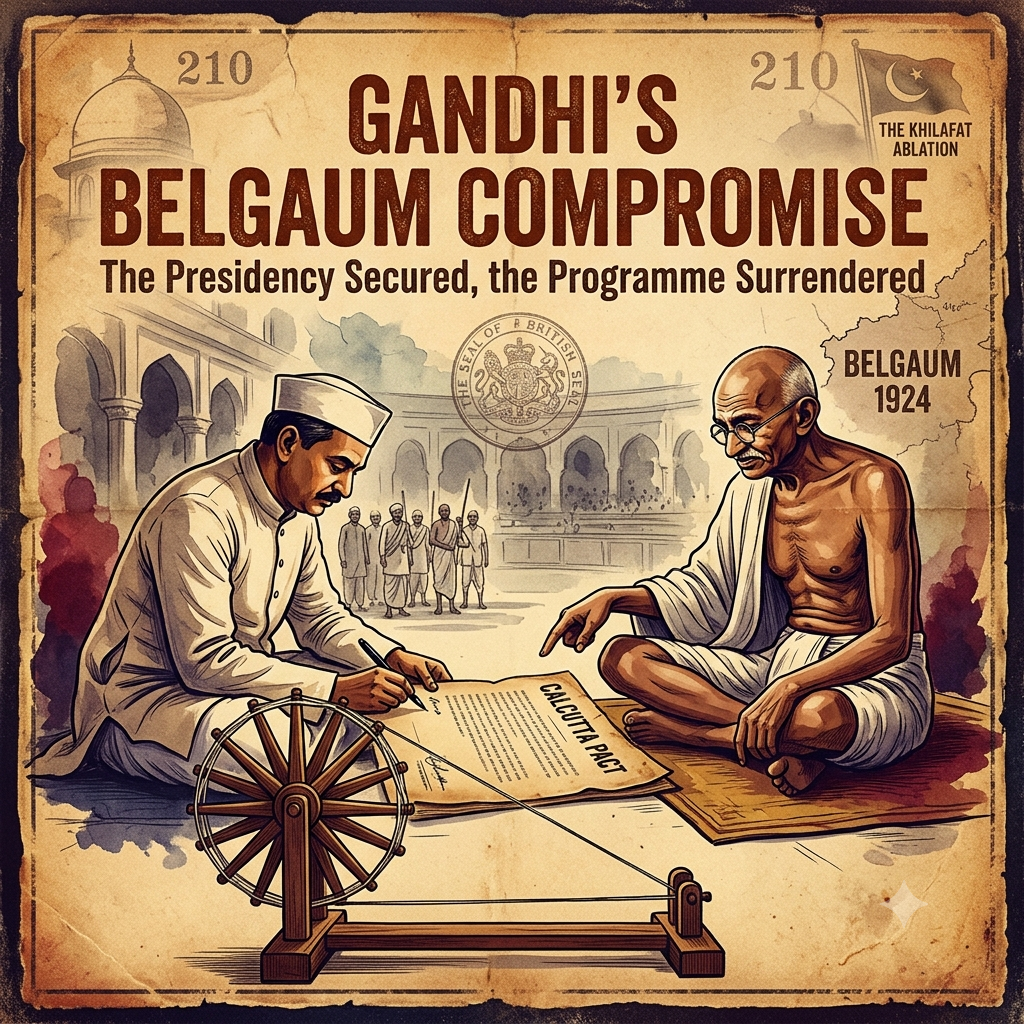
Gandhi’s Belgaum Compromise: Congress Presidency Secured by Programme Surrending (210)
भारत / GB
Part 210: Mahatma Gandhi’s Peace Efforts | Series Index
Blog 209 documented Gandhi’s Atatürk verdict — the 3 March 1924 Turkish Grand National Assembly abolition of the Ottoman Caliphate that extinguished the stated cause of the Congress-Khilafat alliance built at Amritsar in December 1919. This blog picks up twenty-six days earlier, on 5 February 1924, when Gandhi was released from Yerwada Prison on medical grounds, and traces the ten months that followed: his immediate convalescence posture, the June 1924 Ahmedabad AICC clash with the Swarajists, the November 1924 Calcutta Pact, and the Belgaum Congress of December 1924 — where Gandhi accepted the sole Congress presidency, ceded council politics to C. R. Das and Motilal Nehru, and installed the charkha spinning franchise as the gating condition for Congress membership.
THE ARITHMETIC OF THE COMPROMISE
The Action Taken: On 5 February 1924, the Government of India remitted the remainder of Gandhi’s six-year sentence on medical grounds following appendicitis surgery, granting zero political concessions. After failing to dislodge the Swarajists at the June 1924 Ahmedabad AICC meeting, Gandhi signed the November 1924 Calcutta Pact and presided over the Belgaum Congress in December 1924 — his first and only Congress presidency. In exchange for Swarajist recognition of his leadership, Gandhi formally suspended Non-Cooperation, ceded council-entry politics to Motilal Nehru and C. R. Das, and made spinning 2,000 yards of yarn per month on the charkha the qualifying condition for Congress voting membership.
Who Paid the Price: The No-Changers who had boycotted councils and careers in obedience to Gandhi’s 1920–22 mandate watched their position dissolved by the leader who had demanded it. The thirty thousand volunteers imprisoned during Non-Cooperation and abandoned at Bardoli received no accounting before Gandhi reaccepted Congress authority on new terms. The charkha franchise substituted a symbolic loyalty filter for substantive political confrontation with British rule.
Why This Matters: Gandhi’s Belgaum compromise converted personal political retreat into an institutional settlement. Released on health grounds without forcing a single British reform, having lost the Caliphate cause in Ankara, and facing an entrenched Swarajist bloc in the legislatures, Gandhi used Belgaum not to revive mass agitation but to lock in his personal primacy inside a Congress whose direct anti-British confrontation he simultaneously suspended.
Release Without Concession: Yerwada, 5 February 1924
Gandhi had been sentenced to six years’ simple imprisonment in March 1922 for sedition — the trial at which he pleaded guilty and invited the maximum penalty. By January 1924, he had served less than two years. Following an emergency appendectomy performed by Colonel Maddock at Sassoon Hospital, Poona, on 12 January 1924, the Bombay Government — acting with Viceroy Lord Reading’s sanction and just fourteen days after Ramsay MacDonald’s Labour Government took office in London — remitted the unexpired remainder of his sentence under Section 401 of the Code of Criminal Procedure on 5 February 1924.
The release terms and Gandhi’s immediate response form the first fixed coordinate of Gandhi’s Belgaum compromise. Timed for the morning of 5 February to pre-empt a Swarajist resolution demanding his release in the Central Legislative Assembly, the medical remission cost the Raj zero constitutional concessions while eliminating the risk of a martyr’s death in custody. Crucially, had the Assembly debated and forced Gandhi’s release, C. R. Das and Motilal Nehru would have stood before the country as his political liberators — vindicating council entry and diminishing Gandhi’s own authority. The British had no interest in handing the Swarajists that parliamentary triumph or weakening Gandhi’s personal leverage over Congress; by releasing him unconditionally on health grounds hours before the debate opened, Viceroy Lord Reading denied the Swarajists credit while preserving Gandhi’s stature to restrain mass agitation. Rather than treating his freedom as a mandate to resume struggle, Gandhi issued a message on 7 February 1924 stating that he was sorry the Government had prematurely released him on account of illness and that “the illness of a prisoner affords no ground for his release.” Remaining in Sassoon Hospital until 10 March before moving to Juhu for prolonged convalescence, he re-entered public life twenty-six days before Ankara abolished the Ottoman Caliphate — having extracted no political concession from London or Delhi.
The Swarajist Occupation: What Gandhi Returned To
While Gandhi had been imprisoned at Yerwada from March 1922 onward, Motilal Nehru and C. R. Das had organised the Swaraj Party within Congress and contested the November 1923 Central Legislative Assembly elections. The results proved that the constitutional space Non-Cooperation had declared vacant had been occupied on the Swarajists’ own terms. The Swaraj Party won 38 elected seats on the contemporary count — or approximately 38 to 42 seats depending on post-election alignments — out of 105 elected seats in the 145-member Central Assembly, giving them sufficient strength to obstruct Government bills and budgets in alliance with independents.
As Blog 207 documented, the Swaraj Party’s formation had followed the Gaya Congress of December 1922, where the Khilafat-ulama bloc Gandhi had embedded via the Nagpur Constitution defeated C. R. Das on Non-Cooperation. By November 1923, however, the election results confirmed that Gandhi’s council-boycott authority had already shaken — sending immediate warning signals to both Simla and Whitehall. Unlike street agitation that could be policed, Swarajist majorities in the Central Provinces, dominance in Bengal, and a 38-to-42-seat bloc in the Central Assembly threatened to paralyse British budgets and force Viceroy Lord Reading to rule by unpopular executive certification. With the Caliphate soon to be abolished by Turkey in March 1924 and communal tensions rising across northern India, British policymakers calculated that keeping Gandhi in Yerwada only strengthened the Swarajists — whereas releasing him would preserve his authority against C. R. Das and Motilal Nehru while plunging Congress into internal factional paralysis.
From Ahmedabad Collision to Belgaum Presidency (June–December 1924)
Gandhi’s Belgaum compromise emerged only after an initial attempt to force the Swarajists out of Congress failed. At the All-India Congress Committee meeting in Ahmedabad from 27 to 30 June 1924, Gandhi moved resolutions requiring every Congress office-bearer to spin 2,000 yards of yarn monthly, backed by a penalty clause vacating the seats of defaulters, alongside pressure on pro-council members to resign. The Swarajists resisted and staged a walkout, forcing Gandhi to withdraw the penalty clause and acknowledge that, on his own terms, he had been defeated.
Following that collision and a British crackdown on Swarajists in Bengal, Gandhi pivoted from confrontation to accommodation — signing the joint Calcutta Pact with C. R. Das and Motilal Nehru on 6 November 1924 and ratifying it at the Belgaum Congress in December 1924. At Belgaum, Gandhi accepted the sole presidency of the Indian National Congress — an office he had declined throughout the Non-Cooperation years, holding the chair in his own name for the first and only time in his career. In return, Congress formally recognised the Swaraj Party as its integral parliamentary wing, ending Gandhi’s categorical ban on council entry.
The Charkha Franchise
The concession Gandhi extracted in exchange for ceding council politics was structural rather than programmatic. Under the Calcutta Pact ratified at Belgaum, Congress replaced the four-anna cash subscription for active voting membership with a spinning franchise requiring every member to deliver 2,000 yards of self-spun yarn per month (or yarn spun on their behalf under modified terms). The spinning qualification was Gandhi’s instrument for retaining direct personal control over Congress membership criteria at the moment he surrendered the substantive political dispute over legislatures.
The charkha condition embedded in Gandhi’s Belgaum compromise operated as a personal compliance filter. Alongside elevating khadi, national education, removal of untouchability, and Hindu-Muslim unity — underscored by Gandhi’s twenty-one-day fast from 18 September to 8 October 1924 at Mohammad Ali’s house following the Kohat riots — the franchise required no stance against British administration. Members who pursued Swarajist council politics could satisfy the spinning rule, while those who rejected Gandhi’s constructive symbol were excluded from voting rolls regardless of their political commitment.
Ceding Council Politics
The Belgaum settlement resolved the No-Changer versus Pro-Changer deadlock that had divided Congress since Gaya. Gandhi’s No-Changers had defended the boycott of legislatures while the Swarajists built an electoral machine inside them. Once the November 1923 elections and the June 1924 Ahmedabad AICC vote demonstrated that the Swarajists could neither be outvoted nor expelled, Gandhi ratified their position.
At Belgaum, the cession of direct anti-British confrontation was complete. Having suspended mass civil disobedience at Bardoli in February 1922 and watched that vacuum fill with Swarajist constitutionalism, Gandhi at Belgaum formally suspended Non-Cooperation as the national programme — retaining only the boycott of foreign cloth. Gandhi’s Belgaum compromise confirmed that Non-Cooperation had been abandoned twice: first unilaterally at Bardoli in February 1922, and second institutionally at Belgaum in December 1924, when its central pillar — the boycott of British councils — was surrendered by Congress resolution.
What the Compromise Closes
The 1919–1924 arc that opened at Amritsar with the Congress-Khilafat founding alliance closed at Belgaum with a settlement confirming four simultaneous abandonments: the Caliphate cause, abolished by Ankara; mass Non-Cooperation, suspended at Bardoli; the council boycott, terminated at Belgaum; and the No-Changer mandate, dissolved by the very session at which Gandhi accepted the presidency his loyalists had preserved for him. The thirty thousand volunteers imprisoned during Non-Cooperation and abandoned at Bardoli received no accounting before Gandhi reaccepted Congress authority on new terms.
Nor did this settlement reform Congress back into an open deliberative body. Gandhi’s Belgaum compromise permanently reshaped Congress for the second time, with an institutional impact as decisive as the Nagpur transformation of 1920. Whereas Nagpur had embedded a Khilafat-ulama voting bloc inside the party, Belgaum installed a personal loyalty filter that screened non-loyalists out of Congress — leaving only Gandhi’s personal adherents and those willing to accommodate his terms surviving inside the organisation. Gandhi held the presidency; the Swarajists held the councils on his terms; the loyalty filter governed the membership register; and the Congress-Khilafat machine built at Nagpur in 1920 — now without its Caliphate mandate — remained embedded in the constitution long after every cause for which it had been built had vanished. The apparatus it left behind allowed Khilafat-era ideologues to hold their positions inside Congress’s high command and use them to reshape the party’s ideological direction from within — a consequence the Belgaum settlement did nothing to prevent and the Nagpur machinery made structurally inevitable.
Modern Parallel
The Belgaum formula — screening out independent voices through a personal loyalty filter while partitioning formal titles to compliant officeholders — became the permanent operating blueprint of the post-1947 Indian National Congress. In November 1969 and again in 1978, Indira Gandhi demolished the existing Congress organisation twice over, purging veteran regional leaders to create Congress (R) and Congress (I), where survival inside the party depended exclusively on personal allegiance to the leader rather than grassroots election — ultimately establishing the Nehru-Gandhi family as the sole custodian of Congress, a reality underscored by the physical removal of sitting Congress President Sitaram Kesri from his chair in 1998.
Invitation To Defence
The Section 401 medical remission of 5 February 1924, Gandhi’s 7 February 1924 message, the June 1924 Ahmedabad AICC proceedings, the 6 November 1924 Calcutta Pact, and the December 1924 Belgaum resolutions are all in the record. The defence is invited to identify any primary source showing that the Belgaum settlement was accompanied by an accounting to the thirty thousand volunteers imprisoned during Non-Cooperation of what their sacrifice had achieved, or to produce any resolution by which Gandhi reopened mass civil disobedience before the original six-year term of his March 1922 sentence had expired.
Released on medical grounds on 5 February 1924 without a single British concession, Gandhi returned to a Congress the Swarajists had occupied and a Caliphate Ankara abolished twenty-six days later. After failing to expel the Swarajists at Ahmedabad in June, he accepted his sole Congress presidency at Belgaum in December 1924 — suspending Non-Cooperation, ceding council politics to C. R. Das and Motilal Nehru, and installing the charkha as the gating filter for membership. The agitation was shelved. The personal primacy was secured. Gandhi’s Belgaum compromise reshaped Congress for the second time — installing a loyalty filter as durable as the Khilafat-ulama bloc Nagpur had installed four years before.
Feature Image: Click here to view the image.
Videos
Glossary of Terms
1. Gandhi’s Belgaum Compromise: The December 1924 political settlement under which Gandhi accepted the Indian National Congress presidency, recognised the Swarajists’ parliamentary activities, suspended Non-Cooperation, and introduced spinning as a qualification for voting membership.
2. Section 401 Medical Remission: A provision of the Code of Criminal Procedure under which the Government remitted the unexpired portion of Gandhi’s six-year prison sentence on medical grounds on 5 February 1924, without granting political concessions.
3. Swarajists: Members of the Swaraj Party, led by C. R. Das and Motilal Nehru, who entered legislative councils to obstruct British government policies and budgets rather than continue the complete council boycott.
4. No-Changers: Congress members who supported Gandhi’s policy of boycotting legislative councils and concentrating on constructive activities outside the colonial political institutions.
5. Pro-Changers: Congress members who advocated entering legislative councils and participating in constitutional politics, challenging the No-Changers’ insistence on continuing the boycott.
6. All-India Congress Committee (AICC): The principal representative body within the Indian National Congress responsible for considering and adopting organisational and political resolutions. Its June 1924 Ahmedabad meeting became a major confrontation between Gandhi and the Swarajists.
7. Calcutta Pact: The agreement signed by Gandhi, C. R. Das, and Motilal Nehru on 6 November 1924, recognising the Swarajists as an integral parliamentary wing of Congress and resolving the conflict over legislative council participation.
8. Charkha Franchise: The membership qualification introduced under the Belgaum settlement, requiring Congress members to produce or submit 2,000 yards of hand-spun yarn every month to qualify for voting membership.
9. Personal Loyalty Filter: A distinctive institutional mechanism identified in this blog, describing the use of Gandhi’s prescribed spinning qualification as a test of compliance that determined participation in Congress voting membership.
10. Council-Entry Politics: The political strategy of entering British-established legislative councils to oppose government measures, obstruct budgets, and challenge colonial administration from within the legislative system.
11. Non-Cooperation Movement: The mass political movement launched under Gandhi’s leadership in 1920, involving the boycott of British institutions, legislative councils, foreign goods, and other instruments of colonial authority.
12. Khilafat-Ulama Bloc: The organised political influence of Khilafat-associated religious scholars within Congress, embedded through the Nagpur organisational changes of 1920 and discussed in this series as an enduring institutional influence.
13. Constructive Programme: Gandhi’s programme of activities outside direct political confrontation, including khadi promotion, spinning, national education, removal of untouchability, and Hindu-Muslim unity.
14. Executive Certification: The colonial government’s power to validate or enforce financial and legislative measures through executive authority when elected representatives obstructed government business.
15. Belgaum Formula: The institutional arrangement established in December 1924 that combined Gandhi’s personal Congress leadership, Swarajist control of legislative politics, and spinning-based membership qualifications. The blog identifies this arrangement as an important precedent for subsequent Congress leadership structures.
#Gandhi #MahatmaGandhi #IndianHistory #Congress #Swaraj #FreedomStruggle #NonCooperation #BelgaumCongress #IndianPolitics #BritishRaj #HinduinfoPedia
Scan Through The Entire Series at