
Gandhi’s National Calamity: The Documented Verdict — and Its Documented Cost (133)
भारत / GB
Part 133: Mahatma Gandhi’s Peace Efforts | Series Index
Blogs 131 and 132 placed the Chauri Chaura events, the unilateral suspension, and the documented absence of any settlement before the reader. This post places the documented verdict of those who watched the suspension happen — and the documented cost of that verdict.
Thank you for reading this post, don't forget to subscribe!The Action Taken: Subhas Chandra Bose and senior imprisoned leaders formally recorded their condemnation of the Bardoli retreat, with Bose terming the unilateral suspension “nothing short of a national calamity.”
Who Paid the Price: The collective morale of the freedom struggle, which fell into factional infighting and despair following the retreat.
The Alternative Bypassed: Convening an emergency consultation of provincial leaders and imprisoned executives before ordering a national stand-down.
Why This Matters: Contemporaneous peer judgment: senior colleagues recognized at the very moment of withdrawal that unilateral decision-making had destroyed an unrepeatable political advantage.
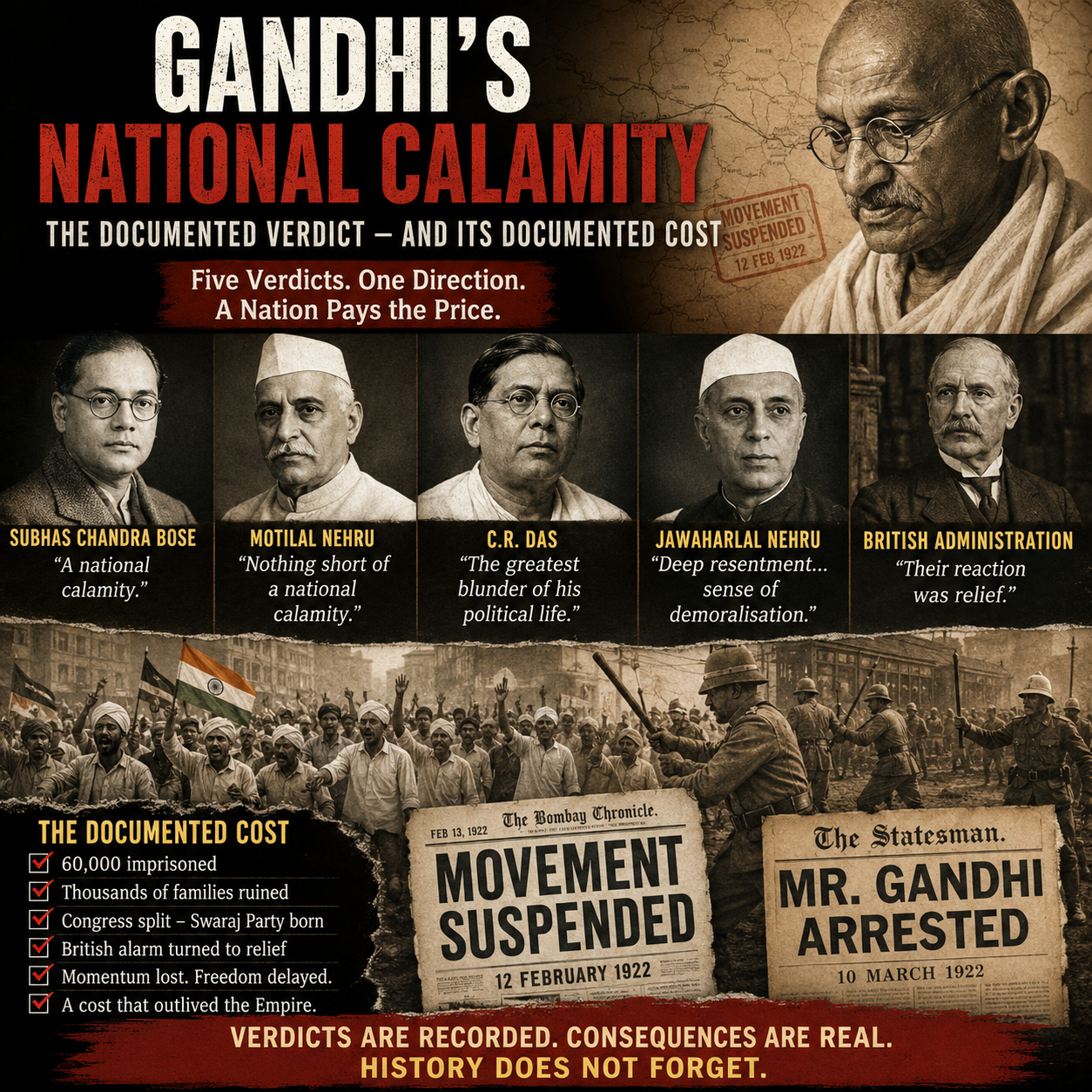
The Documented Verdict — Five Sources, One Direction
Gandhi’s National Calamity places the documented verdicts of those who were in prison for the Non-Cooperation Movement when they heard of the Bardoli suspension before the reader.
First Verdict — Subhas Chandra Bose
Bose documented in The Indian Struggle, 1920-1934 (1935): the Bardoli suspension was “a national calamity.”
Bose’s documented credentials: arrested for the Non-Cooperation Movement, he had worked within its structure, and he watched from inside as Gandhi unilaterally suspended a campaign that was, by documented contemporary accounts, producing genuine alarm in the colonial apparatus.
Second Verdict — Motilal Nehru
Motilal Nehru placed his documented characterisation on the written record independently of Bose:
“To sound the order of retreat just when public enthusiasm was reaching the boiling point was nothing short of a national calamity.”
Two leaders of the independence movement, writing independently, reached the same documented characterisation for the same documented decision. Motilal Nehru heard of the suspension while serving a six-month prison sentence, having been arrested on December 7 1921.
Third Verdict — C.R. Das
C.R. Das, writing from his cell at Calcutta at the time of the suspension, documented that Gandhi had committed “the greatest blunder of his political life.”
On release from prison in June 1922, Motilal Nehru announced the formation of the Swaraj Party with C.R. Das as its President — specifically to pursue constitutional politics inside the legislatures. This was the documented institutional response to Gandhi’s unilateral authority: a formal split within Congress.
Fourth Verdict — Jawaharlal Nehru
Jawaharlal Nehru documented in his autobiography (1936) that he felt “deep resentment” at the movement being stopped just when the government was on the ropes, and that the suspension brought about a sense of “demoralisation.” He heard of the suspension through prison walls, as a fait accompli, without consultation.
Fifth Verdict — The British Administration
The British administration, by documented contemporary accounts, had been genuinely alarmed by the Non-Cooperation Movement’s momentum. When Gandhi suspended the movement on February 12 1922, their documented reaction was relief. They promptly arrested Gandhi on March 10 1922.
The National Calamity — Not a Word, But a Consequence
Gandhi’s National Calamity places the documented consequences already established in Group 5 (Blogs 30-42) before the reader alongside the five verdicts:
- Blog 30 — the suspension signal, the day the British read the map
- Blog 32 — the lathi charge licence, how one suspension freed the baton
- Blog 33 — the torch that showed Britain where to strike, lit three times across twenty years
- Blog 34 — the suspension ledger, who paid and who gained
- Blog 38 — the perpetual debt, twenty-five years of re-payments on a zero price“
- Blog 39 — the cost beyond 1947, the framework that outlasted the empire
These are not abstract claims. They are documented consequences.
The Prosecution’s Extended Argument: Cumulative Interval vs. Direct Cost
Gandhi’s National Calamity places the prosecution’s extended argument before the reader. It distinguishes between direct immediate outcomes, the documented paralysis of the Raj, and cumulative interval costs.
1. Direct Documented Outcomes (1921–1923)
The immediate costs of the 1922 order of retreat require no counterfactual assumptions. They are recorded facts of the period:
- The Asymmetry of Moral Outrage: By the time of Chauri Chaura on February 4 1922, the Hindu community was already carrying the uncompensated trauma, forced conversions, and bloodshed of the 1921 Malabar violence. While months of atrocities against Hindu populations in Malabar did not halt the Khilafat-Non-Cooperation movement, the death of colonial policemen at Chauri Chaura was cited as an absolute moral line. The prosecution places this asymmetry before the reader alongside the documented record of communal riots established in the Khilafat arc.
- Immediate Persecution: Approximately 60,000 participants were jailed, and thousands of agrarian families suffered immediate land seizures, fines, and harassment once the mass movement shield was withdrawn.
- Institutional Split: Congress fractured internally, giving rise to the Swaraj Party as leaders rejected Gandhi’s singular veto.
2. The Paralysis of the Colonial State (Winter 1921–1922)
To evaluate what was surrendered at Bardoli, the prosecution places the documented condition of the British administration in the months leading up to February 1922 before the reader:
- Paralysis of Courts and Administration: The boycott of colonial law courts, educational institutions, and government offices had brought administrative machinery across multiple provinces to a standstill. Thousands of lawyers surrendered practice, and civic litigation within British courts ground to a halt.
- The Collapse of Revenue and Enforcement: Tax boycotts and no-rent campaigns in regions like Midnapore, Guntur, and Assam crippled local administration. Local police structures faced unprecedented demoralization, mass resignations, and social boycotts, leaving the colonial government unable to execute routine administrative functions without deploying armed military units.
- Documented Colonial Alarm: Official despatches from Viceroy Lord Reading to Secretary of State Edwin Montagu documented genuine alarm within the colonial cabinet, explicitly noting that the movement had reached a scale that threatened the basic operation of government authority across urban and rural centres alike.
3. The Cumulative Interval Proposition (1924–1948)
Beyond these immediate impacts, the prosecution places an extended argument before the reader based on the concept of deferred independence:
The Underlying Premise: If the Non-Cooperation Movement in 1921–1922 had brought British administration to the brink of collapse — as documented by colonial alarm — then the unilateral suspension at Bardoli extended British rule by twenty-five years. Under this proposition, the 85,000 Indian military deaths in World War II, the millions lost during the 1943 Bengal Famine, and the continued economic extraction represent the cumulative cost of an empire operating in an extended timeframe. The prosecution places this proposition before the reader. The reader examines it.
The Unbroken Arc: The 1948 Intervention
Gandhi’s National Calamity places the documented arc’s endpoint before the reader. The record extends to January 1948 — the final documented instance of Gandhi using a unilateral personal veto over state policy.
In January 1948, while India and Pakistan were actively engaged in hostilities over Jammu and Kashmir, Gandhi undertook a fast unto death in New Delhi. His demand resulted in the release of ₹55 crore from the Indian treasury to Pakistan — a payment the Indian cabinet had delayed to avoid funding an active combatant state.
The prosecution places this documented sequence on the record: from the unilateral retreat of 1922 to the treasury release of 1948, the pattern of overriding collective strategic necessity with personal doctrine is placed before the reader as a documented arc.
The Cost in Human Lives — World War II
85,000 Indian soldiers died during World War II — fighting under a colonial power whose continued authority over India extended through the twenty-five-year interval that followed the February 1922 suspension.
The prosecution places these 85,000 documented deaths before the reader alongside the documented twenty-five-year interval — and asks the reader to examine what the Bardoli decision established about the cost of colonial continuity.
The Cost — Thousands More
Beyond the 85,000 dead, the documented record of the twenty-five-year interval carries:
- Indian military deaths in British campaigns beyond World War II
- Deaths from starvation and disease as resources were diverted — including the 1943 Bengal Famine, in which an estimated 2 to 3 million civilians died
- Properties confiscated by the British administration
- Indians imprisoned, tried, and executed for resistance under continued colonial rule
These are documented facts of colonial rule across the twenty-five-year interval. The prosecution places them before the reader alongside the February 12 1922 date — and asks the reader to complete the sentence.
Did the Calamity End in 1948?
Gandhi’s National Calamity places the full documented arc before the reader. It runs from February 12 1922 to January 30 1948.
It runs through:
- The 1930 Salt Satyagraha
- The 1942 Quit India Movement
- The deaths of 85,000 Indian soldiers in World War II
- The Bengal Famine of 1943 — an estimated 2 to 3 million dead
- “Gandhi’s Cost Beyond 1947” presents the impact beyond 1947
And it runs to January 1948 — when Gandhi fasted unto death to compel the Indian government to release ₹55 crore to Pakistan while India and Pakistan were at war over Kashmir. Gandhi was shot on January 30 1948, before this fast could reach its conclusion.
The prosecution places the documented sequence before the reader and asks one question: does the documented arc — from the unilateral retreat of February 1922 to the unilateral treasury intervention of January 1948 — belong before the reader as a single documented exhibit?
The prosecution does not answer. The reader will complete the sentence.
The Prosecution’s Position
Gandhi’s National Calamity places five documented facts before the reader:
- Four of Gandhi’s closest colleagues — Bose, Motilal Nehru, C.R. Das, and Jawaharlal Nehru — documented their reactions to the Bardoli suspension: national calamity, greatest blunder, deep resentment, demoralisation.
- The British administration documented their reaction: relief — and Gandhi’s prompt arrest on March 10 1922.
- 85,000 Indian soldiers died in World War II under the authority of a colonial power whose continued rule extended through the twenty-five-year interval that followed Bardoli.
- Thousands more died, and thousands of properties were confiscated, in the documented decades that followed.
- The documented arc continued to 1948 — when Gandhi was shot while preparing to fast unto death over the release of funds to Pakistan during the Kashmir war.
The series does not answer. The documented verdicts, the documented costs, and the documented arc are placed before the reader. The reader will examine what those who were present documented — and complete the sentence.
Invitation To Defence
The floor belongs to the defense. We now invite them to present their exhibits and challenge the narrative established by the prosecution.
Bose: “a national calamity.” Motilal Nehru: “nothing short of a national calamity.” C.R. Das: “the greatest blunder of his political life.” Jawaharlal Nehru: “deep resentment.” The British administration: relief — and Gandhi’s arrest. 85,000 Indian soldiers dead in World War II. Thousands more dead. Thousands of properties confiscated. And in January 1948, a gun stopped Gandhi from intervening in India’s war against Pakistan. The prosecution places the documented verdicts and the documented arc before the reader. The reader will complete the sentence.
Feature Image: Click here to view the image.
Videos
Glossary of Terms
- Bardoli Suspension: Gandhi’s unilateral decision on February 12, 1922, to suspend the Non-Cooperation Movement following the Chauri Chaura incident.
- National Calamity: The phrase used independently by Subhas Chandra Bose and Motilal Nehru to describe the Bardoli Suspension and its consequences.
- Non-Cooperation Movement: The nationwide mass movement launched in 1920 against British rule through boycotts of government institutions, courts, schools, and foreign goods.
- Chauri Chaura Incident: The February 4, 1922, event in which protesters killed colonial policemen, leading Gandhi to suspend the Non-Cooperation Movement.
- Swaraj Party: The political party established in 1922 by C.R. Das and Motilal Nehru to pursue constitutional politics within the legislative councils after the Bardoli Suspension.
- Documented Verdict: A recurring phrase in this series referring to conclusions drawn directly from contemporary writings, memoirs, official records, and historical documents rather than retrospective interpretation.
- Documented Arc: A unique term in this series describing a continuous sequence of documented events extending from the Bardoli Suspension of 1922 to Gandhi’s January 1948 intervention.
- Cumulative Interval Proposition: A unique concept in this series arguing that extending British rule after 1922 increased the cumulative human, economic, and political costs of colonial rule.
- Colonial Paralysis: The documented condition during late 1921 and early 1922 in which British administrative authority was severely disrupted by the Non-Cooperation Movement.
- Personal Veto: The series’ term for Gandhi’s unilateral intervention overriding broader organizational or governmental strategy without collective approval.
- Malabar Violence (1921): The communal violence during the Moplah Rebellion involving killings, forced conversions, displacement, and destruction in the Malabar region.
- Bengal Famine (1943): The famine during British rule in which an estimated two to three million civilians died from starvation and disease.
- Collective Strategic Necessity: A key phrase referring to decisions considered necessary for the broader national struggle rather than individual moral judgment.
- Deferred Independence: The proposition that suspending the Non-Cooperation Movement delayed India’s independence and increased the long-term costs of continued colonial rule.
- Documented Cost: A recurring phrase in this series referring to measurable human, political, administrative, and economic consequences supported by documentary evidence.
#Gandhi #MahatmaGandhi #IndianHistory #FreedomStruggle #NonCooperation #ChauriChaura #Bardoli #BritishRaj #Congress #SubhasBose #Nehru #Partition #History #India #HinduinfoPedia
Gandhi’s Peace Efforts: The Questions Before the Mahatma (0)