
Gandhi’s Khilafat Prosecution Exhibits: Part 2 (129)
भारत / GB
Part 129: Mahatma Gandhi’s Peace Efforts | Series Index
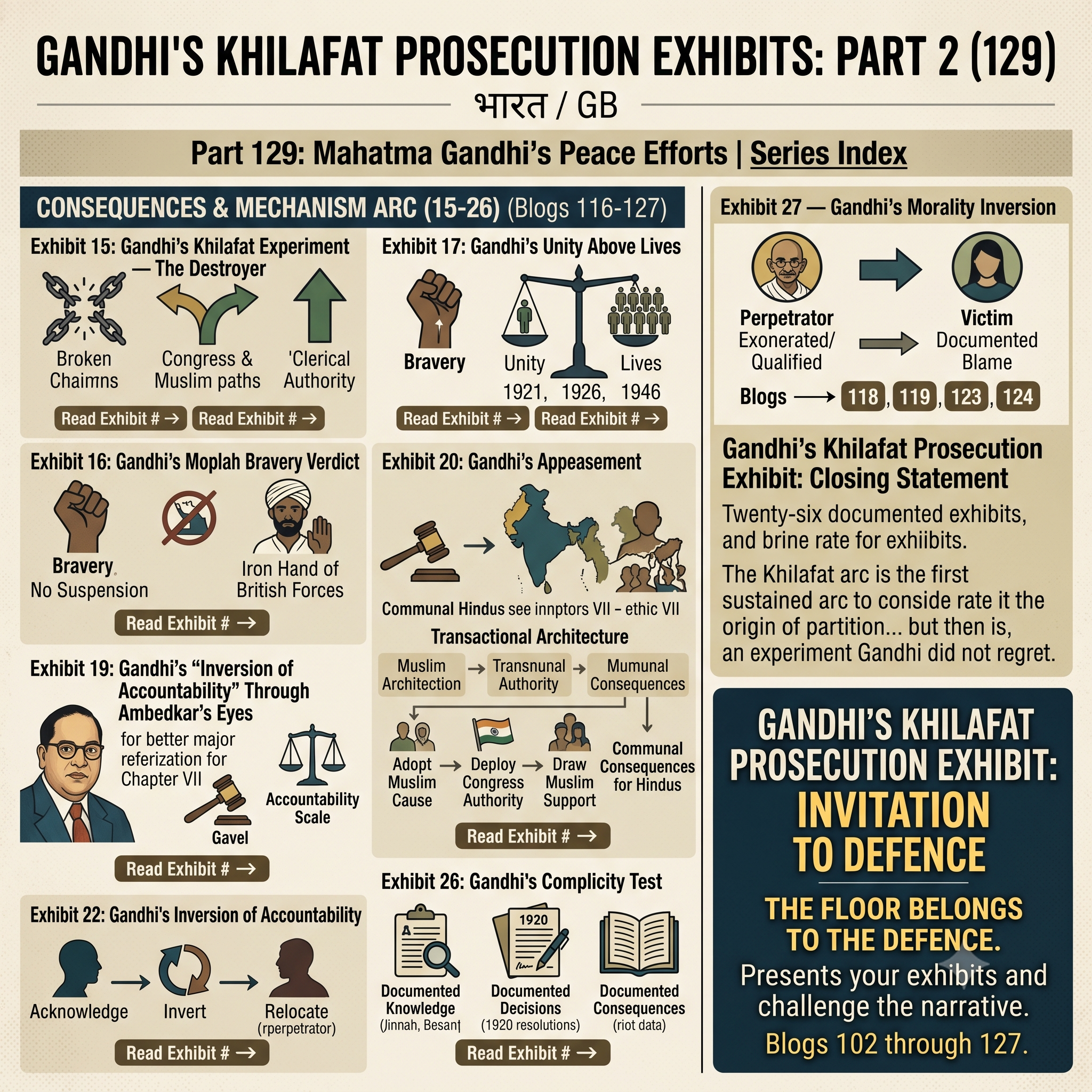
Blog 128 placed Exhibits 1-14 before the reader — the cause arc covering Blogs 102-115. Gandhi’s Khilafat Prosecution Exhibits places Exhibits 15-26 before the reader — the consequences and mechanism arc covering Blogs 116-127. Together the two exhibit lists consolidate the full Khilafat prosecution record.
Thank you for reading this post, don't forget to subscribe!The Action Taken: The series compiled the primary exhibits recording the collapse of the Khilafat agitation, the Turkish abolition decrees, and the resulting casualty returns of the 1922–1926 riots.
Who Paid the Price: The historical narrative of seamless inter-communal unity during the Non-Cooperation era.
The Alternative Bypassed: Separating the launch of the movement from its downstream human consequences.
Why This Matters: Documents the empirical harvest of the clerical alliance: linking the initial political agreements of 1920 directly to the casualty rolls and displacement figures of 1922–1926.
Gandhi’s Khilafat Prosecution Exhibits: The Consequences and Mechanism — 15-26 (Blogs 116-127)
Exhibit 15 — Blog 116: Gandhi’s Khilafat Experiment — The Destroyer
Primary source: S. Gopal (riot frequency data); Ambedkar, Pakistan or the Partition of India; CWMG Vol. 24.
Finding: Three things the experiment destroyed. Hindu-Muslim unity: 16 communal riots in 22 years before the alliance, 72 riots in 3 years that followed. Congress’s secular character: the Lucknow Pact’s constitutional tradition permanently replaced by religious mobilisation; Jinnah’s documented departure at Nagpur the documented moment of separation. The Muslim political future: clerical authority elevated, constitutional Muslim leadership marginalised, Lahore Resolution 1940 the documented endpoint.
Read Exhibit 15 →
Exhibit 16 — Blog 117: Gandhi’s Moplah Bravery Verdict
Primary source: CWMG Vols. 22, 24; Young India September-December 1921.
Finding: Gandhi’s documented vocabulary for the Moplah perpetrators: “brave,” “God-fearing,” “valour,” “a few Moplahs,” “misguided — disservice to Islam and Swaraj.” No movement suspension during four months of documented killings, forced conversions, and temple desecrations. The riots were controlled by the iron hand of the British forces. No fast. Chauri Chaura February 1922 — 22 policemen killed by nationalist protesters in response to attack on peaceful protesters — produced unilateral movement suspension.
Read Exhibit 16 →
Exhibit 17 — Blog 118: Gandhi’s Unity Above Lives
Primary source: CWMG Vol. 21 p.317, CWMG Vol. 32 pp.461-62, CWMG Vol. 98; Bihar riots historical record 1946.
Finding: Three documented instances of the same pattern — Moplah 1921 (“cowardliness of the Hindu brother”), Shraddhanand murder 1926 (“my brother Abdul Rashid, I do not even regard him as guilty”), Direct Action Day 1946 (“senseless violence”) with Bihar fast threat when Hindu crowds attacked Muslims. The pattern across 25 years placed before the reader.
Read Exhibit 17 →
Exhibit 18 — Blog 119: Gandhi’s Documented Dispensation: The Khilafat Period
Primary source: CWMG Vol. 21 p.317 (October 1921); CWMG Vol. 22 (December 8 and January 26 1922).
Finding: Four dated CWMG citations in the densest primary source sequence of the arc. Same paragraph, October 20 1921: “ignorant fanaticism of the Moplah brother” immediately followed by “cowardliness of the Hindu brother who helplessly muttered the Islamic formula.” December 8 1921: “brave God-fearing Moplahs fighting for what they consider as religion.” January 26 1922: Mohani “most courageous, no greater nationalist, heart is sound.” January 26 1922: “Hindus are not without blame — they treated the Moplah as a serf.”
Read Exhibit 18 →
Exhibit 19 — Blog 120: Gandhi’s “Inversion of Accountability” Through Ambedkar’s Eyes
Primary source: Ambedkar, Pakistan or the Partition of India, franpritchett.com; Chapter VII.
Finding: “Gandhi has never called the Muslims to account even when they have been guilty of gross crimes against Hindus.” Written 1940, during Gandhi’s lifetime, by the documented architect of India’s Constitution — the man whose documented constitutional rights Gandhi’s 1932 fast had foreclosed. Ambedkar named the Moplah rebellion, the Shraddhanand murder, and the CWC Moplah resolution as the evidential basis for “never.”
Read Exhibit 19 →
Exhibit 20 — Blog 121: Gandhi’s Appeasement Template
Primary source: Ambedkar, Pakistan or the Partition of India; series primary source record.
Finding: Read across the series, the 1920 decisions reveal a four-part transactional architecture — adopt Muslim community cause, deploy Congress authority, draw Muslim numerical support, communal consequences fell on the Hindu population. No reciprocal commitment on the record from the Khilafat leadership. Ambedkar’s institutional observation: “The Congress virtually granted the power of veto to Muslims, however small their number might be in the Congress, to torpedo any policy or programme of the Congress.”
Read Exhibit 20 →
Exhibit 21 — Blog 122: Gandhi’s Demographic Turn
Primary source: Young India February 1920, CWMG Vol. 17; Ambedkar, Pakistan or the Partition of India; Kanji Dwarkadas, India’s Fight for Freedom, pp.286-287.
Finding: Gandhi presided over the Khilafat Conference (November 1919) and was the dominant force in Congress simultaneously. Young India February 1920: “The Mussalmans have a right to expect the full support of the Hindus in this their just endeavour.” Ambedkar: “Mr. Gandhi took up the cause of the Khilafat with a view to bring the Muslims to join the Congress.” The 1937 Nehru Muslim Mass Contact Programme established the 1920 mobilisation had not produced durable integration.
Read Exhibit 21 →
Exhibit 22 — Blog 123: Gandhi’s Inversion of Accountability
Primary source: Young India January 26 1922, CWMG Vol. 22; CWMG Vol. 32 pp.461-62.
Finding: Three-move rhetorical mechanism — acknowledge (“crude views about religion”), invert (“no greater nationalist, no greater lover of Hindu-Muslim unity”), relocate (“his heart is sound and superior to his intellect”). Applied to Hasrat Mohani January 1922 — who had publicly justified Moplah killings. Applied to Abdul Rashid December 1926 — who had murdered Swami Shraddhanand in his sickbed.
Read Exhibit 22 →
Exhibit 23 — Blog 124: Gandhi’s Overlay
Primary source: CWMG Vol. 21 p.317 (October 1921); CWMG Vol. 22 (December 1921, January 1922); CWMG Vol. 24 p.189 (September 1921).
Finding: The acknowledge-and-overlay mechanism at the level of the act — not the person. September 1921: acknowledge violence, immediately overlay “misguided, disservice to Islam/Swaraj.” December 1921: no acknowledgement, pure overlay “brave God-fearing.” October 1921: “ignorant fanaticism” qualified and then immediate paragraph pivot to victim “cowardliness.” Each overlay deployed before the acknowledgement could stand on its own.
Read Exhibit 23 →
Exhibit 24 — Blog 125: Gandhi’s Learning
Primary source: Young India May 12 1920; Young India May 29 1924, CWMG Vol. 24; S. Gopal riot data.
Finding: The documented absence of learning. Results contradicted hypothesis on every measure — Moplah, 72 riots in 3 years, Jinnah’s departure, Caliphate abolished by Turks, “kind of Jihad against us Hindus.” Gandhi’s response: revised the results, not the hypothesis. “Hearts not pure enough, not because the cause was wrong.” Method repeated without revision: Chauri Chaura 1922, Poona Pact 1932, Navy Mutiny 1946, Pakistan payment 1948.
Read Exhibit 24 →
Exhibit 25 — Blog 126: Gandhi’s Unreported Results
Primary source: Young India May 12 1920; CWMG post-1920 record.
Finding: After May 12 1920, Gandhi never again used the word “experimenting” to describe his method. The same method was renamed — moral imperative, principled position, spiritual obligation, truth-force. Each renaming structurally removed the obligation to examine and report results: a moral imperative cannot produce data, a spiritual obligation is not subject to revision based on outcomes. Four instances of unreported results: Chauri Chaura, Poona Pact, Navy Mutiny, Pakistan payment.
Read Exhibit 25 →
Exhibit 26 —Blog 127: Gandhi’s Complicity Test
Primary source: Full arc consolidated — CWMG primary sources, Ambedkar Pakistan or the Partition of India, Durga Das memoir, Besant The Future of Indian Politics, S. Gopal riot data, official Moplah records.
Finding: Three elements placed before the reader — documented knowledge (Jinnah: disaster; Polak: ill-advised and dangerous; Besant: consequences you cannot control; Gandhi’s own word “experimenting”; Ambedkar: ethical basis questioned by many); documented decisions (Calcutta September 1920, Nagpur December 1920, alliance maintained during Moplah, “brave God-fearing Moplahs,” Hindu-Muslim unity must not be strained even if forced conversions occurring); documented consequences (72 riots/3 years, Ambedkar: “blood-curdling atrocities indescribable,” Lahore Resolution 1940). The reader applies their own standard.
Read Exhibit 26 →
Exhibit 27 — Gandhi’s Morality Inversion
Primary sources: CWMG Vol. 32 pp.461-62 (Shraddhanand/Abdul Rashid — Blog 118, Blog 123); CWMG Vol. 22 January 26 1922 (Moplah Hindu blame — Blog 119, Blog 124).
Finding: Across multiple documented instances established in this series, Gandhi’s documented language followed a consistent pattern — the perpetrator of violence against Hindus was exonerated or qualified, while the Hindu victim community was assigned documented blame for the violence they had suffered.
Shraddhanand murder 1926 (established in Blogs 118 and 123): “I have called Abdul Rashid a brother, and I repeat it, I do not even regard him as guilty of Swamiji’s murder. Guilty, indeed, are all those who excited feelings of hatred against one another” (CWMG Vol. 32, pp.461-62). The killer: not guilty. The guilt: placed on those who had created communal tension — including by implication Hindu voices critical of Muslim conduct. The victim side attributed partial documented blame for the murder of their own leader.
Moplah rebellion 1921 (established in Blogs 119 and 124): “Hindus must find out the causes of Moplah fanaticism. They will find that they are not without blame. They have hitherto not cared for the Moplah. They have either treated him as a serf or dreaded him” (Young India January 26 1922, CWMG Vol. 22). The victims of documented killings, forced conversions, and temple desecrations: attributed documented responsibility for producing the conditions that led to the violence against them. The pattern across both documented instances: perpetrator exonerated or qualified; victim community assigned documented blame. The prosecution places this pattern — established across Blogs 118, 119, 123, and 124 — before the reader as the Khilafat arc’s closing exhibit on Gandhi’s documented language toward violence against
Hindus. See Blogs 118 → | Blog 119 → | Blog 123 → | Blog 124 →
Gandhi’s Khilafat Prosecution Exhibit: Closing Statement
Twenty-six documented exhibits. Twenty-six primary source records placed before the reader across Blogs 102-127. The prosecution makes one closing observation before the series moves to its next arc.
The Khilafat arc is not the series’ only prosecution arc. It is the first sustained arc — the documented decision that Ambedkar called the origin of the series of events leading to partition, and that Gandhi himself documented in May 1920 as an experiment and in May 1924 as producing results he did not regret.
The defence is invited to present its exhibits against the consolidated record of twenty-six documented prosecution exhibits.
Gandhi’s Khilafat Prosecution Exhibit: Invitation To Defence
The floor belongs to the defense. We now invite them to present their exhibits and challenge the narrative established by the prosecution across the full Khilafat arc — Blogs 102 through 127.
Feature Image: Click here to view the image.
Videos
Glossary of Terms
- Nehru’s Synthesis Myth: The central concept of this blog series, describing the claim that Jawaharlal Nehru portrayed centuries of Islamic conquest primarily as a process of cultural synthesis rather than emphasizing conquest and unequal power.
- Synthesis: A process in which two or more traditions merge through mutual participation and equal agency. The blog argues that this term does not accurately describe medieval Indo-Islamic political conditions.
- Court Patronage: Financial and institutional support provided by ruling courts to artists, architects, musicians, scholars, and craftsmen, often reflecting the preferences of the ruling elite.
- Indo-Islamic Civilization: The cultural and political order that developed in parts of the Indian subcontinent under successive Islamic dynasties through interactions between Indian and Islamic traditions.
- Power Asymmetry: An unequal relationship in which one side exercises political, military, or administrative dominance over another, influencing cultural production.
- Delhi Sultanate: A succession of Islamic dynasties that ruled large parts of northern India from the thirteenth to the sixteenth century before the Mughal Empire.
- Cultural Exchange: The voluntary sharing of ideas, traditions, languages, arts, and customs between communities without coercion or political domination.
- Grassroots Cultural Exchange: Cultural interaction among ordinary people, including traders, neighbours, and saint-poets, independent of royal or state patronage.
- Virtue-First Framing: A term coined in this series describing a narrative method that highlights admirable cultural achievements before mentioning or minimizing the coercive historical circumstances behind them.
- Alibi of Culture: A phrase coined in this blog referring to the use of genuine cultural achievements as a justification or distraction from the conquest and coercion under which they emerged.
- Two-Nation Theory: Muhammad Ali Jinnah’s political theory that Hindus and Muslims constituted separate nations requiring separate political destinies.
- Lahore Resolution: The 1940 resolution adopted by the All-India Muslim League that formally called for separate Muslim-majority states, eventually leading to Pakistan.
- Direct Action Day: The political mobilisation called by the Muslim League on 16 August 1946 that resulted in widespread communal violence, especially in Calcutta.
- The Discovery of India: Jawaharlal Nehru’s historical work written during imprisonment, presenting his interpretation of Indian civilization and national identity.
- Indo-Islamic Synthesis: A historical interpretation describing the interaction of Indian and Islamic cultures. The blog argues that the phrase overlooks the unequal political conditions under which much of the interaction occurred.
#Nehru #History #IndianHistory #Partition #Mughal #DelhiSultanate #Aurangzeb #TajMahal #Historiography #Civilization #Culture #Politics #India #HinduinfoPedia
Gandhi’s Peace Efforts: The Questions Before the Mahatma (0)