
Gandhi’s Kept Poverty: The Economics of Austerity (162)
भारत / GB
Part 162: Mahatma Gandhi’s Peace Efforts | Series Index
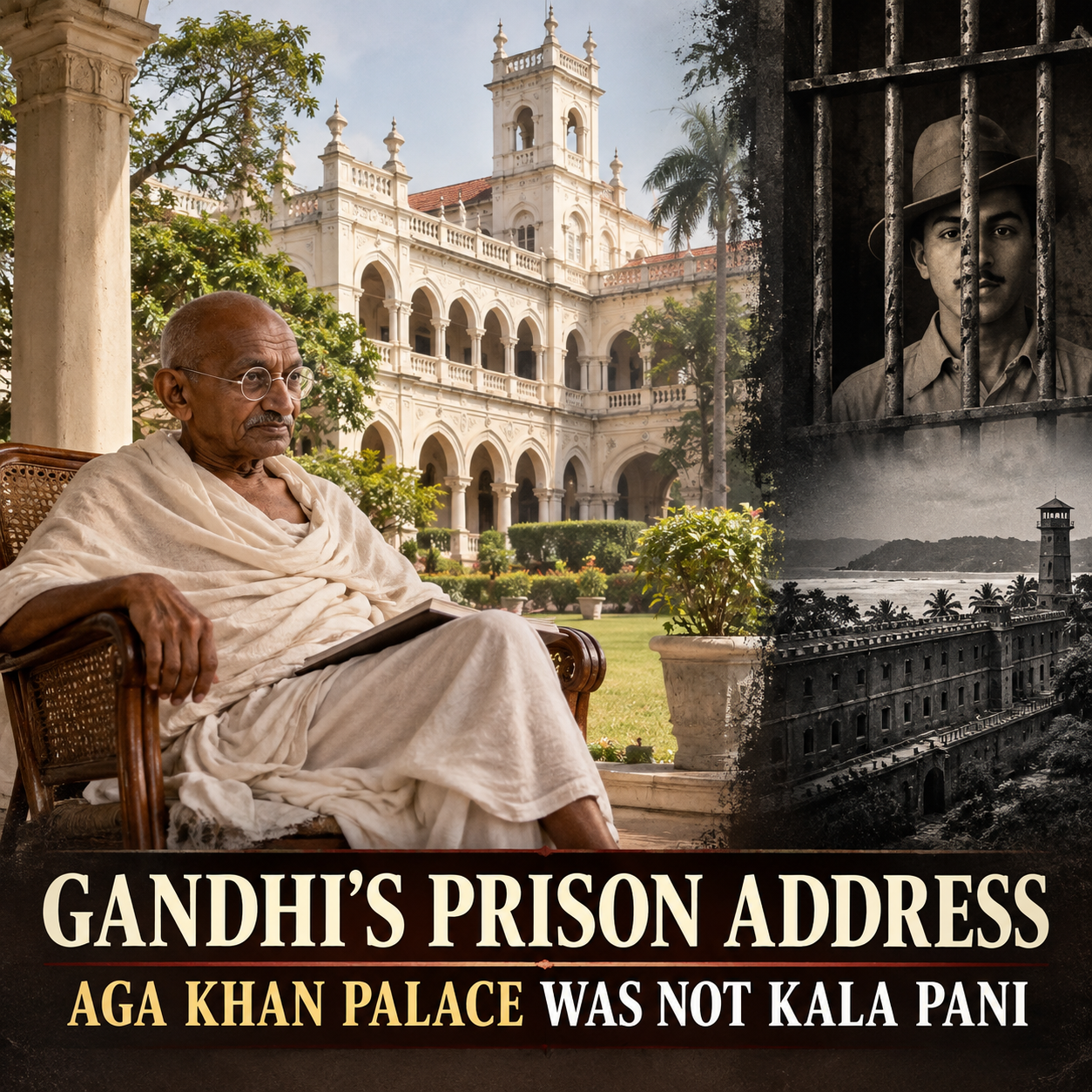
Blog 161 placed the prison differential before the reader — Aga Khan Palace with gardens, companions, and medical supervision for 21 months, while 585 revolutionaries were transported to Kala Pani under documented punitive conditions. This post places a different exhibit before the reader: the economics of Gandhi’s austerity — who paid for the poverty, and what the payment purchased.
Thank you for reading this post, don't forget to subscribe!THE HISTORICAL RECORD — THE PATRONAGE & LOGISTICS FILE (Pillar 5 of 7)
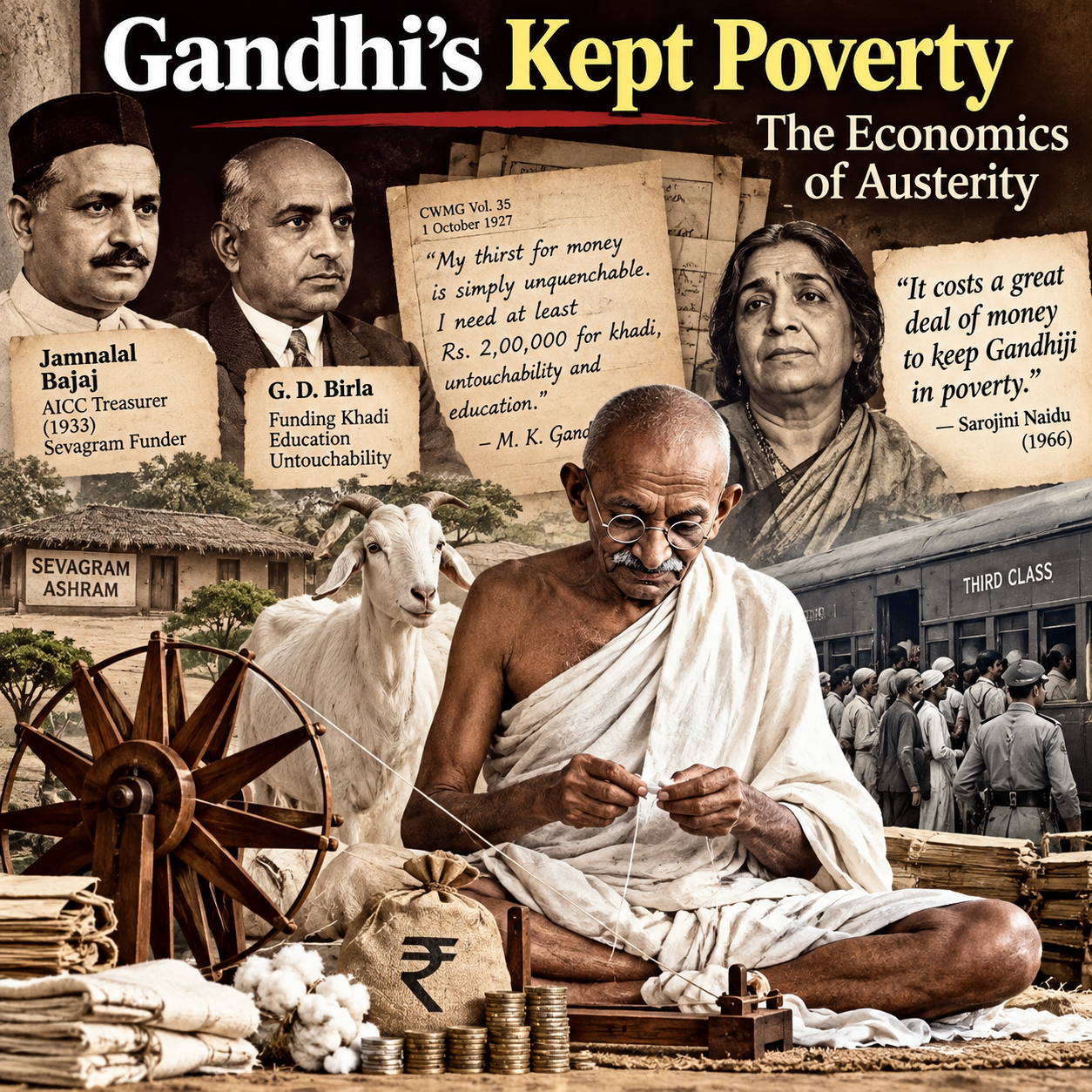
The Action Taken: Gandhi’s public austerity — dhoti, third-class rail travel, goat’s milk diet, spinning wheel — was financed by India’s foremost industrial families. Bajaj served as AICC Treasurer from 1933 and was simultaneously the primary private funder of Sevagram Ashram’s land and operations; he died 11 February 1942, six months before Quit India. On 1 October 1927, Gandhi wrote to G.D. Birla (CWMG Vol. 35): “My thirst for money is simply unquenchable. I need at least Rs. 2,00,000 [equivalent to Rs 12–24 crore today] for khadi, untouchability and education.” Sarojini Naidu, who observed the apparatus firsthand: “It costs a great deal of money to keep Gandhiji in poverty.”
The Structural Exhibit: The party’s institutional treasury and the leader’s domestic sanctuary were anchored to the balance sheet of the same commercial house. The constructive programme — projected as self-reliant and peasant-led — ran on industrial surplus solicited directly from India’s premier capitalists. The poverty was real in its physical dimensions; its maintenance was a funded, organized undertaking.
Why This Matters: The documented convergence — patronage flowing consistently from industrial families whose interest in a non-revolutionary independence was the clearest in the record, outcomes consistently compatible with those interests — is the prosecution’s structural exhibit. Motive is the prosecution’s inference; the convergence is documented.
The Documented Apparatus — Who Paid
Gandhi’s Kept Poverty places the documented economics of Gandhi’s austerity before the reader.
The visible surface of Gandhi’s public life was consistent: the white khadi dhoti, the spinning wheel, the third-class rail compartment, the goat’s milk diet at Sevagram. The imagery generated moral authority — a leader who had renounced, who shared the conditions of the poorest, who stood outside the economy of accumulation. The prosecution places before the reader the documented structure that produced and maintained this image.
Jamnalal Bajaj was the head of the Bajaj commercial house — sugar mills, insurance, trading enterprises built under imperial preference structures. His relationship to the Gandhi movement operated on two formally separate tracks, both documented in Bajaj correspondence edited by Kalelkar (1951). In the first track, Bajaj served as the AICC’s formal Treasurer from 1933 through the later Civil Disobedience and provincial Congress years — keeping the organizational accounts solvent, an audited public role. He remained one of Gandhi’s principal financial associates until his death on 11 February 1942, six months before the Quit India movement was launched. In the second track, Bajaj was Gandhi’s primary private patron — donating his own land at Wardha, funding the construction and operations of Sevagram Ashram, underwriting Gandhi’s base of operations from his personal commercial wealth. The prosecution does not allege an illicit commingling. The formal arrangement itself is the exhibit: the official keeper of the party purse and the personal underwriter of the leader’s daily life were the exact same industrial capitalist.
The G.D. Birla documentation is more specific. On 1 October 1927, Gandhi wrote directly to G.D. Birla (CWMG Vol. 35): “My thirst for money is simply unquenchable. I need at least Rs. 2,00,000 for khadi, untouchability and education.” The prosecution places before the reader what that letter establishes — and what it implies.
What it establishes: Gandhi was the chief fundraiser for a parallel constructive apparatus — the All India Spinners Association, the Gujarat Vidyapith, untouchability removal campaigns — that ran on constant infusions of industrial surplus solicited directly from India’s premier capitalist. The entire programme, projected publicly as self-reliant and peasant-led, required Birla’s cheque.
What it implies: Birla could write that cheque only because the British permitted his commercial operations — cotton purchased at suppressed prices, fabric sold at margin, salt and sugar extracted within an imperial preference framework that made the Birla commercial house possible. The independence movement’s most effective threat to that framework was a revolutionary turn: redistribution, nationalization, expropriation of accumulated commercial capital. Gandhi’s movement, funded by Birla, did not take that turn. The prosecution does not assert that Birla purchased the outcome. It places before the reader the circuit: Gandhi needed Birla’s surplus; Birla’s surplus depended on British commercial tolerance; British commercial tolerance depended on the movement staying within manageable limits without disturbing the British Raj. The letter is one node in that circuit. The reader will assess what the circuit establishes.
The Sarojini Naidu formulation entered the record as a private observation that became a public one. Naidu — poet, Congress president, close Gandhi associate — observed the full apparatus at first-hand range. Her statement, documented in Sengupta’s Naidu biography (1966): “It costs a great deal of money to keep Gandhiji in poverty.” The observation is not hostile — Naidu was a Congress insider and Gandhi loyalist.
It is descriptive: the poverty was an organized, funded condition, not an organic one.
The Goat and the Bogie — The Logistics of Austerity
Gandhi’s Kept Poverty places the logistics of the visible austerity record before the reader.
The goat’s milk diet was Gandhi’s documented nutritional practice from 1917 onward, adopted after his Champaran illness and the collapse of cow’s milk as a dietary option following his vow. The goat at Sevagram was part of the ashram’s livestock, maintained by ashram staff. The prosecution places before the reader what can be documented: Bajaj funded Sevagram’s land, construction, and operations. The ashram’s operational costs — including livestock upkeep — were underwritten by that patronage. The prosecution does not separately claim a document establishing the goat’s specific financing; it places the overall apparatus before the reader and notes that the goat, as an element of that apparatus, existed within a funded institution, not outside one.
Third Class Rail Travel
The third-class railway compartment occupied a specific position in the symbolism of Gandhi’s public life: it signified solidarity with those who could not afford first or second class. The documentary record shows a phase distinction the prosecution places before the reader. In the early years after his return to India — 1915 to approximately 1919 — Gandhi travelled on ordinary, unreserved third-class tickets without special arrangements, enduring the direct conditions of the compartment: overcrowding, foul latrines, passengers climbing through windows, verbal abuse from railway staff. CWMG Vol.14 (“Third Class in Indian Railways,” September 1917) is the record of that phase. After the launch of the Non-Cooperation Movement in 1920, Gandhi’s presence at any public station triggered crushing crowds seeking his darshan, making unreserved travel physically impossible. The logistical apparatus that replaced it was extensive: Congress committees and the Birla-Bajaj patronage network coordinated advance reservation of entire third-class compartments or whole bogies; the carriage held not the general public but Gandhi’s personal secretaries (Mahadev Desai, Pyarelal), family members, physicians, and traveling Congress leaders, with desks set up on wooden benches for secretarial work; armed railway police cordoned his carriage at halts, window shutters were barred at major stations, and ordinary passengers holding general third-class tickets were barred from entering. The costs flowed through the same patronage machine that funded the constructive programme. The wooden bench was authentic. The apparatus ensuring that no stranger sat on that bench was not spontaneous. Third-class physical conditions, organised patronage logistics — and a phase-one record of genuine walk-up travel that the prosecution places alongside, not against, the phase-two apparatus it became.
The spinning wheel — the charkha — was the central visual symbol of Gandhi’s public identity and the Swadeshi programme’s material anchor. Spinning wheels were not free. The khadi that Gandhi wore was produced within a supply chain — fibre sourced, spun, woven, distributed through the All India Spinners Association, an institution with its own administrative apparatus and funding requirements primarily funded by G. D. Birla. The prosecution does not place this before the reader as evidence that spinning was insincere. It places it before the reader as evidence that the austerity was an organized programme, not a personal condition.
The Medical Apparatus
The medical apparatus that sustained Gandhi’s daily physical regimen is the fourth logistics exhibit the prosecution places before the reader — and the most operationally specific. Gandhi’s personal physician Dr. Sushila Nayar, documented in her published reminiscences (Mahatma Gandhi: Satyagraha at Work), recorded the daily routine in clinical detail: enemas administered as a naturopathic measure for chronic constipation and high blood pressure, prepared by attendants who boiled water, mixed sodium bicarbonate solutions, and lubricated rubber cannulas. The procedure was not performed in seclusion — it was conducted in Gandhi’s open ashram quarters while he simultaneously dictated letters and reviewed draft articles with secretaries present. Manu Gandhi’s published diaries (Bapu — My Mother; Ekla Cholo Re) record the ashram kit maintained on her daily rounds: hot water vessels, thermometers, enema cans, rubber tubes, nozzles, cotton swabs, petroleum jelly — sourced, cleaned, and replaced on a twice-daily schedule. Pyarelal’s biographical series (The Last Phase) and Mahadev Desai’s diaries document that Gandhi extended this regimen to other ashram inmates — prescribing enemas to visitors and residents suffering from headaches or fevers, requiring his staff to clean and maintain the equipment for the entire ashram community.
What his staff recorded as their grievance was never misconduct — it was the relentless physical labour of maintaining a king-scale medical household under the banner of naturopathic simplicity.
The prosecution places this apparatus alongside Bajaj’s funded institution and Birla’s cheque: a rotating corps of named physicians, secretaries, and personal attendants, maintaining a daily medical regimen of documented complexity, for a man who had publicly renounced all comfort. The poverty was real in its physical dimensions. Its maintenance infrastructure was not.
The Industrial Interest — What the Payment Purchased
Gandhi’s Kept Poverty places the structural question of patronage motive before the reader.
The defence will argue that Bajaj and Birla funded Gandhi because they believed in the independence cause — that industrial philanthropy in service of national liberation is not evidence of an interest alignment that shaped the movement’s direction. The prosecution does not claim otherwise. No document in the record explicitly establishes that Bajaj or Birla funded Gandhi in order to contain the independence movement’s revolutionary potential. The prosecution’s exhibit is a convergence, not a motive.
The convergence is this: Bajaj and Birla were the principal beneficiaries of the property structure the independence movement would inherit. A revolutionary independence movement — redistribution of industrial assets, nationalization of capital, land reform in the industrial sector — would have cost them what they had. A constitutionalist movement — political power transferred while property structures remained intact — would cost them a Congress contribution and produce a friendly successor government. That structural interest is documented. What the patronage purchased, in terms of movement direction, is the prosecution’s inference from the documented convergence, not a separately established fact.
The convergence itself is documented. The Irwin Pact (Blog 17) delivered zero of eleven demands — but produced no revolutionary interruption to the commercial apparatus. The Poona Pact (Blog 159) resolved the reservation question within an electoral framework that left industrial structures unchanged — and its lead negotiator on the Caste Hindu side was G.D. Birla, who signed the Pact on September 24, 1932, and was appointed Founding President of the Harijan Sevak Sangh six days later: the institution that converted Dalit political mobilization into upper-caste philanthropy under his own chairmanship. The Quit India movement collapsed within weeks of Gandhi’s arrest because no second-tier structure existed — industrial capital’s infrastructure was undisturbed. The prosecution places this convergence before the reader and identifies it as an inference: patronage flowed consistently; outcomes were consistently compatible with the interests of those who funded. The reader will assess what that convergence establishes.
The Structural Pattern — Across the Series
Gandhi’s Kept Poverty places the patronage record alongside the series’ documented funding structure.
Blog 2 placed the NIC founding before the reader: Gandhi’s original Indian institution in South Africa was built on the Dada Abdulla retainer — commercial patronage from the first moment of political organization. The pattern that Sarojini Naidu observed at Sevagram was present from Phoenix Farm.
Blog 4 placed the Boer War logistics before the reader: Gandhi’s wartime ambulance service was funded and organized with British military support — an early structural alignment between Gandhi’s organizational activities and the interests of the administering power. The insulation from cost, which Blog 161 documented in the prison differential, had an economic dimension from the earliest arcs.
Blog 17 placed the Irwin Pact outcome before the reader: zero of eleven demands delivered in full, but the movement’s continuation costs — absorbed by satyagrahis facing colonial prosecution — ended. The industrial constituency that funded Gandhi’s movement was not among those paying the continuation costs.
The prosecution places the cumulative record before the reader. The poverty was kept. The keeping was paid for. The payment came from the industrial families whose interest in a non-revolutionary independence was the clearest in the documented record. The austerity was real. Its economics were not.
The Prosecution’s Position
Gandhi’s Kept Poverty places three questions before the reader.
- Does the documented apparatus — Bajaj as simultaneous AICC Treasurer and Sevagram funder, Birla’s CWMG Vol. 35 correspondence establishing Gandhi’s direct financial dependency, Naidu’s formulation entering the documentary record — constitute an exhibit the reader places alongside the series’ documented pattern of differential cost absorption across seven arcs?
- Does the documented convergence between the patronage structure’s interests and the Congress movement’s documented outcomes — no revolutionary interruption to industrial capital, no redistribution of property structures, constitutionalist transfer of power — constitute an exhibit the reader places alongside the series’ record of what Gandhi’s mass authority delivered to whom?
- Does the logistics record — organised third-class space paid through the patronage machine, ashram livestock maintained within a Bajaj-funded institution, the Birla-coordinated constructive apparatus — constitute a documented pattern the prosecution is entitled to place before the reader as a structural exhibit, not an accusation about Gandhi’s personal sincerity, but a record of the organized economics that produced and maintained the image of renunciation?
The series does not answer. Gandhi’s Kept Poverty places the patron, the ledger, the logistics, the convergence, and the Naidu formulation before the reader. The reader will examine what the economics established — and complete the sentence.
Invitation To Defence
The floor belongs to the defense. We now invite them to present their exhibits and challenge the narrative established by the prosecution.
“It costs a great deal of money to keep Gandhiji in poverty.” — Sarojini Naidu, documented in Sengupta biography (1966). Bajaj: AICC Treasurer from 1933, Sevagram funder, dead six months before Quit India was launched. Birla: CWMG Vol. 35, 1 October 1927 — Gandhi to Birla: “My thirst for money is simply unquenchable. I need at least Rs. 2,00,000 for khadi, untouchability and education.” Organised third-class space, paid by the same patronage machine. Ashram livestock maintained within a Bajaj-funded institution. The poverty was real. Its economics were not. The prosecution places the ledger before the reader. The reader will complete the sentence.
← Part 161 | Series Index | Exhibits Table | Forensic Archive
Feature Image: Click here to view the image.
Videos
Glossary of Terms
- Gandhi’s Kept Poverty: The blog’s key phrase describing Gandhi’s publicly visible austerity as a physical reality whose maintenance depended on an organized and funded institutional structure.
- Economics of Austerity: The economic dimension of Gandhi’s austere public life, focusing on who financed its institutions, logistics, and daily maintenance.
- Patronage & Logistics File: Pillar Five of the series, examining the financial patrons and organizational arrangements that supported Gandhi’s public austerity and political activities.
- Structural Exhibit: A documented arrangement or pattern presented for examination as evidence of a broader structural relationship, rather than as proof of personal motive.
- AICC Treasurer: The officer responsible for the financial administration of the All-India Congress Committee; Jamnalal Bajaj served in this position from 1933.
- CWMG: Collected Works of Mahatma Gandhi, the documentary series cited in the blog for Gandhi’s correspondence and writings.
- Constructive Programme: Gandhi’s organized programme involving activities such as khadi production, spinning, education, and campaigns against untouchability, presented as self-reliant and peasant-led.
- Imperial Preference Structures: Commercial arrangements under British rule that gave particular economic advantages within the imperial trading system and supported commercial enterprises operating within it.
- Industrial Surplus: Financial resources generated by industrial and commercial activity that could be directed toward political, institutional, philanthropic, or organizational purposes.
- Patronage Machine: The blog’s term for the interconnected financial and logistical network through which industrial patronage supported Gandhi’s institutions, travel arrangements, and constructive activities.
- Non-Revolutionary Independence: A form of independence involving political transfer from British rule without the revolutionary redistribution, nationalization, or expropriation of existing industrial and property structures.
- Constitutionalist Movement: A political movement seeking transfer of political power through constitutional arrangements while leaving existing property structures substantially intact.
- Charkha: The spinning wheel that became a central visual symbol of Gandhi’s public identity and a material anchor of the Swadeshi and khadi programme.
- Khadi: Hand-spun and hand-woven cloth associated with Gandhi’s Swadeshi programme and produced through an organized supply chain involving spinning, weaving, and distribution.
- Differential Cost Absorption: The series’ analytical phrase for situations in which the visible political or symbolic activity was undertaken by Gandhi while substantial institutional, financial, logistical, or physical costs were absorbed by others.
#Gandhi #MahatmaGandhi #IndianHistory #IndianIndependence #Khadi #Congress #QuitIndia #Austerity #Sevagram #HinduinfoPedia
Gandhi’s Peace Efforts: The Questions Before the Mahatma (0)