
Gandhi’s Boer War Bargain: Phoenix Farm and the British Medal (4)
भारत / GB
Part 4: Mahatma Gandhi’s Peace Efforts | Series Index
Phoenix Farm: The Commune With a Patron Class
In 1904, on a hundred acres of land outside Durban, Gandhi founded Phoenix Farm — a commune for simple living, hand-printing Indian Opinion, and building the community of disciplined service he had begun to imagine. Residents grew their own food, worked the press, and lived without the comforts of Durban professional life. The experiment was genuine. The simplicity was chosen, not performed.
Thank you for reading this post, don't forget to subscribe!What is also true is that Phoenix Farm was funded through the same patron-client politics that had defined Gandhi’s South Africa years from the beginning. The land was purchased with the help of the same Gujarati trading network that had sent him to Natal, subscribed to the NIC, and retained him as their barrister. The commune where he was learning to live without comforts was made possible by the patrons whose comforts he had professionally served for a decade. The gap between those two facts is the lens through which Blog 4 reads the Boer War years.
Was it the simple life he lived as freedom fighter wearing only the dhoti and living in mansions like Birla house? We will let the reader to reply this question themselves.
The Action Taken: Gandhi organized Indian stretcher-bearer units for the British military during the Boer War and Bambatha rebellion, explicitly framing logistical military service as a down payment on imperial citizenship rights.
Who Paid the Price: Frontline Indian stretcher-bearers serving in fire zones like Spion Kop, and native African populations whose uprisings British forces suppressed.
The Alternative Bypassed: Autonomous anti-colonial solidarity with native African populations facing identical colonial conditions.
Why This Matters: Earned imperial recognition and the Kaiser-i-Hind medal, establishing a baseline of elite imperial standing that colonial governors recognized long after his return to India.
The Blood Investment Strategy: Ambulance Corps 1899 and 1906
The Boer War Corps — Buying Status

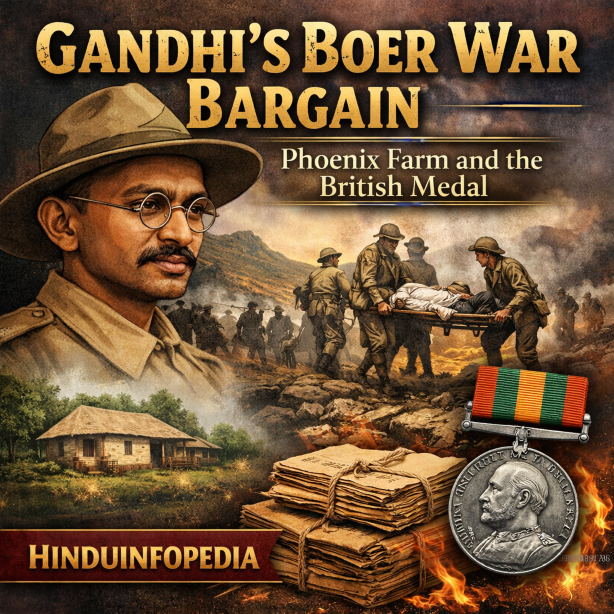
When the Anglo-Boer War broke out in October 1899, Gandhi made a decision that requires careful reading. He organised and led the Indian Ambulance Corps — eleven hundred men, mostly from the Passenger Indian (business) community — to serve under British military command as stretcher-bearers. The physical courage this required was real. Stretcher-bearers operated at the front, unarmed, carrying wounded soldiers under fire. Several corps members were decorated for bravery. Gandhi himself carried stretchers at the Battle of Spion Kop, one of the war’s bloodiest engagements.
What distinguishes Gandhi’s Boer War bargain from straightforward humanitarian service is what he said about it at the time. In his own words, in Indian Opinion and in his correspondence, he framed the corps explicitly as a transaction: Indians were paying a blood price to earn the British recognition of their rights as imperial subjects.
And, here are the quotes from Primary sources
“If we desire to have the rights of British subjects, we must be prepared to discharge the duties of such subjects.”
“Indians have no right to expect that they would be treated as equals unless they are prepared to share the responsibilities and burdens of the Empire.”
“We have always pleaded our loyalty to the British Crown. The present war affords us an opportunity of proving it.”
The blood investment strategy was stated openly — this was not concealed strategy but declared policy. The Collected Works document his position precisely: loyalty demonstrated in war would be rewarded with civic equality in peace. He applied for and received the War Medal 1899–1902 for his Boer War service. The medal exists. The bargain was on record.
The Zulu Rebellion Corps — The Harder Case
In 1906 Gandhi organised a second ambulance corps for the British suppression of the Bambatha Rebellion — a Zulu uprising against a colonial poll tax. This is the more uncomfortable of the two corps.
While the Boer War was a conflict between two European powers, where supporting the ruling authority may appear logical, the Zulu Rebellion was fundamentally different. It involved a colonial government using military force against an African population resisting taxation. It was a struggle for survival against an oppressive power — not even a freedom struggle of the kind his supporters later claim he led in India.
📌 The Probing Question
In this context, some Indian nationalists may ask: Did Gandhi play a similar role for the British in India during his engagements with them from 1916 onwards? They will have to find the answers themselves. Some of those answers may emerge as this series progresses.
Keep reading the series to explore this further…
Gandhi’s corps served the suppressing side.
He later acknowledged that the experience disturbed him — that treating wounded Zulu rebels while serving British forces produced the first serious fracture in his confidence that the blood investment strategy could work.
His critics argue that the acknowledgement and the label as “disturbing” were not genuine.
The questioning did not yet produce a break. The investment was made again.
The ROI Failure: The 1906 Black Act
The British response arrived in the same year as the second ambulance corps. The Asiatic Registration Act of 1906 — the Black Act — required every Indian in the Transvaal, regardless of class, education, or service record, to register with the colonial authorities, submit to fingerprinting, and carry a pass. The Act made no distinction between the Gujarati merchant who had funded the NIC and the Tamil labourer who had never been invited to it. The British had accepted the blood as their right. They were not returning the rights.
Gandhi’s Boer War bargain revealed its terms clearly in 1906: the Empire would take what Indians offered and give nothing back. The elite bridge had always been a one-way street. It took two wars and a fingerprinting order to make that visible.
This is also what explains Satyagraha as mass political tool — not philosophical preference but practical necessity. The petition strategy had been empirically tested and failed. When Gandhi organised the first mass burning of registration certificates in 1907, he was choosing the only remaining instrument after the instrument he had trusted for twelve years had been definitively broken.

The Boer War Bargain — A Compressed View
Between 1899 and 1906, Gandhi tested a political method built on a clear premise: loyalty the Indian National Congress way and loyalty in war would be exchanged for rights in peace. Through the Indian Ambulance Corps in the Boer War and again during the Bambatha Rebellion, he placed Indian bodies in imperial service — not as silent charity, but as declared strategy. His own words framed it explicitly: rights required duties, and duties meant participation in the Empire’s conflicts.
The experiment produced mixed signals. The courage was real. The expectation was stated. The return did not arrive. The Black Act of 1906 erased any distinction between service and status, applying the same control to all Indians regardless of contribution.
Even as Gandhi acknowledged unease after the Zulu campaign, the method was not abandoned. It was repeated. What these years reveal is not ambiguity, but a deliberate political wager — one that the Empire accepted in full, and declined to repay.
Departure 1914: The Balance Sheet
Gandhi left South Africa in July 1914 having negotiated the Indian Relief Act with Jan Smuts. As this series has documented, that Act secured merchant property rights and family law first. The Tamil indentured system remained intact — it would not fall until 1917, through campaigns led by others. The workers whose bodies had finally moved Smuts where twelve years of petitions had not were still legally bound when Gandhi’s ship left Durban harbour.
The twenty-one year South Africa chapter had delivered a partial, class-specific return — the Gandhi class framework producing the same outcome it always had. The merchant community had legal rights, recognised marriages, and a relieved tax burden. The indentured community had the £3 waiver and an intact system of bonded labour. Gokhale had advised him to spend a year observing India in silence before speaking. That advice would not be followed for long. Champaran was ahead.
Series Index
Feature Image: Click here to view the image.
Glossary of Terms
- Boer War (1899–1902): The war between the British Empire and the two Boer republics — the South African Republic (Transvaal) and the Orange Free State — fought over control of southern Africa, particularly following the discovery of gold in the Witwatersrand. Gandhi organised and led the Indian Ambulance Corps in support of the British military effort, for which he was awarded the War Medal. Examined in this blog as the clearest demonstration of the limits of the Pietermaritzburg radicalisation — a man who had resolved to fight racial inequality within the British system then served that system in its colonial war.
- Asiatic Registration Act (1906): The Transvaal legislation — the Black Act — that required all Indians and Chinese in the Transvaal to register, be fingerprinted, and carry registration certificates at all times. Its application regardless of class — affecting both the Passenger Indian merchant and the indentured labourer equally — galvanised the first organised Satyagraha campaign and marked the failure of the NIC’s class-stratified petition strategy.
- NIC (Natal Indian Congress): The political organisation founded by Gandhi in Durban in May 1894 to represent the interests of Indians in the British colony of Natal. Modelled on the Indian National Congress. Financed primarily by Gujarati Muslim and Hindu merchant families. Its founding petition focused on the colonial franchise that the Passenger Indian merchant class held but Tamil indentured labourers did not.
- Indian Relief Act (1914): South African legislation negotiated by Gandhi and Jan Smuts. Recognised Indian marriages under Hindu and Muslim rites, secured property rights, and abolished the £3 annual tax on former indentured labourers. The sequence of its provisions — property and family law first, tax relief second — reflects the priority order of the NIC’s merchant constituency.
- Satyagraha: Sanskrit compound — Satya (truth) and Agraha (insistence/force). Gandhi’s political method of non-violent resistance to unjust laws through mass civil disobedience, non-cooperation, and willing acceptance of legal consequences including imprisonment. First formulated and deployed in South Africa — in the 1906 anti-registration campaign and the 1913 Great March. Later applied at continental scale in India against British colonial rule.
- Patron-Client Framework: The structure of obligation and reciprocity in which a wealthy or powerful patron funds or sponsors an individual in exchange for future service, loyalty, or political representation of patron interests. Applied in this series to examine Gandhi’s relationship with the Gujarati merchant community that funded his legal training and early political career.
- Gandhi Class Framework: The analytical concept applied in this series to describe Gandhi’s consistent pattern of principled advocacy for those already organised within existing power structures, combined with symbolic invocation of the most vulnerable — without giving them structural representation. Established in the NIC period and repeated at continental scale in India after 1915.
- Passenger Indians: The colonial legal classification used in Natal to designate Indians who had arrived voluntarily and paid their own passage — primarily Gujarati Muslim and Hindu merchants. Distinguished in colonial law from Indentured Indians who had arrived under labour contracts. The Passenger Indian community formed the funding base and primary constituency of the Natal Indian Congress.
- Indentured Labour: The system under which Indians — primarily from Bihar, eastern UP, and Tamil Nadu — were contracted to work on British colonial plantations in South Africa, Fiji, Mauritius, the Caribbean, and other territories from 1838 to 1917. Contracts bound labourers for five years under conditions documented as equivalent to slavery. The indentured Indian community in Natal formed a distinct and lower social stratum from the Gujarati merchant class Gandhi primarily represented.
- Jan Smuts (1870–1950): South African statesman who served as Colonial Secretary of the Transvaal and later as Prime Minister of South Africa. Gandhi’s primary negotiating counterpart in the Satyagraha campaigns. They reached the Gandhi-Smuts Agreement of 1914 that produced the Indian Relief Act.
- Gopal Krishna Gokhale (1866–1915): Indian political leader and social reformer. Gandhi’s acknowledged political mentor. Led the moderate wing of the Indian National Congress. Campaigned for abolition of indentured labour — a campaign carried through to conclusion in 1917, two years after his death.
- Great March (1913): The mass protest march led by Gandhi in November 1913 in which approximately four thousand Indian workers — primarily indentured Tamil coal miners from Newcastle — crossed from Natal into the Transvaal in deliberate violation of colonial movement restrictions. The first large-scale deployment of Satyagraha using indentured labour as its mobilising base.
- Reformism: The political approach seeking to improve conditions within an existing power structure rather than dismantle it. Gandhi’s South Africa programme — equal civic rights for Passenger Indians within the British colonial framework — is characterised in this series as reformist rather than anti-colonial. The distinction is not a moral criticism but an analytical description of what the NIC’s programme aimed to achieve.
- Phoenix Farm: The commune founded by Gandhi in 1904 on approximately one hundred acres of land outside Durban, in the Phoenix settlement north of the city. Site of the hand-printing press for Indian Opinion. Residents practised simple living, grew their own food, and lived communally. Funded with the assistance of Gandhi’s Gujarati merchant patron network. The foundational experiment in what Gandhi later developed as the ashram model of disciplined communal service.
- Battle of Spion Kop (23–24 January 1900): One of the Boer War’s bloodiest British defeats — a failed British assault on a hilltop position in the Natal Midlands resulting in over fifteen hundred British casualties in twenty-four hours. Gandhi’s Indian Ambulance Corps served at Spion Kop, carrying wounded under fire. Gandhi personally bore stretchers at the battle. The experience of the corps at Spion Kop was the most intense military engagement of Gandhi’s direct participation in British military operations.
- Bambatha Rebellion (1906): The Zulu uprising against the Natal colonial government’s imposition of a poll tax — the £1 annual head tax introduced in 1905. Led by Chief Bambatha kaMancinza of the Zondi clan. Suppressed by British colonial forces with significant casualties — estimates range from three to four thousand Zulu killed, with approximately thirty Europeans dead. Gandhi organised the second Indian Ambulance Corps to serve the British suppressing force — the more morally uncomfortable of his two corps, as this was not a conflict between European powers but colonial suppression of an African population resisting taxation.
- Indian Opinion: The newspaper founded by Gandhi in 1903 in Natal, published in English, Gujarati, Hindi, and Tamil. Printed at Phoenix Farm from 1904. The principal vehicle through which Gandhi articulated the NIC’s political positions, documented the Satyagraha campaigns, and communicated with both the Indian community in South Africa and audiences in India and Britain. One of the primary primary-source records of Gandhi’s stated political reasoning during the South Africa years.
- Indian Ambulance Corps (1899): The unit of approximately eleven hundred Indian volunteers — drawn primarily from the Passenger Indian merchant community — organised and led by Gandhi during the Anglo-Boer War. Served as stretcher-bearers under British military command. Members carried wounded soldiers under fire at multiple engagements including the Battle of Spion Kop. Gandhi applied for and received the War Medal 1899–1902 for his service. The Corps was the first direct expression of what Gandhi explicitly framed as a blood investment strategy — trading military service for the promise of civic recognition.
- Blood Investment Strategy: Gandhi’s explicitly stated political logic during the South Africa years — that Indians could earn British recognition of their civic rights as imperial subjects by demonstrating loyalty and sacrifice in military service. Articulated openly in Indian Opinion and in Gandhi’s correspondence. Applied through the Indian Ambulance Corps in the Boer War (1899) and the Bambatha Rebellion (1906). Definitively failed when the Asiatic Registration Act of 1906 was applied equally to all Indians regardless of their service record.
- Pass System (Colonial): The colonial administrative requirement that non-white residents of British South African territories carry and produce on demand identity documents confirming their registration, employment, and movement permissions. The Asiatic Registration Act of 1906 — the Black Act — was an extension of pass system logic to the Indian population of the Transvaal. The pass system was the primary instrument of colonial population control in southern Africa and the direct ancestor of apartheid-era pass laws.
- Registration Certificate Burning (1907): The first mass act of Satyagraha — the public burning of Asiatic Registration Act certificates by Indian Transvaal residents at the Hamidia Mosque in Johannesburg on 16 August 1908. Over two thousand certificates were burned. Gandhi had initially negotiated a compromise with General Smuts in which Indians would voluntarily register in exchange for repeal of the Act — but when Smuts declined to honour the agreement, Gandhi called for certificate burning as the escalated response. The act marked the transition from petition politics to direct action as Gandhi’s primary political method.
- Bambatha kaMancinza (c.1865–1906): Zulu chief of the Zondi clan in the Greytown district of Natal. Led the 1906 Zulu uprising against the colonial poll tax — the rebellion that bears his name. Killed in the Battle of Mome Gorge on 10 June 1906 by British colonial forces. His severed head was reportedly displayed by colonial authorities as proof of his death. A figure of anti-colonial resistance whose rebellion Gandhi’s ambulance corps served to suppress — a moral contradiction the blog documents Gandhi himself later acknowledged.
#GandhiBoerWarBargain #PhoenixFarmGandhi #BambathaRebellion #BloodInvestmentStrategy #IndianAmbulanceCorps #GandhiEmpireBargain #MahatmaGandhiSeries #GandhiPeaceEfforts #GandhiSouthAfricaYears #ColonialIndia #PatronClientPolitics #GandhiClassFramework #IndenturedLabour #NatalIndianCongress #GandhiReformism #Satyagraha #HinduinfopediaGandhi #AntiColonialism #GandhiHistory #BoerWar
Related Blogs
Previous Blogs of The Series
- https://hinduinfopedia.in/gandhis-peace-efforts-the-man-before-the-mahatma-1/
https://hinduinfopedia.in/?p=25527 - https://hinduinfopedia.in/gandhis-south-africa-years-inner-temple-to-nic-who-paid-the-fare2/
https://hinduinfopedia.in/?p=25633 - https://hinduinfopedia.in/gandhis-train-to-nowhere-the-pietermaritzburg-moment-and-its-limits-3/
https://hinduinfopedia.in/?p=25645
Previous Blogs on Mahatma Gandhi
- https://hinduinfopedia.in/martyrs-of-indian-independence-and-gandhis-influence/
- https://hinduinfopedia.in/rowlatt-act-and-gandhi/
- https://hinduinfopedia.in/gandhis-post-independence-actions-and-legacy/
- https://hinduinfopedia.in/gandhis-personal-ideologies-and-methodologies/
- https://hinduinfopedia.in/communal-relations-in-indian-history-gandhis-legacy/
- https://hinduinfopedia.in/ideological-divides-and-gandhis-leadership/
- https://hinduinfopedia.in/gandhis-post-independence-actions-and-legacy/
- https://hinduinfopedia.in/gandhi-revisited-a-critical-legacy/
- https://hinduinfopedia.in/indira-gandhis-actions-the-competition-terminator/
- https://hinduinfopedia.in/nonviolent-policy-and-making-of-gandhi-in-south-africa/
- https://hinduinfopedia.org/ambedkars-buddhist-political-move-divergence-from-gandhi-on-caste-issues/
- https://hinduinfopedia.org/mahatma-gandhi-and-nonviolence/
- https://hinduinfopedia.org/mahatma-gandhi-and-his-principles-analyzed/
- https://hinduinfopedia.org/subhash-chandra-bose-contrasting-strategies-with-gandhi/
- https://hinduinfopedia.in/on-this-day-5-march-2024-tuesday/
- https://hinduinfopedia.in/akshardham-temple-terror-attack-2002/
- https://hinduinfopedia.in/nathuram-godse-murderer-patriot-or-fractured-youth/
- https://hinduinfopedia.in/remembering-indian-freedom-struggle-of-february-5/
- https://hinduinfopedia.org/indias-freedom-struggle-and-quit-india-movement-ii/
- https://hinduinfopedia.org/indian-freedom-fighters-legacy-of-gopal-krishna-gokhale/
Follow us:
- English YouTube: https://www.youtube.com/@Hinduofficialstation
- Hindi YouTube: https://www.youtube.com/@HinduinfopediaIn
- X: https://x.com/HinduInfopedia
- Instagram: https://www.instagram.com/hinduinfopedia/
- Facebook: https://www.facebook.com/Hinduinfopediaofficial
- Threads: https://www.threads.com/@hinduinfopedia
Liked this post? Share it on:







Liked this post? Share it on: