
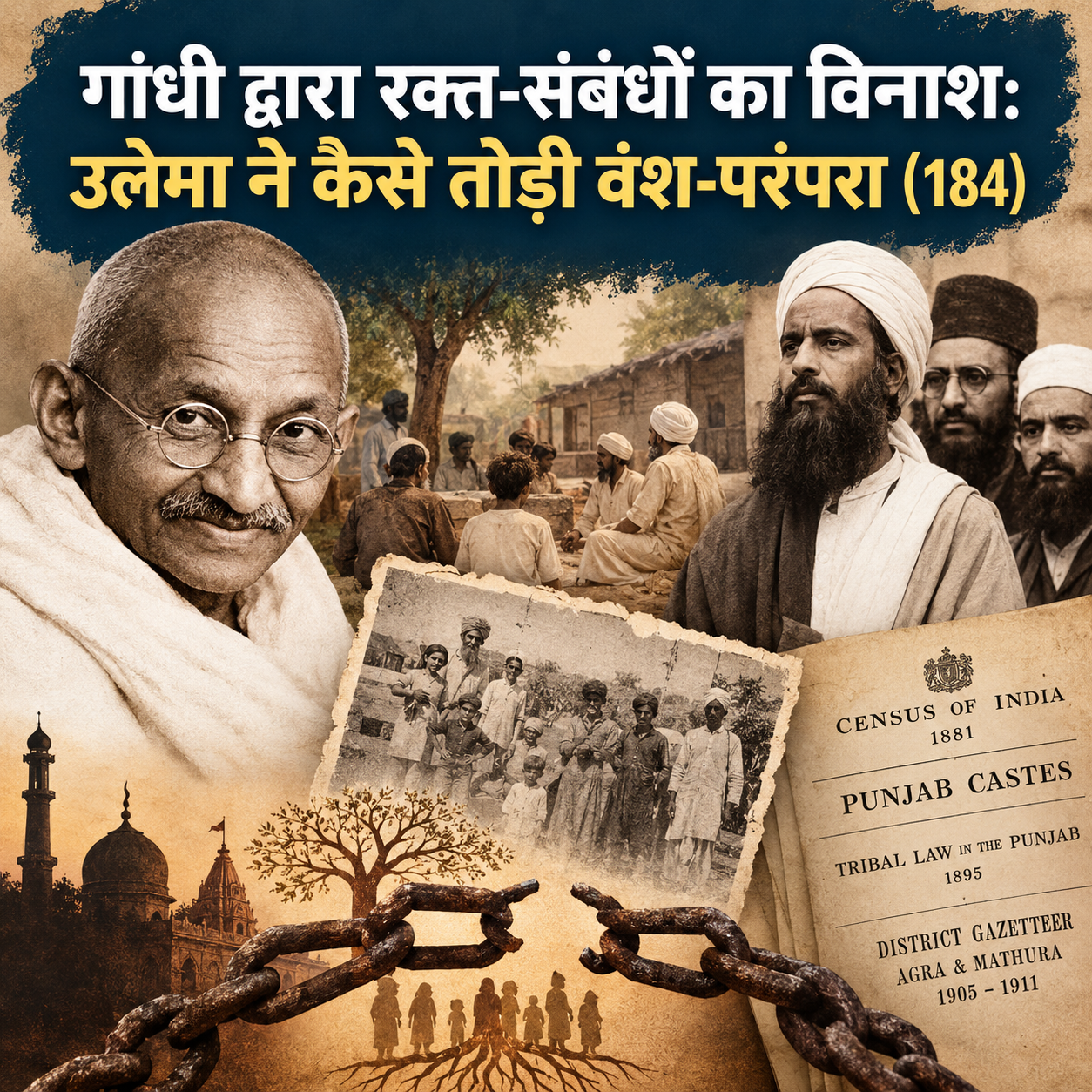
Gandhi’s Kinship Destruction: How the Ulema Severed the Bloodline (184)
भारत / GB
Part 184: Mahatma Gandhi’s Peace Efforts | Series Index
The previous blog placed before the reader the neighbourhood — the civic rituals shared across generations, the commercial trust institutionalised into guild structures, the syncretic households undisturbed for centuries, and what the Mutafiqa Fatwa’s doctrinal reclassification produced when it reached the street, the bazaar, and the village well. Before the reader can assess the destruction of that neighbourhood, the record is placed before them: what existed before 1919, what doctrine existed before 1919, what organisational capacity was created between 1919 and 1922, and what subsequently occurred in 1923–1927. This blog, Gandhi’s Kinship Destruction, analyses how the kinship existed before Gandhi jumped in to support the Khilafat Movement and tries to paint the picture of what Gandhi’s Kinship Destruction started in 1919. The reader is left to assess the relationship between these elements.
Thank you for reading this post, don't forget to subscribe!THE HISTORICAL RECORD — GANDHI’S KINSHIP DESTRUCTION
The Pattern: The standard argument about Gandhi’s Khilafat alliance holds that he attempted to bridge two ancient, historically hostile religious communities. The primary administrative and judicial record documents a different baseline: the Indian Muslim in the village was a converted cultivator, artisan, and kinsman who had retained his ancestral gotra, his customary inheritance law, his ancestral festivals, and his social brotherhood with his Hindu neighbour for centuries after conversion. Clerical doctrine had condemned this indigenous synthesis as apostasy for two hundred years. The primary record is placed before the reader; the reader will assess the relationship between that baseline, that doctrine, and what followed.
The Lethal Exhibit: Young India, 29 May 1924 (CWMG Vol. 24): “The movement has given an awakening to the masses… but it has also given a prestige to the Maulvis which they did not have before.” This is Gandhi’s own observation on what the joint movement produced for the clerical class. Gandhi’s Kinship Destruction places before the reader that observation alongside the subsequent record of what occurred among the Malkana Rajputs of Agra and the Meos of Mewat from 1922 onward.
Why it matters: The administrative record of Punjab customary law, the gazetteers of the United Provinces, and the Census of 1881 document what existed before 1919. The reader will assess whether those who were documented as blood kinsmen were two ancient enemies.
The Baseline: Pre-1920
Gandhi’s Kinship Destruction begins with what the record shows existed before 1919. The primary administrative and judicial record is placed before the reader as it stands.
Sir Denzil Ibbetson’s Punjab Castes — drawn from the 1881 Census — states that conversion to Islam in eastern Punjab left social customs, tribal restrictions, marriage and inheritance rules essentially unaltered; the Muslim Rajput, Gujar, or Jat remained functionally identical to his Hindu counterpart for most social and administrative purposes. Rural Muslim converts continued to observe ancestral marriage exogamy rules identical to their Hindu biradari brothers and maintain clan genealogies through hereditary mirasi keepers. The converted Jat and the Hindu Jat shared the same gotra. They could not marry within it.
Sir Charles Roe and H.A.B. Rattigan’s Tribal Law in the Punjab (1895) — the judicial codification of Punjab customary law — records that among Muslim agricultural tribes (Jats, Rajputs, Gujars) the customary code (Riwaj-i-Am) governed ancestral land alienation, agnatic succession, and the exclusion of women in preference to strict Shariat application in the cases examined. The Muslim Jat in a Punjab land dispute was governed by the same ancestral customary code as his Hindu cousin.
The District Gazetteers of Agra and Mathura, compiled by H.R. Nevill between 1905 and 1911, document the Malkana Rajputs retaining Hindu names, the greeting Ram Ram, dual festival observance including Diwali, gotra rules for marriage, and temple visits alongside circumcision and burial. Major P. Powlett’s Gazetteer of Alwar (1878) records the Meos of Mewat celebrating Hindu festivals, claiming Rajput/Pandava descent, and observing clan exogamy (pal) while being nominally Muslim.
These records document the existence of persistent customary kinship structures among certain convert communities. They do not claim this was universal across all Indian Muslims. Gandhi’s Kinship Destruction places this baseline before the reader because what subsequently occurred was directed at precisely these groups.
Clerical Doctrine: Pre-1919
The primary doctrinal record is placed before the reader alongside the baseline.
Shah Waliullah Dehlawi’s Hujjat Allah al-Baligha (c. 1750s) urges Indian Muslims to avoid the customs of Hindus and Ajam and advocates return to Arabised Islamic norms. The nineteenth-century reform movements — the Faraizi movement in Bengal and the Taiyuni movement under Maulana Karamat Ali Jaunpuri — targeted Bengali peasant converts to sever their participation in Durga Puja and village fairs. The Fatawa-e-Rashidiya of Maulana Rashid Ahmad Gangohi — co-founder of Darul Uloom Deoband — contains rulings against participation in Hindu festivals and declares mixed ritual practices spiritually corrupting under Hanafi orthodoxy.
Two centuries of fatwas. The Meo still celebrated Janmashtami. The Malkana Rajput still said Ram Ram. The Punjab Muslim Jat still governed his land by Riwaj-i-Am.
The theological preference for purging syncretism pre-dates 1919. The primary records show it and they show its limits. Gandhi’s Kinship Destruction places that limit alongside what follows — and the reader will note the difference.
Organisational Capacity Created: 1919–1922
M.A. Jinnah, at the 1918 Muslim League session in Delhi, warned against treating the Khilafat as an Indian issue — secondary accounts record his position: the methods would produce communal disaster. His warning was recorded and the alliance proceeded.
Gandhi placed the All-India Khilafat Committee and the Jamiat Ulema-e-Hind at the helm of the national movement, providing the Congress organisational network, the national moral authority, and — through the Khilafat Volunteer Corps — a uniformed, cadre-based field infrastructure whose activity colonial intelligence files track.
The Mutafiqa Fatwa of the Jamiat Ulema-e-Hind (Delhi, November 1920 onward) declared government service, courts, and aided education haram and framed Tark-e-Mawalat — the absolute severance of cooperative ties with non-Muslim authority — as a religious obligation. Printed versions circulated in 1921 with signatures of leading ulema.
In his autobiography (Part V, Ch. XXXVI; CWMG Vol. 39, p. 358), Gandhi recorded his position on the theology he was institutionalising: “I was not to examine the theological correctness of their position. I felt that if I could be satisfied that they were in earnest, and that their demands were just from their own point of view, and did not involve any moral turpitude, I was bound to help them.” This is Gandhi’s verbatim statement on the theological framework he placed at the helm of the national movement.
Swami Shraddhanand attended the Khilafat Conference at Nagpur with Gandhi. He recorded in The Liberator (July 1926) that the Maulanas recited Quranic verses containing “frequent references to Jihad and killing of the Kaffirs.” When Shraddhanand raised this, Gandhi said: “They are alluding to the British Bureaucracy.” Shraddhanand replied that the Maulanas “would not refrain from using these verses against the Hindus” once feeling reversed. This exchange is placed before the reader as Shraddhanand’s own account, as quoted by Dr. B.R. Ambedkar in Pakistan or the Partition of India (1945) — second-hand, attributed as such.
Muhammad Ali Jouhar first stated his theological position publicly at Aligarh and Lucknow in March 1924, confirmed it verbatim at Bareilly under challenge, and Gandhi addressed and defended it in Young India of 10 April 1924 (CWMG Vol. 23, pp. 410–414): “the creed of even a fallen and degraded Mussulman is entitled to a higher place than that of any other non-Muslim… irrespective of his high character, even though the person in question be Mahatma Gandhi himself.” Gandhi’s defence was that Muhammad Ali was articulating standard orthodox Islamic theological dogma. This is the documented exchange, placed before the reader in its published form.
Gandhi’s observation on the outcome: Young India, 29 May 1924 (CWMG Vol. 24) — “The movement has given an awakening to the masses… but it has also given a prestige to the Maulvis which they did not have before.”
Subsequent Activity: 1923–1927
The Non-Cooperation Movement was withdrawn in February 1922 after the protesters reaction to police excesses at the Chauri Chaura police station. The Government of India’s Home Department intelligence file (NAI, File No. 6/IX/1924) tracks the redirection of volunteer energy into Tabligh and Tanzim against the Arya Samaj’s Shuddhi after the suspension of Non-Cooperation, targeting the syncretic rural groups of western UP and eastern Rajasthan.
The Achhnera and Agra conferences of 1923 — documented in The Leader (Allahabad), March–April 1923, and the UP Government Police Abstracts of Intelligence — brought the Jamiat Ulema-e-Hind, the Anjuman Hamaayat-i-Islam, and Khilafat-associated figures to Agra to counter the Arya Samaj’s Shuddhi movement among the Malkanas. Campaign literature issued warnings to Malkana families: to remain Muslim, they must sever all mixed matrimonial negotiations with Hindu Rajputs, abandon Hindu ancestral names, discard traditional gotra customs, and submit exclusively to Shariat. The greeting Ram Ram, the Diwali lamp, the shared marriage negotiation with the Hindu cousin — each named apostasy.
Muhammad Ali’s Cocanada Congress presidential address (December 1923), delivered from the Congress podium, contains proposals concerning the Depressed Classes and conversion competition — suggesting the syncretic Indian population be partitioned between Hindu and Muslim conversion societies.
Contemporary Witness Statements
Shraddhanand’s account in The Liberator and Inside Congress records his warnings to Gandhi regarding the ulema’s active hostility toward syncretic converts and Gandhi’s responses. He was murdered in December 1926 for defending the indigenous convert’s right to his ancestral identity.
Dr. B.R. Ambedkar’s account in Pakistan or the Partition of India (1945, Ch. VII) argues that the Khilafat movement handed leadership to the ulema, transforming Indian Muslims into an extraterritorial ideological bloc and ending the possibility of common citizenship. The Meo of Mewat, who had traced his lineage to Rama and celebrated Janmashtami in 1918, was by 1947 a communal category. This is Ambedkar’s analysis, placed before the reader as such.
The Record Before the Reader
Gandhi’s Kinship Destruction is the name this series gives to the sequence. The primary and near-primary documents establish it: the customary baseline documented by Ibbetson, Roe and Rattigan, Nevill, and Powlett; the pre-existing clerical hostility to syncretism in the Dehlawi, Jaunpuri, and Gangohi traditions; the creation of organisational capacity under the joint Khilafat–Non-Cooperation movement; Gandhi’s verbatim refusal to examine the theological correctness of the position he was institutionalising (CWMG Vol. 39, p. 358); his observation of the clerical prestige the movement produced (CWMG Vol. 24); and the subsequent competitive campaigns against syncretic groups documented in The Leader, the UP Police Abstracts, and NAI File 6/IX/1924.
No document in this record contains an explicit instruction equating the 1920–21 apparatus with a programme to sever ancestral kinship among the Malkanas or Meos. The primary records show the baseline, the doctrine, the organisational capacity created, Gandhi’s recorded positions, and the subsequent campaigns. Gandhi’s Kinship Destruction places these elements before the reader in sequence. The reader is left to assess the relationship between them.
Invitation To Defence
The floor belongs to the defence. We now invite them to present their exhibits and challenge the record.
The Meo celebrated Janmashtami. The Malkana Rajput said Ram Ram. The Punjab Muslim Jat governed his land by the same customary code as his Hindu cousin. The clerical tradition had condemned this indigenous synthesis for two centuries. Between 1919 and 1922 a joint political movement created organisational capacity that colonial intelligence files track. Gandhi recorded that he was not to examine the theological correctness of the position he was bound to help. He recorded that the movement gave the Maulvis a prestige they did not have before. In 1923, the Agra conferences arrived and the Malkana Rajput was told that his ancestral greeting, his Diwali lamp, and his marriage negotiation with his Hindu cousin were apostasy. Gandhi’s Kinship Destruction places this sequence before the reader.
Feature Image: Click here to view the image.
Videos
Glossary of Terms
1. Gandhi’s Kinship Destruction: A term coined by this blog series to describe the historical sequence in which traditional kinship structures among certain Hindu and Muslim communities were weakened through religious reclassification, political mobilisation, and subsequent campaigns against indigenous customs.
2. Syncretic Communities: Communities in which people belonging to different religious traditions shared ancestral customs, festivals, marriage restrictions, social relationships, and cultural practices.
3. Mutafiqa Fatwa: A religious decree issued by the Jamiat Ulema-e-Hind from November 1920 onward, declaring government service, courts, and aided education impermissible and advocating the severance of cooperative relationships with non-Muslim authority.
4. Tark-e-Mawalat: A doctrine advocating the complete severance of cooperative relationships with non-Muslim authority, presented in the Mutafiqa Fatwa as a religious obligation.
5. Riwaj-i-Am: The customary law or traditional code governing matters such as ancestral land, inheritance, succession, and family relationships among communities in Punjab.
6. Gotra: An ancestral clan lineage traditionally used to regulate marriage. Members belonging to the same gotra are generally prohibited from marrying within that lineage.
7. Biradari: A traditional kinship or community network based on shared ancestry, clan identity, or social relationships, often extending across religious affiliations.
8. Malkana Rajputs: A community of Rajput-origin converts in the Agra and Mathura regions who retained several ancestral Hindu customs, including Hindu names, Ram Ram greetings, Diwali celebrations, and traditional gotra-based marriage restrictions.
9. Meos of Mewat: A rural community of Mewat with Rajput and Pandava ancestry traditions that retained Hindu festivals, Janmashtami celebrations, and clan-based marriage customs despite nominal Muslim religious affiliation.
10. Ulema: Islamic religious scholars and authorities who interpret religious doctrines, issue religious rulings, and provide theological guidance to their communities.
11. Shuddhi Movement: A religious reconversion movement associated with the Arya Samaj that sought to bring individuals and communities of Hindu ancestry who had converted to other religions back into Hindu society.
12. Tabligh and Tanzim: Two forms of religious mobilisation. Tabligh refers to religious propagation, while Tanzim refers to religious organisation and community consolidation. The blog discusses their activities in opposition to the Arya Samaj’s Shuddhi movement.
13. CWMG (Collected Works of Mahatma Gandhi): The published collection of Mahatma Gandhi’s writings, speeches, correspondence, and other documentary material, cited in the blog as a primary reference for his recorded statements.
14. Extraterritorial Ideological Bloc: A term used in Dr. B.R. Ambedkar’s analysis to describe a community whose political and ideological loyalties are understood as extending beyond the territorial boundaries of its own country.
15. Customary Kinship Structures: Traditional systems of family, clan, inheritance, marriage restrictions, ancestral identity, and social relationships that continue to operate within communities independently of formal religious affiliation.
#Gandhi #Khilafat #IndianHistory #MahatmaGandhi #IslamicHistory #HinduMuslimRelations #Partition #IndianNationalism #History #AryaSamaj #Ambedkar #HinduinfoPedia
Scan Through The Entire Series at
Refer to Various Arks Referred to in the Blog
Gandhi’s Kinship Destruction: How the Ulema Severed the Bloodline (184)