
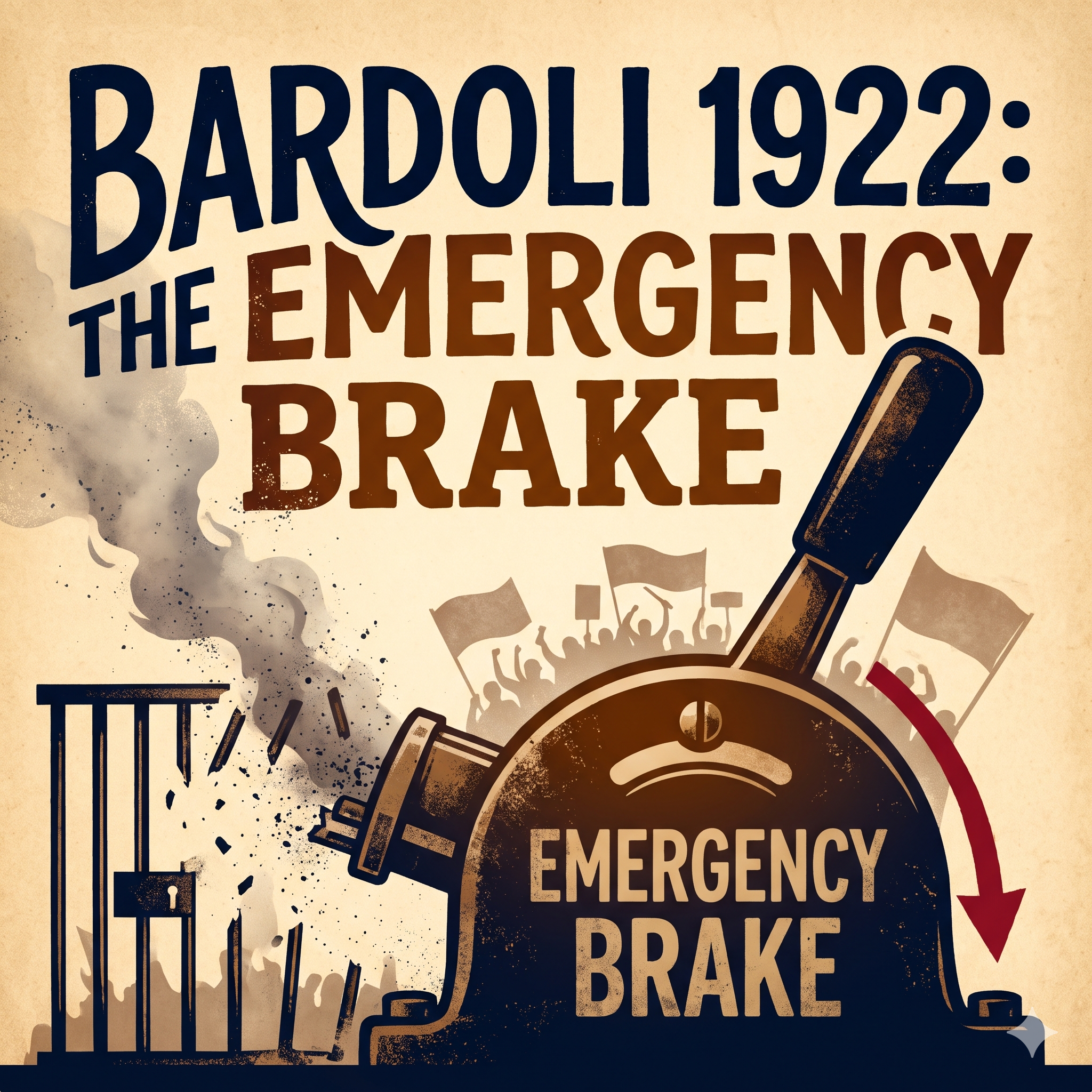
Gandhi’s Bardoli Emergency Brake: Motivated Unilateral Termination or ‘Spiritual Compulsion’? (202)
भारत / GB
Part 202: Mahatma Gandhi’s Peace Efforts | Series Index
Blog 201 placed the arithmetic of Ahimsa before the reader: over 2,500 Malabar Hindu non-combatants killed — the movement continued without pause. Twenty-two colonial police constables killed at Chauri Chaura on 4 February 1922 — the movement was suspended nationally within nine days. This blog, Gandhi’s Bardoli Emergency Brake, documents the instrument by which that suspension was executed: the Bardoli Resolution of 11–12 February 1922. How it was passed. By whose authority. On what stated grounds. What it did and did not do. And what the constitutional record shows about a leader who held no institutional check on his own power to halt a movement thirty thousand people were in jail for.
THE BARDOLI RESOLUTION — WHAT THE RECORD SHOWS
On 11–12 February 1922, the Congress Working Committee met at Bardoli, Surat District, Gujarat, and passed a resolution suspending all civil disobedience across India. The resolution was initiated by Gandhi. It was passed without prior consultation with the thirty thousand Indians then in British jails on account of the movement. No concession was obtained from the British administration in exchange. No date for resumption was set. The stated ground was that India was spiritually unready for Swaraj because a crowd in Gorakhpur had burned a police station. Gandhi’s Bardoli emergency brake is the name the prosecution gives to this instrument.
The Setting: Bardoli, February 1922
By February 1922 the Non-Cooperation Movement had been running for fourteen months. It had mobilised lawyers out of the courts, students out of government schools, merchants out of foreign cloth, and hundreds of thousands of ordinary Indians into the streets, the prisons, and the Congress volunteer ranks. The Tilak Swaraj Fund had raised over ₹1.2 crore. Approximately thirty thousand Indians were in British custody as political prisoners. The movement’s declared objective — Swaraj within one year — had not been delivered by the Nagpur deadline of December 1921, but Gandhi had not publicly withdrawn the pledge. The Bardoli satyagraha campaign was being prepared as the next phase of intensified non-cooperation, to be launched from Gandhi’s own base in Surat District.
It was in this operational context — a movement at or near its peak mass commitment — that the events at Chauri Chaura on 4 February 1922 placed Gandhi before a decision. The decision he made, and the instrument by which he executed it, are the subject of this blog.
The Resolution: What Was Passed
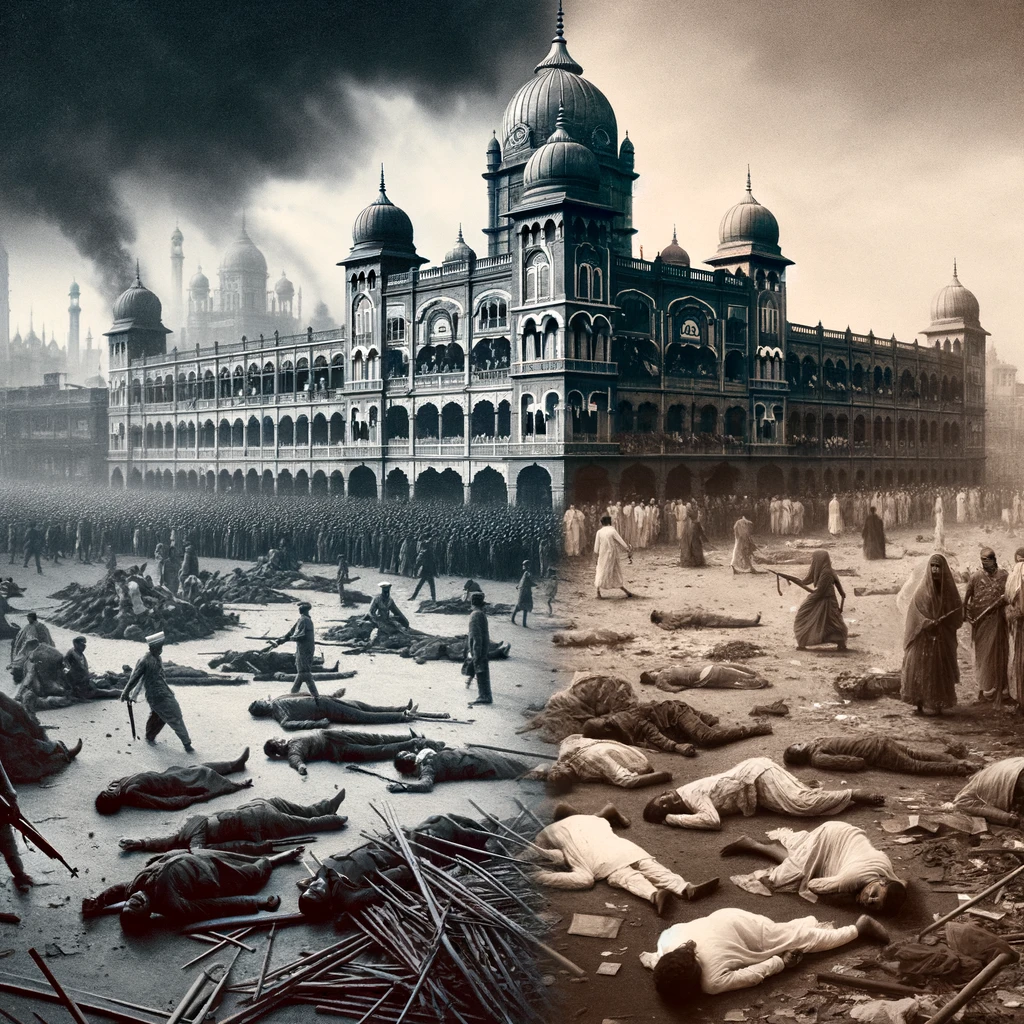
The resolution passed at Bardoli on 11–12 February 1922 — known formally in Congress records as the Bardoli Resolution — brought the Non-Cooperation Movement to an abrupt national halt. In its operative clauses, the Working Committee resolved that all mass and individual civil disobedience, all non-payment of taxes, all picketing, and all unauthorized processions across India be suspended with immediate effect. The planned Bardoli satyagraha campaign — the intensive no-tax offensive intended as the movement’s apex — was cancelled outright.
In place of direct political agitation, Congress volunteers were ordered to redirect their resources exclusively toward a ‘constructive programme’: spinning khadi, organizing national schools, and promoting temperance. In an extraordinary reassurance to propertied interests, the resolution specifically directed peasants to pay their land revenue to the British government and advised tenants that withholding rent from zamindars was contrary to Congress policy. The British administration conceded nothing in exchange: no political prisoners were released, no negotiations were opened, and no date for resumption was scheduled. The directive reached provincial committees not as a draft for consultation, but as a completed executive decree.
By Whom, Under Whose Authority, and the Absence of Quorum
The resolution was initiated by Gandhi and approved by a mere fraction of the Congress Working Committee. Under the 1920 Nagpur Constitution, the CWC was designed as a fifteen-member national executive. But by February 1922, a functioning deliberative quorum was physically impossible: the British government had already arrested the movement’s senior leadership under the Criminal Law Amendment Act.
C.R. Das (the elected President) was in Calcutta’s Presidency Jail; Motilal Nehru and Jawaharlal Nehru were in Lucknow; Lala Lajpat Rai was in Lahore; and Maulana Azad and C. Rajagopalachari were behind bars. The assembly at Bardoli was a rural rump caucus of barely four or five men — including Gandhi, Vithalbhai Patel, N.C. Kelkar, and Treasurer Jamnalal Bajaj, the industrialist presiding over the murky, unvouched ledgers of the Tilak Swaraj Fund whose propertied class interests urgently aligned with extinguishing peasant rent and tax strikes.
Gandhi’s authority to enforce this liquidation rested on Resolution No. 2 of the December 1921 Ahmedabad Congress, which had designated him the ‘sole executive authority’ of the Congress in anticipation of mass arrests. At Bardoli, that emergency authority was turned inward to dismantle the campaign itself. The thirty thousand Indians then in jail learned from prison cells that their struggle had been ended without their knowledge. Gandhi’s Bardoli emergency brake was pulled by executive fiat in a room emptied of its counterweights by colonial arrests, surrendering national leverage without a single concession in return.
The Stated Ground: ‘Spiritual Unreadiness’
Gandhi’s public justification for the Bardoli Resolution was set out in Young India on 16 February 1922, in an article titled “The Crime of Chauri Chaura.” The argument rested on a doctrine Gandhi had used before: that mass civil disobedience required absolute non-violent discipline, and that a single failure of that discipline — anywhere, by anyone participating in the movement — proved that the entire nation was spiritually unready for Swaraj.
The logic, as stated, was absolute. It held that the actions of a crowd in Gorakhpur District on 4 February 1922 were the actions of the Non-Cooperation Movement in its totality, and that this totality had demonstrated its incapacity for the moral standard Swaraj required. In Young India, Gandhi described Chauri Chaura as a “bitter humiliation” and “a warning from God.” He invoked the framework first deployed during the 1919 anti-Rowlatt agitation, when he had termed his misjudgement of crowd readiness a “Himalayan miscalculation.” The self-critical framing masked an identical operational move: unilateral suspension, personal veto, and zero institutional check.
The ‘spiritual unreadiness’ justification carried a specific institutional asymmetry that the documented record exposes. Six months earlier, the Moplah uprising of August 1921 had produced over 2,500 Hindu deaths, thousands of forced conversions, and mass displacement — all within the same Non-Cooperation calendar. The clerical leadership that directed that violence had explicitly overridden Gandhi’s Ahimsa doctrine in documented sermons before the detonation. The doctrine of ‘spiritual unreadiness’ had been fully available to Gandhi in August 1921. It was not invoked. The reader will note the dates.
The Constitutional Position: No Institutional Check
The Bardoli Resolution exposes a constitutional vacuum within the Congress that the documented record answers directly. The Working Committee held executive authority between annual sessions, and Gandhi’s conviction commanded the Working Committee. The annual Congress session — the only body capable of reviewing executive resolutions — had last met in December 1921 and would not meet again until December 1922. In the ten-month interval, no institutional mechanism existed for the thirty thousand prisoners or the mass membership to challenge a Working Committee decree.
The constitutional concentration was deliberate. At Nagpur in December 1920, Gandhi had restructured the Congress into a centralised mass organisation with a four-anna membership, an AICC, and a powerful Working Committee. That restructuring had concentrated operational authority at the centre while eliminating the independent provincial bases of the old guard who might have served as counterweights. Gandhi’s Bardoli emergency brake operated in a constitutional clearing of his own design: he built the centralized machine, secured sole executive authority at Ahmedabad, and then used it to halt the national movement at will.
The Nationalist Leadership’s Response
The backlash within the nationalist leadership was immediate and severe, but entirely without institutional effect. The leaders who opposed the suspension were in British jails and learned of the surrender from behind prison walls.
Subhas Chandra Bose characterized Gandhi’s retreat as a “national calamity,” the documented fallout. Jawaharlal Nehru recorded “amazement and consternation” at dismantling a nationwide movement over an isolated village riot. C.R. Das, from his cell in Presidency Jail, condemned the resolution as the “greatest blunder of his political life.” Motilal Nehru and Lala Lajpat Rai sent scathing, exhaustive protests from their own cells.
None of these protests altered the outcome. The British administration, observing the collapse of momentum, made no concessions: no prisoners were released, no negotiations were opened, and the mass leverage of the movement was voluntarily dissolved. Gandhi’s Bardoli emergency brake, once applied, was never released. The planned satyagraha was not rescheduled, no new timeline for Swaraj was given, and the campaign ended precisely where the resolution left it.
The Formal Consequences
The Bardoli Resolution produced four immediate institutional consequences that the record shows:
First, the mass mobilization of the Non-Cooperation Movement was permanently dismantled. Provincial Congress committees stood down their preparations, and the volunteer apparatus was demobilized.
Second, the British administration moved to arrest Gandhi once it was certain the threat of mass explosion had vanished. The arrest order, long held back for fear of a nationwide uprising, was executed smoothly on 10 March 1922.
Third, Gandhi was tried before Judge C.N. Broomfield at Ahmedabad on 18 March 1922 under Section 124A IPC and sentenced to six years’ simple imprisonment. The proceedings became an exchange of mutual courtesy — Broomfield expressed personal regret from the bench, a consideration extended to no ordinary prisoner. Gandhi served two years in Yerwada Jail reading, spinning, and recovering before release on medical grounds, while the thirty thousand volunteers who had filled colonial prisons on his promise enjoyed no such accommodation.
Fourth, the 172 Chauri Chaura accused — the peasant volunteers whose actions Gandhi cited to justify the national retreat — were left to face the colonial gallows. As documented at Blog 175, the Congress high command organized no legal defence for them; that burden fell entirely to Pandit Madan Mohan Malaviya. Gandhi’s Bardoli emergency brake was pulled in their name, while their physical defense was abandoned.
What the Resolution Left Intact
The Bardoli Resolution suspended civil disobedience, but it left the communal apparatus of 1920–21 completely untouched. The Khilafat Volunteer Corps was not disbanded. The All-India Khilafat Committee remained fully active. The Jamiat Ulema-e-Hind continued to consolidate its theological machinery. The clerical networks whose documented sermons had incited the Malabar violence were never disciplined or held to account by the Working Committee.
The documented asymmetry remains absolute: a clash by peasant volunteers in Gorakhpur was cited to shut down an entire national freedom movement, while an apparatus responsible for over 2,500 deaths in Malabar received no censure from the same executive. Gandhi’s Bardoli emergency brake was rigorously selective in what it halted and what it allowed to continue running.
The Modern Parallel
The constitutional anatomy of the Bardoli decision anticipated a dynamic that would reappear fifty-four years later in the republic Gandhi helped found. During the 1976 Emergency, Indira Gandhi’s administration passed the 42nd Constitutional Amendment — fundamentally restructuring parliamentary powers and altering the preamble — through a Parliament whose principal opposition leaders were imprisoned in Tihar, Rohtak, and Bangalore.
The institutional pathology was identical: the physical confinement of deliberative counterweights allowed an executive core to push through a foundational course reversal that could never have survived open debate. When C.R. Das, Motilal Nehru, Lala Lajpat Rai, and Abul Kalam Azad received word of the movement’s liquidation behind bars, they occupied the exact position that Morarji Desai, Atal Bihari Vajpayee, L.K. Advani, and Madhu Dandavate would occupy decades later — members of an institutional decision-making body presented with the surrender of their mandate by an executive operating in an empty room.
Invitation To Defence
The Bardoli Resolution is in the record. The Working Committee proceedings are in the record. The stated grounds — collective spiritual unreadiness — are in the record. The thirty thousand prisoners who were not consulted are in the record. The British concessions obtained in exchange are in the record: there were none. If the application of the ‘spiritual unreadiness’ doctrine was consistent — if it was a moral absolute and not a selective instrument — the defence is invited to identify where it was applied with equal force in August 1921, when the apparatus Gandhi had built detonated across Malabar. The resolution is there to read. The August 1921 record is there to read beside it.
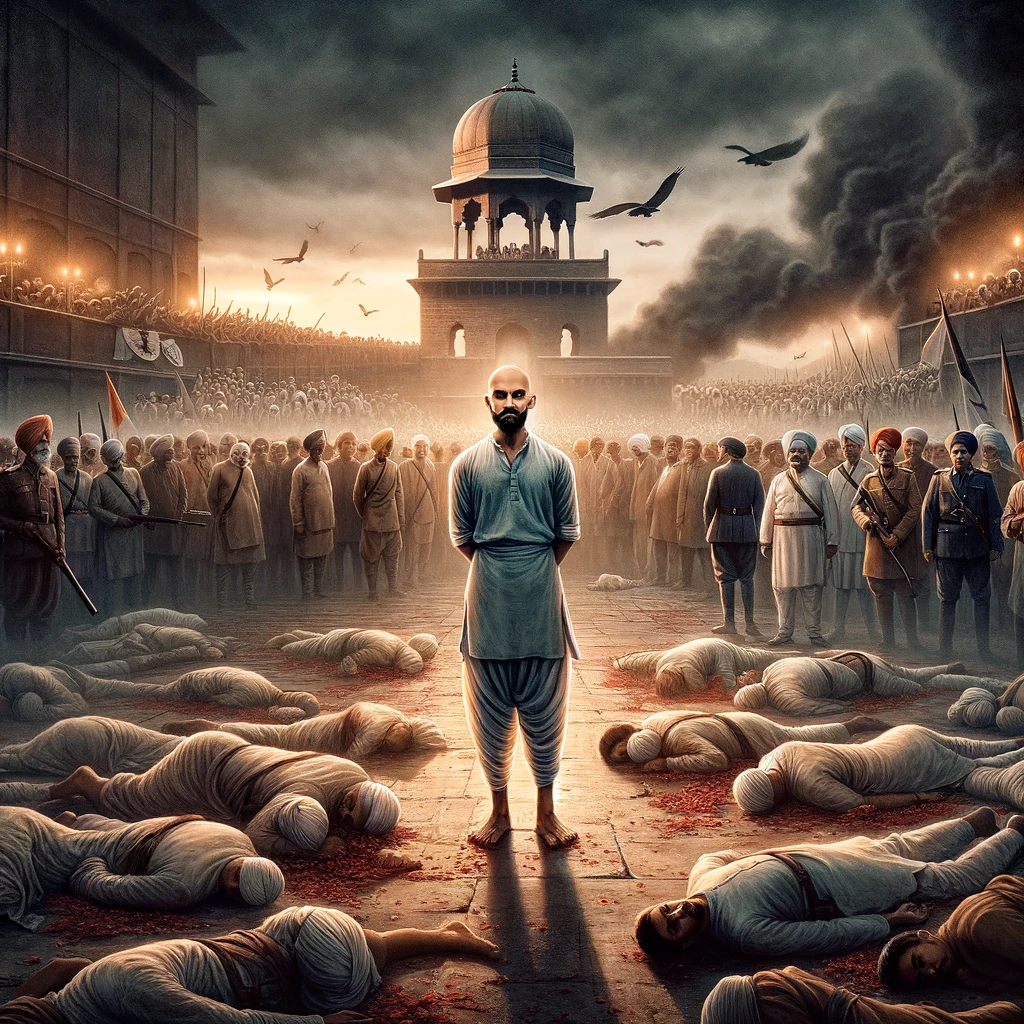
Thirty thousand Indians were in British jails when the Bardoli Resolution was passed. They were not consulted. The movement that had recruited them, mobilised them, and taken them to prison was suspended by a Working Committee resolution initiated by one man, without their knowledge, without a British concession, without a date for resumption. The stated ground was that a crowd in Gorakhpur had burned a police station. The apparatus that had killed over 2,500 Malabar Hindus six months earlier continued without equivalent intervention. The resolution is in the record. The reader will place it beside the August 1921 record and complete the arithmetic.
Feature Image: Click here to view the image.
Videos
Glossary of Terms
1. Gandhi’s Bardoli Emergency Brake: A distinctive term coined in this blog to describe Gandhi’s unilateral decision to suspend the Non-Cooperation Movement through the Bardoli Resolution, using his executive authority without an effective institutional check.
2. Bardoli Resolution: The resolution passed by the Congress Working Committee on 11–12 February 1922 at Bardoli, Gujarat, which suspended civil disobedience throughout India and cancelled the planned Bardoli Satyagraha.
3. Non-Cooperation Movement: A nationwide political movement led by Mahatma Gandhi that encouraged Indians to withdraw from British institutions, including courts, government schools and foreign cloth trade, as part of the struggle for Swaraj.
4. Spiritual Unreadiness: Gandhi’s stated justification for suspending the movement, based on his argument that the Chauri Chaura violence demonstrated that the nation was not sufficiently prepared for the discipline required to attain Swaraj.
5. Congress Working Committee (CWC): The central executive body of the Indian National Congress, responsible for exercising organisational authority between annual Congress sessions.
6. Sole Executive Authority: The special authority granted to Gandhi through Resolution No. 2 of the December 1921 Ahmedabad Congress, empowering him to exercise executive control over the Congress in anticipation of mass arrests.
7. Quorum: The minimum number of members required for a committee or deliberative body to conduct a valid meeting and make decisions. Its absence or practical impossibility is central to the blog’s examination of the Bardoli meeting.
8. Constitutional Vacuum: A situation in which no effective institutional mechanism exists to review, challenge or reverse an executive decision. The blog uses this expression to describe the concentration of authority within the Congress under Gandhi’s leadership.
9. Executive Fiat: An authoritative decision imposed by an executive leader without meaningful consultation or deliberative approval from those affected by it.
10. Tilak Swaraj Fund: A fund established to finance the Non-Cooperation Movement, which had collected more than ₹1.2 crore by February 1922.
11. Constructive Programme: The Congress programme that redirected volunteers away from direct political agitation towards activities such as spinning khadi, organising national schools and promoting temperance.
12. Khilafat Volunteer Corps: A volunteer organisation associated with the Khilafat Movement. The blog highlights that it was not disbanded when the Bardoli Resolution suspended civil disobedience.
13. Criminal Law Amendment Act: The colonial legislation invoked in the blog in connection with the arrests of senior nationalist leaders, which left the Congress Working Committee without several important members at Bardoli.
14. Section 124A IPC: The sedition provision of the Indian Penal Code under which Gandhi was tried at Ahmedabad on 18 March 1922 and sentenced to six years’ simple imprisonment.
15. Institutional Counterweights: Independent organisational authorities or leadership structures capable of limiting executive power, questioning decisions and preventing unilateral control. The blog uses this concept to examine the restructuring of Congress under Gandhi.
#Gandhi #Bardoli #History #India #Swaraj #Congress #Ahimsa #Khilafat #Malabar #ChauriChaura #HinduinfoPedia
Scan Through The Entire Series at