
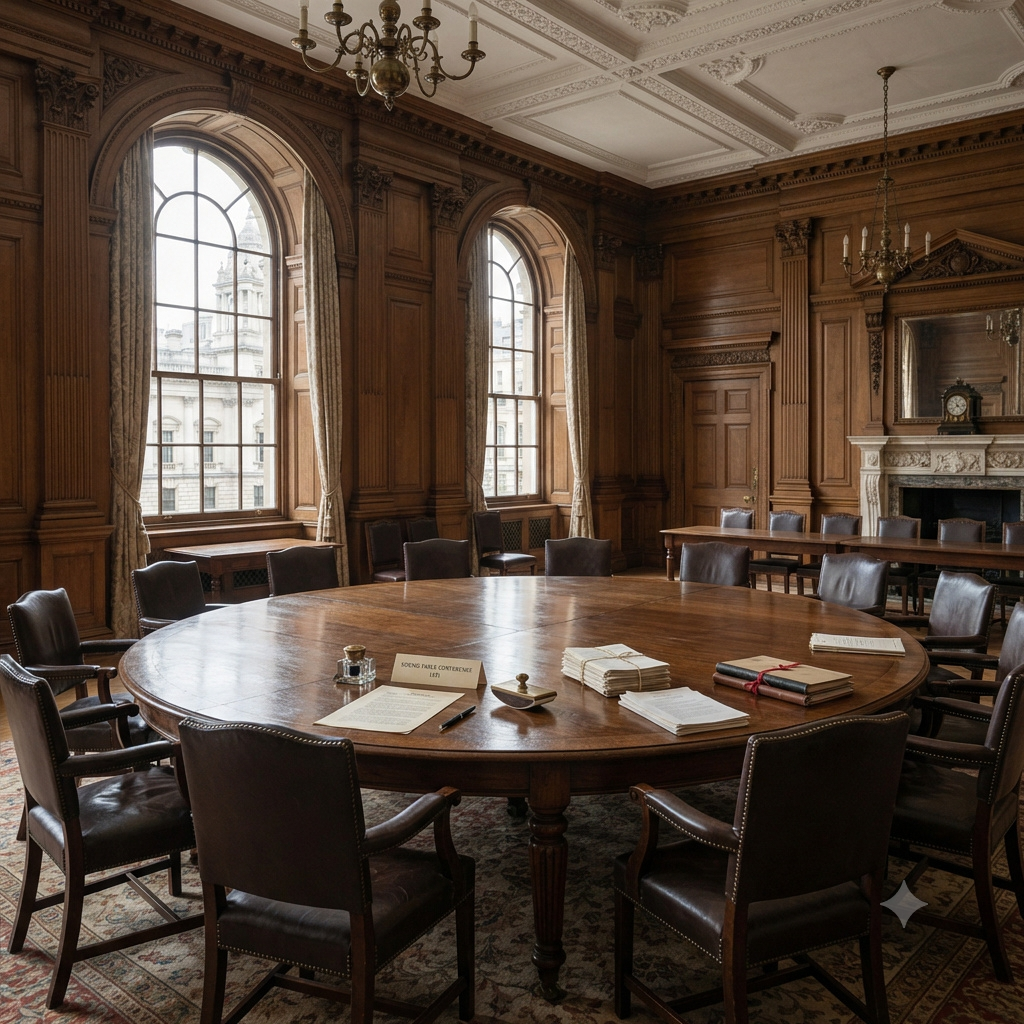
Gandhi’s Second Round Table: Did He Present All Indians? (235)
भारत / GB
Part 235: Mahatma Gandhi’s Peace Efforts (Residue Enters Constitution) | Series Index
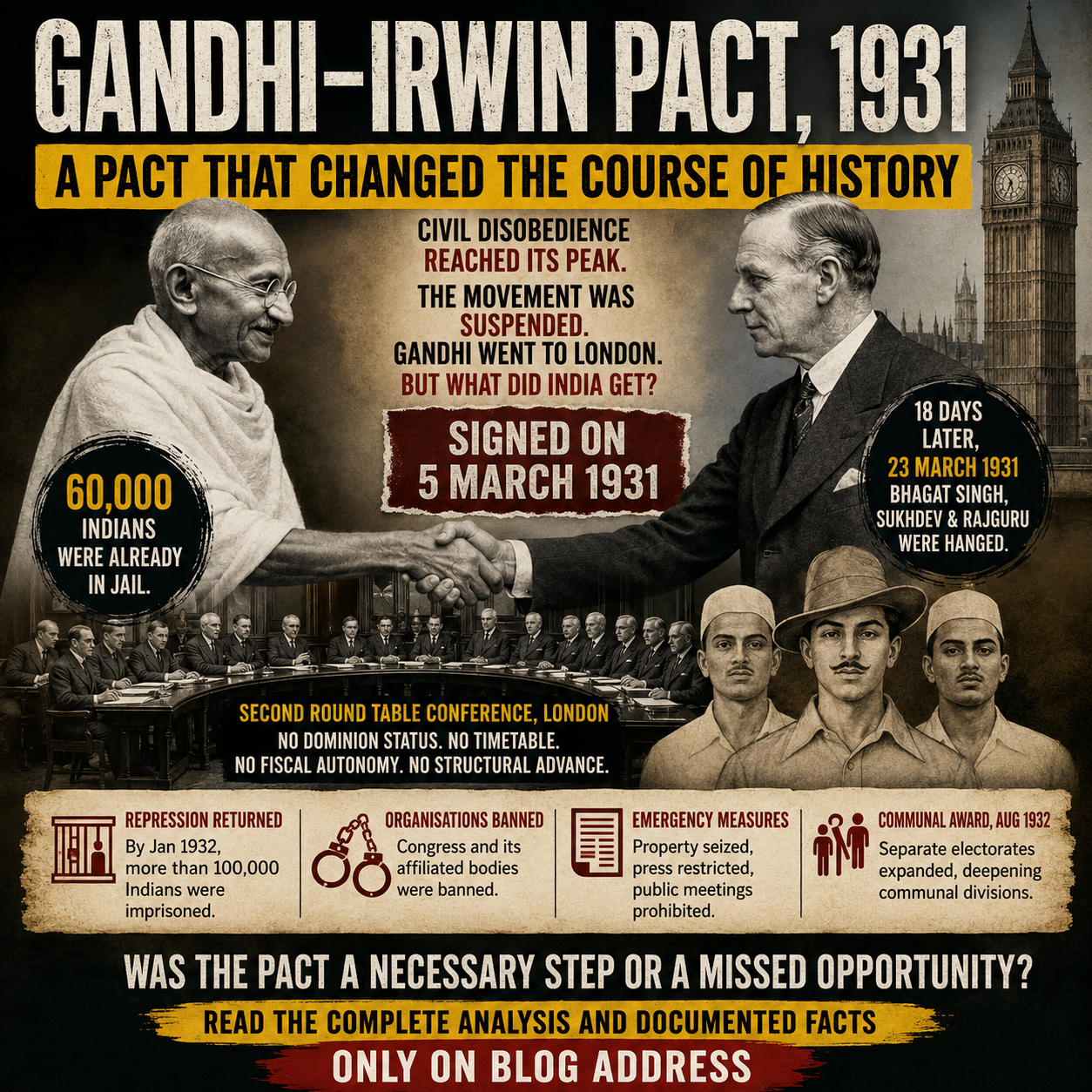
Blog 234 covered the Karachi Congress of March 1931. It met six days after Bhagat Singh, Rajguru and Sukhdev were hanged, a de-fecto approval of sorts, on the hanging of the revolutionaries. It approved the Delhi Pact, passed a charter of rights, and named Gandhi the only Congress representative for London. It reached no Hindu–Muslim agreement. This blog, Gandhi’s Second Round Table, covers what Gandhi said and did in London from September to December 1931. Who represented India at the conference is covered in Blog 153. The gains and losses of the Pact are covered in Blog 138.
Thank you for reading this post, don't forget to subscribe!THE LONDON RECORD: SEPTEMBER – DECEMBER 1931
The Action Taken: Gandhi went to London as the only Congress delegate. He told the conference that the Congress represented over 85 per cent of Indians, all the minorities, and even the princes. He said every other party represented only “sectional interests”. He said he could not settle the Muslim question without Dr. M.A. Ansari, a Congress Muslim who was not a delegate. He called the conference “unrepresentative in every sense of the word”.
Who Paid the Price: The minorities question. The Muslim, Depressed Classes, Sikh, Christian and Anglo-Indian delegates did not accept that the Congress spoke for them. The conference ended with no agreement on how each community would be represented.
Why This Matters: Gandhi claimed to speak for all of India. The other Indian delegates did not accept that claim.
1. Gandhi Goes to London Alone
Gandhi sailed from Bombay on the S.S. Rajputana on 29 August 1931. He was the only official Congress delegate, as decided at Karachi.
The British Government invited the other Indian delegates. They included:
- The Aga Khan, Jinnah, Shaukat Ali and Muhammad Iqbal for the Muslims
- Dr. B.R. Ambedkar for the Depressed Classes
- B.S. Moonje for the Hindu Mahasabha
- Delegates for the Sikhs, Christians, Anglo-Indians and Europeans
- The Liberals
- The princes and their ministers
Sarojini Naidu attended for Indian women. Madan Mohan Malaviya also attended. Neither was a Congress delegate.
Two committees did the main work of Gandhi’s Second Round Table. The Federal Structure Committee met from 7 September. It dealt with the form of the constitution. The Minorities Committee met from 28 September. It dealt with seats and electorates for each community. The Congress had not settled this question at Calcutta in 1928, at Lahore in 1929, or at Karachi in 1931.
2. What Gandhi Claimed
Monday, 14 September 1931, was Gandhi’s weekly day of silence, and he did not speak at the committee. On 15 September he made his first speech there. He demanded complete independence.
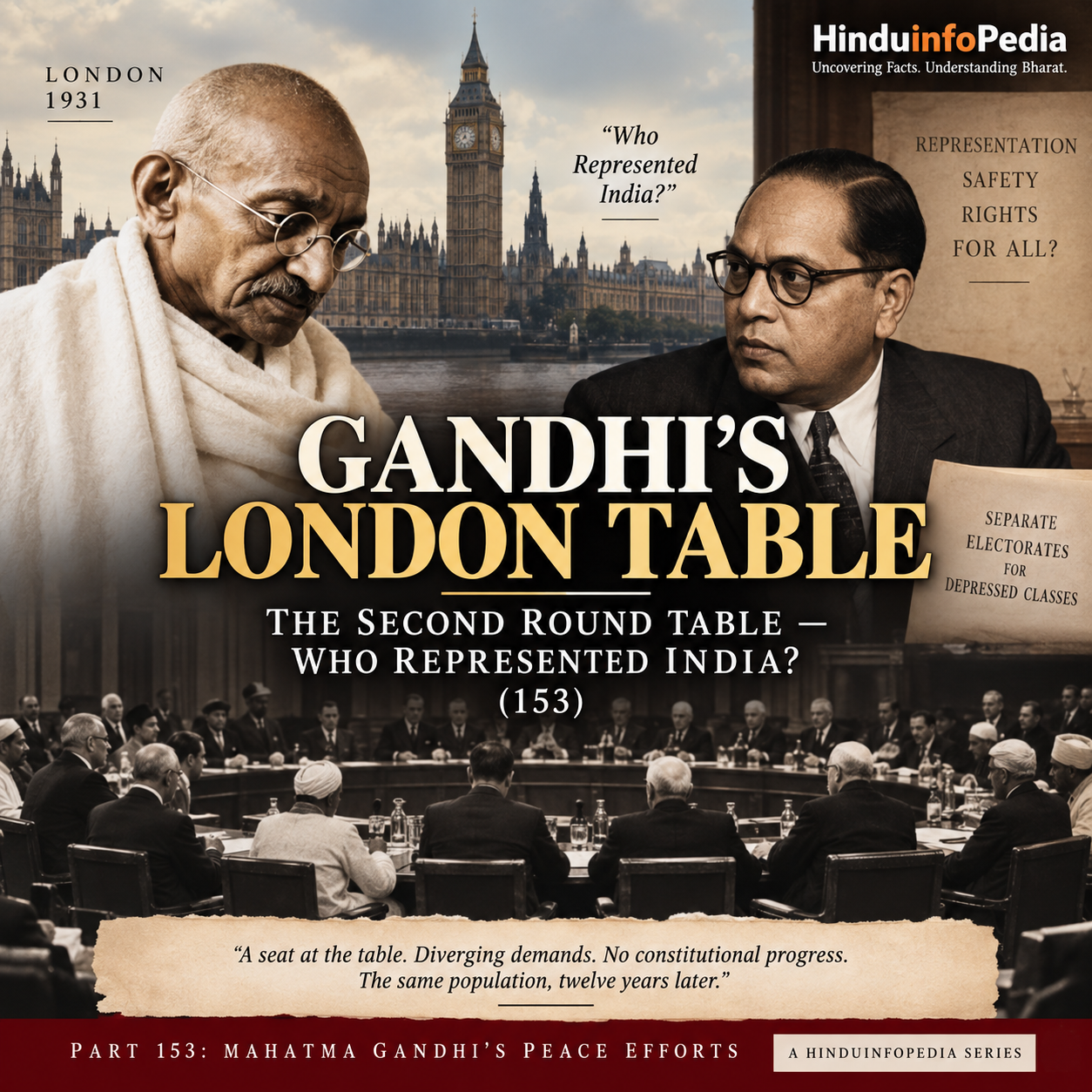
At Gandhi’s Second Round Table he also stated whom the Congress represented. In his speech to the full conference on 30 November he said:
- The Congress “claimed to represent over 85 percent of the population of India”.
- The Congress also represented the princes, the landlords and the educated class.
- “All the other Parties at this meeting represent sectional interests. Congress alone claims to represent the whole of India and all interests.”
- The Congress was “bereft of any communal bias”.
- The minorities claimed to represent 46 per cent of the population. He said they made that claim “unjustifiably”.
The table below compares the claim with the conference.
| Gandhi said the Congress represented | Who represented them at the conference |
|---|---|
| The Muslims | The Aga Khan, Jinnah, Shaukat Ali, Iqbal and the Muslim delegation |
| The Depressed Classes | Dr. B.R. Ambedkar and R. Srinivasan |
| The other minorities | Sikh, Christian, Anglo-Indian and European delegates |
| The princes | The rulers and ministers of the Indian states |
| The Congress | Gandhi |
3. Dr. Ansari Was Not a Delegate
Sir Muhammad Zafrulla Khan was a Muslim delegate. He recorded what happened when Gandhi met the Muslim delegation.
Gandhi told them that before leaving India he had promised Dr. M.A. Ansari that he would not settle the Muslim question without him. Ansari was a Congress Muslim and a former Congress President. He was not a delegate. Gandhi asked the Muslim delegates to request that Ansari be invited.
The leading Muslim delegates refused. They strongly opposed Ansari’s nomination.
So at Gandhi’s Second Round Table, Gandhi claimed to represent the Muslims. But he said he could not decide the Muslim question without Ansari. And the Muslim delegates did not accept Ansari, or the Congress, as their representative.
4. The Minorities Made Their Own Demands
The minorities put their own demands before the Minorities Committee:
- The Muslim delegates demanded separate electorates and other safeguards.
- Dr. Ambedkar demanded separate representation for the Depressed Classes.
- The Sikhs, Christians and Anglo-Indians made their own claims.
Gandhi’s reply was that these claims were unjustified, because the Congress already represented all of them.
On 31 October he was asked about the conference. He said it was “unrepresentative in every sense of the word.”
The Minorities Committee did not reach an agreement. This was the main failure of Gandhi’s Second Round Table.
5. How It Ended
On 1 December 1931 the British Prime Minister, Ramsay MacDonald, closed the conference with a statement of government policy. Gandhi left England in early December and reached Bombay on 28 December. The Congress restarted civil disobedience, and Gandhi was arrested on 4 January 1932. The gains and losses of the Pact are covered in Blog 138.
The facts of Gandhi’s Second Round Table are these. Gandhi said the Congress represented all of India. The Muslim, Depressed Classes, Sikh, Christian and Anglo-Indian delegates did not accept that. The conference ended with no agreement on the minorities.
Prosecution’s Position
The prosecution does not dispute that the Congress was the largest political party in India in 1931. It places on the record that Gandhi went to London as its only delegate; that he said the Congress represented over 85 per cent of Indians and all the minorities; that he said every other party represented only a section; that he said he could not settle the Muslim question without Dr. Ansari, whom the Muslim delegates refused to accept; that he called the minorities’ claims unjustified and the conference unrepresentative; and that the conference ended with no agreement on the minorities.
Invitation To Defence
Gandhi’s appointment as the only Congress delegate, his speeches of 15 September and 30 November 1931, his interview of 31 October 1931, Sir Muhammad Zafrulla Khan’s account of the Ansari condition, and the end of the conference without a minorities agreement are established exhibits. The defence is invited to name any Muslim, Depressed Classes, Sikh or Christian delegate who accepted that the Congress represented his community, or any step Gandhi took before sailing to reach an agreement with the Muslim leaders.
Gandhi told the conference that the Congress represented over 85 per cent of Indians, all the minorities and the princes. The minorities were present and made their own demands. He said he could not settle the Muslim question without Dr. Ansari, whom the Muslim delegates refused. The conference ended with no agreement.
Feature Image: Click here to view the image.
Videos
Glossary of Terms
- Gandhi’s Second Round Table: The Second Round Table Conference held in London from September to December 1931, where Mahatma Gandhi attended as the sole official Congress delegate and disputed questions of Indian representation remained unresolved.
- Second Round Table Conference: The second of the three constitutional conferences convened by the British Government in London between 1931 and 1932 to discuss India’s constitutional future.
- Congress Delegate: An officially appointed representative of the Indian National Congress. Gandhi was the only official Congress delegate at the 1931 conference.
- Minorities Committee: A committee of the Second Round Table Conference established to discuss minority representation, electoral arrangements and political safeguards for different Indian communities.
- Federal Structure Committee: The conference committee responsible for discussing the proposed constitutional structure and federal arrangements for British India and the princely states.
- Sectional Interests: A phrase Gandhi used to describe political parties and representatives whom he considered to speak for particular communities or groups rather than the entire Indian population.
- Depressed Classes: The historical administrative and political term used during British rule for communities subjected to caste-based social discrimination. Dr. B.R. Ambedkar represented their political interests at the conference.
- Separate Electorates: An electoral arrangement under which members of a particular community elect their own representatives through a separate electorate rather than a common constituency.
- Dr. M.A. Ansari: Mukhtar Ahmad Ansari, a prominent Congress leader and former Congress President. Gandhi referred to his earlier assurance that he would not settle the Muslim question without Ansari, who was not a conference delegate.
- Sir Muhammad Zafrulla Khan: A Muslim representative at the Second Round Table Conference who recorded Gandhi’s interaction with the Muslim delegation concerning Dr. Ansari.
- Aga Khan: Sultan Mahomed Shah, the Aga Khan III, who participated in the Second Round Table Conference as a representative of Muslim political interests.
- Ramsay MacDonald: The British Prime Minister who delivered the government’s concluding statement on 1 December 1931, bringing the Second Round Table Conference to a close.
- Delhi Pact: The agreement between Mahatma Gandhi and Viceroy Lord Irwin in March 1931, which led to the suspension of the Civil Disobedience Movement and Gandhi’s participation in the Second Round Table Conference.
- Civil Disobedience Movement: A political campaign of non-violent resistance against British rule, involving the deliberate violation of selected colonial laws and regulations.
- Residue Enters Constitution: A series phrase describing how unresolved political and communal questions from earlier negotiations carried forward into subsequent constitutional discussions and arrangements.
#Gandhi #GandhiHistory #IndianHistory #RoundTableConference #Congress #Ambedkar #BritishIndia #IndianPolitics #HinduinfoPedia
Scan Through The Entire Series at