
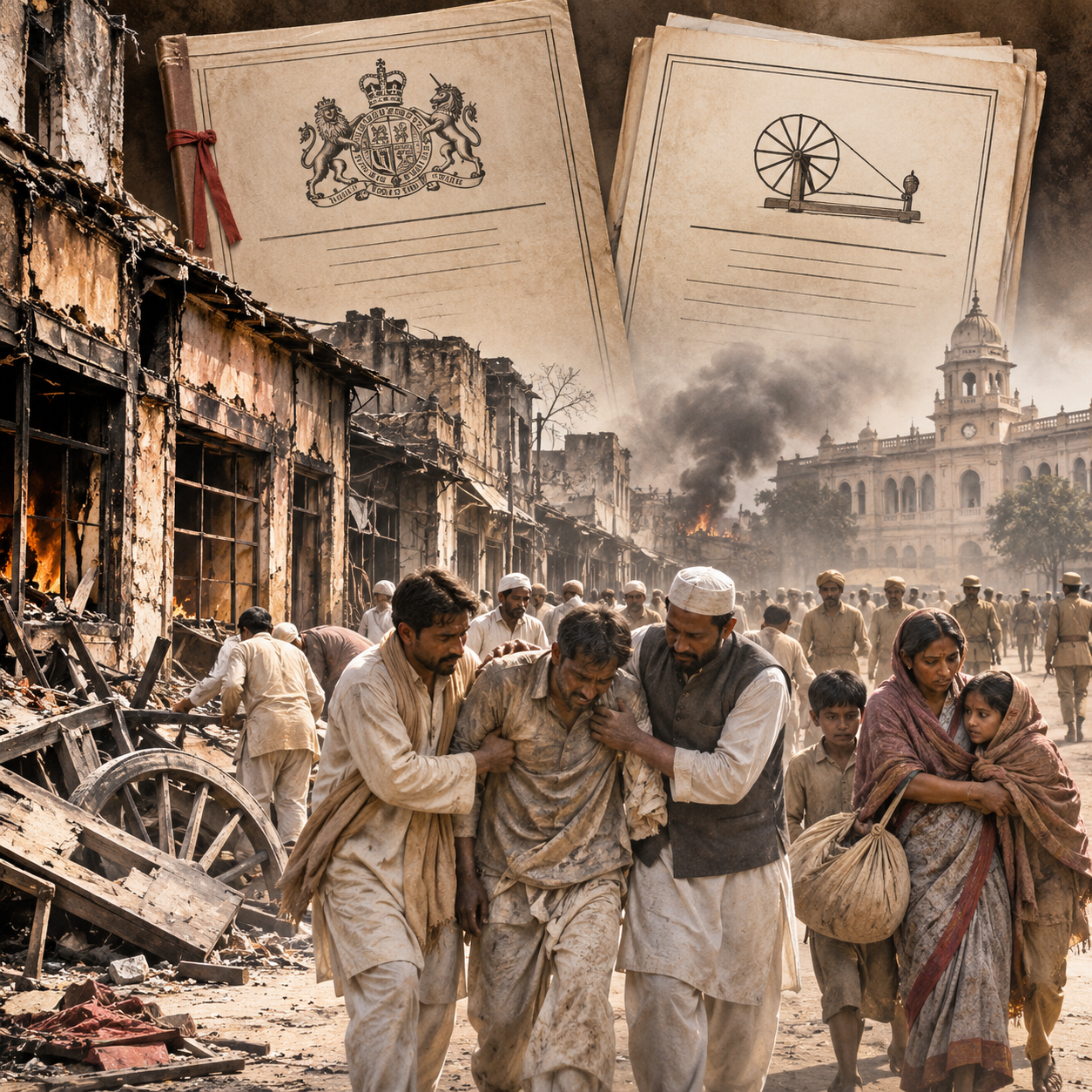
Gandhi’s Kanpur Riots: Four Hundred Dead and Two Rival Reports (227)
भारत / GB
Part 227: Mahatma Gandhi’s Peace Efforts (Residue Enters Constitution) | Series Index
Blog 226 closed the 1920–1928 record by placing its five mechanisms on a single balance sheet: the 1920 Hijrat transmission machine (Blog 215), the moral inversion that called Swami Shraddhanand’s assassin a brother (Blogs 220–222), the Kohat distress sales of 1924 (Blog 223), the Census evidence and shrinking settlements Congress rejected up to Calcutta 1928 (Blog 224), and the one-way relief ledger (Blog 225). That record ended with the residue intact. From here the series follows the same residue into the constitutional bargaining of 1927–1935, opening at the point where it was most visible: Kanpur, March 1931, in the month the Delhi Pact truce began. Ganesh Shankar Vidyarthi’s death in that riot is examined in Blog 72 and Blog 156; this instalment documents the outbreak itself and the two records it produced.
Thank you for reading this post, don't forget to subscribe!THE RIOT RECORD: KANPUR, MARCH 1931 — THE TRUCE-MONTH OUTBREAK
The Action Taken: Nineteen days after the Delhi Pact of 5 March 1931 suspended civil disobedience, a hartal in Kanpur protesting the 23 March Lahore executions of Bhagat Singh, Sukhdev and Rajguru broke into the worst communal outbreak of the truce. The Government’s commission of inquiry put the dead at 400 to 500. The Congress appointed its own six-member inquiry at Karachi; that report reached the Congress President in October 1931, after Gandhi had sailed for the Second Round Table, and was not in print until 1933.
Who Paid the Price: The residents of Kanpur’s mixed mohallas — Hindu and Muslim — who were killed, wounded and burned out between 24 and 27 March 1931, and the city’s public life, which a colonial administration that had anticipated trouble did not protect.
Why This Matters: The worst communal violence of the truce entered the record twice — once in a Government resolution that blamed the civil disobedience movement and once in a Congress report that stayed unpublished while Gandhi told London that Congress spoke for every community. The constitutional bargaining that follows begins with the communal evidence off the table.
1. Nineteen Days of Truce: From the Delhi Pact to the Lahore Executions
The sequence that produced Gandhi’s Kanpur riots runs through three dates. On 5 March 1931 Gandhi signed the Delhi Pact with Lord Irwin, suspending civil disobedience on terms already audited in Blog 20. Commutation of the death sentences on Bhagat Singh, Sukhdev and Rajguru was not made a condition of that settlement (Blog 158) — creating the exact conditions where the three were hanged at Lahore on 23 March 1931 before the Congress plenary could even assemble to take a decision or refuse to ratify Gandhi’s unilateral truce post facto.
On the next day, 24 March, a hartal — a closure of shops and business — was called in Kanpur to mark the executions. The British administration had expected demonstrations: the Secretary of State later told the Commons that confidential instructions had gone to commissioners and district officers on precautions for demonstrations connected with the executions. Within hours the enforcement of the hartal turned into street fighting between Hindus and Muslims. Contemporary wire reports from Delhi record fires and looting across the city and British troops called out at midnight.
- The trigger as Parliament heard it: Members asked the Secretary of State whether the rioting had begun with an attempt by a Congress leader to force citizens to close their shops in protest against the executions (HC Deb 20 April 1931).
- The administration on the ground: The Commissioner of the Division was in Kanpur from 26 to 30 March inclusive, and the Governor and the Home Member also came to the city (HC Deb 6 July 1931).
The first entry in the record of Gandhi’s Kanpur riots is therefore a date relationship: a truce signed without a condition on the executions, executions carried out inside the truce, and a protest hartal that the city could not hold together.
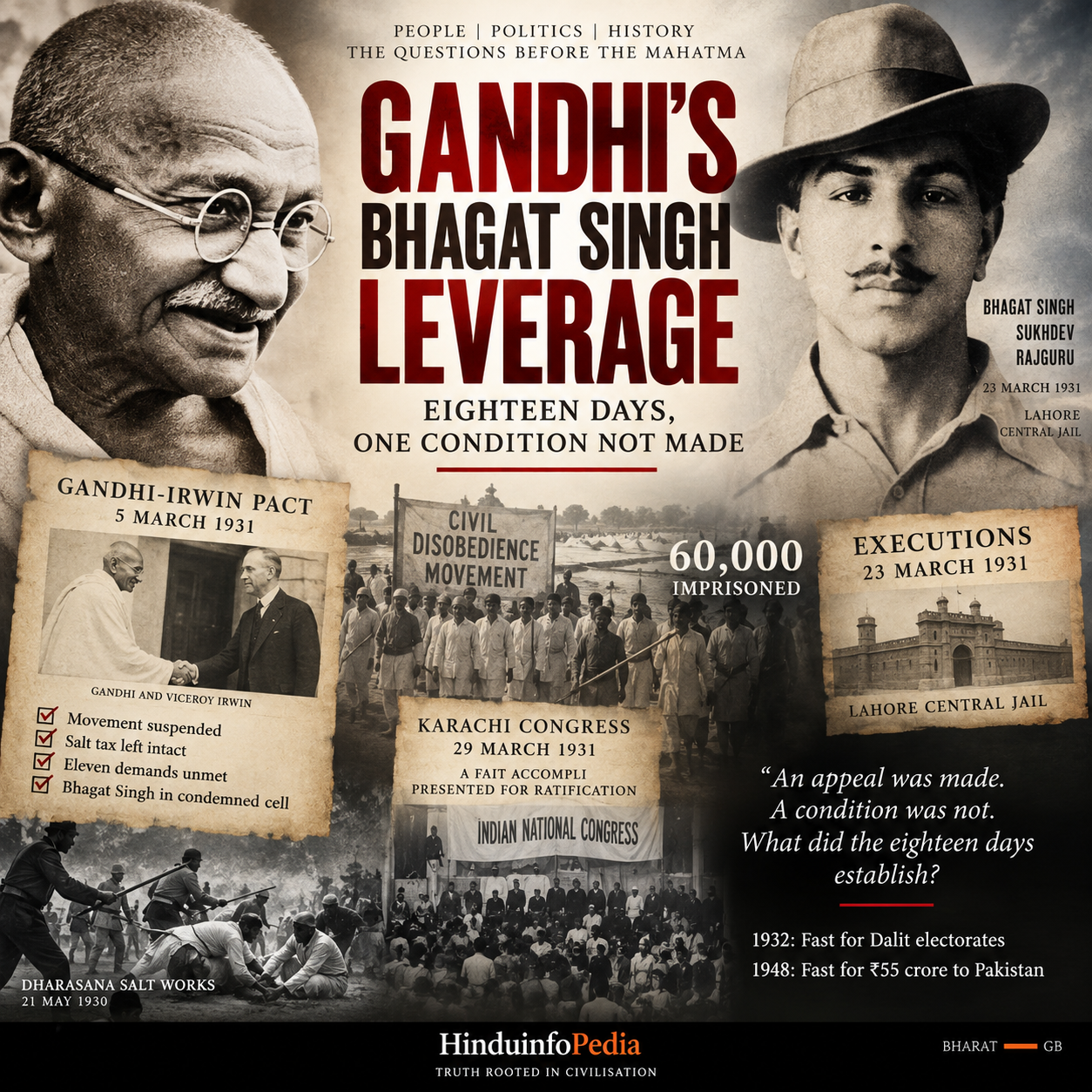
2. The Body Count: From 294 to “Between 400 and 500”
The scale of the outbreak was revised upward at every stage of the official record:
| Date of Record | Figure Given | Source |
|---|---|---|
| 25 March 1931 | 20 killed, 120 injured after the first day | Press Association wire from Delhi, published 26 March 1931 |
| May 1931 | 1,000 to 2,000, per eye-witness letters to the press | Question in HC Deb 4 May 1931 — unofficial, not adopted by either inquiry |
| 8 June 1931 | 294 dead at Kanpur — out of 349 killed in 21 riots across India in the period | Secretary of State, HC Deb 8 June 1931 |
| June 1931 | Between 400 and 500 dead | Government Commission of Inquiry, as put to the Secretary of State in HC Deb 22 June 1931 |
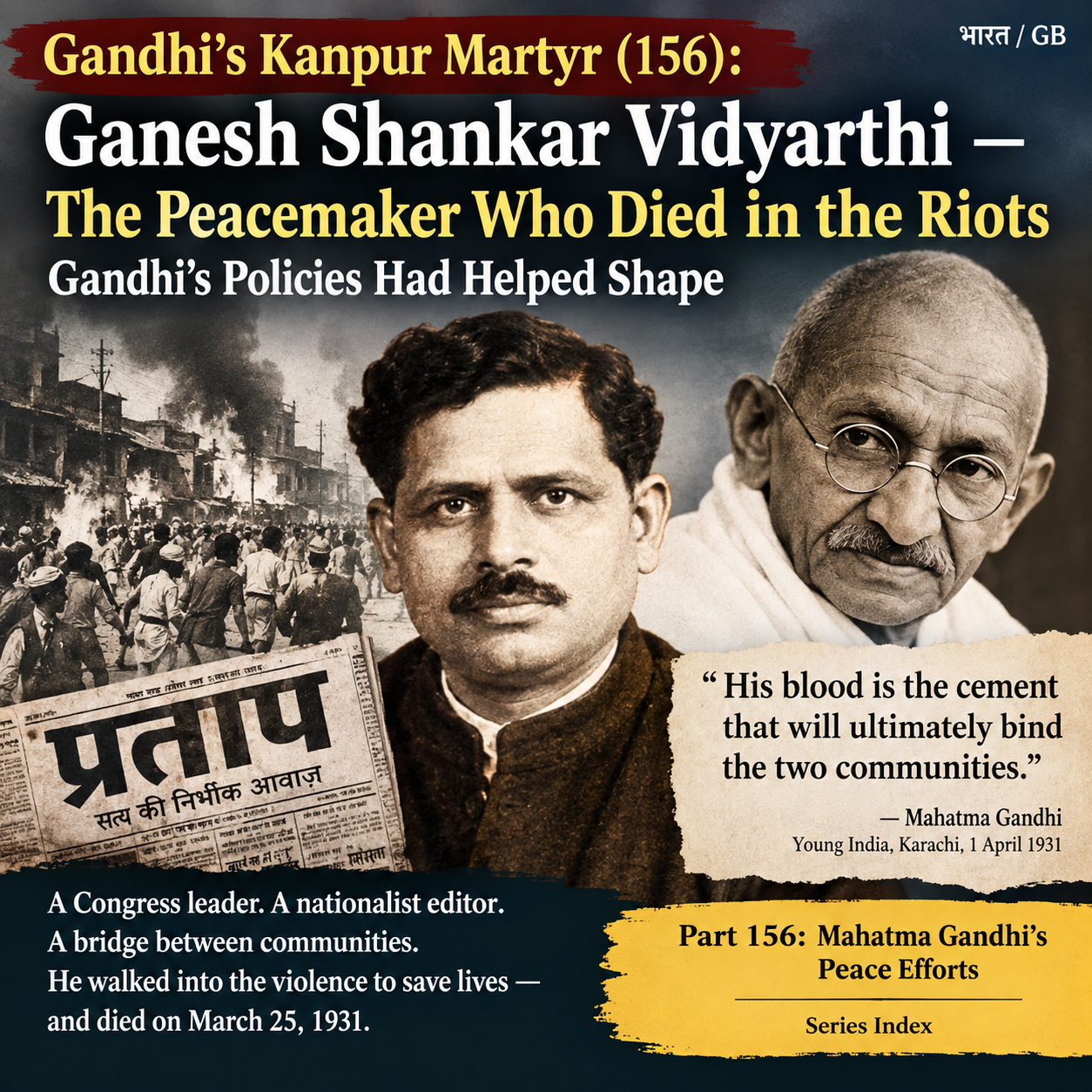
Whichever figure is taken, Kanpur alone accounted for most of the deaths in communal rioting recorded across India in that period. The cost of Gandhi’s Kanpur riots fell on the people of the city’s mixed neighbourhoods; the only national figure who died in it, Vidyarthi, died trying to stop it. The people Gandhi’s own pact left exposed are traced in Martyrs of Indian Independence and Gandhi’s Influence.
3. Two Inquiries, Two Verdicts
Two bodies examined the outbreak, and they reached their conclusions on different timetables.
- The Government Commission (reported June 1931): The United Provinces Government appointed a commission to report on the predisposing and immediate causes of the outbreak and on the adequacy of the measures taken (HC Deb 16 April 1931). Its resolution, issued in June 1931, held the civil disobedience movement responsible for the embittered feeling between the communities and found the district magistrate, J. F. Sale, at fault for failing to see the need for firmer measures. Sale was offered transfer or leave and took leave (HC Deb 15 June 1931). Commenting on the findings, the Statesman of Calcutta, as quoted in the Press Association cable of 9 June 1931, called the hartal “the intolerable tyranny of the Indian National Congress” — a newspaper’s characterisation, not the wording of the Government resolution.
- The Congress Inquiry Committee (appointed at Karachi, March 1931): The Karachi Congress set up a six-member committee under Bhagwan Das, with Pandit Sunderlal as secretary and Purushottam Das Tandon, Manzar Ali Sokhta, Abdul Latif Bijnori and Zafar-ul-Mulk as members. It submitted its report to the Congress President, Vallabhbhai Patel, in October 1931. The Working Committee, at its session spanning the turn of the year (29 December 1931 – 1 January 1932), resolved to publish it; the resolution is recorded under 31 December 1931. A dissenting note by Zafar-ul-Mulk recorded the general Muslim belief that genuinely non-communal members were a very small minority within the Congress.
- The Congress report in print (1933): When the report was finally printed at the Minerva Press, Allahabad, the district magistrate demanded security under the Press Act, 1931. The question put in the Commons described a report of about 600 pages, based on some 300 witnesses from all communities. The Government defended the order on the ground that the report could bring the Government into hatred and contempt and revive communal animosity, and refused any inquiry (HC Deb 13 June 1933).
The Government’s verdict on Gandhi’s Kanpur riots was public within three months. The Congress’s own verdict, prepared by its own senior members, did not reach the public for two years — and by then the constitutional questions it bore on had already been settled elsewhere. The previous treatment of the Kanpur inquiry in this series is in Blog 73.
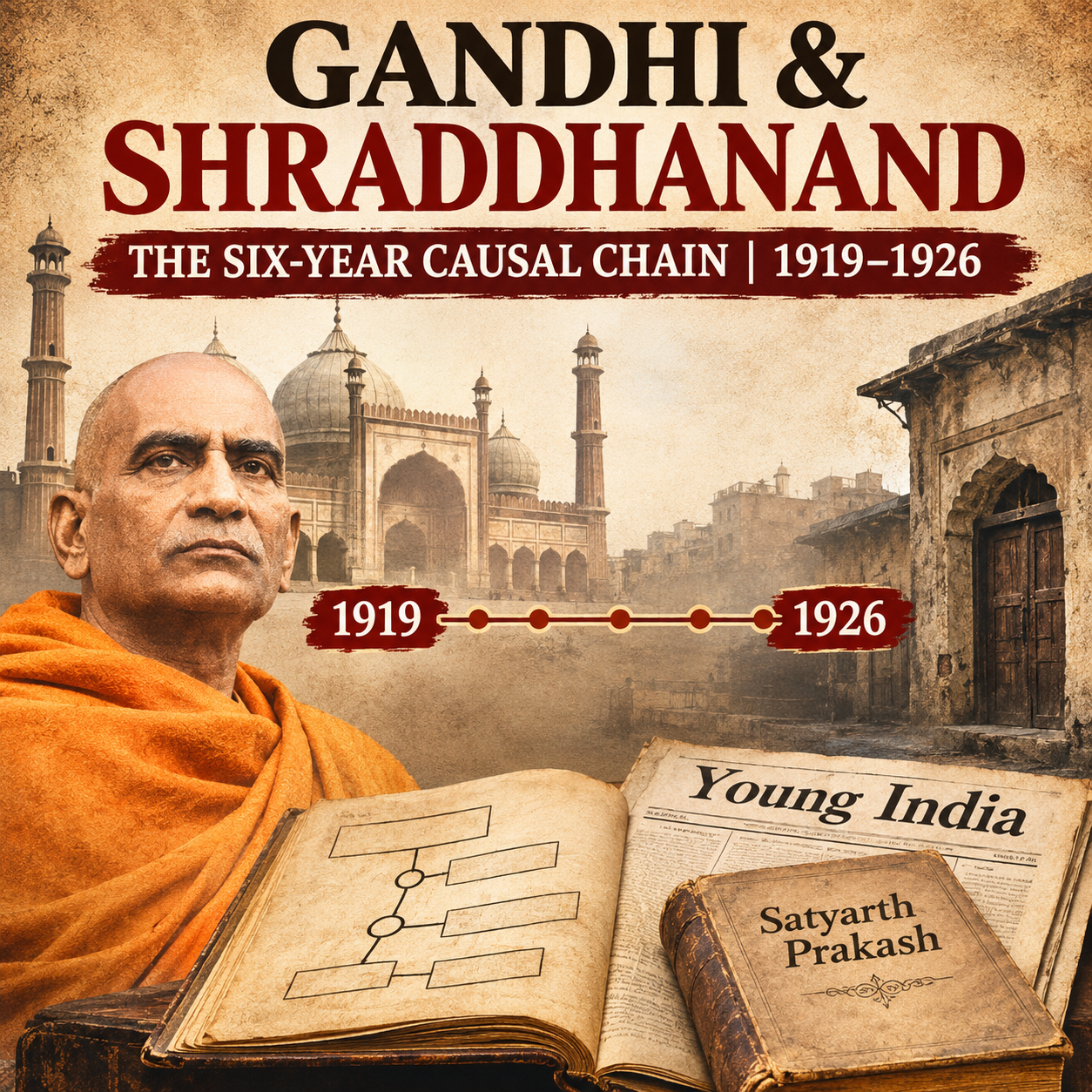
4. From Kanpur to London: The Evidence That Did Not Travel
The calendar after Kanpur explains why this riot opens the constitutional record rather than closing the riot record:
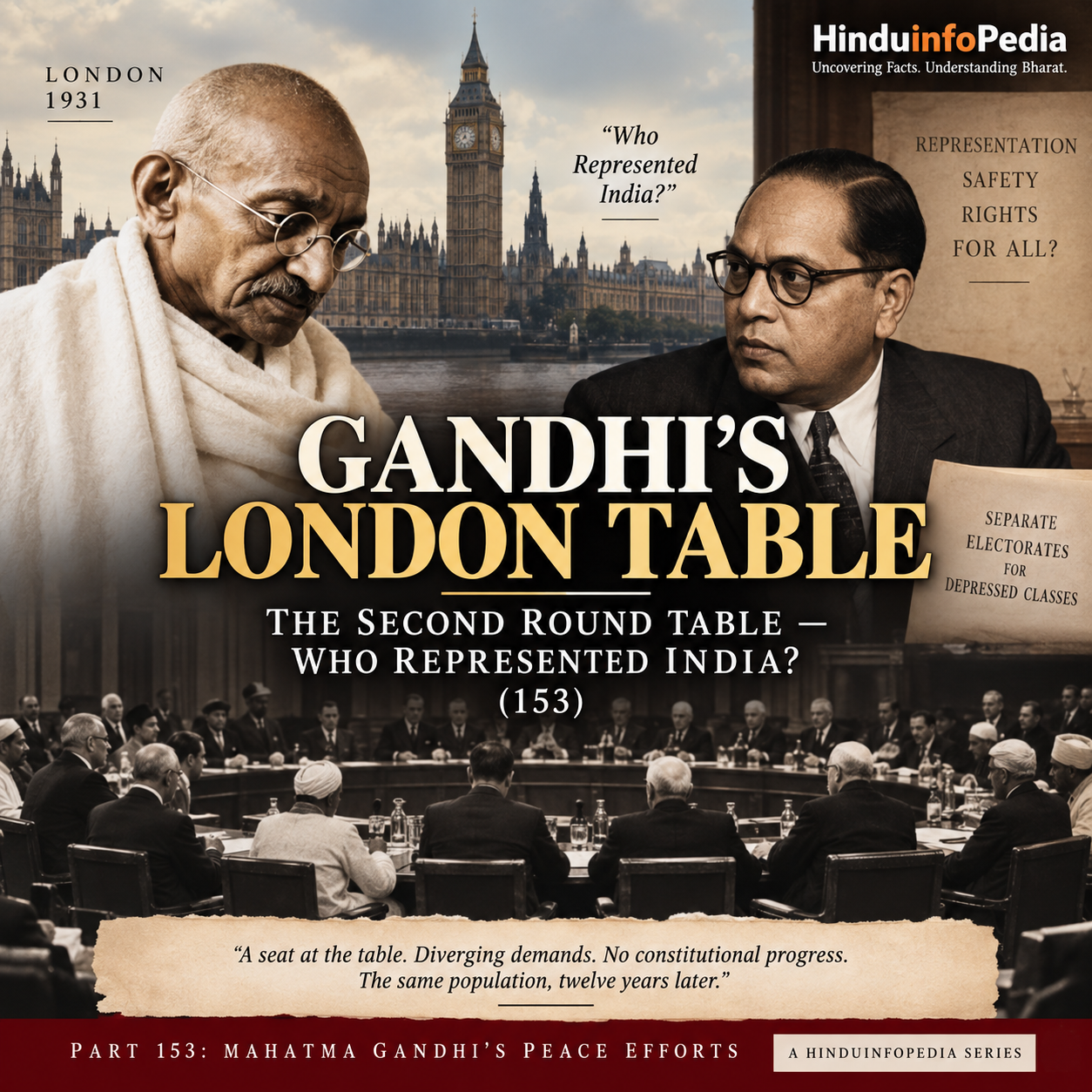
- August–December 1931: Gandhi sailed for the Second Round Table Conference as the Congress’s sole representative and argued there that the Congress represented all of India across communities (Blog 153). The Minorities Committee deadlocked. The Conference closed on 1 December 1931.
- October 1931: While Gandhi was in London, the Congress’s own report on the worst communal outbreak of the truce was already with the Congress President. It was not in print, and it was not before the Conference.
- 31 December 1931 – January 1932: The Working Committee resolved to publish the report. Within days the truce ended, Gandhi was arrested and the Congress was declared unlawful (Blog 28).
- August 1932: With no Indian agreement reached in London, the British Government announced the Communal Award, fixing separate electorates by statute — an exhibit still ahead in this series.
The documented sequence is the exhibit: the claim of a single national representation was made in London while the Congress’s own evidence on communal estrangement — including a member’s dissent on how Muslims saw the Congress — sat unpublished in the Congress President’s office. Whether that evidence would have changed the London outcome is not established by the record; what the record establishes is that it was not placed before the Conference that decided the electorates. That is the entry point for Gandhi’s Kanpur riots into the constitutional record.
Modern Parallel
The pattern of a communal riot documented in detail by an inquiry and then kept from consequence did not end in 1933. The Srikrishna Commission, appointed after the Bombay riots of December 1992 and January 1993, was wound up by the Maharashtra government on 23 January 1996 and later revived. It submitted its report on 16 February 1998 after examining 502 witnesses and 2,903 exhibits. The report reached the Assembly only on 6 August 1998, when the state government tabled it with an Action Taken Report that rejected most of its findings. The government that followed accepted a bureaucrats’ committee’s conclusions over the judge’s and declined the action he had recommended against named policemen and politicians. Governments of different alignments treated the report the same way — the 1931 pattern of evidence prepared, then withheld from effect.
The Hansard record of 1931–1933, the Government Commission’s figures and the Congress committee’s own history leave the sequence beyond dispute: Gandhi’s Kanpur riots produced the largest communal death toll of the truce, two rival verdicts, and a Congress report that did not reach the public until the constitutional questions it touched had already been decided in London.
Invitation To Defence
The Commons answers of 16 April, 8 June, 15 June, 22 June, 6 July and 8 July 1931, the June 1931 resolution of the United Provinces Government, the Karachi appointment and 31 December 1931 resolution of the Congress Working Committee, and the 13 June 1933 answer on the Minerva Press security are established archival exhibits. The defence is invited to produce any record showing the Congress Kanpur Inquiry Committee’s findings placed befhttps://youtu.be/oEcoSNSIDMQore the Minorities Committee of the Second Round Table Conference, or any public statement of those findings by the Congress before the Communal Award of August 1932.
Nineteen days after the Delhi Pact, a protest hartal in Kanpur became the deadliest communal outbreak of the truce — between 400 and 500 dead by the Government’s count. The Government’s verdict was public by June 1931; the Congress’s own report reached its President in October 1931, while Gandhi was telling London that the Congress spoke for every community, and reached the public only in 1933.
Feature Image: Click here to view the image.
Videos
Glossary of Terms
1. Gandhi’s Kanpur Riots: The communal outbreak in Kanpur between 24 and 27 March 1931, following a protest hartal against the executions of Bhagat Singh, Sukhdev and Rajguru. The Government Commission estimated the death toll at between 400 and 500.
2. Delhi Pact (1931): The agreement signed by Mahatma Gandhi and Lord Irwin on 5 March 1931, under which the Civil Disobedience Movement was suspended. The commutation of the death sentences of Bhagat Singh, Sukhdev and Rajguru was not included as a condition.
3. Hartal: A form of protest involving the closure of shops, businesses and commercial establishments, generally to express public opposition to a political decision or event.
4. Civil Disobedience Movement: A political movement led by Mahatma Gandhi that sought to challenge British colonial authority through non-violent resistance and the deliberate violation of selected laws.
5. Government Commission of Inquiry: The investigation appointed by the United Provinces Government to examine the causes of the Kanpur outbreak, the circumstances surrounding the violence and the adequacy of administrative measures.
6. Congress Inquiry Committee: A six-member committee appointed at the Karachi Congress in March 1931 under Bhagwan Das to investigate the Kanpur riots. Its report was submitted to Congress President Vallabhbhai Patel in October 1931 but was not published until 1933.
7. United Provinces: The British Indian administrative province that included Kanpur and was governed during the colonial period. It was subsequently reorganised and renamed Uttar Pradesh.
8. HC Deb (House of Commons Debates): The official record of proceedings, questions and answers in the British House of Commons. The blog uses these parliamentary records to establish the chronology, casualty figures and administrative responses to the Kanpur violence.
9. Second Round Table Conference: The constitutional conference held in London from August to December 1931 to discuss India’s political future. Mahatma Gandhi attended as the sole Congress representative.
10. Minorities Committee: A committee of the Second Round Table Conference responsible for discussing minority representation and constitutional safeguards. Its deliberations ended in a deadlock.
11. Dissenting Note: A written statement expressing disagreement with the conclusions or general position of a committee. In the Congress Kanpur Inquiry Committee’s report, Zafar-ul-Mulk recorded his observations concerning Muslim perceptions of Congress’s non-communal character.
12. Communal Award (1932): The constitutional arrangement announced by the British Government in August 1932 that provided for separate electorates for specified communities and groups in British India.
13. Minerva Press: The printing establishment in Allahabad where the Congress Kanpur Inquiry Committee’s report was eventually printed in 1933. Its publication led to a demand for security under the Press Act, 1931.
14. Srikrishna Commission: The judicial commission appointed to investigate the Bombay riots of December 1992 and January 1993. Its delayed report and subsequent government response provide the modern institutional comparison discussed in the blog.
15. Action Taken Report (ATR): An official government document explaining the action taken, or proposed to be taken, in response to the findings and recommendations of an inquiry commission.
#Gandhi #Kanpur #IndianHistory #BritishIndia #BhagatSingh #Congress #IndianFreedomStruggle #History #CommunalRiots #HinduinfoPedia
Scan Through The Entire Series at
Refer to Various Arks Referred to in the Blog
Gandhi’s Kanpur Riots: Four Hundred Dead and Two Rival Reports (227)