
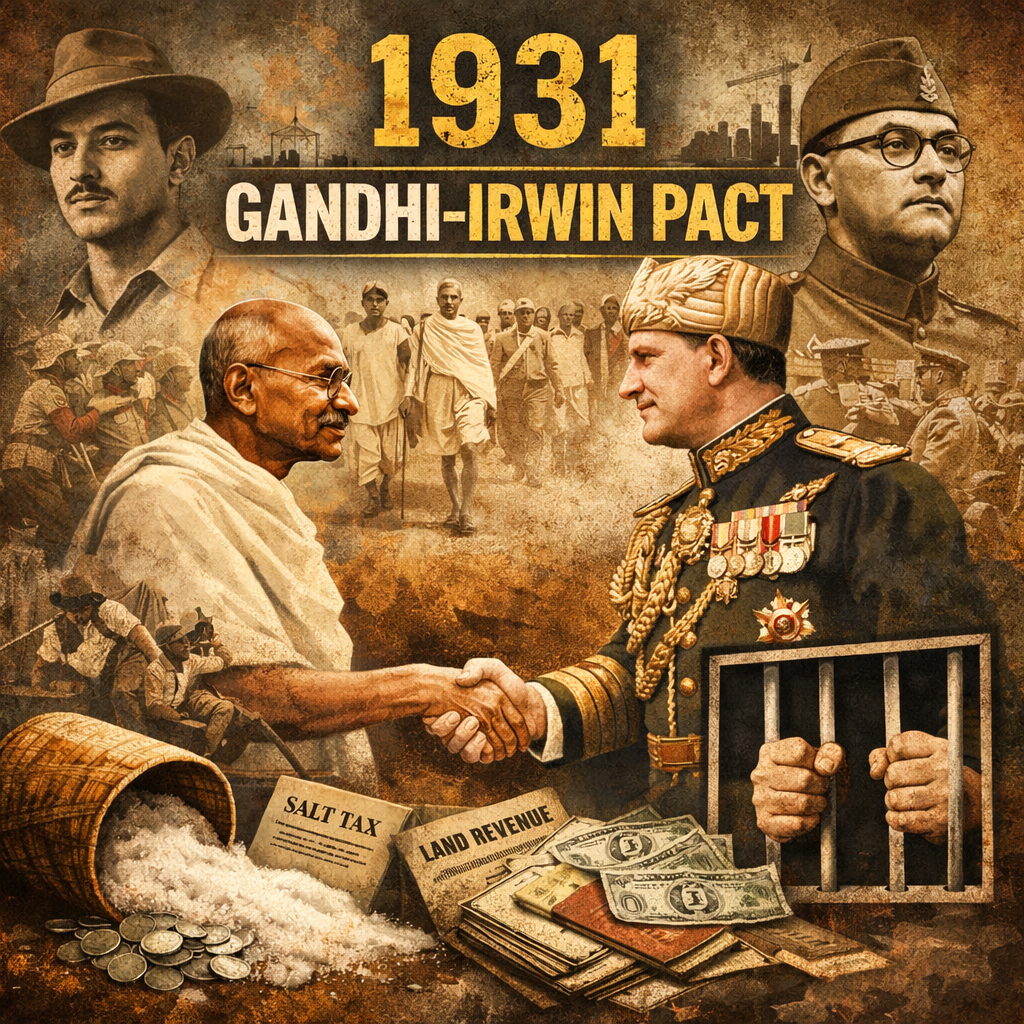
Gandhi’s Irwin Pact: The Handshake That Buried the Revolution (17)
भारत / GB
Part 17: Mahatma Gandhi’s Peace Efforts
Gandhi- Irvin Pact: A Pact or a Sellout
From the Council Bills mechanism to the £9.2 trillion price tag, from the eleven demands as a structural shutdown notice to the question Irwin answered with silence — four blogs established what was at stake when Gandhi walked into the Viceroy’s house on 17 February 1931. Gandhi’s Irwin Pact is what he walked out with. The Gandhi–Irwin Pact, conducted in a courteous and formal setting, followed the jailing of sixty thousand to ninety thousand satyagrahis, the killing of hundreds, and the confiscation of countless properties; it must be read in that context.
Thank you for reading this post, don't forget to subscribe!This analysis examines what Gandhi did and what the Pact produced, not what was said about it. The focus now shifts from claims to outcomes.
The most powerful weapon assembled in a generation — and what became of it
Blog 9 described the Salt March as a mechanism: 241 miles of walking that converted a universal grievance into a global spectacle, 60,000 arrests that collapsed the colonial administration’s capacity to respond, a movement that had paralysed provincial governance from Peshawar to Madras. The march ended at the sea on 6 April 1930. Gandhi lifted a handful of salt and the image circled the world. The documentation of what followed — the crackdown, the jailings, the six months of sustained civil disobedience — establishes that by late 1930, the colonial administration was under a pressure it had not experienced since 1857.Gandhi’s Irwin Pact was signed on 5 March 1931. The negotiations lasted two weeks. Gandhi met Irwin eleven times.
The terms are on the public record. Congress would suspend civil disobedience. Political prisoners not convicted of violence would be released. Indians living on the coast could manufacture salt for personal use. Gandhi would attend the Second Round Table Conference in London as the sole Congress representative.
The salt tax remained. It was not reduced. It was not reviewed. It was not scheduled for renegotiation. The tax that had been the moral centre of the entire campaign — the levy that Gandhi had chosen precisely because it was universal, indefensible, and paid by every Indian family regardless of income — was not mentioned in the final text of Gandhi’s Irwin Pact as a matter requiring resolution. The Viceroy retained it in full.
The Property Trap: Legalized Dispossession
The Pact’s restitution clause contained a structural failure: only confiscated land not yet sold to third parties would be returned. During the 1930 crackdown, the British had moved aggressively to auction seized assets to loyalists. Under the terms Gandhi signed, these permanent losses were accepted. Fines already collected were not refunded; only uncollected levies were remitted. While the leadership walked out of prison, the rural “foot soldiers” in regions like Bardoli remained economically broken, their livelihoods signed away in a “truce” that prioritized a cessation of agitation over the restoration of peasant property.
What the eleven demands became
Blog 11 documented all eleven demands Gandhi had placed before Irwin in January 1930. Blog 15 mapped each one against the specific extraction mechanism it would have dismantled. Gandhi’s Irwin Pact addressed none of them structurally. The rupee-sterling rate remained fixed. Land revenue continued at existing levels. The military budget was unchanged. The CID continued to operate. Lancashire’s preferential access to the Indian market was undisturbed.
The documentation shows that Gandhi’s Irwin Pact did not mention the eleven demands by name. The Round Table Conference, to which Gandhi agreed to travel as Congress’s sole voice, was convened by the British government with terms of reference that explicitly excluded dominion status from the agenda. The record shows Gandhi knew this before he signed .
The methodology Gandhi applied throughout his political career involved a consistent structure: mass mobilisation to a peak, followed by a negotiated settlement that fell short of the movement’s stated aims, followed by a personal departure from the scene. The historians who have examined Gandhi’s Irwin Pact most carefully — including Judith Brown and Ramachandra Guha — note that Gandhi entered the negotiations with the strongest hand the independence movement had held to that point. The documentation of what he accepted in return is not in dispute.
This gap between mobilisation goals and negotiated outcomes is central to understanding the Pact’s long-term impact.
From Peak Leverage to Liquidated Momentum
The methodology Gandhi applied throughout his political career involved a consistent structure: mass mobilisation to a peak, followed by a negotiated settlement that is nowhere near the goals of the mobilisation, followed by a personal departure from the scene.
Historians like Judith Brown and Ramachandra Guha note that Gandhi entered these negotiations at a moment of peak mobilisation and maximum political leverage. However, critics and contemporaneous observers viewed the outcome not as a “truce,” but as a strategic sell-out.
By signing the Pact, Gandhi effectively ignored the very Indian interests—the Eleven Demands and the Salt Tax—that had powered the agitation. The documentation shows that rather than advancing the cause of freedom, the Pact served to strengthen the British position, effectively providing the colonial administration a period of reprieve to regroup, identify agitators, and recover from the administrative paralysis the Salt March had achieved.
Beyond economic and political outcomes, the consequences extended into the human condition of the movement’s base.
The repression did not end at imprisonment or confiscation. It extended into the physical breaking of the movement’s base. Protesters were subjected to severe beatings, with many left seriously injured and without treatment or restitution built into the settlement Gandhi accepted. This was not incidental—it functioned as enforcement. The message was clear: participation in mass mobilisation carried consequences that would extend beyond the moment of protest into permanent personal damage. What emerged from the Pact was not just a pause in agitation, but a population conditioned to understand the cost of defiance in bodily terms.

Karachi, March 1931: the Congress that received the news
The Indian National Congress met at Karachi on 26 March 1931, three weeks after Gandhi’s Irwin Pact was signed, to ratify the agreement. The atmosphere, documented in contemporaneous accounts and later in the memoirs of delegates present, was not jubilant.
Bhagat Singh had been hanged four days earlier, on 23 March 1931. He was twenty-three. The timing was not accidental — the British administration had scheduled the execution for the period between the pact’s signing and its ratification, a window in which Gandhi had leverage he had already agreed not to use. Gandhi had been asked, by Bhagat Singh’s family and by sections of Congress, to make the commutation of the death sentence a condition of his participation in the Round Table Conference. The record shows he declined to do so. Gandhi’s Irwin Pact contains no reference to Bhagat Singh.The Karachi session ratified the pact. It also, in a move that reflected the temperature of the Congress rank and file, passed a resolution on fundamental rights drafted substantially by Jawaharlal Nehru — a document that went considerably further than anything Gandhi had negotiated. The delegates who voted for ratification and then voted for the Nehru resolution were not in contradiction. They were recording, simultaneously, what had been accepted and what had been lost.Subhas Chandra Bose, present at Karachi, was among those who received Gandhi’s Irwin Pact with open dissatisfaction. The documentation of Bose’s position in early 1931 shows a figure who had concluded that the movement’s maximum pressure point had been traded for a conference seat. His trajectory after Karachi — the growing distance from Gandhi, the eventual turn toward the INA — has its documentary roots in the weeks surrounding Gandhi’s Irwin Pact.

London, December 1931: what the Round Table produced
Gandhi attended the Second Round Table Conference in London from September to December 1931 as the sole representative of the Indian National Congress. He returned without an agreement. The Conference produced no constitutional progress toward self-governance. Dominion status, excluded from the agenda before Gandhi signed Gandhi’s Irwin Pact, remained excluded throughout. The British government’s position — that any transfer of power must be gradual, conditional, and structured around communal representation arrangements that Congress found unacceptable — had not shifted.
The civil disobedience movement, suspended under Gandhi’s Irwin Pact, was resumed on Gandhi’s return. The administration that had been under maximum pressure in late 1930 had used the intervening year to reinforce its position. The political prisoners released under the pact’s terms had not been replaced by a structural concession. The movement that resumed in January 1932 operated without the momentum, the international attention, or the administrative paralysis that the Salt March had generated. The record shows it did not reach the same pressure point again.Gandhi’s Irwin Pact exchanged the movement’s peak leverage for a conference that produced nothing, at a moment when a man of twenty-three who had done more to radicalise Indian youth than a decade of khadi was four days from the gallows. The historical record does not require characterisation. It requires only that these facts be placed in sequence and read in the same room.
What the series now carries forward
Gandhi’s Irwin Pact is the document against which the Economic Prosecution Arc was built. Blogs 13 through 16 established what was on the table—the machine, its price, the termination notice, and the unanswered question. This blog has recorded what was accepted instead: a strategic disarmament that critics argue was a total sell-out of Indian interests, refortifying the British position precisely when the colonial administration was most vulnerable.
Gandhi’s Irwin Pact: The Property Trap
The series now moves into territory signaled since Blog 7. The Khilafat, Jallianwala Bagh, and the Moplah massacre—each is a documented event where Gandhi’s decisions produced outcomes the historical record continues to examine. However, the most immediate consequence of the 1931 handshake remains the material betrayal of the movement’s base. Gandhi and the Property Trap—the specific mechanism of asset confiscation and the “third-party” land auctions that broke the Indian peasantry—will be the subject of a dedicated investigation in Part 19.
The pattern the reader has been assembling since Blog 9 is about to be given significantly more material. The series index tracks every blog in this arc. The next post examines the first communal compact.
Feature Image: Click here to view the image.
Videos
Glossary of Terms
- Gandhi–Irwin Pact: An agreement signed on five March nineteen thirty one between Mahatma Gandhi and Lord Irwin that led to suspension of civil disobedience in India.
- Salt March: A two hundred forty one mile march led by Mahatma Gandhi in nineteen thirty to protest the British salt tax and mobilise mass participation.
- Civil Disobedience Movement: A nationwide movement led by the Indian National Congress involving non-payment of taxes and peaceful resistance against British rule.
- Eleven Demands: A set of demands presented by Mahatma Gandhi to Lord Irwin in January nineteen thirty targeting economic and administrative policies of British rule.
- Salt Tax: A tax imposed by the British on salt production and sale in India, affecting all sections of society.
- Round Table Conference: A series of meetings held in London between nineteen thirty and nineteen thirty two to discuss constitutional reforms in India.
- Karachi Session: The March nineteen thirty one meeting of the Indian National Congress where the Gandhi–Irwin Pact was approved.
- Bardoli: A region in Gujarat associated with peasant resistance and affected by land revenue policies during British rule.
- Land Revenue System: The taxation system under British administration that collected revenue from agricultural land in India.
- CID (Criminal Investigation Department): A British-era intelligence and policing body used to monitor political activities and movements.
- Dominion Status: A proposed political status allowing self-governance within the British Empire while retaining the British monarch as head.
- Bhagat Singh: An Indian revolutionary executed in March nineteen thirty one, whose case became a major political issue during the period.
- Subhas Chandra Bose: An Indian nationalist leader who later led the Indian National Army and expressed disagreement with Congress leadership strategies.
- Lancashire Textile Interests: British industrial groups that benefited from preferential access to Indian markets under colonial economic policies.
- Civil Repression: The use of force, arrests, and administrative measures by colonial authorities to suppress political movements.
#GandhiIrwinPact #SaltMarch #Indian Freedom #BhagatSingh #RoundTable #Congress #BritishRaj #ModernIndia #HinduinfoPedia
Previous Blogs of The Series
- https://hinduinfopedia.in/gandhis-peace-efforts-the-man-before-the-mahatma-1/
and https://hinduinfopedia.in/?p=25527 - https://hinduinfopedia.in/gandhis-south-africa-years-inner-temple-to-nic-who-paid-the-fare2/
and https://hinduinfopedia.in/?p=25633 - https://hinduinfopedia.in/gandhis-train-to-nowhere-the-pietermaritzburg-moment-and-its-limits-3/
and https://hinduinfopedia.in/?p=25645 - https://hinduinfopedia.in/gandhis-boer-war-bargain-phoenix-farm-and-the-british-medal-4/
and https://hinduinfopedia.in/?p=25686 - https://hinduinfopedia.in/gandhis-rural-india-champaran-real-suffering-real-limits-5/
and https://hinduinfopedia.in/?p=25747 - https://hinduinfopedia.in/gandhis-khadi-revolution-the-spinning-wheel-as-a-weapon-6/
and https://hinduinfopedia.in/?p=25772 - https://hinduinfopedia.in/gandhis-non-cooperation-the-first-time-india-said-no-7/
and https://hinduinfopedia.in/?p=25802 - https://hinduinfopedia.in/gandhis-salt-march-241-miles-that-changed-everything-8/
and https://hinduinfopedia.in/?p=25825 - https://hinduinfopedia.in/gandhis-sea-sand-chemical-bomb-the-arsenal-that-could-end-empire-09/
and https://hinduinfopedia.in/?p=25876 - https://hinduinfopedia.in/gandhis-four-satyagrahas-four-battles-four-betrayals-10/
and https://hinduinfopedia.in/?p=25903 - https://hinduinfopedia.in/gandhis-eleven-demands-the-charter-britain-ignored-11/
and https://hinduinfopedia.in/?p=25924 - https://hinduinfopedia.in/gandhis-eleven-demands-dissected-why-britain-could-not-say-yes-12/
and https://hinduinfopedia.in/?p=25946 - https://hinduinfopedia.in/gandhis-extraction-machine-the-9-2-trillion-apparatus-13/
and https://hinduinfopedia.in/?p=25977 - https://hinduinfopedia.in/gandhis-price-tag-9-2-trillion-and-a-life-expectancy-of-27-14/
and https://hinduinfopedia.in/?p=26003 - https://hinduinfopedia.in/gandhis-termination-notice-eleven-demands-one-machine-15/
and https://hinduinfopedia.in/?p=26029 - https://hinduinfopedia.in/gandhis-unanswered-question-machine-stops-britain-leaves-16/
and https://hinduinfopedia.in/?p=26054
Follow us:
- English YouTube: https://www.youtube.com/@Hinduofficialstation
- Hindi YouTube: https://www.youtube.com/@HinduinfopediaIn
- X: https://x.com/HinduInfopedia
- Instagram: https://www.instagram.com/hinduinfopedia/
- Facebook: https://www.facebook.com/Hinduinfopediaofficial
- Threads: https://www.threads.com/@hinduinfopedia