
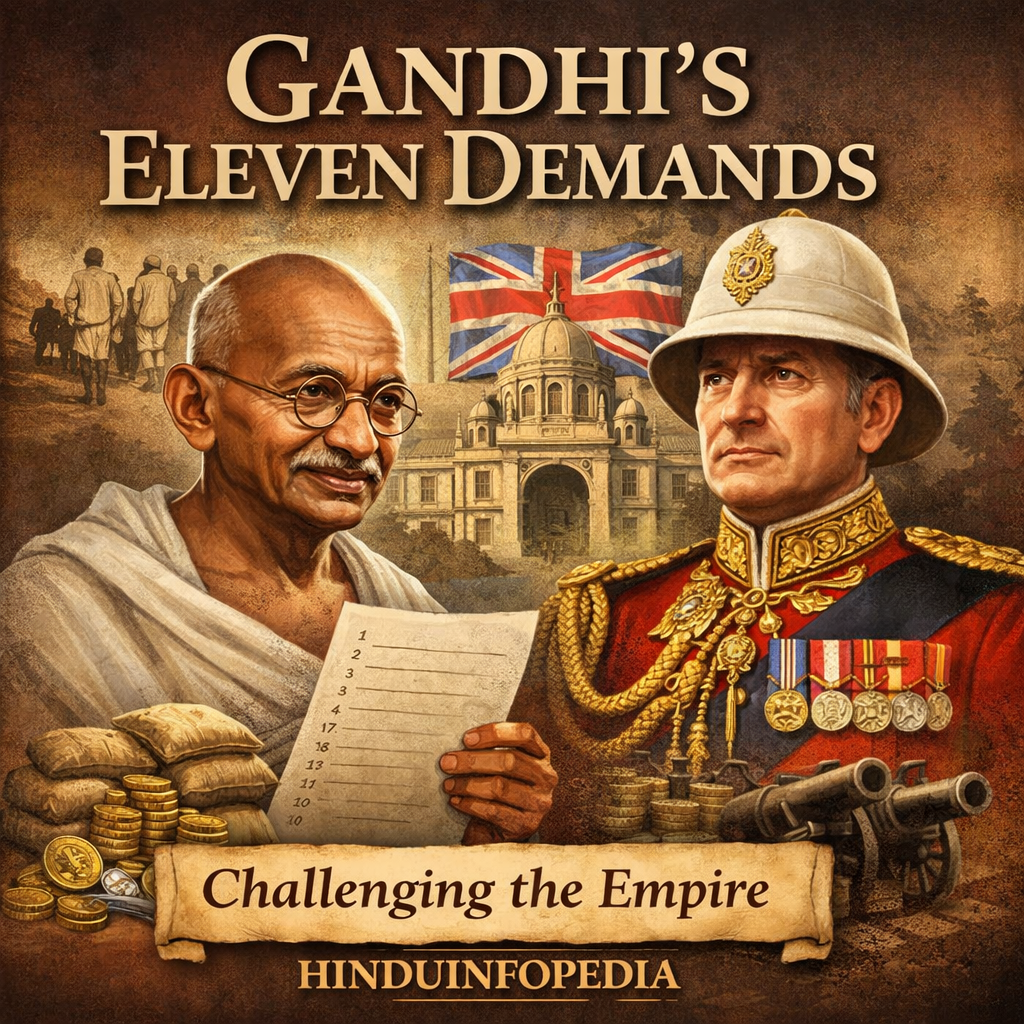
Gandhi’s Termination Notice: Eleven Demands, One Machine (15)
भारत / GB
Part 15: Mahatma Gandhi’s Peace Efforts | Series Index
Charter of Demands or Gandhi’s Termination Notice?
We have discussed Gandhi’s formation into the Satyagrahi from a renowned barrister and how the four Satyagrahs he lead starting from South Africa impacted people around him. We are now deep diving into the intellectual acumen of the Mahatma and the machine that British had been running for one hundred and seventy years — Council Bills draining trade surpluses, Home Charges bleeding the treasury, salt and land turned into instruments of tribute. Blog 13 documented the apparatus; Blog 14 priced it at £9.2 trillion and a life expectancy of twenty-seven. Gandhi’s letter to Lord Irwin, dated 31 January 1930, arrived at the machine’s door with eleven demands. This blog reads what each demand was actually aimed at. We now examine how the eleven demands constituted the termination of British Raj what we call as “Gandhi’s Termination Notice”.
Thank you for reading this post, don't forget to subscribe!The Action Taken: Gandhi’s charter mapped specific demands directly onto the primary gears of colonial extraction (salt, land revenue, tariffs, military budget, currency ratios).
Who Paid the Price: Grassroots volunteers mobilized under the belief that these 11 points were non-negotiable terms of national self-rule.
The Alternative Bypassed: The British Executive Council’s revenue autonomy, which was directly challenged by the targeted points.
Why This Matters: Documents that the leadership held an accurate structural blueprint of imperial fiscal vulnerability, meaning the subsequent surrender of these leverage points was an unforced choice.
Letter Written Viceroy: The Termination of British Raj
Gandhi’s Termination Notice was not framed as one. It arrived in polite English, in the hand of a Quaker emissary, addressed personally to Lord Irwin. It opened with the observation that the British and Indians were “moving in opposite directions.” It closed with a deadline of eleven days. What sat between those courtesies was, demand by demand, a precise map of every major component of colonial extraction — and a notice that each one must stop.
The eleven demands are documented in full in Blog 11. What Blog 13 and Blog 14 established is the machine those demands were served upon: the Council Bills mechanism that converted India’s genuine trade surplus with Britain into a recorded deficit, the Home Charges that extracted administrative costs from the colonised rather than the coloniser, the salt monopoly that taxed the one mineral no family could live without, the land revenue system that consumed up to half a cultivator’s harvest, and the Lancashire tariff arrangement that kept Indian textile manufacture permanently subordinate to British mills. Gandhi’s Termination Notice mapped onto each of these with a specificity that could not have been accidental.

Reading each demand against the mechanism it targeted
Gandhi’s Termination Notice began with the rupee-sterling exchange rate — fixed since 1899 at 1s 4d to the rupee. The rate was not merely unfavourable; it was the lever through which the Council Bills mechanism operated.
Britain purchased rupees cheaply, paid Indian exporters in those rupees, and extracted the sterling difference as invisible tribute. A rate correction would have severed the Council Bills drain at its root. The demand was framed as currency reform. The record shows it was structural severance.
The demand for a fifty percent reduction in land revenue struck directly at the largest single line of colonial extraction. Land tax, assessed at British discretion and collected regardless of harvest failure, had been the primary instrument of drain since the days of the East India Company. Dadabhai Naoroji’s calculations, cited in Blog 13, placed land revenue at the centre of the annual outflow he estimated at £200–300 million in 1901 prices.
Gandhi’s Termination Notice did not abolish the land tax; it proposed halving it, a demand that is difficult to reject.
The documentation indicates that even this partial demand would have removed the financial foundation of provincial colonial administration.
The abolition of the salt monopoly, the demand that Gandhi chose as the march’s public face, was simultaneously the most universal and the most symbolically exposed of the eleven. Every Indian household paid the salt tax — not as a percentage of income, but as a flat levy on biological necessity. The colonial administration’s own records showed the tax was regressive by design: it consumed a greater share of a landless labourer’s income than a zamindar’s. Gandhi’s Termination Notice named this plainly. The salt demand was chosen for the march precisely because it was impossible to defend in any forum before a watching world press.
The structural demands the standard history underweights
Three further demands in Gandhi’s Termination Notice receive less attention in the standard narrative than the salt and land clauses — and the documentation suggests they may have been the most structurally significant of all.
The demand for a fifty percent reduction in military expenditure targeted the imperial subsidy hidden inside India’s defence budget. India was being billed for the maintenance of a military that was used to suppress ordinary Indian to serve the British imperial interests across the globe. The figures, recorded in the annual India Office accounts, show that a substantial portion of what was classified as Indian military expenditure was in fact the cost of British power projection funded by Indian revenue. Gandhi’s Termination Notice served notice on this arrangement directly.
The demand for abolition of the Criminal Investigation Department — the CID — targeted the surveillance architecture that made organised resistance costly and visible. The CID maintained files on political activists, monitored correspondence, and provided the intelligence infrastructure through which the colonial state identified and neutralised emerging threats before they could consolidate. Without it, the information asymmetry that gave the colonial administration its tactical advantage over every mass movement would have been sharply reduced.
The tariff demand — protection for Indian textiles against British imports — was the economic heart of the khadi argument translated into legislative language. The Lancashire mills had operated behind an arrangement — not a formal treaty, but an enforced commercial reality — in which Indian import duties on British cloth were kept artificially low. Indian textile manufacture could not compete on those terms. The demand for a protective tariff would have broken Lancashire’s captive market of three hundred million consumers.

What the eleven demands were, read together
Individually, each of the eleven demands in Gandhi’s Termination Notice addressed a documented grievance.
Read together, the historical record shows they constituted something more coherent: a point-by-point dismantling of the specific mechanisms through which, as Utsa Patnaik’s research calculated and Shashi Tharoor’s parliamentary testimony corroborated, £9.2 trillion left India between 1765 and 1938.
- The rupee-sterling demand severed the Council Bills drain.
- The land revenue demand broke the primary extraction line.
- The salt demand abolished the most universally paid colonial tax.
- The military demand ended the imperial subsidy.
- The CID demand removed the surveillance architecture.
- The tariff demand opened the space for Indian industrial development.
No single demand was revolutionary in isolation. Assembled on one page, delivered with a deadline, Gandhi’s Termination Notice was — if its eleven demands had been granted in full — the end of the financial case for holding India at all.
Lord Irwin did not reply. The march began on 12 March 1930.
What the silence answered, and what Blog 16 now asks
Gandhi’s Termination Notice received no substantive response. Irwin’s private correspondence, later made available through the India Office records, reveals that the Viceroy understood the demands clearly. The documentation indicates that the administration’s internal assessment was not that the demands were unreasonable, but that granting them would unravel the financial architecture of the Raj itself.
That assessment is the subject of Blog 16. If the machine stops — if all eleven demands are granted — does Britain stay? The historians who have examined this question most carefully, from Naoroji to Patnaik to Tharoor, have arrived at the same structural answer. Blog 16 lays out that answer in full, through four decades of evidence assembled across this arc.
Gandhi’s Termination Notice was not answered in January 1930. The question it asked has been accumulating an answer ever since.
Feature Image: Click here to view the image.
Video
Glossary of Terms
- Council Bills: A financial mechanism used by the British government to convert India’s export surplus into a recorded deficit, enabling transfer of wealth to Britain without direct bullion movement.
- Home Charges: Payments made by India to Britain for administrative, military, and pension expenses, effectively shifting imperial costs onto Indian revenues.
- Salt Monopoly: A colonial system where the British controlled salt production and imposed tax on it, making a basic necessity a source of revenue.
- Land Revenue System: A taxation structure under British rule where agricultural producers were required to pay high taxes, often up to half of their output, regardless of crop conditions.
- Rupee–Sterling Exchange Rate: The fixed currency ratio (1 shilling 4 pence per rupee) that enabled Britain to extract value through trade and financial operations.
- Invisible Tribute: The hidden transfer of wealth from India to Britain through mechanisms like exchange manipulation and financial settlements rather than direct taxation.
- Economic Drain: The large-scale transfer of wealth from India to Britain during colonial rule, estimated by scholars like Dadabhai Naoroji and later expanded by Utsa Patnaik.
- Criminal Investigation Department (CID): A colonial intelligence agency used to monitor political activities, track communications, and suppress resistance movements.
- Information Asymmetry: A condition where the colonial administration possessed significantly more information than the public, enabling control over political movements.
- Imperial Subsidy: Financial burden placed on India to fund British military and administrative activities, including operations outside India.
- Lancashire Tariff System: A trade arrangement that kept Indian import duties on British textiles artificially low, ensuring dominance of British mills.
- Protective Tariff: A tax imposed on imported goods to support domestic industries by making foreign products less competitive.
- Regressive Taxation: A tax system where lower-income groups pay a higher proportion of their income compared to wealthier groups, as seen in the salt tax.
- Satyagraha: A method of non-violent resistance developed by Mahatma Gandhi, based on truth and moral force.
- Termination Notice (Interpretive Term): A conceptual framing used in the blog to describe Gandhi’s eleven demands as a structured challenge to the economic foundations of British rule.
#Gandhi #IndianHistory #FreedomStruggle #BritishRaj #SaltMarch #EconomicDrain #ColonialIndia #Independence #HinduinfoPedia
Scan Through The Entire Series at
Gandhi’s Peace Efforts: The Questions Before the Mahatma (0)
Refer to Various Arks Referred to in the Blog
- English YouTube: https://www.youtube.com/@Hinduofficialstation
- Hindi YouTube: https://www.youtube.com/@HinduinfopediaIn
- X: https://x.com/HinduInfopedia
- Instagram: https://www.instagram.com/hinduinfopedia/
- Facebook: https://www.facebook.com/Hinduinfopediaofficial
- Threads: https://www.threads.com/@hinduinfopedia