
Gandhi’s Opportunity: His Own Documented Word — and What He Overruled to Pursue (103)
भारत / GB
Part 103: Mahatma Gandhi’s Peace Efforts | Series Index
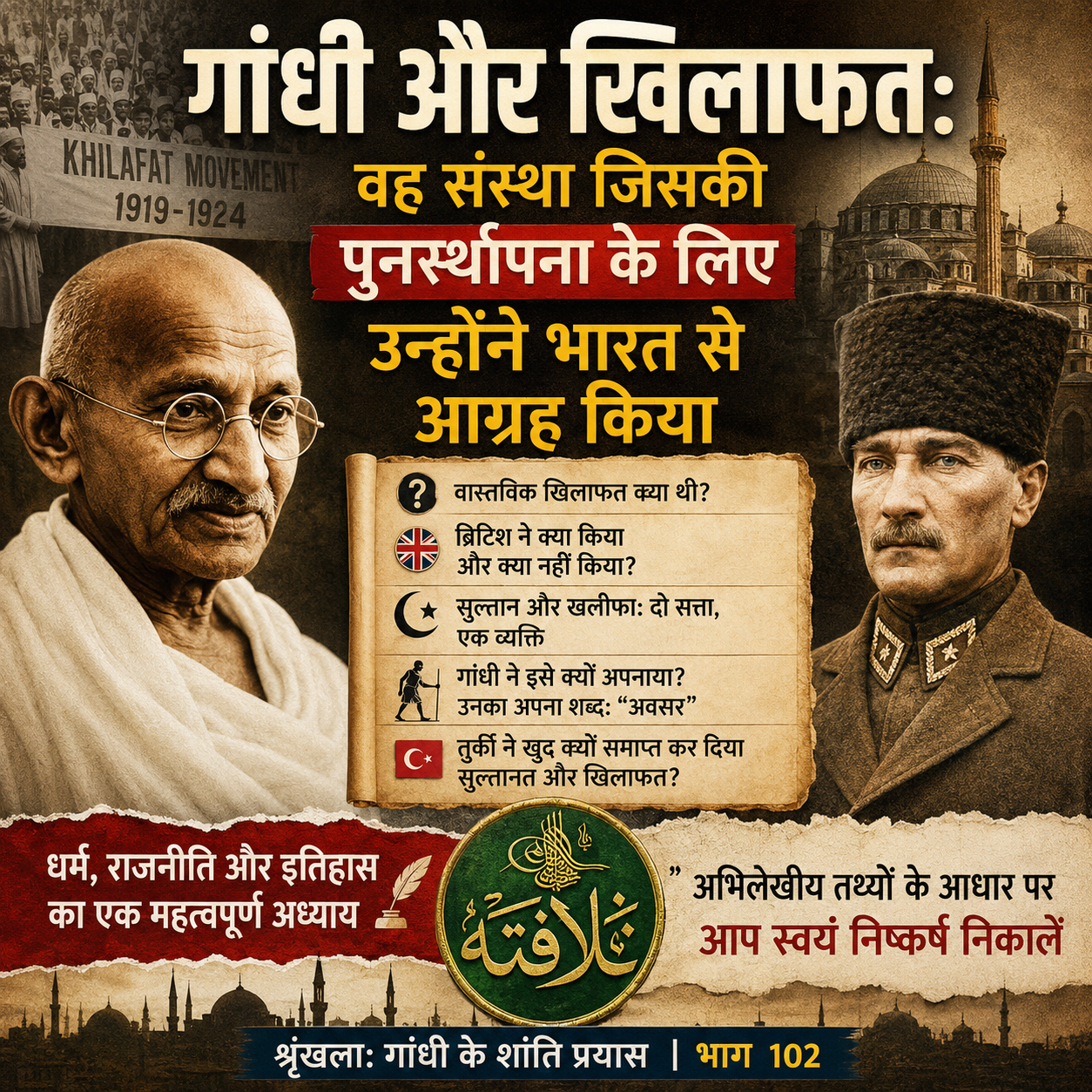
Blog 102 documented what the Ottoman Caliphate was, what the British actually did and did not do to it, and why its demands were territorial rather than religious. This post places Gandhi’s own documented word for his decision to adopt the Khilafat cause before the reader — and what he overruled to pursue it.
Thank you for reading this post, don't forget to subscribe!The Action Taken: Gandhi partnered with the Ali brothers as his primary political ambassadors, repeatedly endorsing their authority even as they declared religious loyalty superior to Indian civil governance.
Who Paid the Price: Modern secular leadership within the Indian Muslim community, which was sidelined in favor of revivalist theological orators.
The Alternative Bypassed: Aligning with non-sectarian, constitutional Muslim public figures who prioritized Indian self-determination over pan-Islamic revival.
Why This Matters: Elevated charismatic pan-Islamic clerics to the highest rungs of national leadership, creating a precedent where religious zealotry was granted official Congress cover.
Gandhi’s Own Word — Documented
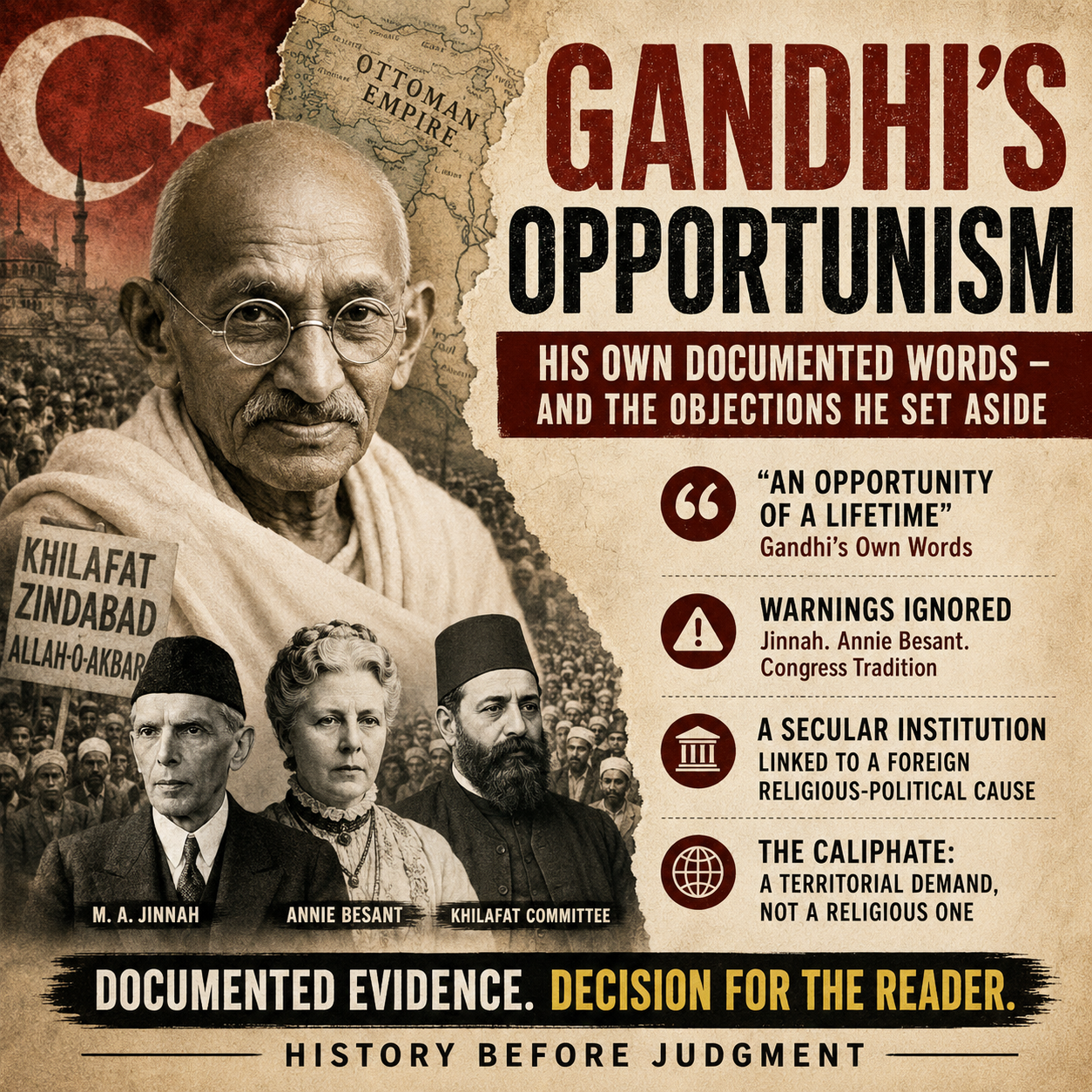
Gandhi’s Opportunity places the primary exhibit before the reader at the outset: Gandhi’s own documented description of the Khilafat cause.
Gandhi saw in the Khilafat cause what he called an “opportunity of a lifetime” — to forge a lasting alliance between Hindus and Muslims and bring the Muslim population into the mainstream of the nationalist struggle against British rule. This is Gandhi’s own documented language. The series does not characterise Gandhi’s motivation. Gandhi named it himself.
The prosecution places one observation alongside that word: Gandhi was not a Muslim and held no personal religious investment in the Caliphate. His own documented stated reason for joining the cause was the opportunity it represented — not doctrinal conviction — placed on record in his own words and by contemporaries. He was not a Muslim. He held no investment in the Ottoman Sultan’s religious authority. He adopted a pan-Islamic territorial demand — established in Blog 102 as a demand for the restoration of a defeated foreign empire’s territorial sovereignty — because he saw in it an opportunity to mobilise India’s Muslim population into the independence movement.
What Gandhi Overruled — Documented
Gandhi’s Opportunity places the documented institutional objections Gandhi overruled to pursue that opportunity before the reader.
1. The Political Warning: M.A. Jinnah
The first documented objection is Jinnah’s — placed before the reader in Blog 82. At the 1920 Nagpur session, Jinnah warned Gandhi directly that entangling the secular independence movement with the religious elements of the Khilafat cause was a structural mistake. He was shouted down by the Muslim majority Gandhi had mobilised and resigned from Congress rather than support the alliance. Jinnah’s objection was not a whispered reservation — it was a public warning made in Congress’s own session, by the man who had been called the Ambassador of Hindu-Muslim Unity, at the moment Gandhi was building the alliance Jinnah was warning against.
2. The Ideological Warning: Annie Besant
The second documented objection is Annie Besant’s. Besant — then President of the Theosophical Society and a senior Congress leader — warned Gandhi that mixing religion with politics would produce consequences he could not control. Her warning named the specific danger: that a movement built on religious mobilisation would fragment along religious lines once the immediate cause dissipated. The documented record of what followed — examined in later blogs — is available for the reader to assess against Besant’s warning.
3. The Institutional Constraint: The Indian National Congress
The third overridden constraint was structural rather than personal: the Indian National Congress was a secular independence organisation. Making the restoration of a foreign empire’s religious-political authority a formal Congress demand — alongside Swaraj — altered the character of the organisation. Gandhi held documented unchallengeable authority over Congress, established across the series. He used that authority to override the secular institutional logic of the organisation he led.
The Ambedkar primary source at franpritchett.com documents the consequence precisely: the Non-Cooperation Movement was initiated by the Khilafat Committee, and what the Calcutta Congress session did was adopt what the Khilafat Conference had already done — in the interest not of Swaraj, but of the Khilafat cause. The secular independence movement formally adopted a foreign religious-political institution’s territorial restoration as its own demand, by Gandhi’s intervention.
The Documented Logic of the Opportunity
Gandhi’s Opportunity places Gandhi’s own documented reasoning before the reader. Gandhi was certain, by his own documented account, that no mass Non-Cooperation Movement could be organised without bringing Hindus and Muslims closer together. The Khilafat cause was, in his documented assessment, the available mechanism — a cause that resonated deeply with India’s Muslim population and that could be adopted to build the broadest possible coalition against British rule.
The prosecution places the documented logic alongside the documented institution. The cause Gandhi adopted as his opportunity was one whose demands were territorial, whose institution the British had not attacked as a religious body, and whose own successor state would abolish it within four years. Gandhi’s own documented word — “opportunity of a lifetime” — is placed before the reader alongside what he adopted and what he overruled to adopt it.
The Prosecution’s Position
Gandhi’s Opportunity places three questions before the reader.
- Did Gandhi adopt the Khilafat cause — by his own documented word — as an “opportunity of a lifetime,” knowing he did not believe in a Caliphate, and knowing the cause’s demands were territorial rather than religious?
- Did Gandhi overrule Jinnah’s documented 1920 warning, Besant’s documented warning, and the secular institutional logic of Congress itself, using the documented unchallengeable authority the series has established across multiple blogs?
- Does the documented institution Gandhi adopted as his opportunity — a defeated foreign empire’s territorial restoration demand, abolished by the Turks themselves in 1924 — belong before the reader alongside his documented word for the decision?
The series does not answer. Gandhi’s Opportunity places Gandhi’s own documented word, the documented institutional objections he overruled, and the documented character of the cause he adopted before the reader. The reader will examine the opportunity Gandhi named — and complete the sentence.
Invitation To Defence
The floor belongs to the defense. We now invite them to present their exhibits and challenge the narrative established by the prosecution.
Gandhi’s own documented word: an opportunity of a lifetime. Gandhi did not believe in a Caliphate — his support was tactical. Jinnah warned him at Nagpur — was shouted down, resigned. Besant warned him — consequences he could not control. The secular character of Congress — overruled by the authority the series has documented. The institution adopted: a defeated foreign empire’s territorial demand, abolished by the Turks in 1924. The prosecution places Gandhi’s own word before the reader. The reader will complete the sentence.
Feature Image: Click here to view the image.
Videos
Glossary of Terms
- Khilafat Movement: A political movement launched to support the continuation of the Ottoman Caliphate after the First World War, later supported by Mahatma Gandhi to build Hindu-Muslim cooperation.
- Ottoman Caliphate: The religious-political institution headed by the Ottoman Sultan, abolished by the Republic of Türkiye in nineteen hundred twenty-four.
- Opportunity of a Lifetime: Gandhi’s documented phrase describing his decision to support the Khilafat cause as a means of fostering Hindu-Muslim unity and strengthening the national movement.
- Non-Cooperation Movement: A nationwide movement launched in nineteen hundred twenty to oppose British rule through peaceful non-cooperation.
- Pan-Islamic Cause: A movement seeking political solidarity among Muslims across national boundaries, including support for the Ottoman Caliphate.
- Territorial Restoration: The demand to restore the territorial sovereignty and political authority of a defeated state or empire.
- M. A. Jinnah: A senior Congress leader who opposed linking India’s nationalist movement with the Khilafat issue and later became the founder of Pakistan.
- Annie Besant: A Congress leader and President of the Theosophical Society who warned against combining religion with politics.
- Secular Institutional Logic: The principle that the Indian National Congress functioned as a non-religious political organization focused on India’s independence.
- Congress Nagpur Session (1920): The Indian National Congress session where Gandhi’s Non-Cooperation programme and the Khilafat alliance were adopted, despite Jinnah’s objections.
- Khilafat Committee: The organization formed to lead the Khilafat Movement, whose programme later became closely linked with the Non-Cooperation Movement.
- Calcutta Congress Session (1920): The special Congress session that accepted the Non-Cooperation programme associated with the Khilafat Movement.
- Documented Institution: A key phrase in this series referring to institutions examined through primary historical records rather than later interpretations.
- Documented Opportunity: A key phrase coined in this series referring to Gandhi’s own recorded description of the Khilafat cause as an “opportunity of a lifetime.”
- Prosecution Framework: The analytical method used in this series that presents historical documents as evidence while inviting readers to reach their own conclusions.
#Gandhi #Khilafat #Congress #Jinnah #History #India #Freedom #Caliphate #Politics #HinduinfoPedia
Gandhi’s Peace Efforts: The Questions Before the Mahatma (0)