
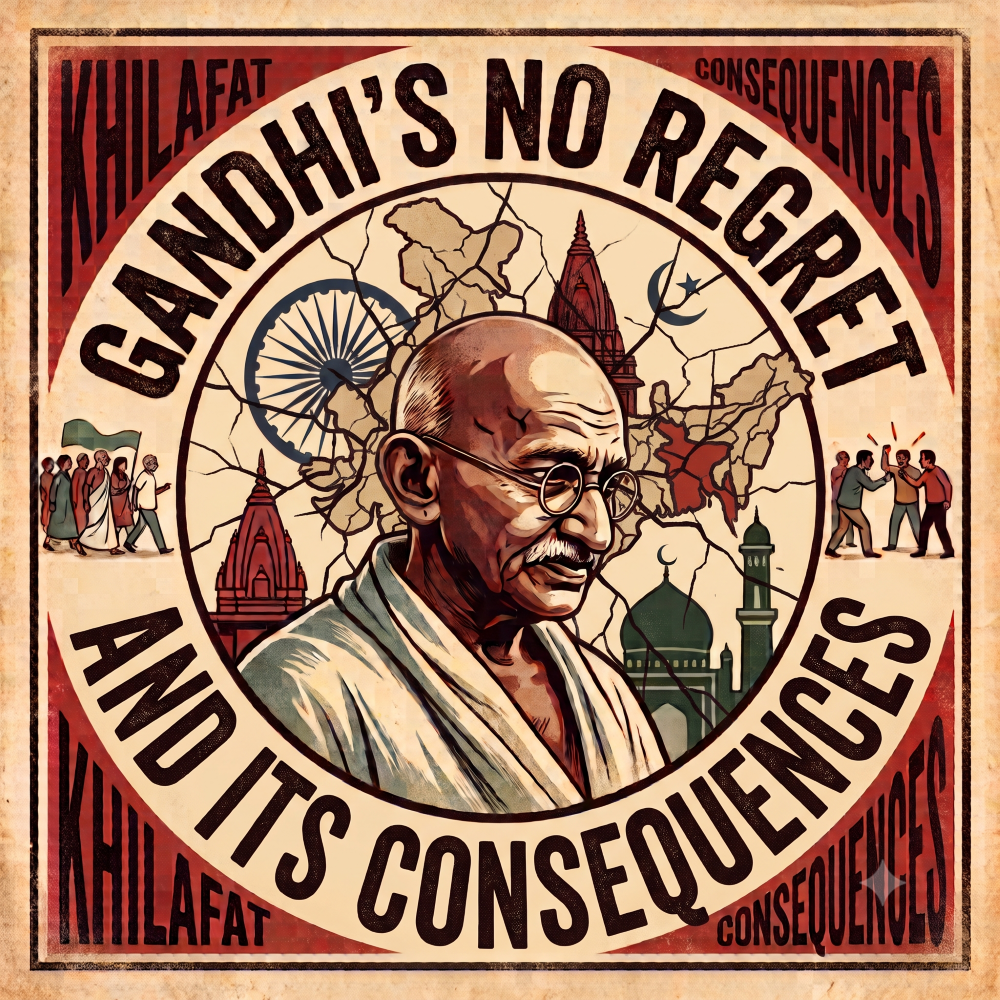
Gandhi’s No Regret: His Position on Khilafat Decision And Consequences (111)
भारत / GB
Part 111: Mahatma Gandhi’s Peace Efforts | Series Index
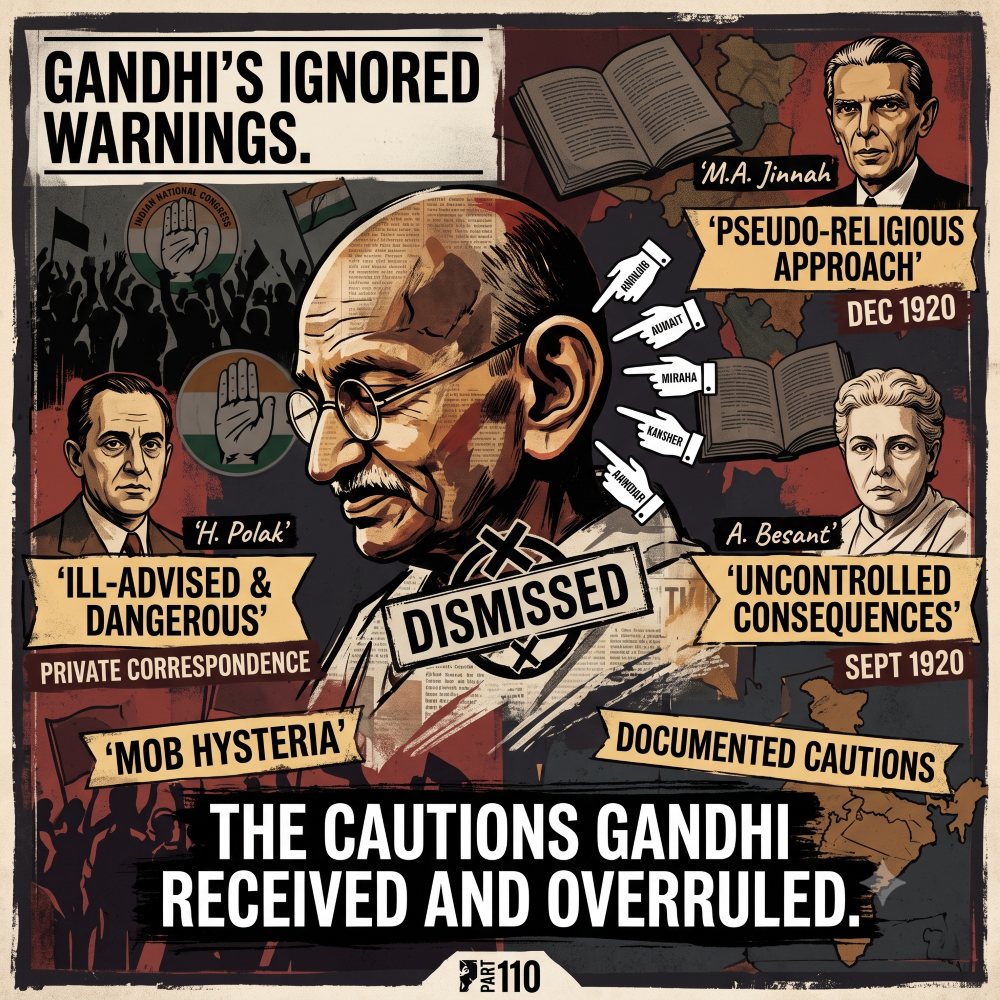
Blog 110 placed the documented warnings Gandhi received before and during the Khilafat decision — from Jinnah, Polak, and Besant. This post, Gandhi’s No Regret, places Gandhi’s own documented position after the consequences arrived: what he said about the Khilafat decision in 1924, after the Moplah rebellion, after the communal riots, after the movement’s collapse — and what he chose not to call a mistake.
Thank you for reading this post, don't forget to subscribe!The Action Taken: Even as communal riots erupted across India following the collapse of the Khilafat movement, Gandhi declared in print: “I have no regret whatsoever for having taken up the Khilafat cause.”
Who Paid the Price: The victims of the post-1922 riot cascade, who bore the human consequences of an experiment the leadership refused to evaluate critically.
The Alternative Bypassed: Conducting a formal, public review of the Khilafat strategy and redesigning nationalist mobilization methods.
Why This Matters: Doctrinal immutability: the leadership preserved its ideological position unchanged despite visible, systemic failure on the ground.
What Had Already Happened by 1924
Gandhi’s No Regret places the documented record before the reader first, so that Gandhi’s 1924 position can be assessed against what it followed.
By 1924: the Moplah rebellion of 1921 had produced documented killings, forced conversions, and temple desecrations in Malabar, that followed the growth of communal riots between Muslims and Hindus post the Moplah killings — examined in detail in the following blog in this series. The Non-Cooperation Movement had been suspended by Gandhi unilaterally in February 1922 following Chauri Chaura — twenty-two policemen killed by a crowd as a backlash of the police action on peaceful demonstrators. The Caliphate had been separated from the Turkish state in 1922 and would be abolished entirely in March 1924. Communal riots had broken out across India: Multan (September 1922), Amritsar (April 1923), Agra and Saharanpur (August 1923), Nagpur (1923 and 1924). The Khilafat movement had disintegrated. The documented cause — restoration of the Ottoman Caliphate — had been rendered moot by the Turks themselves.
Gandhi, who was arrested after British were given lathi charge license by Gandhi himself as a consequence of suspension of Non-Cooperation Movement, was released from prison on February 4 1924. He wrote his most extensive post-facto assessment of the Khilafat period in Young India on May 29 1924.
Gandhi’s Own 1924 Documented Words — Young India, May 29 1924
Gandhi’s No Regret places Gandhi’s own documented words from that article before the reader. The article, “Hindu-Muslim Tension: Its Cause and Cure,” appears in CWMG Vol. 24, pp. 136-154. The opening documented passage, as cited in asthabharati.org from CWMG Vol. 24, p. 136:
“You asked the Hindus to make common cause with the Mussalmans on the Khilafat question. Your being identified with it gave it an importance it would never have otherwise received. It unified and awakened the Mussalmans. It gave prestige to the Maulvis which they never had before. And now that the Khilafat question is over, the awakened Mussalmans have proclaimed a kind of Jihad against us Hindus.”
The prosecution places one observation alongside this documented passage: Gandhi explicitly structured the May 29 1924 article with a “Hindu Indictment” section — recording what Hindus said to him — followed by his own analysis and cure. The “hearts not pure enough” conclusion appeared in Gandhi’s own analytical voice, not in the Hindu Indictment section. Gandhi used the structural separation of the article to place the documented consequence in Hindu mouths and the documented explanation in his own — as analysis, not admission. He recorded what Hindus were saying to him, not what he himself concluded. The distinction matters: Gandhi documented the consequence in the voices of those who suffered it, while the question of whether he regretted producing it remains in what follows.
The Himalayan Blunder — What Gandhi Called a Mistake
Gandhi famously admitted to a “Himalayan Miscalculation” or “Himalayan Blunder.” Gandhi’s No Regret places the documented definition of that blunder before the reader precisely.
Gandhi applied the Himalayan Blunder specifically to launching mass civil disobedience before the people were trained in non-violence — his documented reflection after the Chauri Chaura incident of February 1922, in which twenty-two policemen were killed by a crowd. The documented occasion was Chauri Chaura, not the Khilafat decision. Gandhi’s documented position: the miscalculation was calling people to civil disobedience before they had qualified themselves for it (CWMG Vol. 22, post-February 1922 writings). The decision to introduce religion into politics — his own documented May 1920 language — was not what Gandhi called the Himalayan Miscalculation. That was the blunder. The decision to introduce religion into politics as an experiment — his own documented May 12 1920 Young India language — was not what Gandhi called the Himalayan Blunder.
Gandhi’s No Regret places this documented distinction before the reader: the experimenter identified a flaw in the execution, not in the experiment itself.
Gandhi’s Documented Post-1924 Justification
The documented post-facto position is available across multiple sources. Gandhi’s documented position, recorded across contemporary sources and secondary accounts drawing on Young India 1924: he did not regret the Khilafat decision. He saw it as a necessary demonstration that Hindus felt for Muslim grievances as brothers. If the unity achieved was temporary, Gandhi’s documented reasoning held that the failure lay in insufficient purity of heart among the participants — not in the cause itself, not in the decision to adopt it, and not in the introduction of religion into politics as a method.
The documented Jinnah verdict on this method — “pseudo-religious approach to politics,” “working up mob hysteria” — is placed before the reader alongside Gandhi’s documented post-facto justification. The documented Besant verdict — consequences Gandhi could not control — is placed alongside Gandhi’s documented position that the hearts of the participants were not pure enough. The prosecution places both sets of documented positions before the reader and asks the reader to examine what Gandhi chose to call a mistake, and what he chose not to.
What Gandhi Chose Not to Call a Mistake
Gandhi’s No Regret places the documented record of what Gandhi did not retract before the reader.
Gandhi did not retract the May 12 1920 Young India statement that he had been “experimenting with myself and my friends by introducing religion into politics.” He did not publicly acknowledge that Jinnah’s documented warning — that the pseudo-religious approach would mean disaster — had been correct. He did not retract the September 1920 Calcutta session adoption of Khilafat demands alongside Swaraj. He did not retract the December 1920 Nagpur override of Jinnah’s solitary documented dissent.
What Gandhi documented instead: the 1924 communal riots as a test of Hindu courage, the Moplahs as acting under a mistaken sense of religion, and the Himalayan Blunder as a flaw in mass readiness rather than a flaw in the experiment itself.
The Prosecution’s Position
Gandhi’s No Regret places three questions before the reader.
- Did Gandhi’s own documented May 29 1924 Young India article place on record the communal consequence of the Khilafat decision — “the awakened Mussalmans have proclaimed a kind of Jihad against us Hindus” (CWMG Vol. 24, p. 136) — while framing it as Hindu anguish reported to him rather than as his own verdict on the decision?
- Did Gandhi define the Himalayan Blunder specifically as a flaw in mass readiness for non-violence — not as a flaw in the decision to introduce religion into politics as an experiment — placing before the reader a documented distinction between what Gandhi called a mistake and what he did not?
- Does Gandhi’s documented post-facto position — no regret for the decision, blame on insufficient purity of heart rather than on the decision itself — belong before the reader alongside the documented warnings he received before proceeding and the documented consequences he recorded after they arrived?
The series does not answer. Gandhi’s No Regret places Gandhi’s own documented 1924 words, his documented definition of the Himalayan Blunder, and his documented post-facto position before the reader. The reader will examine what Gandhi chose to call a mistake — and what he did not — and complete the sentence.
Invitation To Defence
The floor belongs to the defense. We now invite them to present their exhibits and challenge the narrative established by the prosecution.
1924. The Moplah rebellion documented. Communal riots documented across India. The Caliphate abolished by the Turks. Gandhi’s own documented words: “the awakened Mussalmans have proclaimed a kind of Jihad against us Hindus.” The Himalayan Blunder: the masses were not ready — not that religion was introduced into politics. No documented retraction of the experiment. No documented acknowledgment that Jinnah’s warning was correct. The prosecution places Gandhi’s own documented position after the consequences before the reader. The reader will complete the sentence.
Feature Image: Click here to view the image.
Videos
Glossary of Terms
- Gandhi’s Rejection of Error: The central theme of this blog, referring to Gandhi’s documented refusal to regard the Khilafat decision as a mistake despite its consequences.
- Khilafat Decision: Gandhi’s support for the Khilafat Movement in 1920 by linking it with the Indian nationalist struggle.
- Khilafat Movement: A movement launched to preserve the Ottoman Caliphate after the First World War, strongly supported by many Indian Muslim leaders.
- Young India: Gandhi’s weekly journal in which he published his political views, including his 29 May 1924 assessment of the Khilafat period.
- CWMG (Collected Works of Mahatma Gandhi): The official multi-volume collection of Gandhi’s writings, speeches, correspondence, and published articles.
- Himalayan Blunder: Gandhi’s expression describing his mistake of beginning mass civil disobedience before the public was adequately trained in non-violence.
- Moplah Rebellion: The 1921 uprising in Malabar involving violence, killings, forced conversions, and destruction of temples during the Khilafat period.
- Chauri Chaura Incident: The February 1922 event in which a violent mob killed twenty-two policemen, leading Gandhi to suspend the Non-Cooperation Movement.
- Non-Cooperation Movement: Gandhi’s nationwide campaign of peaceful resistance against British rule launched in 1920.
- Pseudo-Religious Politics: Jinnah’s description of mixing religion with political mobilization, which he warned would produce disastrous consequences.
- Communal Riots: Violent conflicts between religious communities that spread across several Indian cities during 1922–1924.
- Caliphate Abolition: The formal abolition of the Ottoman Caliphate by the Republic of Türkiye in March 1924, ending the original objective of the Khilafat Movement.
- Documented Post-Facto Position: Gandhi’s recorded explanation of the Khilafat decision after its political and social consequences had unfolded.
- Hindu Indictment: The section in Gandhi’s 29 May 1924 Young India article where he reproduced criticisms expressed to him by Hindus before presenting his own analysis.
- Series Index: The master page linking all parts of the Mahatma Gandhi’s Peace Efforts series in chronological order.
#Gandhi #Khilafat #History #India #Jinnah #Congress #Freedom #Politics #Moplah #HinduinfoPedia
Gandhi’s Peace Efforts: The Questions Before the Mahatma (0)