
Gandhi’s Duty Mandate: National Hindu Sanction To Khilafat Cause (219)
भारत / GB
Part 219: Mahatma Gandhi’s Peace Efforts (The Communal Contagion & Malabar Prototype) | Series Index
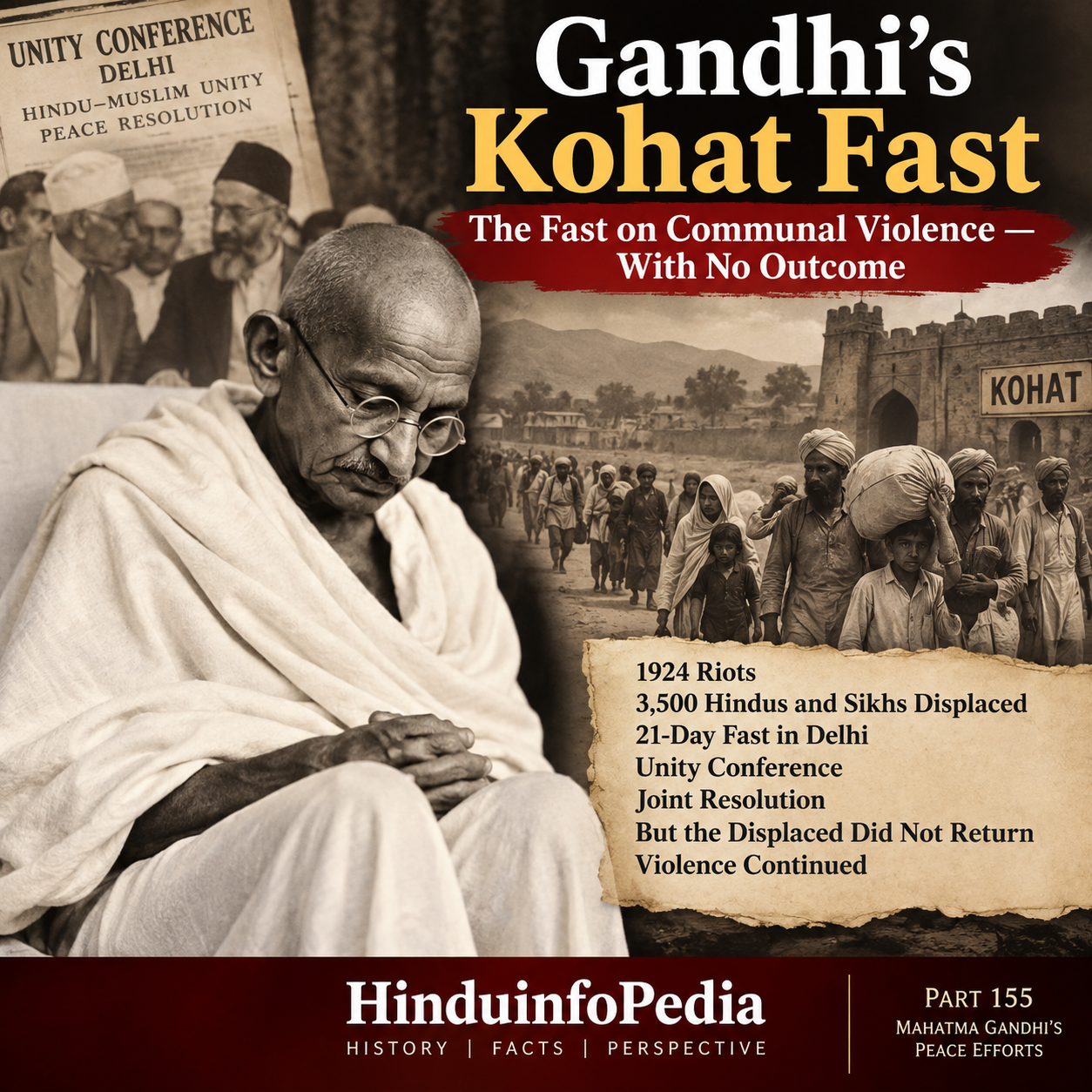
In Blog 218, we examined how the Khilafat apparatus took over Congress operations through two simultaneous tracks after driving Muhammad Ali Jinnah out at Nagpur — enabled by Gandhi’s rebranding of Khilafat support as a “paramount duty” under the English label of Non-Cooperation. This instalment isolates the exact primary texts behind that rebranding: Gandhi’s June–August 1920 Young India statements framing Khilafat support as a binding duty on non-Muslim Indians, contrasted with the classical Hanafi counter-rulings and constitutional warnings simultaneously on the record but absent from Young India. The three-tier transmission machine that carried these endorsements into the Frontier is in Blog 215; the counter-authority Gandhi declined to amplify is in Blog 216; the root causes of the Kohat attacks on Hindus and Sikhs are in Blog 217; Gandhi’s response fast is in Blog 155.
Thank you for reading this post, don't forget to subscribe!GANDHI’S JUNE–AUGUST 1920 YOUNG INDIA DUTY LANGUAGE: THE PRIMARY RECORD
The Action Taken: Between June and August 1920, Gandhi published a sequence of statements in Young India — the English-language weekly he edited — that framed Khilafat support not as a political choice but as a duty: a “paramount duty” of every Indian, Hindu and Muslim alike, to redress the wrong done to the Caliphate by the British government. These statements appeared in the same weeks that Ahmed Raza Khan’s counter-fatwas (Tadbir-e-Falah o Najat o Islah and Al-Mahajjat al-Mu’taminah) ruling the Dar-ul-Harb declaration invalid were in circulation in classical Hanafi clerical networks, and that Jinnah’s constitutionalist objections were on record in Congress correspondence. None of the counter-authority appeared in Young India.
Who Paid the Price: The Hindu and Sikh communities across north India and the North-West Frontier whose neighbourhood relations with Muslim families were fractured by the reclassification of Khilafat support from political choice to binding duty — a reclassification that, once transmitted through the mosque-pulpit circuit documented in Blog 215, reached populations that had never read Young India and carried consequences Gandhi’s English-language framing had not acknowledged.
Why This Matters: Gandhi’s duty-language gave the Khilafat agitation something it could not have generated from within its own clerical constituency: the public endorsement of the most prominent non-Muslim political figure in India, framed as a national obligation rather than a sectarian cause. That endorsement is documented in the pages of Young India and in CWMG Volumes 17–20. The counter-record Gandhi chose not to amplify is documented in Blog 216.
1. The “Paramount Duty” Statements: June–August 1920 Young India
The significance of “paramount duty” as framing was structural, not rhetorical. Addressed to an English-language audience of Congress members, moderate politicians, and the British administration under the secular label of Non-Cooperation, the statements appeared to be an expression of inclusive nationalism. Transmitted through the mosque-pulpit circuit — where Gandhi’s endorsements were cited alongside Quranic injunctions as confirmation that the Khilafat cause carried the support of Hindu India — they functioned as national sanction for a theological-political programme that classical Hanafi jurisprudence had already ruled invalid. This is Gandhi’s duty mandate: the documented conversion of Khilafat support from a Muslim sectarian claim into a binding national obligation, in Gandhi’s own published words.
2. What Young India Did Not Publish: The Counter-Record in the Same Weeks
In the same June–August 1920 period that Gandhi was publishing his duty-language on Khilafat, two bodies of counter-authority were on the record and available to him. First, Ahmed Raza Khan of Bareilly had issued his formal fatwas — Tadbir-e-Falah o Najat o Islah and Al-Mahajjat al-Mu’taminah — ruling that the classical Hanafi conditions for Dar-ul-Harb were not met in British India and that the Hijrat call was therefore a politically manufactured obligation rather than a valid religious duty. These rulings were circulating in the same clerical networks that were transmitting the Khilafat agitation. Second, Muhammad Ali Jinnah’s constitutionalist warnings — that mixing mass agitation with clerical authority would produce consequences Congress could not control — were on record in Congress correspondence and would be stated from the Nagpur floor in December 1920.
Neither the Ahmed Raza Khan fatwas nor Jinnah’s constitutional objections appeared in Young India in June–August 1920 or in the subsequent months before the Nagpur Congress. Gandhi’s duty mandate, documented in Young India, was not accompanied by any acknowledgement that authoritative counter-rulings existed within classical Hanafi jurisprudence — the same legal tradition the Khilafat agitation was invoking. The asymmetry is documented: what Gandhi published and what Gandhi did not publish, in the same editorial weeks, is in the archive.
3. The Causal Chain: Duty-Language to Neighbourhood Destruction
Gandhi’s framing of Khilafat support as a “paramount duty” binding on non-Muslim Indians had a specific street-level consequence that his English-language audience could not see from Young India alone. When transmitted through the mosque-pulpit circuit — where the same duty-language was reinforced by Quranic injunctions on Tark-e-Mawalat (severance of ties with non-Muslims) and the Dar-ul-Harb framework — it contributed to the reclassification of multi-generational Hindu–Muslim commercial and social relationships as religiously impermissible. The bahi-khata credit partnerships, the shared marketplaces, and the daily civic relations documented in Blog 183 across Chandni Chowk and the Agra–Mathura belt were not severed by mosque sermons alone — they were severed by mosque sermons that could cite Gandhi’s public authority as confirmation that the cause was a national duty, not a sectarian one.
The causal chain from Gandhi’s duty mandate to documented neighbourhood destruction runs through four links: Gandhi’s English-language duty-framing (June–August 1920 Young India) → transmission through the clerical-mosque circuit (the three-tier machine of Blog 215) → street-level commercial and social severance (Blog 183) → the Kohat expulsion of Hindus and Sikhs in September 1924 (Blog 217) and Gandhi’s 21-day fast with zero prosecutions (Blog 155). Each link in this chain is documented independently. The chain itself is what this instalment assembles from those independent records.
4. The Bilingual Asymmetry: What Each Audience Received
Gandhi’s June–August 1920 Young India statements and his joint tour with the Ali Brothers in July 1920 produced two different messages for two different audiences simultaneously. The English-language audience — Congress members, moderate politicians, the British administration, and international observers — received a message of inclusive nationalism: Hindu–Muslim brotherhood expressed through shared political grievance against British policy on the Caliphate. The Urdu-language mosque audience — frontier Muslim populations, district-level Khilafat organisers, and the clerical networks transmitting the Dar-ul-Harb framework — received Gandhi’s public endorsements as confirmation from Hindu India’s most prominent leader that the Khilafat cause carried national sanction, reinforcing the theological injunctions already in circulation.
This bilingual asymmetry is not an inference about Gandhi’s intent — it is a structural consequence of the two different transmission channels operating simultaneously on the same set of public statements. Gandhi’s duty mandate, as documented in the June–August 1920 Young India sequence, did not reach its two audiences with the same meaning. The English-language record and the Urdu-language operational record are both in the archive; they document different consequences of the same published statements. The 300-series carry-forward to Blog 303 will address what that asymmetry meant for the constitutional question; this instalment documents only what the primary record shows about the two channels and what each received.
Modern Parallel
The pattern documented in Gandhi’s duty mandate — a prominent non-Muslim leader framing a clerical-sectarian demand as a national duty binding on citizens of other faiths, while ignoring authoritative Muslim jurists and constitutional reformers who opposed that demand — has recurred in post-1947 Indian politics whenever secular leaders have endorsed clerical campaigns over personal law or religious offence as a test of “secular duty.” When English-language political endorsements enter religious mobilisation circuits that the endorsing leader neither monitors nor controls, they confer national legitimacy on street demands whose consequences the leader’s secular audience neither anticipates nor owns.
Through Gandhi’s duty mandate in June–August 1920, English-language duty-framing by a prominent non-Muslim leader — transmitted through Urdu-language clerical circuits as national sanction — gave the Khilafat agitation access to a legitimacy resource it could not have generated from within its own constituency. That resource was Gandhi’s public authority. The Young India record shows precisely when and how that authority was committed, in Gandhi’s own words, to a cause whose theological basis had been ruled invalid by the most authoritative counter-voice within classical Hanafi jurisprudence.
Invitation To Defence
The Young India issues of June–August 1920 and their CWMG equivalents are publicly available archival records. Ahmed Raza Khan’s counter-fatwas and Jinnah’s constitutionalist warnings are documented in the same period. The defence is invited to produce any primary document from June–August 1920 showing that Gandhi’s Young India duty-language was accompanied by any acknowledgement of Ahmed Raza Khan’s counter-ruling, any caveat qualifying the “paramount duty” framing to exclude the theological dimensions of the Khilafat cause, or any instruction to the mosque-circuit transmission network to separate Gandhi’s political endorsement from the Dar-ul-Harb and Tark-e-Mawalat framework it was amplifying simultaneously.
Between June and August 1920, Gandhi’s Young India statements framed Khilafat support as a “paramount duty” binding on all Indians — in the same weeks that classical Hanafi counter-authority ruling the Dar-ul-Harb declaration invalid was in circulation and absent from Young India. Gandhi’s duty mandate, transmitted through the three-tier machine documented in Blog 215, gave the Khilafat agitation national Hindu sanction it could not have generated alone — and whose street-level consequences reached Kohat four years later.
Feature Image: Click here to view the image.
Videos
Glossary of Terms
1. Gandhi’s Duty Mandate: The term used in this blog to describe Gandhi’s June–August 1920 public statements presenting support for the Khilafat cause as a paramount national duty for Hindus and Muslims alike.
2. Khilafat Movement: A political and religious movement organised by Indian Muslims to oppose British policy concerning the Ottoman Caliphate after the First World War.
3. Young India: The English-language weekly newspaper edited by Mahatma Gandhi, in which he published his statements on Khilafat support and Hindu–Muslim cooperation during 1920.
4. Paramount Duty: Gandhi’s expression describing support for the Khilafat cause as an overriding obligation for Indians, including those who did not belong to the Muslim community.
5. Caliphate: The institution of religious and political leadership associated with the Ottoman Sultan, whose status became a central concern of the Khilafat agitation.
6. Hanafi Jurisprudence: A major school of Islamic legal interpretation. The blog discusses its classical legal conditions concerning the classification of British India as Dar-ul-Harb.
7. Dar-ul-Harb: A classical Islamic legal classification referring to a territory considered outside the jurisdiction of Islamic political authority. The blog examines the rulings that rejected its application to British India.
8. Hijrat: Migration undertaken for religious reasons. In 1920, the Hijrat movement encouraged Indian Muslims to migrate to Afghanistan on the argument that British India was Dar-ul-Harb.
9. Ahmed Raza Khan’s Counter-Fatwas: Religious legal opinions issued by Ahmed Raza Khan of Bareilly, including Tadbir-e-Falah o Najat o Islah and Al-Mahajjat al-Mu’taminah, rejecting the validity of the Dar-ul-Harb declaration and the associated Hijrat obligation.
10. Tark-e-Mawalat: A religious-legal expression concerning the severance or withdrawal of social and cooperative relations with non-Muslims. The blog examines its role in the transmission of religious-political messaging.
11. CWMG (Collected Works of Mahatma Gandhi): The collected documentary volumes containing Gandhi’s writings, speeches, correspondence and other historical records. Volumes seventeen to twenty are particularly relevant to this instalment.
12. Three-Tier Transmission Machine: A term used in the series to describe the communication network through which English-language political endorsements were transmitted into Urdu-language clerical and mosque-pulpit mobilisation.
13. Bilingual Asymmetry: The difference between the messages received by English-language political audiences and Urdu-language mosque audiences from the same public endorsements, as examined in this blog.
14. Mosque-Pulpit Circuit: The network of religious communication through which political and theological messages were conveyed to local Muslim populations and community organisers.
15. National Sanction: The public legitimacy or endorsement that Gandhi’s political authority provided to the Khilafat cause by presenting its support as a national obligation rather than merely a political choice.
#Gandhi #Khilafat #IndianHistory #YoungIndia #BritishIndia #NonCooperation #IndianPolitics #HinduMuslimRelations #HinduinfoPedia
Scan Through The Entire Series at