
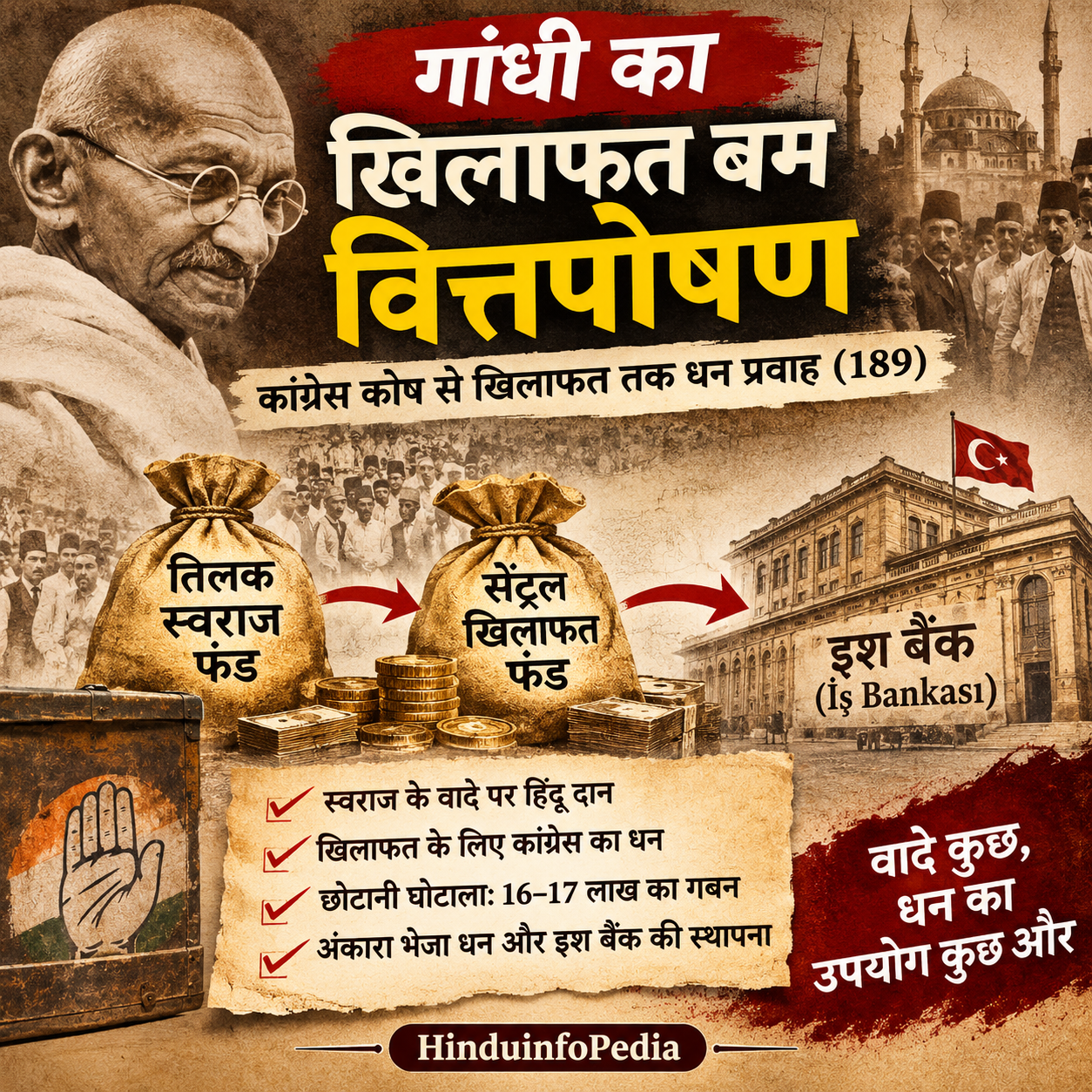
Gandhi’s Khilafat Bomb Funding: Tracing Congress Funds to Khilafat (189)
भारत / GB
Part 189: Mahatma Gandhi’s Peace Efforts | Series Index
The previous blog placed four institutional mechanisms before the reader: the Tilak Swaraj Fund deployed into Khilafat infrastructure, the packed floors at Calcutta and Nagpur that silenced constitutional resistance and booed Jinnah off the platform, the formal merger of Congress field workers with the Khilafat Volunteer Corps, and the systematic suppression of Hindu alarm labelled anti-national. Gandhi’s Khilafat bomb funding now places before the reader the financial record of the machine: who provided the money, under what promise it was collected, through whose hands it passed, and where, in the end, it went.
Thank you for reading this post, don't forget to subscribe!THE HISTORICAL RECORD — THE MONEY TRAIL
The Pattern: The standard defence of the Khilafat alliance frames the movement’s finances as a separate Muslim organisational matter, insulated from Congress collections. The documentary record does not support that separation. The Tilak Swaraj Fund — the largest voluntary collection in Indian political history to that date, raised under the explicit promise of Swaraj within one year, collected predominantly from Hindu merchants and industrialists — was the primary financial engine underwriting the joint Congress–Khilafat Non-Cooperation agitation infrastructure across 1920 and 1921: the Ali Brothers’ national agitation tours, the Khilafat Volunteer Corps mobilised under the Non-Cooperation umbrella, and institutional grants such as the direct subvention to Jamia Millia Islamia recorded in the Congress Working Committee minutes. Beyond the Congress-directed collection, the Central Khilafat Fund ran on separate accounts outside any public audit and produced, within a year of its peak operations, one of the most documented financial scandals in the early nationalist record. And the gold and currency drafts collected for Mustafa Kemal’s military campaign — collected under the theological banner of restoring the Caliphate — landed, four months after the Caliphate was abolished, in the founding capital of a secular Turkish commercial bank.
The Lethal Exhibit: The prosecution places three financial flows before the reader in the sequence they occurred: the Tilak Swaraj Fund underwriting Congress-Khilafat joint operations (1921); the Central Khilafat Fund diversion into Haji Jan Muhammad Chotani’s commercial enterprises — 16 to 17 lakhs, two mills surrendered, no public reckoning (1921–22); and the İşbank paradox — £125,000 to £150,000 in Indian donor money sent to Ankara for the Caliphate’s military restoration, converted into founding capital of İş Bankası four months after the Caliphate was abolished (March 1924 → August 1924). Gandhi’s Khilafat bomb funding produced no Swaraj. It produced a secular Turkish bank, a domestic embezzler’s textile ledger, and an organisational infrastructure that detonated in Malabar in August 1921 while the collections were still running.
Why it matters: Gandhi’s Khilafat bomb funding is the financial anatomy of the machine — every political promise made to the donor, and every destination the money actually reached.
The Prosecution’s Premise
Every political machine requires a treasury. The Khilafat apparatus — the Volunteer Corps, the district Khilafat committees, the special trains of the Ali Brothers’ agitation tours, the publications, the ulema allowances, the Shariat panchayat networks — required substantial and continuous funding across 1920 and 1921. The prosecution places a simple question before the reader: where did the money come from, who authorised its deployment, and where did it go?
The answer runs across three documented financial flows. Each flow carries its own cast of donors, its own stated purpose, and its own documented destination. The prosecution places all three before the reader without assessing the donor’s intent. The reader will assess what the three flows constitute when placed alongside the promise under which the money was collected.
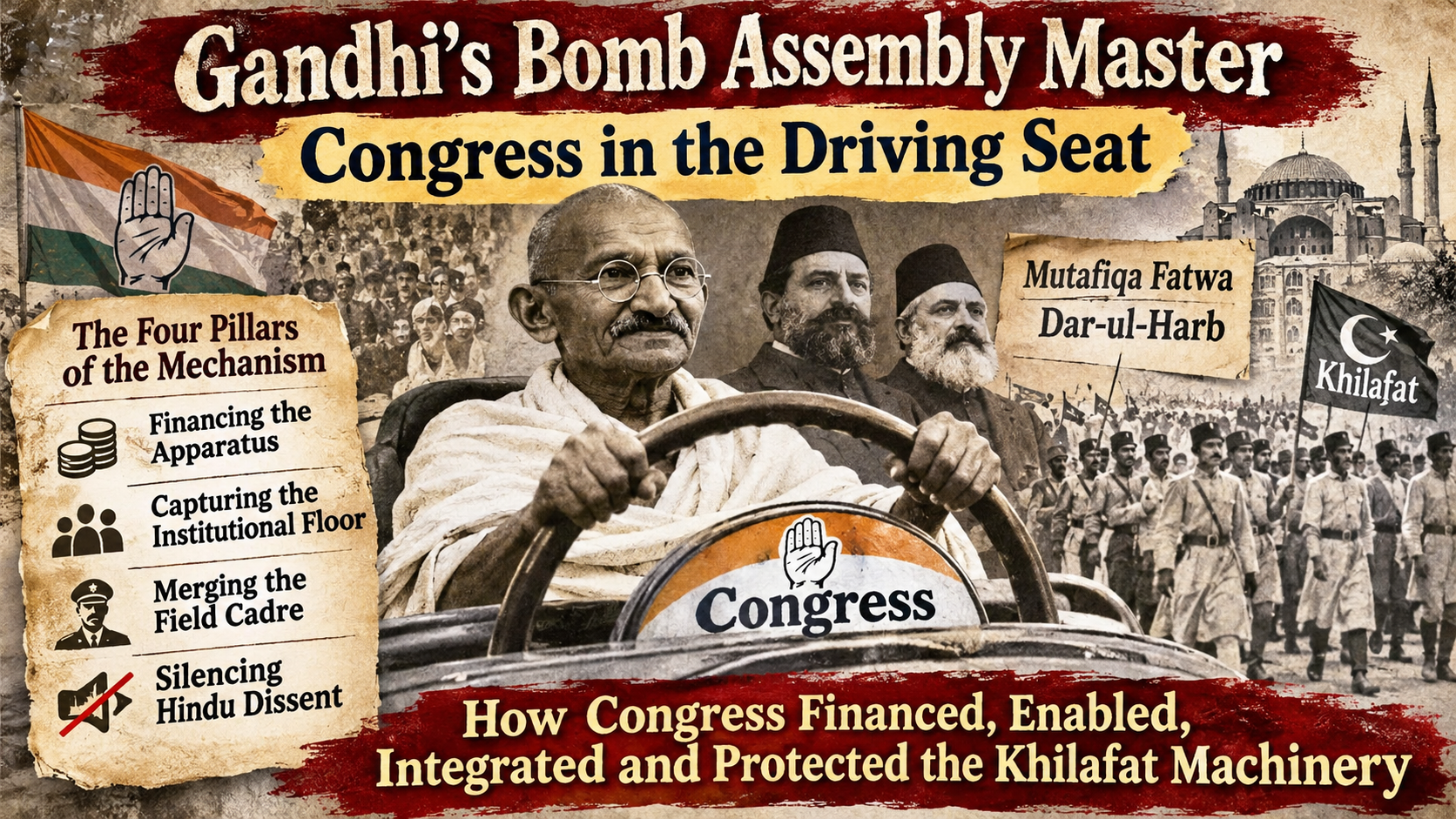
Exhibit One: The Tilak Swaraj Fund — Hindu Money for Swaraj, Deployed for Khilafat
In 1921, following the death of Bal Gangadhar Tilak in August 1920, Gandhi mobilised the full national machinery of the Indian National Congress to collect one crore rupees — ten million rupees — for the Tilak Swaraj Fund. The fund was established in Tilak’s name and the collections were conducted under a specific and public promise: Swaraj within one year. Gandhi gave his personal moral guarantee to that promise, repeating it across his correspondence and in Young India through 1920 and 1921.
The donor base for the Tilak Swaraj Fund was predominantly Hindu: merchants, industrialists, and middle-class contributors from Gujarat, Maharashtra, Bengal, and the United Provinces, whose giving was motivated by the combined pull of nationalist fervour, Tilak’s memory, and Gandhi’s personal credibility as guarantor. The collections were conducted through Congress provincial committees — the same provincial committees that were simultaneously being instructed to recognise and coordinate with the district Khilafat committees.
Substantial tranches of the Tilak Swaraj Fund were deployed into Khilafat organisational operations. The travel allowances and special-train charters that moved the Ali Brothers across the subcontinent on their agitation circuit were funded through Congress organisational accounts. The daily maintenance of the Khilafat Volunteer Corps — the stipends, the uniforms, the district infrastructure — drew on the same pool. The Jamia Millia Islamia, established in October 1920 as the educational institution of the Khilafat movement, received a direct subvention from Congress funds at Gandhi’s personal intervention, recorded in the Congress Working Committee minutes.
Gandhi’s Khilafat bomb funding places before the reader the gap between the stated purpose and the documented deployment: Hindu donors contributed to a fund named after Bal Gangadhar Tilak, under the promise of Indian self-rule within one year, to an apparatus whose theological foundation — the Mutafiqa Fatwa — classified their land as Dar-ul-Harb and their cooperative presence in it as the canonical obstacle to Muslim religious obligation. The reader is asked to note who collected the fund, who provided the moral guarantee, and who authorised the deployment.
Exhibit Two: The Chotani Scandal — The Central Khilafat Fund and the Embezzler’s Mills
Parallel to the Tilak Swaraj Fund operated the Central Khilafat Fund, the autonomous financial arm of the All-India Khilafat Committee. The Central Khilafat Fund ran outside Congress audit and outside any public accounting mechanism. Its collections were conducted through the mosque network, the Khilafat committee district apparatus, and direct appeals by the ulema and the Ali Brothers at public gatherings. Its treasurer and dominant figure was Haji Jan Muhammad Chotani, a Bombay merchant who had risen to the presidency of the All-India Khilafat Committee and who served as the movement’s most prominent lay financier.
The record compiled by Sir Cecil Kaye and published in the 1925 Government of India intelligence report on the Khilafat and Non-Cooperation movements — Bamford’s Histories of the Non-Co-operation and Khilafat Movements — documents what the Central Khilafat Fund’s accounts, when they were eventually examined, revealed. Between 16 and 17 lakhs of rupees — 1.6 to 1.7 million rupees — had been diverted from the Central Khilafat Fund into Chotani’s own commercial enterprises. Two of his mills were transferred over to the fund as partial settlement of the liability. No criminal prosecution followed. The Congress Working Committee — whose membership remained operative outside prison walls through 1922 and 1923 while Gandhi was imprisoned at Yerwada following his arrest on 10 March 1922 — issued no public accounting demand, no resolution calling for audit, and no statement requiring restitution of donor money.
Gandhi was released from Yerwada on 5 February 1924. No article appeared subsequently in Young India demanding a post-facto reckoning with the diversion, the settlement, or the accountability of the movement’s treasurer.
Gandhi’s Khilafat bomb funding places the Chotani record before the reader alongside a single observation: the institutional silence that followed the diversion runs in two distinct phases and covers the full institutional leadership. The Congress Working Committee outside prison issued nothing through 1922–23. Gandhi upon his release in 1924 issued nothing thereafter. The same institutional machinery that had labelled Hindu alarm over the Khilafat apparatus’s theological declarations as anti-national and communal produced no corresponding alarm — no label, no resolution, no public statement — when the movement’s primary autonomous financial account was found to have been systematically looted by its own treasurer.
Exhibit Three: The İşbank Paradox — The Caliphate’s Gold and the Secular Bank
The third financial flow is the most precisely documented and the most forensically revealing. Through 1920 and 1921, the Khilafat movement conducted collections specifically designated for military and logistical support for Mustafa Kemal’s Turkish nationalist forces. The theological framing of these collections was explicit: the Grand National Assembly’s forces were fighting to restore the Ottoman territorial position, preserve the Caliphate as the seat of Islamic authority, and reverse the Allied dismemberment of Muslim lands. Indian Muslims were contributing to the defence of the Caliphate itself.
The amounts collected and remitted to Ankara are documented in the Bamford report and the Home Department Political Files. Across 1920 to 1923, the Indian Khilafat movement remitted between £125,000 and £150,000 to the Grand National Assembly in Ankara — a substantial sum in gold and currency drafts, assembled from mosque collections, Khilafat committee fundraisers, and the personal donations of the movement’s merchant patrons.
The prosecution places two dates before the reader.
March 1924: Mustafa Kemal Atatürk abolished the Caliphate. The Ottoman Caliphate, whose restoration had been the stated purpose of every rupee collected from every Indian mosque since 1919, ceased to exist. The cause for which the Indian donor had sacrificed was, in the secular Turkish republic’s constitutional declaration, permanently closed.
August 1924: İş Bankası — the İşbank, Turkey’s first national commercial bank — was founded in Ankara. The founding capital of İş Bankası included a substantial component of the Indian Khilafat donations that had been remitted to the Grand National Assembly. The gold collected to restore a Sunni Caliphate became the seed capital of a secular Turkish commercial bank — four months after the Caliphate was abolished.
Gandhi’s Khilafat bomb funding places this four-month interval before the reader without editorial comment. The donor’s stated purpose: the restoration of the Caliphate. The money’s documented destination: the founding capital of a secular bank in a republic whose first constitutional act had been to abolish the Caliphate the donor had paid to restore.
The Moral and Sovereign Asymmetry
The prosecution draws the three financial flows into a single frame and places before the reader the asymmetry they constitute.
The Hindu donor contributing to the Tilak Swaraj Fund was asked to sacrifice for national liberation — for the retrieval of Indian sovereignty from colonial rule, under the guarantee of a man whose South Africa record demonstrated that he delivered what he promised when the political conditions were within his control.
The Muslim donor contributing to the Central Khilafat Fund and the Ankara remittance was asked to sacrifice for a theological imperative — the restoration of a Caliphate located in a foreign country, under the political conditions of a Turkish nationalist movement over which no Indian authority had any influence.
Neither donor received what they were promised. The Hindu donor’s Tilak Swaraj Fund was deployed into an apparatus whose theological foundation classified his land as the Abode of War. The Muslim donor’s Caliphate fund was looted by the movement’s own treasurer or converted into the founding capital of the secular bank of the republic that abolished the Caliphate four months before the bank opened.
Gandhi’s Khilafat bomb funding places the moral asymmetry before the reader without attribution of intent. The reader is asked to note that the man who provided the moral guarantee for the Tilak Swaraj Fund’s collection — who personally assured Hindu donors that their sacrifice would produce Swaraj within one year — issued no equivalent guarantee for the deployment of those funds; that when the Chotani diversion became known, no public accountability mechanism was invoked; and that when the İşbank paradox became the documented outcome of the Caliphate remittances, no Young India article addressed the donor’s reasonable expectation that his money had been spent on the cause he had been asked to fund.
A Modern Parallel: Calamity Relief to Party Trust
The structural pattern did not end in 1924. The precedent of directing public treasuries into party-affiliated vehicles surfaced as early as July 1991, when Manmohan Singh’s Union Budget proposed an unprecedented ₹100-crore allocation of taxpayer funds directly to the newly formed Rajiv Gandhi Foundation — rescinded only after parliamentary resistance. Between 2004 and 2014, the bypass shifted from open budget lines to public sector enterprises and emergency reserves. Under the Manmohan Singh government, approximately ₹1.45 crore from the Prime Minister’s National Relief Fund (PMNRF) — public disaster donations whose charter restricts deployment to immediate calamity relief — was transferred across 2005–2008 to the RGF. Sonia Gandhi held a permanent seat on the PMNRF management committee while simultaneously serving as Chairperson of the receiving foundation. Protected from CAG audit and RTI scrutiny as an autonomous trust, the transfers avoided real-time constitutional oversight. The Ministry of Home Affairs cancelled the RGF’s FCRA licence in October 2022 — fourteen years after the last transfer. The reader will assess what that continuity reveals: a custodian on both sides, calamity reserves deployed as political endowments, no audit operating in real time.
The Prosecution’s Position
Three questions stand before the reader.
- Does the documented deployment of Tilak Swaraj Fund tranches into Khilafat organisational infrastructure — Hindu donor money collected under the promise of Swaraj within one year, authorised by Gandhi personally, deployed into an apparatus whose theological foundation classified the donors’ land as Dar-ul-Harb — constitute an exhibit the reader places alongside the claim that Congress was a financial bystander to the Khilafat machine?
- Does the Chotani diversion — 16 to 17 lakhs from the Central Khilafat Fund into the treasurer’s commercial enterprises, two mills surrendered in partial settlement, no Congress Working Committee statement of accountability, no Young India demand for restitution — constitute an exhibit the reader places alongside the claim that the Congress leadership exercised responsible stewardship of the nationalist alliance?
- Does the İşbank paradox — £125,000 to £150,000 in Indian Caliphate donor money, collected under the explicit promise of restoring the Caliphate, converted into the founding capital of a secular Turkish bank four months after the Caliphate was abolished — constitute an exhibit the reader places alongside any account of the Khilafat movement’s financial integrity, or its leaders’ accountability to the men and women who funded it?
The series does not answer. Gandhi’s Khilafat bomb funding places the three flows, their stated purposes, and their documented destinations before the reader. The next blog places before the reader where the apparatus those funds had built began to produce its first field consequences — the pre-rebellion signals in Malabar, the Ponnani pulpits, and the intelligence dossiers of early 1921.
Invitation To Defence
The floor belongs to the defence. We now invite them to present their exhibits and challenge the record.
One crore collected from Hindu donors under the promise of Swaraj within one year — deployed into Khilafat organisational infrastructure. Sixteen to seventeen lakhs diverted from the Central Khilafat Fund into the treasurer’s own mills — no Congress demand for accountability, no Gandhi statement in Young India. £125,000 to £150,000 in Indian Caliphate gold remitted to Ankara for the restoration of the Caliphate — converted into the founding capital of İş Bankası, a secular Turkish commercial bank, four months after the Caliphate was abolished. Gandhi’s Khilafat bomb funding places all three flows, all three stated purposes, and all three documented destinations before the reader.
Feature Image: Click here to view the image.
Videos
Glossary of Terms
1. Tilak Swaraj Fund: A fund established in the name of Bal Gangadhar Tilak in 1921, with a target of one crore rupees, collected under Gandhi’s public promise of achieving Swaraj within one year.
2. Central Khilafat Fund: The autonomous financial fund of the All-India Khilafat Committee, which operated separately from Congress accounts and was used to finance Khilafat movement activities.
3. Khilafat Volunteer Corps: An organised body of volunteers associated with the Khilafat movement, responsible for mobilising supporters and maintaining the movement’s district-level organisational infrastructure.
4. Mutafiqa Fatwa: A religious ruling cited in the blog as the theological basis for classifying India as Dar-ul-Harb and addressing the religious implications of Muslim political cooperation under British rule.
5. Dar-ul-Harb: An Islamic jurisprudential term meaning the Abode of War, referring in certain traditional interpretations to territory not governed under Islamic authority.
6. Subvention: A financial grant or contribution provided by an organisation or institution to support another organisation’s activities. The blog uses this term in connection with Congress funding provided to Jamia Millia Islamia.
7. Chotani Scandal: The financial controversy involving Haji Jan Muhammad Chotani, the treasurer of the Central Khilafat Fund, concerning the alleged diversion of sixteen to seventeen lakh rupees into his commercial enterprises, followed by the transfer of two mills as partial settlement.
8. Ankara Remittance: The transfer of Indian Khilafat donations, reportedly amounting to £125,000–£150,000, to the Grand National Assembly in Ankara for supporting Mustafa Kemal’s Turkish nationalist forces and the restoration of the Caliphate.
9. İş Bankası (İşbank): Turkey’s first national commercial bank, established in Ankara in August 1924. The blog examines the reported inclusion of Indian Khilafat donations in its founding capital after the abolition of the Caliphate in March 1924.
10. Moral and Sovereign Asymmetry: A phrase used in the blog to describe the contrast between Hindu donors contributing towards Indian self-rule and Muslim donors contributing towards the restoration of a religious institution in a foreign country.
11. Financial Accountability: The obligation of individuals and institutions entrusted with collected funds to maintain transparent accounts, disclose their use and account for any diversion or misuse.
12. PMNRF (Prime Minister’s National Relief Fund): A public relief fund established to provide assistance to people affected by natural disasters and other emergencies. The blog discusses its reported transfers to the Rajiv Gandhi Foundation between 2005 and 2008.
13. RGF (Rajiv Gandhi Foundation): A foundation established in 1991 and discussed in the blog in connection with the proposed government allocation and subsequent transfers from the Prime Minister’s National Relief Fund.
14. CAG (Comptroller and Auditor General of India): India’s constitutional auditing authority responsible for auditing government receipts and expenditure and examining the financial accountability of specified public institutions.
15. FCRA (Foreign Contribution Regulation Act): Indian legislation regulating the acceptance and utilisation of foreign contributions by individuals, associations and organisations. The blog refers to the cancellation of the Rajiv Gandhi Foundation’s FCRA licence in October 2022.
#Gandhi #Khilafat #Congress #Swaraj #IndianHistory #FreedomMovement #History #India #PoliticalHistory #HinduinfoPedia
Scan Through The Entire Series at
Refer to Various Arks Referred to in the Blog
Gandhi’s Khilafat Bomb Funding: Tracing Congress Funds to Khilafat (189)