
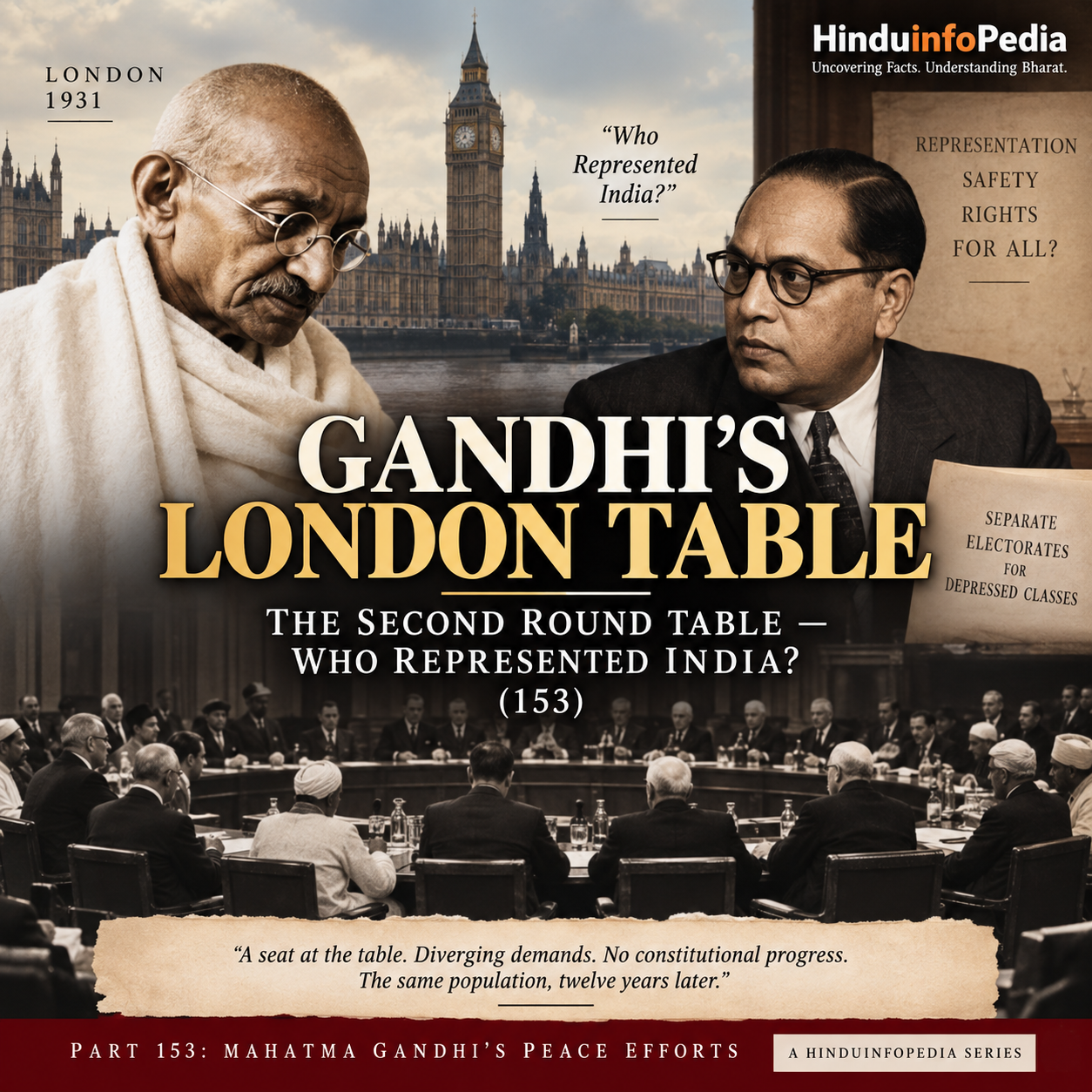
Gandhi’s London Table: The Second Round Table — Who Represented India? (153)
भारत / GB
Part 153: Mahatma Gandhi’s Peace Efforts | Series Index
Blog 147 placed the Gandhi-Irwin Pact’s documented negotiated return before the reader — a conference seat in exchange for the suspension of the largest documented civilian uprising in colonial history. This post, Gandhi’s London Table, places what Gandhi did with that documented conference seat before the reader: who he aligned with, who he refused to align with, and what the documented conference produced.
Thank you for reading this post, don't forget to subscribe!The Action Taken: During and after his 21-day fast in Delhi, Gandhi urged displaced Kohat refugees sheltering in Rawalpindi not to demand state compensation or make the prosecution of murderers a precondition for returning to their burnt homes.
Who Paid the Price: Over 3,000 displaced refugees, who were asked to accept total financial and physical ruin as a demonstration of trust toward the community that had expelled them.
The Alternative Bypassed: Demanding that the colonial state enforce law and order, seize rioters’ assets to rebuild the town, and guarantee armed civilian protection.
Why This Matters: The self-defense directive in its starkest form: victims of communal expulsion were asked to abandon all legal and financial redress in exchange for moral reconciliation without protection.
The Documented Seat
Gandhi’s London Table places the documented context of the Second Round Table Conference before the reader. Gandhi arrived in London in September 1931 as Congress’s sole documented representative — established in Blog 147 of this series. He was the documented product of the Gandhi-Irwin Pact — the documented exchange of peak Civil Disobedience leverage for this documented seat.
The Second Round Table Conference had been structured by the British administration to include documented representatives of every documented Indian interest — princely states, minorities, communal organisations, labour, women. Gandhi’s documented position: Congress represented all Indians and required no coalition with other documented representatives. He would speak for India.
Who Was at the Table
Gandhi’s London Table places the documented composition of the conference before the reader.
Among the documented delegates: B.R. Ambedkar — representing the documented Depressed Classes, the documented 60 million Dalits Gandhi’s Congress claimed as included within its documented all-India mandate. Ambedkar’s documented position: Dalits required documented separate electorates as structural documented protection — the documented same mechanism Muslim League had received in the documented Lucknow Pact of 1916. Without documented separate electorates, Dalits would remain at the documented mercy of documented caste Hindu majorities in any documented unified electorate.
Among the documented delegates: representatives of documented minorities — Muslims, Sikhs, Christians, Anglo-Indians. Each with documented separate demands for documented constitutional protection.
Among the documented delegates: representatives of the documented princely states — 562 documented states whose documented rulers had documented interests distinct from British India’s documented constitutional demands.
Gandhi’s documented position at the table: Congress spoke for all. Separate electorates for Dalits were unnecessary — Gandhi would protect Dalit interests through the documented Congress framework. The documented structural design of the conference — who was invited, who was excluded, and what the participant arithmetic established about the British design — is placed before the reader separately in this series.
Who Gandhi Refused
Gandhi’s London Table places Gandhi’s documented refusals before the reader.
Gandhi’s documented refusal of Ambedkar’s documented demand is the most consequential alignment at the table. Ambedkar had placed the case for documented Dalit separate electorates on the written record — the documented structural protection that would give 60 million documented Dalits a documented guaranteed voice in the documented constitutional framework. Gandhi’s documented response: he would fast unto death if the documented British granted separate electorates to Dalits. The documented fast — deployed a year later in Yerawada Jail September 1932 — was Gandhi’s documented instrument for blocking Ambedkar’s documented demand.
Gandhi’s documented position on minorities: Congress represented all Indians including documented minorities. Documented separate electorates — the documented constitutional protection minorities had documented as the documented structural guarantee of their documented representation — were documented by Gandhi as dividing India.
What the Conference Produced
Gandhi’s London Table places the documented conference outcome before the reader.
The Second Round Table Conference produced zero documented constitutional progress. No documented dominion status. No documented timeline for independence. No documented fiscal autonomy. No documented transfer of political power.
Gandhi returned to Bombay on December 28 1931 — established in Blog 147 of this series. Within one week — January 4 1932 — Viceroy Willingdon’s Emergency Powers Ordinances. Gandhi and Patel arrested. Congress banned. 100,000 jailed within weeks.
The documented conference seat — the documented exchange for the largest documented civilian uprising in colonial history — produced nothing the documented independence movement had demanded. The documented structural framework remained intact.
The Documented Sequel — Same Population, Twelve Years
Gandhi’s London Table places one documented observation before the reader. Blog 149 placed the 490 documented names of Jallianwala Bagh before the reader — April 13 1919. Twelve years later — 1931 — Gandhi sat at the documented London table as the documented sole representative of the documented Indian population that had included those 490 documented names.
The documented constitutional protection those 490 documented names had not had in 1919 — no documented right to assembly free from documented military enforcement, no documented constitutional guarantee, no documented structural protection — was what the documented London table was supposed to produce.
The documented conference produced nothing. The documented population sat where it had sat in 1919 — without documented structural constitutional protection — twelve documented years after 490 of their documented number had entered a documented garden and not come out.
The Prosecution’s Position
Gandhi’s London Table places three questions before the reader.
- Did Gandhi’s documented refusal to align with Ambedkar’s documented Dalit separate electorate demand — placing Congress’s documented all-India mandate above the documented structural constitutional protection of 60 million documented Dalits — constitute a documented exhibit the reader places alongside Gandhi’s documented Champaran Arithmetic (Blog 143) of who the documented settlements protected and who they left behind?
- Does the documented conference outcome — zero constitutional progress, the documented conference seat exchanged for the largest documented civilian uprising in colonial history, Gandhi returning empty-handed December 28 1931, British Emergency Ordinances promulgated January 4 1932 — constitute an exhibit the reader places alongside the documented Irwin Pact balance sheet established in Blog 147?
- Does the documented twelve-year gap between the documented 490 names of April 13 1919 and the documented London table of September 1931 — the same documented Indian population without documented structural constitutional protection at both documented moments — constitute an exhibit the reader places alongside Gandhi’s documented claim that Congress represented all Indians?
The series does not answer. Gandhi’s London Table places the documented seat, the documented refusals, the documented outcome, and the documented twelve-year gap before the reader. The reader will examine what the documented conference established — and complete the sentence.
Invitation To Defence
The floor belongs to the defense. We now invite them to present their exhibits and challenge the narrative established by the prosecution.
September 1931: Gandhi arrived in London as Congress’s sole documented representative — the documented exchange for the largest documented civilian uprising in colonial history. Ambedkar placed the documented case for 60 million Dalits before the table. Gandhi refused to align. The conference produced zero constitutional progress. Gandhi returned December 28 1931. January 4 1932: Emergency Ordinances. The twelve-year documented gap: same population, same documented absence of structural constitutional protection, 490 documented names in April 1919 and the same documented population unprotected at the London table. The prosecution places the documented seat, the documented refusals, and the documented outcome before the reader. The reader will complete the sentence.
Feature Image: Click here to view the image.
Videos
Glossary of Terms
- Second Round Table Conference: The 1931 constitutional conference in London where representatives of different Indian interests, including Gandhi and B. R. Ambedkar, discussed India’s constitutional future.
- Gandhi-Irwin Pact: The agreement between Mahatma Gandhi and Viceroy Lord Irwin that suspended the Civil Disobedience Movement and enabled Gandhi to attend the Second Round Table Conference.
- Civil Disobedience Movement: The mass Indian movement of civil resistance whose suspension formed part of the Gandhi-Irwin Pact and preceded Gandhi’s participation in the London conference.
- B. R. Ambedkar: The representative of the Depressed Classes at the Second Round Table Conference who advocated separate electorates for Dalits as a constitutional safeguard.
- Depressed Classes: The historical term used for communities later associated with Dalits, represented by B. R. Ambedkar at the Second Round Table Conference.
- Separate Electorates: A constitutional electoral arrangement in which a particular community elects its own representatives, advocated by Ambedkar as protection for Dalit representation.
- Structural Constitutional Protection: The blog’s key phrase for constitutional arrangements intended to provide communities with guaranteed representation and protection within the political system.
- Congress’s All-India Mandate: Gandhi’s position that the Indian National Congress represented all Indians, including the Depressed Classes and minorities, and therefore did not require separate representation for them.
- Dominion Status: A constitutional status sought in India’s political development but not achieved through the Second Round Table Conference.
- Emergency Powers Ordinances: Measures issued by Viceroy Willingdon on January 4, 1932, following Gandhi’s return from London, leading to arrests, the banning of Congress, and widespread imprisonment.
- Jallianwala Bagh: The Amritsar site associated with the April 13, 1919 massacre, used in the blog to establish a twelve-year comparison with the 1931 London conference.
- Twelve-Year Gap: The blog’s key comparative phrase for the period between the 490 documented names associated with Jallianwala Bagh in April 1919 and Gandhi’s participation at the London conference in September 1931, emphasizing the continued absence of structural constitutional protection.
- Gandhi’s London Table: The blog’s distinctive phrase for Gandhi’s participation at the Second Round Table Conference and the examination of whom he represented, whom he refused to align with, and what the conference produced.
- Prosecution’s Position: The blog’s distinctive courtroom-style framing through which Gandhi’s documented seat, refusals, conference outcome, and the twelve-year gap are presented as evidence for the reader’s examination.
- Invitation To Defence: The blog’s distinctive courtroom-style transition inviting the defence to present evidence and challenge the narrative established by the prosecution.
#Gandhi #India #Ambedkar #History #RoundTable #Congress #Dalits #HinduinfoPedia
Scan Through The Entire Series at
Gandhi’s Peace Efforts: The Questions Before the Mahatma (0)