
Gandhi’s Khilafat Alternative Routes: The Seven-Month Pivot (179)
भारत / GB
Part 179: Mahatma Gandhi’s Peace Efforts | Series Index
Blog 178 placed before the reader the motive — Gandhi’s political isolation after the Rowlatt collapse, the closed doors across every provincial Congress network, and the question of how a leader discredited by the April 1919 withdrawal became the undisputed dictator of the Congress by December 1920. This Blog, Gandhi’s Khilafat Alternative Routes: The Seven-Month Pivot, places before the reader the operational answer: the seven months between April and November 1919 in which Gandhi systematically constructed the parallel political apparatus that would deliver that majority. Gandhi’s Khilafat Alternative Routes— the seven-month pivot — was not a reactive alliance of convenience. It was a calculated, sequential construction of a power base outside the Congress while the established provincial committees assumed he was politically neutralised.
Thank you for reading this post, don't forget to subscribe!THE HISTORICAL RECORD — THE SEVEN-MONTH PIVOT
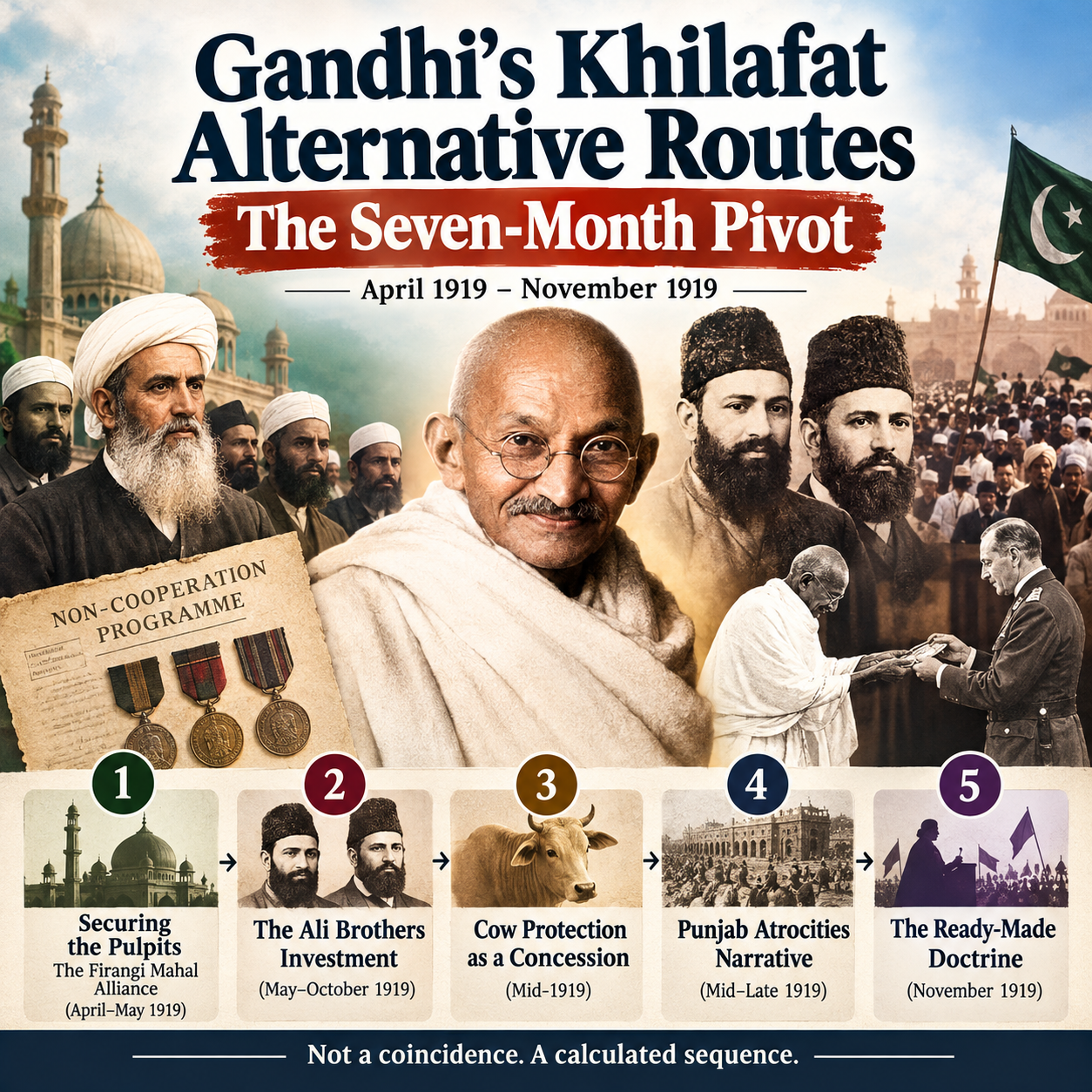
The Pattern: Between his admission of a “Himalayan blunder” in April 1919 and his election as President of the All-India Khilafat Conference on 23 November 1919, Gandhi rebuilt his political standing through five sequential steps: securing the traditional Sunni pulpit networks through Maulana Abdul Bari of Firangi Mahal; converting the detention of the Ali Brothers into a personal political investment; turning cow-protection from a communal friction point into a unilateral Hindu concession; seizing the narrative of the Punjab atrocities inquiry to build operational command alongside Muslim political elites; and arriving at Delhi with a complete, ready-made doctrine to exchange for the undisputed presidency of a mass clerical front. Gandhi’s Khilafat Alternative Routes — the seven-month pivot — documents not an opportunistic drift but a constructed architecture.
The Lethal Exhibit: The sequence of dates is precise. On 23 November 1919 Gandhi was elected president of the All-India Khilafat Conference — not as a bystander invited to lend moral weight, but as the architect who handed the assembly a complete operational programme in exchange for its leadership. The Central Khilafat Committee formally ratified Gandhi’s four-stage Non-Cooperation programme in May–June 1920. Gandhi surrendered his Kaisar-i-Hind, Zulu War, and Boer War medals to Viceroy Chelmsford on 1 August 1920 — the date he himself had set to inaugurate the movement. The medals were not the price of the presidency. They were Stage One of the programme he had drafted for the apparatus he had spent seven months assembling.
Why it matters: The prosecution does not assert that Gandhi’s outreach to Muslim leadership was cynical by definition. It places before the reader the documented operational sequence: five distinct steps, each extending his reach into a network the established Congress could not penetrate, each executed while the Congress old guard assumed he was neutralised. The question of whether that sequence constitutes calculated political construction or principled coalition-building is precisely what the evidence is placed before the reader to decide. Gandhi’s Khilafat Alternative Routes — the seven-month pivot — is the assembly line.
Step One: Securing the Pulpits — The Firangi Mahal Alliance (April–May 1919)
In the immediate aftermath of the 18 April suspension, the established Congress leadership closed ranks against Gandhi. Annie Besant, V.S. Srinivasa Sastri, and Madan Mohan Malaviya publicly condemned him for inciting violence and retreating. Tilakites and nationalist extremists viewed the withdrawal as evidence that Gandhi’s doctrine of absolute non-violence could not survive contact with mass politics. The formal provincial Congress networks — Bengal under Das, Maharashtra under the Tilakites, Bombay under Jinnah — were fortified against his programme.
Gandhi did not attempt to re-enter through those doors. He turned instead to a constituency the Westernised Congress leadership had never engaged: the traditional Sunni clerical establishment.
Maulana Abdul Bari of Lucknow’s Firangi Mahal — the preeminent Islamic seminary coordinating conservative Sunni ulema across the United Provinces and beyond — was the gateway to that establishment. Gandhi cultivated the alliance directly and on terms the seminary found compelling: if the ulema joined a national platform against British rule, Gandhi would champion the Ottoman cause without reservation and without conditions.
The exchange gave Gandhi something no Congress resolution could supply: credibility and access among traditional clerical networks that had previously held aloof from Westernised nationalist politicians entirely. Gandhi’s Khilafat Alternative Routes — the seven-month pivot — opened its first account here: not inside the Congress, but inside the mosque.
Step Two: The Ali Brothers Investment (May–October 1919)
Mohammad Ali and Shaukat Ali were interned under the Defence of India Act and regarded across Muslim political circles as heroes of pan-Islamic resistance. Senior Congress figures maintained cautious distance from pan-Islamic agitation, calculating that open association with the Ali Brothers’ cause would alienate British administrators whose cooperation the constitutional programme required.
Gandhi made the opposite calculation.
He wrote persistent petitions and public appeals to Viceroy Chelmsford demanding the brothers’ unconditional release, framing their detention not as a Muslim grievance but as a national insult. He reached out directly to their mother, Bi Amman, and their family networks. Long before Mohammad Ali and Shaukat Ali stepped out of internment, Gandhi had cultivated the unconditional loyalty of their followers — the radical Muslim youth constituency that the Ali Brothers commanded and that no Congress figure had previously been able to reach.
The investment was structural, not ceremonial. When the brothers were released and returned to national agitation, their networks were already oriented toward Gandhi as the man who had championed their cause while the constitutional old guard had kept its distance.
Step Three: The Cow-Protection Reversal (July–September 1919)
Historically, Hindu revivalists had demanded legislative or coercive measures against cow slaughter — a recurring friction point that had periodically exploded into communal violence across the subcontinent. The demand placed Muslim communities on the defensive and made any overture from Hindu nationalist circles suspect as a negotiating trap.
Gandhi dissolved the trap by removing the demand.
His formulation was precise: Hindus should give unconditional support to Muslims on the Khilafat grievance without demanding an explicit reciprocal commitment on cow protection. He argued that voluntary Muslim restraint — arising out of friendship rather than coercion — would follow naturally from genuine communal solidarity. He explicitly disavowed legislation or pressure as the instrument of Hindu interest on the question.
The effect among the Muslim merchant class in Bombay and Delhi was significant. Chotani’s commercial networks and the conservative Muslim trading communities that financed the clerical apparatus read Gandhi’s formulation as a substantive concession from the Hindu majority rather than a rhetorical gesture. It gave his overtures moral currency that no Congress declaration of Hindu-Muslim unity had previously carried.
Step Four: The Punjab Inquiry as Command Platform (July–October 1919)
The colonial government restricted Gandhi from entering Punjab until mid-October 1919. The restriction was not politically neutral: it excluded Gandhi from the most politically charged theatre of the post-Rowlatt landscape while the district administration managed the aftermath of Jallianwala Bagh under martial law.
When Gandhi was finally permitted entry, he led the unofficial Congress inquiry into the massacre and martial law excesses alongside Dr. M.A. Ansari and Hakim Ajmal Khan — two of the most prominent Muslim political elites in Delhi. The inquiry work placed Gandhi at the operational centre of a team whose Muslim members had standing, networks, and credibility in Punjab political circles that no Hindu Congress figure possessed.
By steering the investigative work and writing the findings, Gandhi positioned himself as the essential bridge connecting Delhi and Punjab Muslim political leadership to national agitation. Ansari and Ajmal Khan would become two of the most important figures in the Khilafat movement’s national coordination. Their operational alignment with Gandhi was forged here, in the inquiry rooms of Lahore and Amritsar, not in the Congress session halls.

Step Five: The Delhi Capture — A Doctrine for a Presidency (23 November 1919)
When the All-India Khilafat Conference gathered in Delhi on 23 November 1919, the delegates faced an internal impasse. Militant factions led by Hasrat Mohani demanded a boycott of British goods — an economic weapon that had political appeal but no operational infrastructure behind it. The boycott faction could name a target; it could not name a programme.
Gandhi arrived with a programme.
He countered Mohani’s economic boycott proposal directly, arguing that a goods boycott was impractical, piecemeal, and tactically weak. In its place he offered a complete operational doctrine: Non-Cooperation — the progressive withdrawal of Indian collaboration from colonial institutions in four stages: the surrender of imperial titles and honours; the boycott of government schools and law courts; the boycott of legislative councils; and the refusal of military service.
The doctrine was non-violent. It was nationally applicable. It was immediately actionable. And it had been drafted by the one figure in the hall who combined Hindu political standing, clerical access through Firangi Mahal, direct relationships with the Ali Brothers, and operational command of the Punjab inquiry. The conference elected Gandhi president that day to lead the new programme.
The precision of the timeline matters here. Gandhi’s election as president of the Khilafat Conference on 23 November 1919 preceded the Congress adoption of Non-Cooperation by ten months. The Central Khilafat Committee formally ratified Gandhi’s four-stage programme in meetings at Bombay and Allahabad in May and June 1920 — before the Congress had debated it. Gandhi surrendered his Kaisar-i-Hind, Zulu War, and Boer War medals to Viceroy Chelmsford on 1 August 1920 — the date he had set for the national inauguration of Stage One.
The medals were not the price Gandhi paid for the Khilafat Conference presidency in November 1919. They were the personal execution of Stage One of the programme he had drafted for the apparatus he had spent seven months constructing. Gandhi’s Khilafat Alternative Routes — the seven-month pivot — was complete.
The Prosecution’s Position
Three questions now stand before the reader.
- Does the documented five-step sequence — Firangi Mahal in April, the Ali Brothers campaign from May, the cow-protection concession in July, the Punjab inquiry command platform in October, and the Delhi presidency on 23 November 1919 — executed while the established Congress provincial networks remained closed against Gandhi’s programme, constitute an exhibit the reader places alongside the claim that Gandhi’s alliance with the Khilafat leadership was a spontaneous act of principled solidarity rather than a sequential construction of a parallel power base?
- Does the precision of the timeline — the Khilafat Conference presidency in November 1919, the CKC ratification of Gandhi’s programme before the Congress adopted it in May–June 1920, and the physical surrender of the medals on 1 August 1920 as Stage One of a pre-drafted operational sequence — constitute an exhibit the reader places alongside the claim that Gandhi’s alliance with pan-Islamism was a natural convergence of shared values rather than a structured exchange: a complete doctrine for an undisputed presidency?
- Does the fact that every network Gandhi cultivated between April and November 1919 — the Firangi Mahal pulpits, the Ali Brothers constituency, the Chotani commercial treasury, the Ansari-Ajmal Khan operational axis — became the organisational infrastructure that packed the Calcutta Special Session in September 1920 and carried the Non-Cooperation resolution by 1,886 to 884, constitute an exhibit the reader places alongside the key phrase: Gandhi’s Khilafat Alternative Routes — the seven-month pivot?
The series does not answer. Gandhi’s Khilafat Alternative Routes — the seven-month pivot — places the assembly line before the reader: the pulpit access, the hostage investment, the communal concession, the inquiry command, and the doctrine-for-presidency exchange. Invitation To Defence
The floor belongs to the defence. We now invite them to present their exhibits and challenge the narrative established by the prosecution.
In April 1919 Gandhi was politically isolated and discredited. By November 1919 he was president of the All-India Khilafat Conference. Between those two dates: Firangi Mahal, the Ali Brothers campaign, the cow-protection concession, the Punjab inquiry, and a complete operational doctrine exchanged for an undisputed presidency. The Khilafat Conference adopted his programme before the Congress did. The CKC ratified it before the Congress voted. The medals were surrendered on the date he had set. Gandhi’s Khilafat Alternative Routes — the seven-month pivot — places the assembly line before the reader. The reader will complete the sentence.
Feature Image: Click here to view the image.
Videos
Glossary of Terms
1. Gandhi’s Khilafat Alternative Routes — The Seven-Month Pivot: The blog’s central phrase describing the alleged strategic construction of a parallel political power base by Gandhi between April and November nineteen nineteen, culminating in his election as president of the All-India Khilafat Conference.
2. Seven-Month Pivot: A coined phrase referring to the period from April to November nineteen nineteen during which Gandhi allegedly rebuilt his political standing through five sequential initiatives outside the established provincial Congress networks.
3. Khilafat Movement: A political and religious movement organized by Indian Muslims to defend the Ottoman Caliphate after the First World War. Gandhi supported the movement and linked it to the broader struggle against British rule.
4. Firangi Mahal Alliance: The political outreach described in the blog between Gandhi and Maulana Abdul Bari of Lucknow’s Firangi Mahal, through which Gandhi allegedly established access to traditional Sunni religious networks by supporting the Ottoman Khilafat cause.
5. Ali Brothers: Mohammad Ali and Shaukat Ali, prominent leaders of the Khilafat Movement who were interned under the Defence of India Act. Gandhi campaigned for their release and developed political connections with their followers.
6. Pan-Islamism: A political and religious movement advocating solidarity among Muslim communities across national boundaries. The blog uses the term to examine Gandhi’s engagement with Khilafat leadership and its wider political networks.
7. Cow-Protection Reversal: A phrase describing Gandhi’s position that Hindus should support the Khilafat cause without demanding a reciprocal commitment on cow protection, relying instead on voluntary Muslim restraint arising from communal friendship.
8. Punjab Inquiry: The unofficial Congress investigation into the Jallianwala Bagh massacre and excesses committed under martial law. Gandhi worked alongside Dr. M. A. Ansari and Hakim Ajmal Khan, strengthening his connections with Muslim political leaders.
9. Non-Cooperation Programme: Gandhi’s proposed four-stage withdrawal of Indian cooperation from British colonial institutions, involving the surrender of imperial honours, boycotts of government schools and law courts, boycotts of legislative councils, and refusal of military service.
10. Central Khilafat Committee (CKC): The organization that formally ratified Gandhi’s four-stage Non-Cooperation programme in May and June nineteen twenty, before the Indian National Congress adopted the programme.
11. Parallel Political Apparatus: A term used in the blog for the political networks allegedly developed by Gandhi outside the established provincial Congress organization to build support for his leadership and programme.
12. Doctrine-for-Presidency Exchange: A phrase coined in the blog to describe its interpretation of Gandhi’s presentation of a complete Non-Cooperation programme in connection with his election as president of the All-India Khilafat Conference.
13. Himalayan Blunder: Gandhi’s own expression for a major political error, referenced in the blog in connection with the suspension of the Rowlatt Satyagraha in April nineteen nineteen and the resulting damage to his political standing.
14. Kaisar-i-Hind Medal: An honour awarded by the British Indian government in recognition of public service. Gandhi surrendered this medal, along with his Zulu War and Boer War medals, to Viceroy Chelmsford on the first of August nineteen twenty.
15. Operational Alignment: The process by which individuals and political networks coordinate their activities toward a shared organizational programme. The blog uses this phrase to describe the relationships Gandhi developed with Khilafat leaders and Muslim political figures during the seven-month period.
#Gandhi #Khilafat #Congress #India #History #Freedom #Politics #NonCooperation #BritishRule #HinduinfoPedia
Scan Through The Entire Series at