
Gandhi’s Complicity Test: The One Question The Khilafat Record Asks (127)
भारत / GB
Part 127: Mahatma Gandhi’s Peace Efforts | Series Index
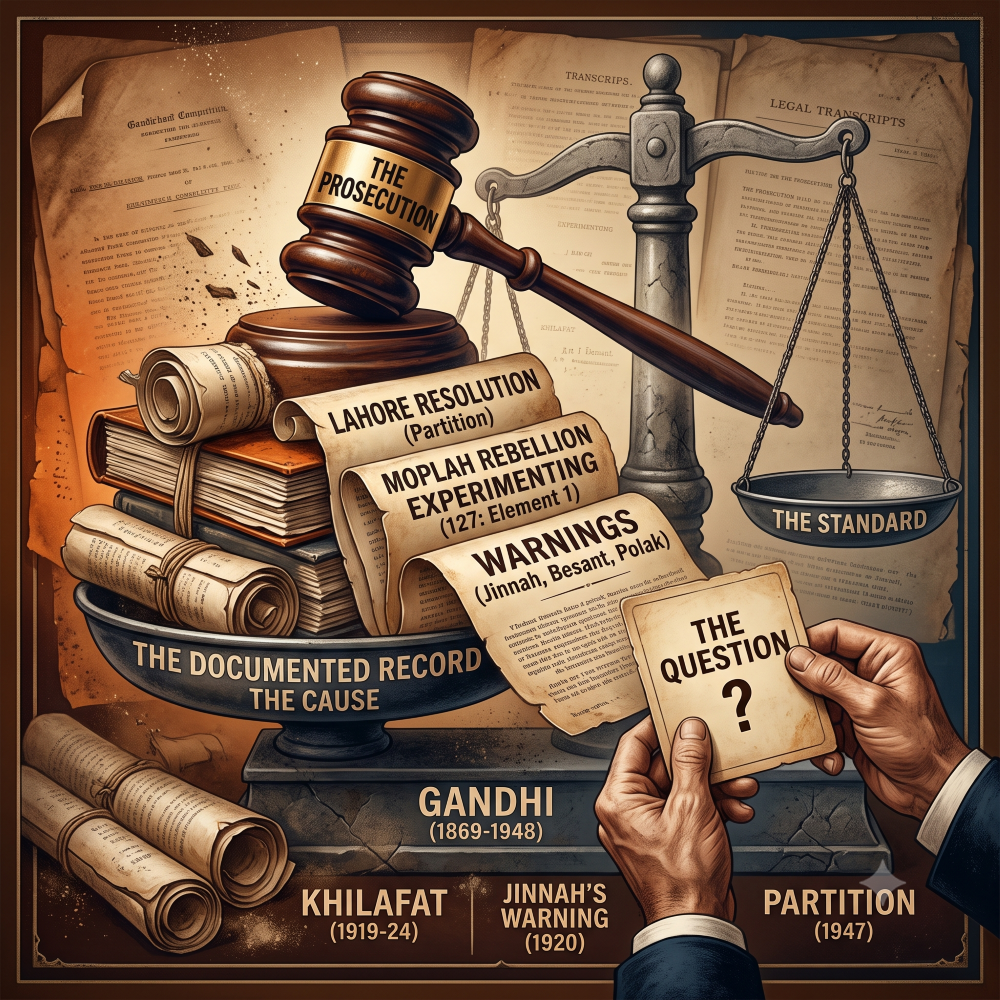
Blogs 102-126 placed the full Khilafat prosecution record before the reader — twenty-five documented exhibits covering the cause, the experiment, the warnings, the admission, the destruction, the dispensation, the template, the mechanism, and the method. This post places the closing prosecutorial question before the reader. Not a verdict. A test.
Thank you for reading this post, don't forget to subscribe!The Action Taken: Gandhi utilized the moral weight of his indefinite fasts to compel victimized communities to withdraw formal criminal cases and property claims filed against rioters.
Who Paid the Price: The aggrieved victims of riots, who were morally coerced into abandoning their legal rights under the penal code.
The Alternative Bypassed: Allowing statutory criminal justice to run its natural judicial course to punish convicted rioters.
Why This Matters: The legal effect of the moral veto: fasting was deployed as an emotional weapon to force victims into compromising their statutory legal rights.
What the Test Requires
Gandhi’s Complicity Test places the standard before the reader first. The prosecution does not define complicity — that is the reader’s task. What the prosecution places before the reader is the documented record against which the reader applies whatever standard they bring.
The standard that most frameworks of moral accountability share has three elements: knowledge of foreseeable consequences, a decision to proceed despite that knowledge, and consequences that followed from that decision. The prosecution places the documented record against each of these three elements before the reader.
Element 1 — The Documented Knowledge
Gandhi’s Complicity Test places the documented knowledge Gandhi held before the reader.
Jinnah’s documented warning, Nagpur December 1920 — established in Blog 110: “introducing religion into politics will mean a disaster for the country.” Gandhi heard this. Jinnah was present. The warning is on the record.
Polak’s documented warning — established in Blog 110, CWMG Vol. XCVI pp. 271-273: the Non-Cooperation/Khilafat merger was “ill-advised and dangerous.” Gandhi tried to convert Polak and failed. The warning is on the record.
Besant’s documented warning — established in Blog 106: mass religious mobilisation would produce consequences Gandhi could not control. The warning is on the record.
Gandhi’s own documented words, Young India May 12 1920 — established in Blog 112: “I have been experimenting with myself and my friends by introducing religion into politics.” Gandhi named the method. He knew it was an experiment with uncertain outcomes.
Ambedkar’s primary source observation, Pakistan or the Partition of India, pp. 146-147: “Many people doubted the ethical basis of the Khilafat movement and tried to dissuade Gandhi from taking any part in the movement, the ethical basis of which was so questionable.” Multiple documented contemporaries placed their doubts on the record. Gandhi proceeded.
Element 2 — The Documented Decision
Gandhi’s Complicity Test places the documented decisions before the reader.
September 1920, Calcutta special session — established in Blog 105: Non-Cooperation formally adopted with Khilafat demands as primary cause. Gandhi’s documented words at the same session, established in Blog 107: “I would, in order to achieve success in the Khilafat issue, even postpone the issue of Swaraj.”
December 1920, Nagpur session — established in Blogs 109 and 122: Jinnah’s solitary constitutional dissent overridden by the pro-Khilafat contingent. Gandhi presided over both the Khilafat Conference and the Congress platform. The decision was carried.
Gandhi’s documented conduct during the Moplah rebellion, August-December 1921 — established in Blog 117: no movement suspension, no withdrawal from the alliance, documented characterisation of the perpetrators as “brave God-fearing Moplahs.” And one further documented statement placed before the reader from the search: Gandhi said that even if Muslims were converting Hindus by force, the Hindus must not let this “put a strain on the Hindu-Moslem unity and break it.” The decision to maintain the alliance was made while the rebellion was ongoing.
Element 3 — The Documented Consequences
Gandhi’s Complicity Test places the documented consequences before the reader. The prosecution does not assert that Gandhi alone caused these consequences — it places the documented chain before the reader.
Riot frequency, established in this series from historian S. Gopal: 16 communal riots in 22 years before the Khilafat alliance, 72 riots in the 3 years that followed. The Blog 80 has analysed the issue based on primary sources.
The Moplah rebellion 1921 — established across Blogs 54-68 (Group 7, Moplah Unrest, Moplah Conclusions) and 117–124. Ambedkar’s primary source characterisation, Pakistan or the Partition of India: “The blood-curdling atrocities committed by the Moplahs in Malabar against the Hindus were indescribable.” Official records: 2,266 killed, 1,615 wounded, 5,688 captured, 38,256 surrendered during military operations.
The Jinnah arc — established across Blogs 81-98 (Closing Arc, Prosecution Exhibits, The Caliphate and The Khilafat Movement). The man Gandhi overrode at Nagpur produced the Lahore Resolution of March 1940 — the documented constitutional demand for partition.
The Ambedkar verdict — established in Blog 120, Pakistan or the Partition of India: “Gandhi was so much obsessed by the necessity of establishing Hindu-Moslem unity that he was prepared to make light of the doings of the Moplas… Any person could have said that this was too heavy a price for Hindu-Moslem unity. But Mr. Gandhi…”
The Test — Placed Before the Reader
Gandhi’s Complicity Test places the three elements before the reader in sequence and asks one question.
The documented knowledge: multiple warnings, Gandhi’s own documented word “experimenting,” Ambedkar’s observation that the ethical basis was questioned by many.
The documented decision: September 1920 Calcutta, December 1920 Nagpur, continued alliance during the Moplah rebellion, documented “brave God-fearing Moplahs” while the rebellion was ongoing, documented position that Hindu-Muslim unity must not be strained even if conversions by force were occurring.
The documented consequences: 72 riots in 3 years, Moplah rebellion, Jinnah arc, Lahore Resolution, and what followed.
The prosecution places one question before the reader: given the documented knowledge, the documented decisions, and the documented consequences — what standard does the reader apply, and what does the record establish?
The series does not answer. Gandhi’s Complicity Test places the full documented Khilafat arc before the reader as a single consolidated question. The reader will complete the sentence.
The Prosecution’s Position
Gandhi’s Complicity Test places three questions before the reader.
- Does the documented record establish that Gandhi held knowledge of foreseeable consequences — from Jinnah, Polak, Besant, his own documented word “experimenting,” and Ambedkar’s observation that many had questioned the ethical basis — before making the documented decisions of September and December 1920?
- Does the documented record establish that Gandhi made and maintained those decisions — at Calcutta, at Nagpur, and during the Moplah rebellion — including his documented position that Hindu-Muslim unity must not be strained even if forced conversions were occurring?
- Does the documented record of consequences — 72 riots in 3 years, Ambedkar’s “blood-curdling atrocities indescribable,” the Jinnah arc, the Lahore Resolution — placed against the documented knowledge and the documented decisions, constitute the evidentiary record to which the reader applies their own standard of moral accountability?
The series does not answer. The prosecution places the documented knowledge, the documented decisions, and the documented consequences before the reader. The reader will apply their own standard — and complete the sentence.
Invitation To Defence
The floor belongs to the defense. We now invite them to present their exhibits and challenge the narrative established by the prosecution.
The documented knowledge: Jinnah — disaster. Polak — ill-advised and dangerous. Besant — consequences you cannot control. Gandhi’s own word — experimenting. Ambedkar — the ethical basis was questioned by many. The documented decisions: Calcutta September 1920, Nagpur December 1920, alliance maintained during Moplah 1921, “brave God-fearing Moplahs,” Hindu-Muslim unity must not be strained even if conversions by force were occurring. The documented consequences: 72 riots in 3 years, “blood-curdling atrocities indescribable,” Lahore Resolution 1940. The prosecution places the full Khilafat record before the reader and asks one question. The reader will apply their standard — and complete the sentence.
Feature Image: Click here to view the image.
Videos
Glossary of Terms
- Complicity Test: A concluding analytical framework in this blog that examines whether documented knowledge, documented decisions, and documented consequences together establish moral or historical complicity.
- Khilafat Movement: A political-religious movement launched after the First World War to preserve the Ottoman Caliphate, later supported by Mahatma Gandhi through the Non-Cooperation Movement.
- Documented Knowledge: The collection of recorded warnings, statements, and historical evidence available to Gandhi before his major Khilafat-related decisions.
- Documented Decision: Officially recorded political actions and public positions adopted by Gandhi during the Khilafat period, including decisions at Calcutta, Nagpur, and during the Moplah Rebellion.
- Documented Consequences: Historically recorded outcomes that followed the Khilafat alliance, including communal riots, the Moplah Rebellion, constitutional developments, and the Lahore Resolution.
- Non-Cooperation Movement: The nationwide movement launched in 1920 under Gandhi that became closely linked with the Khilafat cause.
- Moplah Rebellion: The 1921 uprising in the Malabar region, marked by widespread violence, military suppression, and significant historical debate regarding its causes and consequences.
- Lahore Resolution: The political resolution adopted by the Muslim League in March 1940 calling for separate Muslim-majority states, later associated with the Partition of India.
- Pakistan or the Partition of India: Dr. B. R. Ambedkar’s landmark historical and political work examining communal politics, Partition, and the Khilafat Movement.
- CWMG (Collected Works of Mahatma Gandhi): The official multi-volume collection of Gandhi’s speeches, letters, articles, and public writings used as a primary historical source.
- Moral Accountability: The ethical standard by which responsibility is assessed after considering knowledge, decisions, and resulting consequences.
- Jinnah Arc: A recurring analytical term in this series describing Muhammad Ali Jinnah’s constitutional journey from his warnings against religious politics to the Lahore Resolution.
- Prosecution Record: A unique term in this series referring to the cumulative documentary evidence assembled across multiple blogs for analytical examination rather than judicial determination.
- Prosecution Exhibits: Numbered documentary references compiled throughout this series to present chronological evidence supporting the analytical framework.
#Gandhi #Khilafat #History #Partition #Jinnah #Ambedkar #Congress #India #Politics #HinduinfoPedia
Gandhi’s Peace Efforts: The Questions Before the Mahatma (0)
Refer to Various Arks Referred to in the Blog