
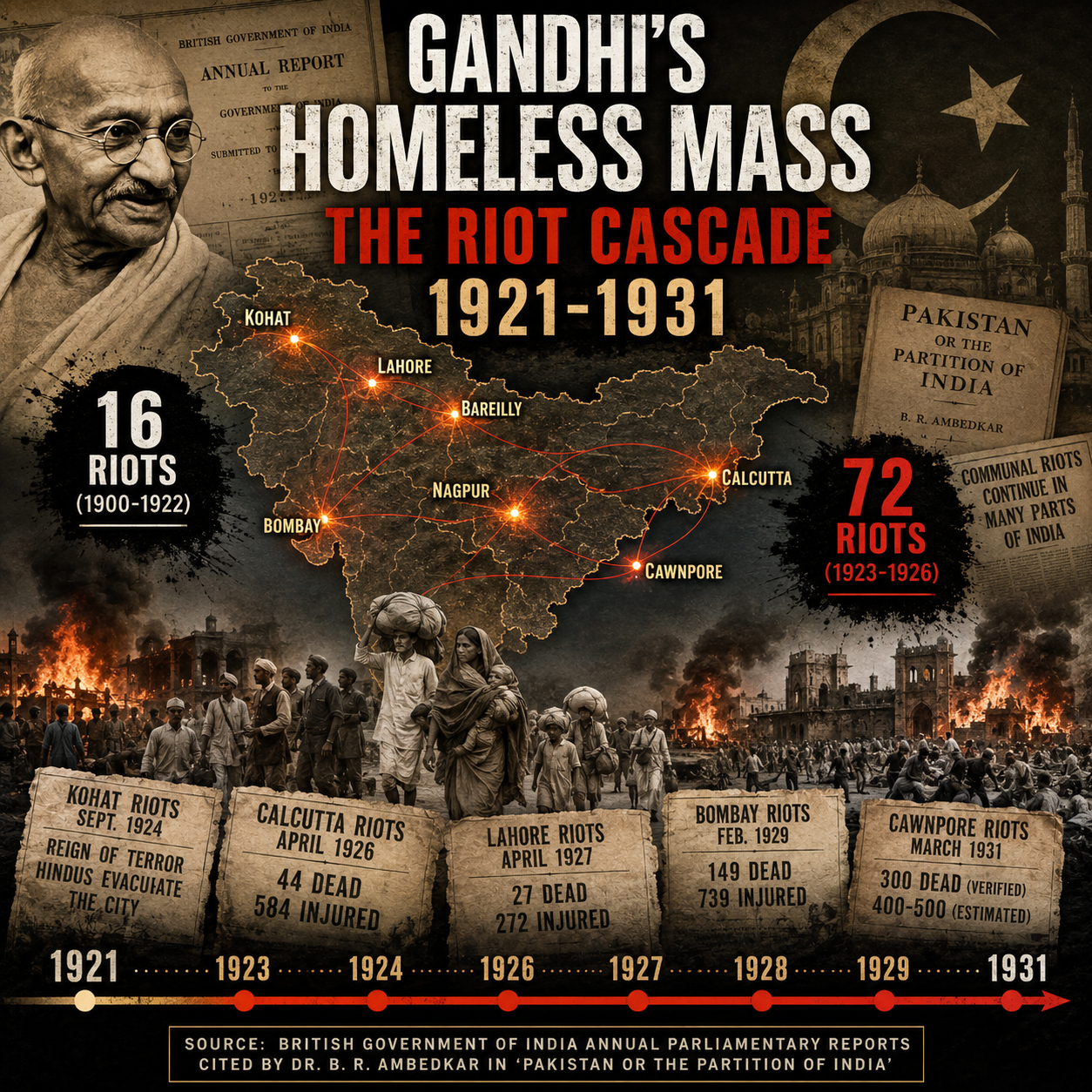
Gandhi’s Homeless Mass: The Riot Cascade He Left Behind — 1921-1931 (80)
भारत / GB
Part 80: Mahatma Gandhi’s Peace Efforts | Series Index
The Moplah Arc documented Gandhi’s conduct during and after the 1921 massacre. This post examines what followed — the decade of communal violence that Gandhi’s Khilafat experiment left behind when the Caliphate was abolished in 1924. The documented evidence is drawn from the British Government of India’s Annual Parliamentary Reports, cited by Ambedkar in Pakistan or the Partition of India, Chapter VII, and confirmed by S. Gopal’s The Viceroyalty of Lord Irwin, Oxford University Press, 1957.
Thank you for reading this post, don't forget to subscribe!The Action Taken: When M.A. Jinnah stood before the Nagpur Congress and warned that entangling religious passion with mass political agitation would lead to communal disaster, he was shouted down and forced from the platform.
Who Paid the Price: The constitutional, secular wing of the nationalist movement, which was permanently marginalized within Congress decision-making.
The Alternative Bypassed: Retaining a constitutional, non-sectarian path to self-governance that engaged colonial authority through legal negotiation.
Why This Matters: The pivotal constitutional fork in the road: the architect of future Pakistan was originally the staunchest opponent of religious mobilization, driven out by a shouting Congress crowd.
The Before-After Numbers
Gandhi’s Homeless Mass begins with two numbers placed before the reader.
S. Gopal, The Viceroyalty of Lord Irwin, Oxford University Press, 1957, p. 8 — cited in Fernando, P.T.M. (1969), Modern Asian Studies, 3(3), 245-255, DOI: https://doi.org/10.1017/s0026749x00002353:
1900-1922 — 22 years — 16 communal riots in India.
1923-1926 — 3 years — 72 communal riots in India.
Less than one riot per year for twenty-two years. Twenty-four riots per year for three years. The pivot point is 1923 — two years after Gandhi’s Khilafat experiment reached its peak mobilisation, and one year before the Caliphate was abolished.
The prosecution places these two numbers before the reader without characterisation. They are drawn from an Oxford-published scholarly source citing British Government parliamentary records. They are not contested. They are placed before the reader as the exhibit’s foundation.
What Gandhi’s Experiment Had Built
The Khilafat alliance formalised at Nagpur in December 1920 mobilised a consolidated pan-Islamic political identity at mass scale. Jinnah warned it was a category error and resigned. Besant warned the preaching would produce consequences Gandhi could not control — and was proven right within eleven months at Moplah.
Gandhi did not call off the coordination between Congress and Khilafat proponents when he saw Khilafat is bringing Muslims against Hindus rather than supporting the core cause of Non-Cooperation Movement against the British as documented in Gandhi’s Moplah Silence.
The Caliphate was abolished by Kemal Ataturk in March 1924. The Khilafat movement collapsed immediately. The consolidated Muslim political identity Gandhi had built — energised, mobilised, given a framework of pan-Islamic solidarity — was left without a cause. Gandhi’s Homeless Mass documents precisely what that identity did next — and what Gandhi did and did not do in response. The identity had already demonstrated its destructive capacity at Moplah in 1921. Those who held political authority in 1924 knew what they were leaving unmanaged.
The Documented Cascade — 1921 to 1931
The following sequence is drawn from Ambedkar’s Pakistan or the Partition of India, Chapter VII — available at https://franpritchett.com/00ambedkar/ambedkar_partition/307c.html — which Ambedkar explicitly states is based on the British Government of India’s Annual Reports submitted to Parliament.
1920-1922 — Moplah, Bengal, Punjab: The Moplah rebellion — documented across seventeen series blogs. Muharram riots in Bengal and Punjab simultaneously. Multan: heavy property damage.
1924 — Kohat: Riots September 9-10. Total casualties approximately 155 killed and wounded. Property worth Rs. 9 lakhs destroyed. Ambedkar’s documented phrase from the Government Annual Report: “reign of terror.” The entire Hindu population evacuated the city of Kohat.
1924-1925 — The summer of riots: Delhi — severe fighting with serious casualties. Nagpur — bad outbreak. August: Lahore, Lucknow, Moradabad, Bhagalpur — simultaneous riots. September-October: Lucknow, Shahjahanpur, Kankinarah, Allahabad — severe fighting.
1925-1926 — The widening: Calcutta, United Provinces, Central Provinces, Bombay Presidency — all scenes of riots. Significant documented feature: riots now occurring in small villages, not only urban centres. Gujarat: temple desecration documented. Aligarh: police fired, five persons killed. Sholapur: Hindu idol procession passed near a mosque — serious riot.
1926 — Calcutta: April 1-5: affray outside a mosque — 44 deaths, 584 injured, 110 fires in three days. April 22-28: petty street quarrel reignited — 66 deaths, 391 injured, police fired on twelve occasions. July 15: Hindu procession playing music near mosques — 14 deaths, 116 injured. July 16-25: Muharram — 28 deaths, 226 injured.
1926-1927 summary: 40 riots in twelve months — 197 deaths, 1,598 injuries.
1927 April-September: 25 riots — 103 deaths, 1,084 wounded. Lahore: 27 deaths, 272 injured. Bareilly: 14 deaths, 165 injured. Nagpur: 19 deaths, 123 injured. Khyber Pass region: approximately 450 Hindus expelled from tribal territories.
1928-1929: 22 riots — 204 deaths, nearly 1,000 injured. Bombay February 1929 alone: 149 deaths, 739 injured over a fortnight of continuous rioting.
1931 — Cawnpore: 300 verified deaths — estimated between 400 and 500. Widespread arson of temples, mosques, and homes. Slaughter of entire families documented.
The Structural Connection
Gandhi’s Homeless Mass places one further structural observation before the reader — drawn from Fernando (1969) citing Gopal (1957):
The exponential jump directly correlates with the immediate aftermath of the Non-Cooperation and Khilafat collapses. Localized religious friction points — cow slaughter disputes, music near mosques, procession routes — had existed for decades without producing a riot per year. After 1922, the same friction points produced twenty-four riots per year.
Bipan Chandra, *Communalism in Modern India*, confirmed independently: communal tension and riots did not occur on any significant scale in India until 1946-47. Before that, the maximum communal rioting took place during 1923-26. Two independent historians, two independent assessments, the same documented conclusion — the maximum communal rioting before Partition occurred in the years immediately following Gandhi’s Khilafat experiment. Gandhi’s Homeless Mass is the documented record of that identity expressing itself without direction — in Kohat, in Calcutta, in Lahore, in Nagpur, in Bombay, in Cawnpore — across a decade Gandhi had built the preconditions for and then left unmanaged. The series will document Gandhi’s response to this cascade — or the documented absence of one — in the blogs that follow.
The Prosecution’s Position
Gandhi’s Homeless Mass places three questions before the reader — each answerable from the documented cascade above.
- Did Gandhi’s Khilafat experiment consolidate a pan-Islamic political identity at mass scale between 1920 and 1924?
- Did the Caliphate’s abolition in 1924 leave that consolidated identity without a cause or framework — and did the documented riot cascade follow immediately?
- Did Gandhi address the cascade — fast for its victims, demand accountability, dissolve what his experiment had left behind — or did the series’ documented record show his conduct directed elsewhere during this decade?
The prosecution does not answer. The two numbers are placed before the reader. The documented cascade is placed before the reader. The structural observation from two independent scholars is placed before the reader. The reader will examine all three and complete the sentence.
1900 to 1922 — twenty-two years — sixteen communal riots. 1923 to 1926 — three years — seventy-two communal riots. The Caliphate was abolished in 1924. The consolidated Muslim political identity Gandhi’s experiment had built was left without a cause. The prosecution places the documented cascade before the reader — Kohat, Calcutta, Lahore, Nagpur, Bareilly, Bombay, Cawnpore. Source: British Government of India Annual Parliamentary Reports, cited by Ambedkar in Pakistan or the Partition of India. The reader will complete the sentence.
Feature Image: Click here to view the image.
Videos
Glossary of Terms
- Gandhi’s Homeless Mass: A phrase coined in this series to describe the politically mobilized mass following the Khilafat movement that, after the abolition of the Caliphate, was left without its original unifying cause.
- Khilafat Movement: A pan-Islamic political campaign launched after World War I to preserve the Ottoman Caliphate, supported by Mahatma Gandhi as part of the Non-Cooperation Movement.
- Non-Cooperation Movement: A mass political movement led by Gandhi between 1920 and 1922 encouraging Indians to withdraw cooperation from British institutions and administration.
- Caliphate: The institution of Islamic leadership claiming succession to Prophet Muhammad, abolished in Turkey in 1924 by Mustafa Kemal Atatürk.
- Pan-Islamic Identity: A political and religious consciousness emphasizing unity among Muslims across national and regional boundaries.
- Moplah Rebellion: The 1921 uprising in the Malabar region involving sections of the Moplah Muslim community, remembered variously as an anti-colonial revolt, agrarian uprising, and communal massacre.
- Muharram Riots: Communal disturbances associated with processions and observances during Muharram, the first month of the Islamic calendar.
- Kohat Riots: Major communal riots that occurred in Kohat in 1924, resulting in heavy casualties, destruction of property, and evacuation of the Hindu population from the town.
- Communal Riot: Violent conflict between groups identified primarily by religious communities, especially Hindus and Muslims in the colonial Indian context.
- British Government of India Annual Reports: Official reports submitted by the colonial administration to the British Parliament, documenting political, social, and security developments in India.
- Pakistan or the Partition of India: Dr. B.R. Ambedkar’s influential work analyzing Hindu-Muslim relations, communal politics, and the factors leading to Partition.
- Riot Cascade: A key phrase used in this blog to describe the sequence of recurring communal disturbances across India during the decade following the collapse of the Khilafat movement.
- Cawnpore: The colonial-era name of Kanpur, a major city in present-day Uttar Pradesh and the site of severe communal violence in 1931.
- Structural Observation: An analytical conclusion drawn from patterns and trends in historical data rather than from a single event or incident.
- Prosecution’s Position: A recurring series framework in which evidence, questions, and historical records are presented for readers to evaluate, analogous to a legal prosecution presenting its case.
#Gandhi #Khilafat #Riots #History #Partition #Congress #Ambedkar #India #Politics #Communalism #FreedomStruggle #HinduinfoPedia
Gandhi’s Peace Efforts: The Questions Before the Mahatma (0)
Refer to Various Arks Referred to in the Blog