
Gandhi’s Vidyarthi: The Man the Pact Released — and What Followed (71)
भारत / GB
Part 71: Mahatma Gandhi’s Peace Efforts | Series Index
The Moplah arc — Blogs 54 to 70 — has placed Gandhi’s documented conduct across the first great downstream flood before the reader. This post moves the series forward by examining one documented life that intersected with Gandhi’s framework at three precise points: the movement, the pact, and the death. The prosecution places the documented facts before the reader without characterisation.
Thank you for reading this post, don't forget to subscribe!The Action Taken: When Ganesh Shankar Vidyarthi was murdered by communal mobs while attempting to pacify rioters unarmed during the March 1931 Kanpur riots, Gandhi praised his death as an ideal satyagrahi sacrifice to be emulated.
Who Paid the Price: Nationalist workers instructed to enter active, lethal riot zones unarmed rather than demanding statutory police deterrence and order.
The Alternative Bypassed: Recognizing that violent civil riots require armed police intervention and statutory law enforcement, not unarmed sacrificial pacification.
Why This Matters: Transformed a catastrophic law-enforcement breakdown into an idealized moral imperative, urging followers to offer their lives rather than demand physical protection from the state.
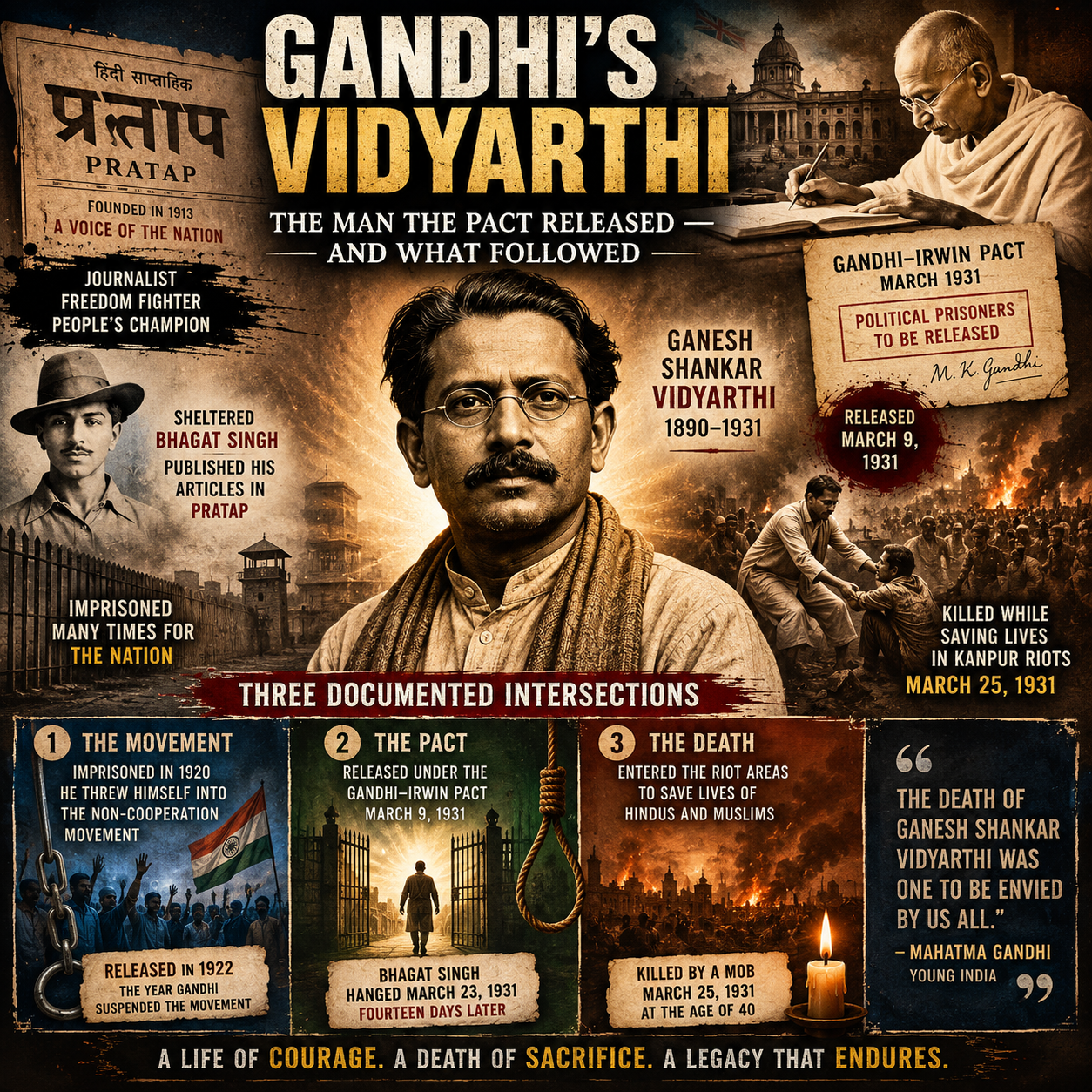
Who Vidyarthi Was — Documented
Gandhi’s Vidyarthi — Ganesh Shankar Vidyarthi — was born October 26, 1890. He founded the Hindi weekly Pratap in Kanpur in 1913 — which became a daily in 1920. He met Gandhi in Lucknow in 1916 and committed himself to the national movement. He was imprisoned multiple times — for championing Rae Bareli peasants, for delivering a speech at the Provincial Political Conference at Fatehgarh, for his journalism.
Vidyarthi occupied a documented position that the series has not yet placed on the record — the junction between Gandhi’s constitutional framework and the revolutionary tradition Gandhi had consistently distanced himself from. Vidyarthi was a Congress member and a Gandhian who simultaneously gave Bhagat Singh refuge when he was in hiding, published his articles in Pratap under the pen name Balwant Singh, and covered his sixty-three-day hunger strike.
He was a man who believed in both methods — Gandhi’s and Bhagat Singh’s — and served both. He pleaded for clemency for Bhagat Singh. His efforts were unsuccessful. He facilitated a meeting between Chandra Shekhar Azad and Jawaharlal Nehru in Allahabad — an attempt to bridge the revolutionary and constitutional paths that Gandhi had kept separate. The meeting ended in failure. Vidyarthi remained committed to both traditions simultaneously — a position Gandhi’s framework did not accommodate.
Three Documented Intersections
Gandhi’s Vidyarthi places three documented intersections before the reader — each precise, each dated, each connected to Gandhi’s documented choices.
Intersection One — The Movement:
Vidyarthi threw himself into the Non-Cooperation Movement. He was imprisoned in 1920 for championing peasant rights through Pratap — the same year Gandhi launched the movement. He was released in 1922 — the same year Gandhi suspended it. The thirty thousand who went to jail and received nothing included men like Vidyarthi. He received his imprisonment. He did not receive the Swaraj Gandhi had promised within one year.
Intersection Two — The Pact:
Vidyarthi was among those released from prison under the Gandhi-Irwin Pact of March 1931. He walked out of jail on March 9, 1931. The Pact that released him was signed while Bhagat Singh was awaiting execution. Gandhi told Lord Irwin that Bhagat Singh’s case had no connection with the Pact negotiation — documented in Blog 51. Bhagat Singh was hanged on March 23, 1931 — fourteen days after Vidyarthi walked free under the Pact Gandhi had signed.
Intersection Three — The Death:
Kanpur erupted in communal violence in late March 1931. Ganesh Shankar Vidyarthi — sixteen days after his release from the jail the Gandhi-Irwin Pact had opened — threw himself into the midst of rioters to save lives of both Hindus and Muslims. He was killed by a mob on March 25, 1931. He was forty years old.
Gandhi’s documented response to Vidyarthi’s death, published in Young India: “The death of Ganesh Shankar Vidyarthi was one to be envied by us all.”
The Communal Violence That Killed Vidyarthi
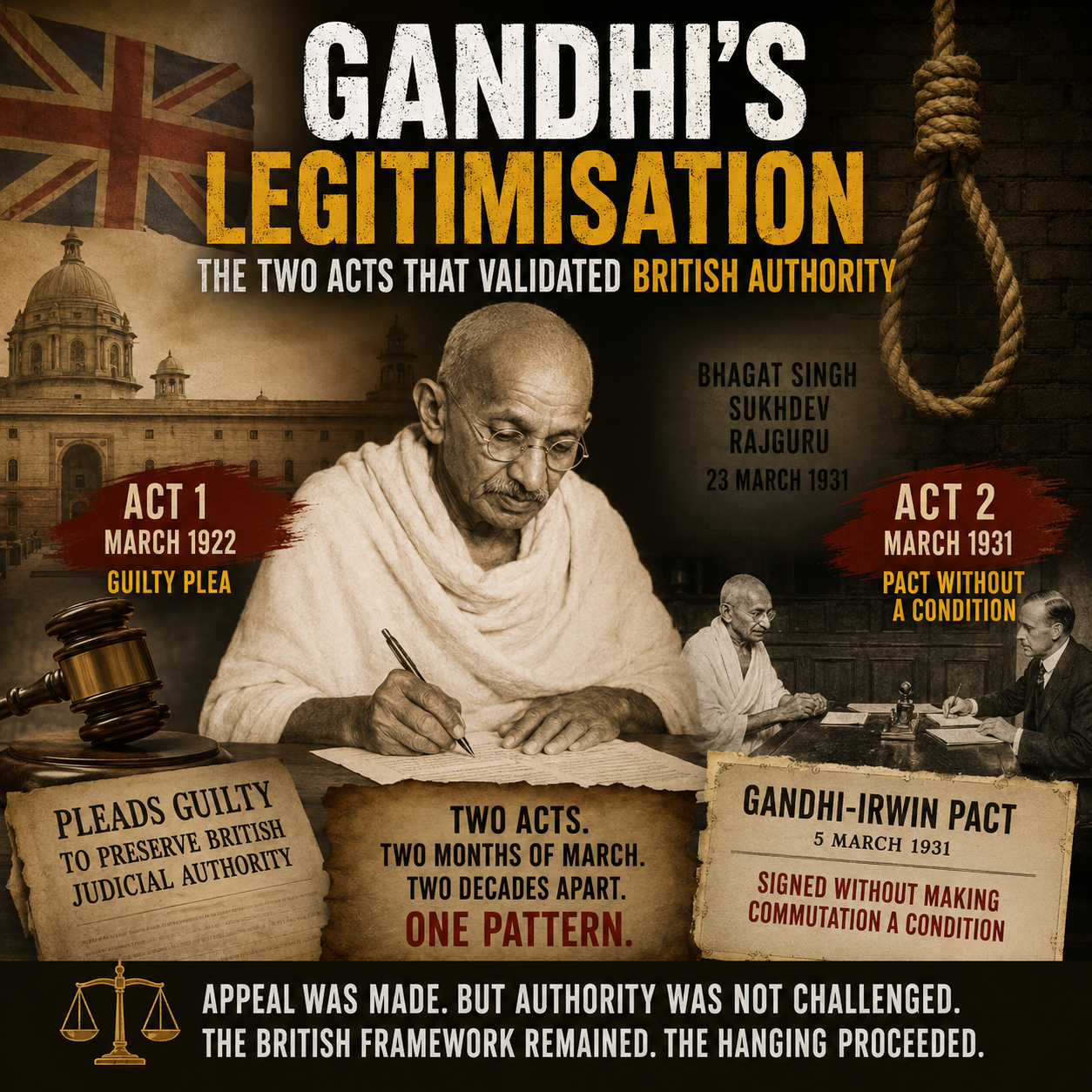
The communal violence in Kanpur in March 1931 that killed Vidyarthi is documented precisely. The riots erupted on March 24 1931 — the day after Bhagat Singh, Rajguru and Sukhdev were hanged — when Muslims opposed a Hindu hartal called to mourn the executions. The riots lasted six days and claimed over 400 lives. The Congress’s own Cawnpore Riots Inquiry Committee produced a 293-page documented report on their causes — a report subsequently banned by the colonial administration.
Gandhi’s Vidyarthi was in Kanpur when the riots began. He chose not to attend the Karachi Congress session — which opened on March 26 under Sardar Patel’s presidency — and instead entered the riot-stricken areas to save lives. Gandhi’s documented response came in Young India: the death was one to be envied. His blood was the cement that would ultimately bind two communities.
Vidyarthi died two days after Bhagat Singh was hanged under the Pact Gandhi had signed without making the execution a condition of negotiation. Gandhi called the death glorious and enviable. Vidyarthi had given Bhagat Singh his platform. Gandhi had not made Bhagat Singh’s life a condition of the Pact that freed Vidyarthi.
The Prosecution’s Position
Gandhi’s Vidyarthi does not claim Gandhi caused Vidyarthi’s death. It places three documented intersections before the reader and asks the reader to examine them.
- Did the Non-Cooperation Movement that Vidyarthi served produce the Swaraj Gandhi had promised within one year — or did Gandhi suspend it before that confrontation arrived, leaving Vidyarthi and thirty thousand others with nothing?
- Did the Gandhi-Irwin Pact that released Vidyarthi on March 9, 1931 also secure a commutation for Bhagat Singh — whose platform Vidyarthi had provided — or did Gandhi tell Irwin the hanging had no connection with his negotiation?
- Did Gandhi call the death that followed — Vidyarthi killed in the communal violence Gandhi’s framework had neither prevented nor condemned — enviable and glorious?
The series does not answer. Gandhi’s Vidyarthi places the three documented intersections before the reader. The reader will examine the sequence and complete the sentence.
1916 — Vidyarthi met Gandhi, committed to the movement. 1920 — imprisoned for the movement. 1922 — released when Gandhi suspended it, receiving nothing. 1931 — released from jail under Gandhi’s Pact, March 9. Bhagat Singh hanged under Gandhi’s Pact, March 23. Vidyarthi killed in communal violence, March 25. Gandhi called the death glorious and enviable. The prosecution places the documented sequence before the reader.
Feature Image: Click here to view the image.
Videos
Glossary of Terms
- Ganesh Shankar Vidyarthi: Indian journalist, freedom activist, founder of the Hindi newspaper Pratap, and a Congress leader who was killed while attempting to rescue victims during the Kanpur communal riots of March 1931.
- Pratap: A Hindi newspaper founded by Ganesh Shankar Vidyarthi in 1913 that became known for nationalist journalism, peasant advocacy, and support for freedom movement causes.
- Non-Cooperation Movement: A mass movement launched by Gandhi in 1920 urging Indians to withdraw cooperation from British institutions, courts, schools, and honours.
- Swaraj: A term meaning self-rule or self-government, widely used during India’s freedom struggle as the objective of nationalist movements.
- Gandhi-Irwin Pact: An agreement signed in March 1931 between Mahatma Gandhi and Lord Irwin that led to the release of many political prisoners and paved the way for Congress participation in constitutional discussions.
- Lord Irwin: The Viceroy of India from 1926 to 1931 who negotiated the Gandhi-Irwin Pact with Gandhi.
- Bhagat Singh: Revolutionary freedom fighter executed by the British on March 23, 1931, along with Rajguru and Sukhdev for their role in anti-colonial revolutionary activities.
- Balwant Singh: The pen name under which Bhagat Singh’s writings were published in Pratap while he was in hiding.
- Chandra Shekhar Azad: Revolutionary leader of the Hindustan Socialist Republican Association who sought armed resistance against British rule.
- Karachi Congress Session: The annual session of the Indian National Congress held in Karachi in March 1931, shortly after the execution of Bhagat Singh and the signing of the Gandhi-Irwin Pact.
- Young India: Gandhi’s English-language journal in which he regularly published political commentary, reflections, and responses to contemporary events.
- Cawnpore Riots Inquiry Committee: A committee established to investigate the causes and course of the 1931 Kanpur communal riots, producing a detailed report on the violence.
- Prosecution’s Position: A recurring series phrase referring to the method of presenting documented facts, chronology, and evidence before readers without directly imposing a final conclusion.
- Documented Intersections: A series-specific phrase describing significant points where an individual’s life, Gandhi’s actions, and major historical events directly intersect in a verifiable historical sequence.
- Gandhi’s Vidyarthi: A series-specific phrase highlighting Ganesh Shankar Vidyarthi’s association with Gandhi’s political movement while examining the consequences of key events linked to Gandhi’s leadership.
#Gandhi #BhagatSingh #FreedomStruggle #IndianHistory #Congress #NationalMovement #GaneshShankarVidyarthi #BritishRaj #Swaraj #India #HinduinfoPedia
Gandhi’s Peace Efforts: The Questions Before the Mahatma (0)