
Gandhi’s Wardha Defeat: The October 1939 Decision Against Gandhi and Patel (94)
भारत / GB
Part 94: Mahatma Gandhi’s Peace Efforts | Series Index
Blog 93 documented Gandhi’s own reservation about the October 1939 ministry resignation — his stated fear that it would strengthen the Muslim League and free British wartime control. This post documents the mechanics of how that decision was actually made, and where Gandhi stood within it.
Thank you for reading this post, don't forget to subscribe!The Action Taken: Under Gandhi’s direction, the CWC mandated that all eight Congress provincial ministries resign simultaneously to protest Britain declaring India at war without legislative consultation.
Who Paid the Price: The Indian electorate, which was stripped of elected provincial governments, handing absolute executive power back to British governors under Section 93.
The Alternative Bypassed: Utilizing provincial ministerial power to bargain for wartime concessions, military recruitment control, and post-war constitutional guarantees.
Why This Matters: Repeating the 1922 pattern: voluntary abdication of institutional leverage vacated the governance space, leaving the field open for the British and the Muslim League to coordinate wartime strategy.
The Wardha Meeting — Documented
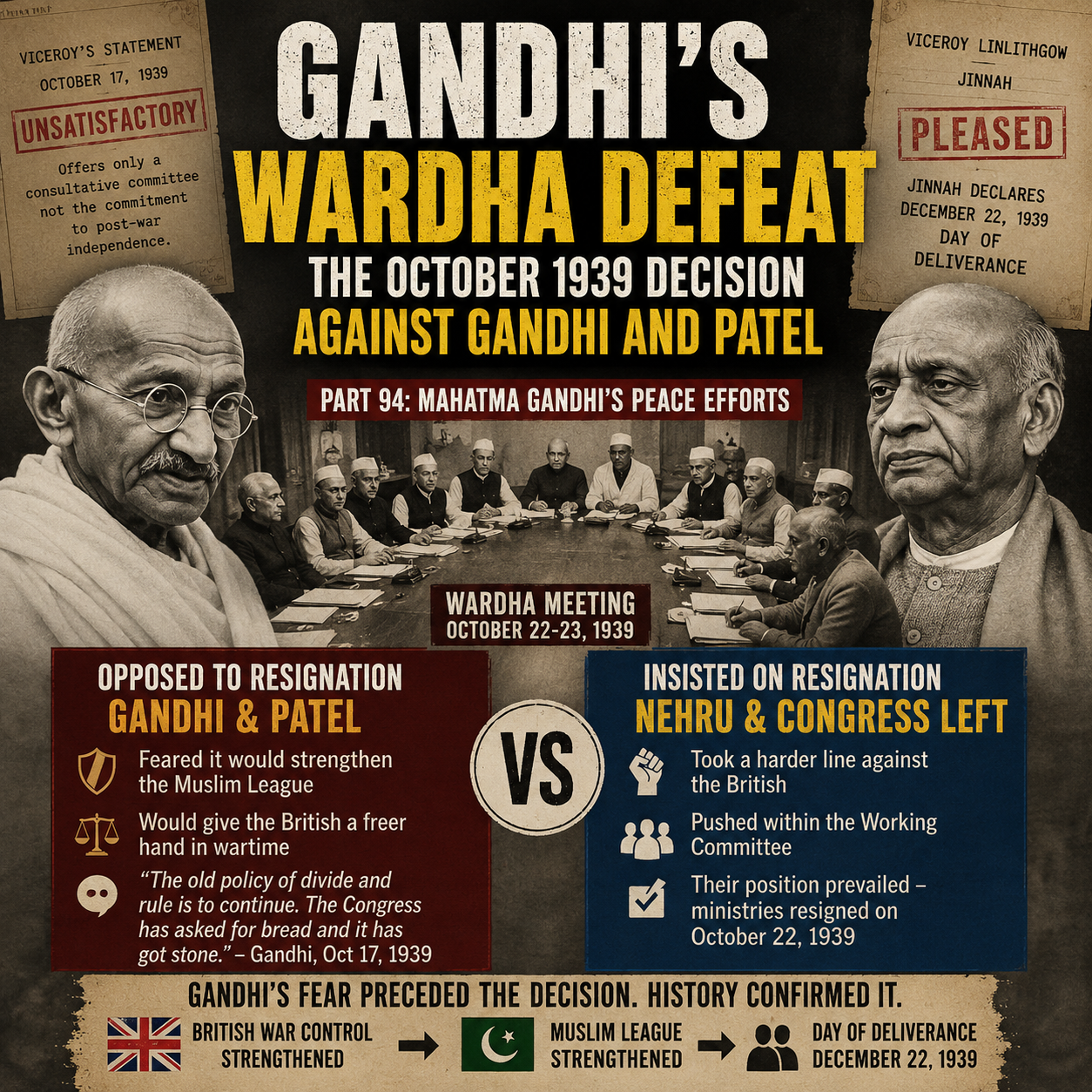
The Congress Working Committee met at Wardha on October 22-23, 1939, to decide Congress’s response to the Viceroy’s unilateral declaration of war and his subsequent statement of October 17. Viceroy Linlithgow had declared India a participant in the war on September 3, 1939, without consulting any elected Indian representative or provincial government. The Working Committee had initially responded with a resolution condemning German aggression while stating that India could not associate itself with the war effort unless consulted. The Viceroy’s October 17 response was considered unsatisfactory by Congress — it offered only a consultative committee for advisory purposes, not the commitment to post-war independence Congress had sought.
Gandhi’s Wardha Defeat places the documented record of this meeting before the reader. The resignation of the eight provincial ministries was not a decision Gandhi made. It was a decision taken by the Working Committee, where factions held different positions and one faction prevailed.
The Documented Alignment
Documented accounts of the Wardha proceedings record that Gandhi and Sardar Patel were not in favour of non-cooperation with the British over the war, and were not in favour of the ministries resigning. Jawaharlal Nehru, leading the push within the Working Committee, and the Congress socialist bloc advocated for resignation and insisted upon it. The Working Committee resolution of October 10, 1939 had already signalled the direction of the internal debate, stating that India could not associate itself with the war unless consulted first — language that left open whether the response would be protest short of resignation, or resignation itself.
Before that resolution, Congress had sought a joint approach with the Muslim League on the war question specifically. Jinnah was invited to the Working Committee’s September 1939 meeting but declined to attend. Nehru met him separately — once together with Gandhi — and a convergence of views was documented as emerging between the two sides. The Viceroy’s October 17 rejection of the Congress position collapsed this track along with the ministries themselves.
Gandhi’s Wardha Defeat places this documented alignment before the reader without alteration: Gandhi and Patel on one side, opposed to resignation; Nehru and the socialist faction on the other, insisting on it. The resignation that followed has been documented as a victory of the Congress Left within the Working Committee.
The Sequence of Gandhi’s Own Words
Gandhi’s Wardha Defeat places the documented timeline before the reader with precision, because the sequence matters to what the record establishes.
Gandhi’s stated reservation — that resignation would strengthen the Muslim League and give the British a freer hand to militarise India — is documented as his position held at the time of the Wardha vote, not as a conclusion he reached afterward. This was a prediction made before the decision was taken, not a retrospective explanation offered after the fact. Gandhi’s reaction to the Viceroy’s October 17 statement was recorded at the time: “the old policy of divide and rule is to continue. The Congress has asked for bread and it has got stone.” Even with this assessment of the Viceroy’s conduct, Gandhi did not align with the resignation strategy that the rest of the Working Committee adopted in response to it.
The decision went against him. The ministries resigned on October 22, 1939, on instructions issued by the Congress High Command following the Working Committee decision. The documented outcome that followed: both Viceroy Linlithgow and Muhammad Ali Jinnah were recorded as pleased with the resignations. Jinnah declared December 22 the “Day of Deliverance” ten weeks later, examined in Blog 93.
What the Documented Record Establishes
Gandhi’s Wardha Defeat places one structural observation before the reader, distinct from earlier characterisations in this series of Gandhi’s documented authority over Congress.
The series has documented, across Blogs 21-22 and elsewhere, instances where Gandhi exercised unilateral authority over Congress decisions — Chauri Chaura in 1922 being a documented example of a decision Gandhi made alone, against the wishes of much of the movement’s organised base, and enforced through his own standing rather than through a Working Committee vote. The October 1939 resignation does not fit that same pattern. The documented record shows Gandhi on the losing side of an internal Working Committee vote, opposed by Nehru and the socialist bloc, with Patel standing alongside him in opposition.
This distinction matters for how the documented record should be read. A decision Gandhi made unilaterally and a decision Gandhi opposed and lost are not the same kind of exhibit, even where both produced outcomes later criticised. The October 1939 resignation belongs to the second category: a documented internal defeat, not an exercise of unchallengeable authority.
The Prosecution’s Position
Gandhi’s Wardha Defeat places three questions before the reader.
- Did Gandhi state his opposition to the ministry resignation, and his prediction of its consequences, before the Working Committee vote at Wardha — making it a documented prediction rather than a retrospective justification?
- Did the Wardha decision go against Gandhi and Patel, carried by Nehru and the Congress socialist bloc — making the resignation a documented internal defeat rather than a decision within Gandhi’s unilateral control?
- Did the documented outcome that followed — the Viceroy’s and Jinnah’s satisfaction, and the League’s subsequent consolidation around the “Day of Deliverance” — match precisely what Gandhi had predicted before the vote was taken?
The series does not answer. The documented Wardha proceedings, Gandhi’s pre-vote statement of reservation, and the documented post-resignation outcome are placed before the reader. The reader will examine the sequence and complete the sentence.
Invitation To Defence
We now invite the defence to present its exhibits, offering a direct rebuttal to the evidence put forth in the prosecution’s case.
October 22-23, 1939, Wardha. Gandhi and Patel opposed the ministry resignation. Nehru and the socialist bloc insisted on it and won. Gandhi’s stated fear — that resignation would strengthen the League and free British wartime control — preceded the vote, not followed it. The resignation went through. The Viceroy and Jinnah were documented as pleased. The prosecution places the documented vote and its documented outcome before the reader. The reader will complete the sentence.
Feature Image: Click here to view the image.
Videos
Glossary of Terms
1. Wardha Meeting: The Congress Working Committee meeting held at Wardha on October 22–23, 1939, where Congress decided its response to British wartime policy.
2. Congress Working Committee (CWC): The highest decision-making body of the Indian National Congress responsible for major political and organizational decisions.
3. Viceroy Linlithgow: The British Viceroy of India from 1936 to 1943 who declared India a participant in World War II without consulting elected Indian representatives.
4. Provincial Ministries Resignation: The collective resignation of eight Congress-led provincial governments in October 1939 following the Working Committee decision.
5. Muslim League: The political organization led by Muhammad Ali Jinnah that later spearheaded the demand for Pakistan.
6. Day of Deliverance: A day proclaimed by Jinnah on December 22, 1939, to mark the end of Congress provincial ministries.
7. Congress Socialist Bloc: The socialist-oriented faction within Congress that strongly supported the resignation of the ministries in 1939.
8. Congress Left: The broader left-leaning grouping within Congress that advocated a stronger anti-British response during the war crisis.
9. Non-Cooperation: A political strategy involving refusal to cooperate with British authorities as a form of protest.
10. World War II War Effort: The military and administrative campaign undertaken by Britain during World War II, to which India was committed without consultation.
11. Documented Record: Official resolutions, correspondence, speeches, and proceedings used as historical evidence.
12. Wardha Defeat: A term coined in this series describing Gandhi’s documented loss within the Congress Working Committee during the October 1939 decision.
13. Chauri Chaura Incident: The 1922 event after which Gandhi suspended the Non-Cooperation Movement despite opposition from many Congress activists.
14. Unilateral Authority: The ability of a leader to impose a decision primarily through personal influence rather than organizational consensus.
15. Internal Working Committee Vote: The formal decision-making process within the Congress Working Committee where competing viewpoints were debated and voted upon.
#Gandhi #Congress #Nehru #Patel #Jinnah #History #India #Politics #Wardha #Freedom #HinduinfoPedia
Gandhi’s Peace Efforts: The Questions Before the Mahatma (0)