
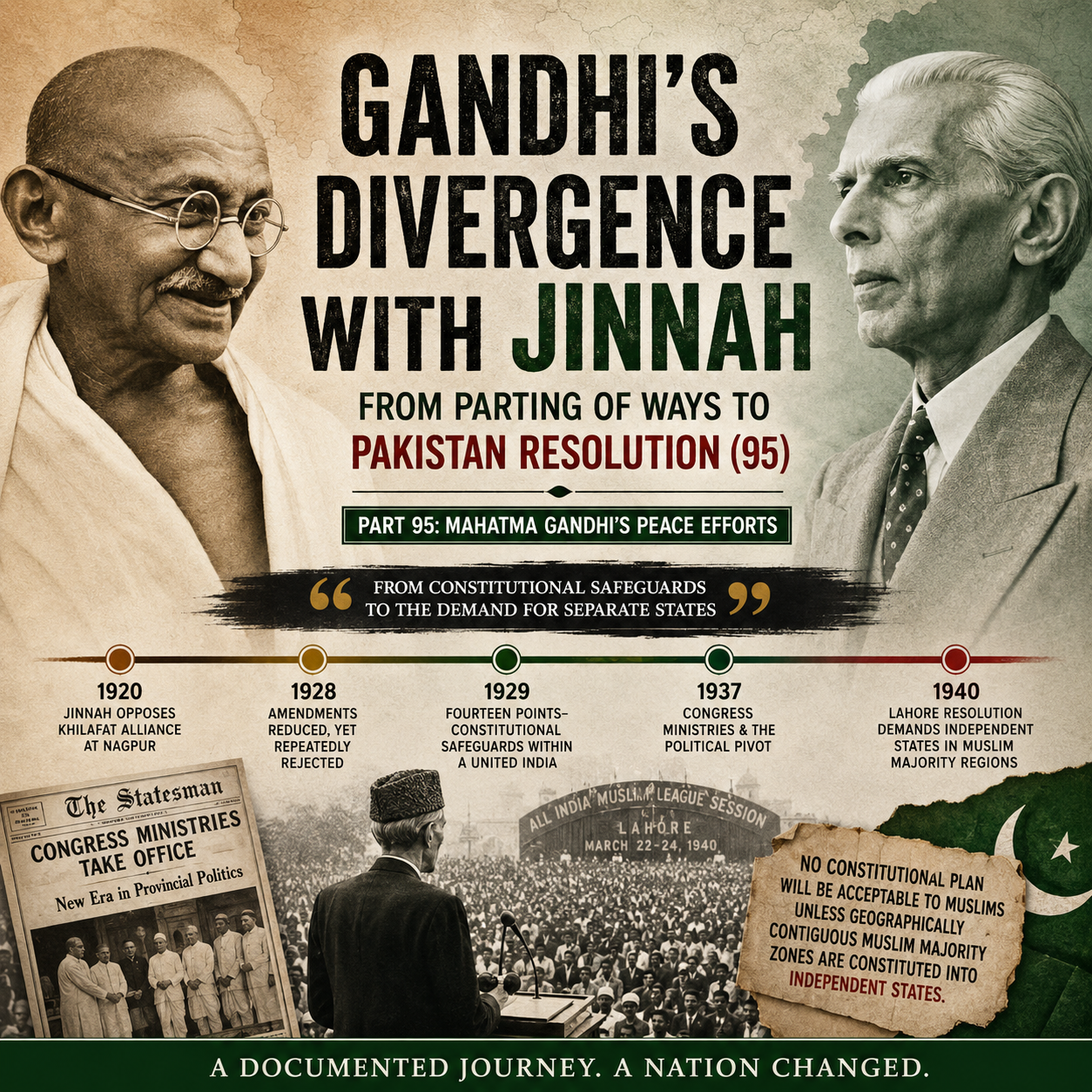
Gandhi’s Divergence With Jinnah: From Parting of Ways to Pakistan Resolution (95)
भारत / GB
Part 95: Mahatma Gandhi’s Peace Efforts | Series Index
Blog 94 documented the Wardha CWC decision and the documented outcome that followed — both the Viceroy and Jinnah pleased, the League strengthened. This post closes the arc: the documented twenty-year sequence from Jinnah’s 1920 objection to Gandhi’s support of the Khilafat Movement, through the 1928 parting of ways, to the Lahore Resolution of March 1940, and what the record shows changed along the way.
Thank you for reading this post, don't forget to subscribe!What Jinnah Had Not Yet Abandoned
Gandhi’s Divergence With Jinnah places one documented fact before the reader before examining the break itself. Jinnah’s objection traces to 1920, when he opposed Gandhi’s alliance with the Khilafat Movement at the Nagpur session and resigned from Congress rather than support it. That objection did not, at the time, foreclose constitutional engagement. As late as the mid-1930s, Muslim leaders were still working to secure maximum political safeguards for Muslims within a federation of India — not outside it. Separate electorates under the Government of India Act 1935 were sought as protection within a shared constitutional structure, not as a step toward separation. Jinnah’s own 1929 Fourteen Points, documented in Blog 81, were built on the same premise — residual provincial powers within a single India.
The documented record does not show a man arriving in 1920, or even in 1928, already committed to partition. It shows an objection raised in 1920, a constitutional track pursued for eight years afterward despite that objection, and proposals reduced repeatedly to find common ground and repeatedly rejected — documented across Blogs 81, 84, and 85. Gandhi’s Divergence With Jinnah examines what changed between the 1920 objection and the demand made at Lahore twenty years later.
The 1937 Pivot — Documented
The 1937 provincial elections, documented in Blog 86, left the Muslim League without a government in any Muslim-majority province. Out of 482 Muslim seats contested, the League won 106. In Punjab, the Unionists formed government; in Sindh, an alliance of independents; in the North-West Frontier Province, the Khan brothers led a Congress-aligned government. The League was, by its own later account, virtually nowhere.
Congress’s High Command then governed with what is documented as iron control over its own provinces — control that, extended to the centre, signalled to League leadership what federation under a Congress-dominated centre would mean for Muslim-majority provinces. Gandhi’s Coalition Terms (Blog 88) and Gandhi’s Mass Contact Programme (Blog 89) are the specific documented instances of this period: coalition terms requiring the League’s dissolution, and a Congress outreach campaign aimed directly at the League’s own base. The Mass Contact Programme’s documented consequence is part of the same record: rather than weakening the League, the campaign earned Jinnah’s documented anger and is credited, in the same sources, with helping bring the Muslim premiers of Punjab, Bengal, and Assam into the League’s camp by 1940 — three provinces whose support would prove decisive at Lahore.
The Lahore Resolution — Documented
On March 22-24, 1940, the All-India Muslim League held its annual session at Lahore, Punjab, attended by an estimated 100,000 people at Minto Park. Jinnah’s presidential address, delivered in English over roughly two hours, argued that Hindus and Muslims were not minority and majority within one nation, but two nations by any definition of the term — distinct in religion, social custom, literature, and historical inspiration. Jinnah framed the issue as international rather than internal: a problem between two nations, not a domestic minority question.
The resolution itself was drafted initially by Sir Sikandar Hayat Khan, Chief Minister of Punjab, then refined by a Subjects Committee chaired by Jinnah. It was moved in the general session by A.K. Fazlul Huq, Premier of Bengal, and seconded by Chaudhry Khaliquzzaman from the United Provinces, Zafar Ali Khan from Punjab, Sardar Aurangzeb Khan from the North-West Frontier Province, Pir Ziauddin Andrabi from Kashmir, and Sir Abdullah Haroon from Sindh. The resolution declared that no constitutional plan would be acceptable to Muslims unless geographically contiguous Muslim-majority zones in the North-West and East were constituted into independent states.
The word “Pakistan” did not appear in the text. The resolution used “states,” plural — a documented ambiguity later debated by historians as either an unresolved drafting question or evidence the League had not yet settled on a single nation. It was contemporary Hindu newspapers, not the League, who first attached the name “Pakistan” to the resolution.
The Documented Sequence in Full
Gandhi’s Divergence With Jinnah places the full twenty-year sequence before the reader. 1920: Nagpur, Jinnah’s objection to the Khilafat alliance and his resignation from Congress. 1928: Calcutta, parting of the ways, documented in Blog 85. 1929: Fourteen Points, rejected. 1930-1934: London years, the League largely dormant. 1935: Jinnah’s return. 1937: elections, the League shut out of every Muslim-majority province, Congress’s coalition terms and Mass Contact campaign that followed. 1939: the Wardha vote, the ministry resignations, the Day of Deliverance, documented in Blog 93 and 94. 1940: Lahore. The series has now placed each documented step of this sequence on the record across this arc, Gandhi’s Divergence With Jinnah being the closing exhibit.
The Prosecution’s Position
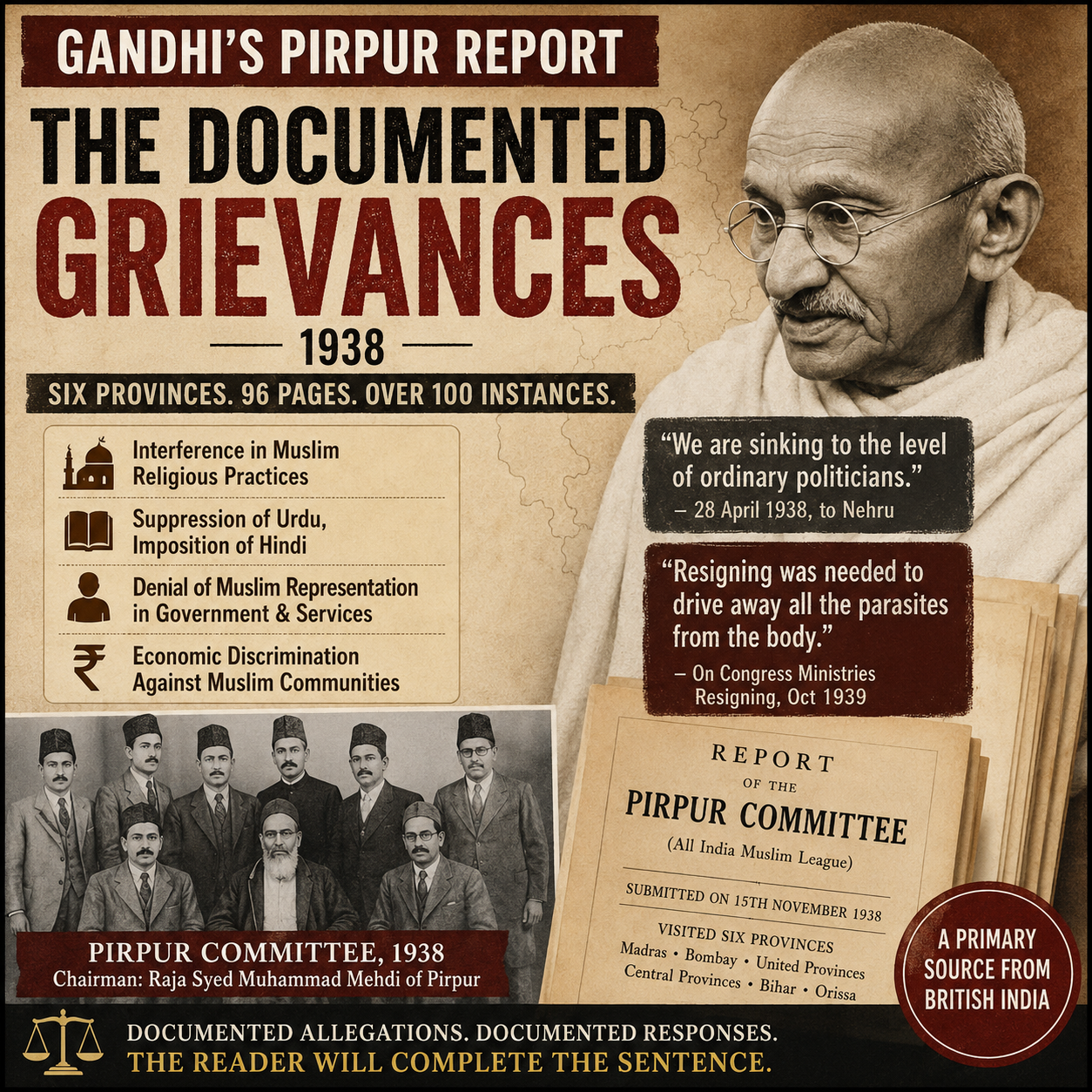
Gandhi’s Divergence With Jinnah places three questions before the reader.
- Did the documented record show Jinnah still seeking safeguards within a united India as late as the mid-1930s, rather than already committed to separation in 1920 or 1928?
- Did the documented sequence of 1937 — the League’s electoral exclusion, the coalition terms requiring its dissolution, the Mass Contact campaign aimed at its base — precede and accompany the League’s transformation into a mass movement?
- Did the Lahore Resolution’s own ambiguity — “states” rather than “state,” no mention of Pakistan by name — reflect a demand still being formed, arrived at through this specific documented sequence rather than a fixed goal from the outset?
The series does not answer. The twenty-year documented sequence, Blogs 81 through 94, is placed before the reader in full. The reader will examine it and complete the sentence.
Invitation To Defence
The floor belongs to the defense. We now invite them to present their exhibits and challenge the narrative established by the prosecution.
1920: Nagpur, objection and resignation. 1928: parting of the ways. 1929: Fourteen Points, rejected. 1937: shut out of every Muslim-majority province, then offered dissolution as the price of return. 1939: Wardha, the resignations, the Day of Deliverance. 1940: Lahore — two nations, not one, “states” not yet “state.” Twenty years, documented step by step. The prosecution places the full sequence before the reader. The reader will complete the sentence.
Feature Image: Click here to view the image.
Videos
Glossary of Terms
- Khilafat Movement: A political movement supported by Mahatma Gandhi after World War I to defend the Ottoman Caliphate, opposed by Jinnah at the 1920 Nagpur Session.
- Nagpur Session (1920): The Congress session where Gandhi’s Non-Cooperation and Khilafat strategy prevailed and Jinnah chose to leave Congress.
- Constitutional Safeguards: Political and legal protections sought by Muslim leaders within a united Indian constitutional framework.
- Government of India Act 1935: The British constitutional framework that expanded provincial autonomy and led to the provincial elections of 1937.
- Separate Electorates: An electoral system under which members of a religious community elected representatives from their own community.
- Fourteen Points: Jinnah’s 1929 constitutional proposals designed to protect Muslim political interests within a united India.
- Federal Structure: A constitutional arrangement dividing powers between a central government and provincial governments.
- Muslim League: The All-India Muslim League, the principal political organization led by Jinnah during the later phase of British rule.
- Mass Contact Programme: A Congress campaign launched after the 1937 elections to directly mobilize Muslim voters rather than working through the Muslim League.
- Congress Ministries: Provincial governments formed by Congress after its electoral victories in 1937.
- Day of Deliverance: The observance announced by Jinnah in December 1939 after the resignation of Congress ministries.
- Lahore Resolution: The resolution adopted by the Muslim League in March 1940 calling for independent political units in Muslim-majority regions.
- Minto Park: The Lahore venue where the Muslim League adopted the Lahore Resolution in March 1940.
- Two-Nation Theory: The proposition that Hindus and Muslims constituted distinct nations rather than communities within a single nation.
- Gandhi’s Divergence With Jinnah: The key phrase of this series describing the documented political and constitutional separation between Gandhi’s and Jinnah’s approaches from 1920 to 1940.
#Gandhi #Jinnah #Congress #MuslimLeague #Pakistan #Partition #History #India #Politics #HinduinfoPedia
Scan Through The Entire Series at
Gandhi’s Peace Efforts: The Questions Before the Mahatma (0)