
Gandhi’s Switch: Consequential Switch Gandhi Held to Stop Movement Without Extracting Return (144)
भारत / GB
Part 144: Mahatma Gandhi’s Peace Efforts | Series Index
Blog 143 placed the arithmetic of the Champaran settlement before the reader — who organised it, who funded it, who it protected, and who it left behind. This post, “Gandhi’s Switch”, places a different documented exhibit before the reader: what the February 1922 suspension revealed to both the British administration and to India about the nature of Gandhi’s authority — and why that revelation made his authority after the suspension larger than it had been before it.
Thank you for reading this post, don't forget to subscribe!The Action Taken: While publicly preaching nature cures, mud packs, and spiritual healing to the Indian masses, Gandhi traveled with a dedicated retinue of Western-trained medical doctors and specialists.
Who Paid the Price: The public health narrative, which absorbed anti-modern medical advice while the leadership relied on continuous elite Western medical care.
The Alternative Bypassed: Promoting modern medical infrastructure, sanitation, and Western scientific healthcare across the national movement.
Why This Matters: The biographical divergence: public advocacy of traditional nature cure was paired with private reliance on elite Western-trained physicians and clinical specialists.
The Revelation
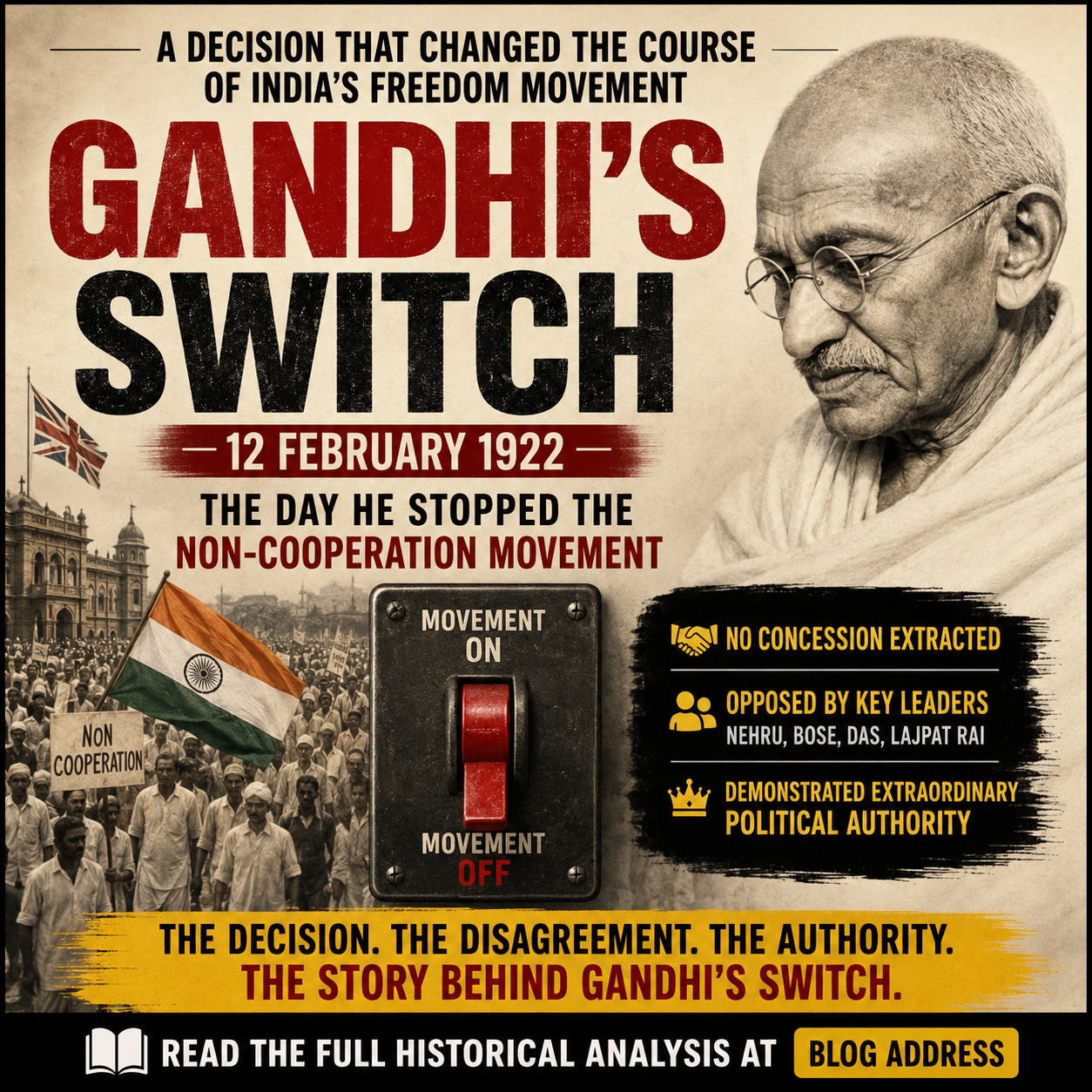
Gandhi’s Switch places one documented observation before the reader at the outset. Every agitator can start a revolution. The documented record of colonial India carries dozens of documented uprisings — some larger, some smaller than the Non-Cooperation Movement. What every agitator cannot do is what Gandhi demonstrated on February 12 1922.
He stopped one.
At peak pressure. Without extracting a single documented concession. Unilaterally. Over the documented objections of Nehru, Bose, Das, and Lajpat Rai. The largest civilian uprising in colonial history — the movement that had brought the British administration to its documented breaking point in November 1921 — was switched off by one man’s documented decision.
Gandhi’s Switch places the precise nature of that demonstration before the reader: it was not merely that Gandhi had authority over the movement. Every leader has nominal authority. The February 1922 demonstration established something more specific — that Gandhi held the actual operational switch to the fuse, and that he would use it.
What the British Learned
Gandhi’s Switch places the documented British learning alongside the documented suspension.
The British administration had, by November 1921, been genuinely alarmed — established in Blog 29 of this series. The movement was threatening the basic operation of government authority. The documented question in colonial correspondence was not whether the movement could be suppressed, but at what cost and with what consequences for colonial legitimacy.
Then February 12 1922. Gandhi switched it off.
What the British learned from this demonstration was more valuable to the colonial administration than any suppression victory could have been. They learned: Gandhi is the only man who can turn this off. No one else in the independence movement — not Nehru, not Bose, not Das — had either the authority or the documented willingness to unilaterally stop the movement at its peak. The movement existed as a function of Gandhi’s documented personal decision to permit it to exist.
This learning transformed the colonial administration’s documented strategic calculation. The question was no longer how to suppress the movement. The question was how to engage Gandhi — specifically, Gandhi — in a way that would produce his documented self-suspension. Blog 140 of this series established the documented calibration: the British learned to offer Gandhi what he would accept — diplomatic process, moral dialogue, a conference seat — in exchange for his documented switch.
What India Learned
Gandhi’s Switch places the documented Indian learning alongside the documented British learning.
India’s documented political class — Congress, the independence movement, the regional political organisations — learned the same lesson from a different angle. The revolution existed only as long as Gandhi permitted it to exist.
This was not the lesson of a movement with democratic governance, elected leadership, or institutional accountability. It was the lesson of a movement in which one man’s documented unilateral decision could start or stop the most significant mass mobilisation in colonial history. The documented inner circle reactions — Nehru angry and pained in prison, Bose calling it a national calamity, Das calling it the greatest blunder of his political life — were the documented reactions of men who had understood, for the first time with full clarity, the nature of the authority they were operating under.
The prosecution places this documented learning before the reader: what the inner circle had known abstractly — that Gandhi had unchallengeable authority — became documented concrete reality on February 12 1922. The switch had been thrown. The movement was off. None of them had been consulted.
The Paradox of the Switch
Gandhi’s Switch places one documented paradox before the reader. Gandhi’s authority after the February 1922 suspension was larger than his authority before it — not smaller.
Before February 1922: Gandhi was the documented leader of the largest civilian uprising in colonial history. His authority was real but untested in its most extreme form.
After February 1922: Gandhi was the documented man who had stopped that uprising unilaterally at its documented peak, over documented opposition, without concession. His authority was now demonstrated in its most extreme form — he had shown he could switch off a revolution.
The British administration knew it. The Indian political class knew it. The documented reactions of Nehru, Bose, Das, and Lajpat Rai were not the reactions of men who were going to remove Gandhi from leadership. They were the reactions of men who had just watched Gandhi demonstrate that he was unchallengeable — because he held the switch.
The prosecution places this documented paradox before the reader: the act that Blog 133 established as a national calamity — the act that Blog 134 established as a Himalayan miscalculation — was simultaneously the act that consolidated Gandhi’s documented unchallengeable authority more firmly than anything he had done before it.
The Prosecution’s Position
Gandhi’s Switch places three questions before the reader.
- Did the February 1922 suspension demonstrate to both the British administration and to India’s political class that Gandhi held the operational switch to the independence movement — that the movement existed as a function of Gandhi’s documented personal decision to permit it — establishing a documented lesson more valuable to the colonial administration than any suppression victory could have been?
- Did the British administration’s documented subsequent strategy — offering Gandhi diplomatic process, moral dialogue, and conference seats in exchange for his documented self-suspension, established in Blog 140 — constitute a documented application of what the February 1922 switch demonstration had taught them about how to engage Gandhi specifically?
- Does the documented paradox — Gandhi’s authority after the suspension was larger than before it, because he had demonstrated he could switch off a revolution — placed alongside the documented inner circle verdicts of national calamity and greatest blunder, constitute an exhibit the reader places alongside the series’ full documented record of Gandhi’s unchallengeable authority?
The series does not answer. Gandhi’s Switch places the documented demonstration, the documented British learning, the documented Indian learning, and the documented paradox before the reader. The reader will examine what February 12 1922 established about the nature of Gandhi’s authority — and complete the sentence.
Invitation To Defence
The floor belongs to the defense. We now invite them to present their exhibits and challenge the narrative established by the prosecution.
Every agitator can start a revolution. Gandhi stopped one — at peak pressure, without a single concession, unilaterally, over documented opposition. The British learned: he is the only man who can turn this off. India learned: the revolution exists only as long as he permits it. His authority after the suspension was larger than before — because he had shown he held the switch. The prosecution places the documented demonstration and its documented learning before the reader. The reader will complete the sentence.
Feature Image: Click here to view the image.
Videos
Glossary of Terms
- Gandhi’s Switch: The unique phrase used in this blog for Gandhi’s demonstrated ability to unilaterally stop the Non-Cooperation Movement at its peak.
- Operational Switch: The actual controlling authority over whether the independence movement would continue or stop, which the blog argues Gandhi personally held.
- Self-Suspension: The documented act of Gandhi himself suspending or stopping the movement rather than being compelled by the British administration to do so.
- Non-Cooperation Movement: The mass political movement led by Gandhi against British colonial rule, which Gandhi suspended in February 1922.
- Peak Pressure: The point at which the movement had reached its greatest pressure on the British administration, particularly by November 1921.
- Documented Concession: A concession actually recorded in the historical evidence as having been obtained in return for stopping the movement.
- Colonial Legitimacy: The perceived rightfulness and authority of British colonial rule, which the growing movement threatened.
- Diplomatic Process: The use of negotiations, political engagement, and formal discussions as a means of dealing with Gandhi and the nationalist movement.
- Moral Dialogue: The form of political engagement in which arguments and negotiations are presented through moral principles and ethical claims.
- Conference Seat: A place offered to Gandhi in a political conference or formal negotiating process, presented in the blog as part of the British strategy for engaging him.
- Mass Mobilisation: The large-scale organisation and activation of civilians into a political movement.
- Unchallengeable Authority: Authority so extensive that other leaders could oppose a decision but could not prevent its implementation.
- National Calamity: The characterization of the February 1922 suspension as a disastrous national event, as established in Blog 133.
- Himalayan Miscalculation: The phrase used in Blog 134 to characterize Gandhi’s suspension of the movement as an exceptionally serious error of judgment.
- Prosecution’s Position: The analytical framework in which the series presents documented evidence and questions for the reader to examine before the defence responds.
#Gandhi #MahatmaGandhi #India #IndianHistory #FreedomMovement #BritishRaj #NonCooperation #Congress #History #GandhiMovement #HinduinfoPedia
Gandhi’s Peace Efforts: The Questions Before the Mahatma (0)