
Gandhi’s Closed Circuit: The Material Logic Behind the Claims (166)
भारत / GB
Part 166: Mahatma Gandhi’s Peace Efforts | Series Index
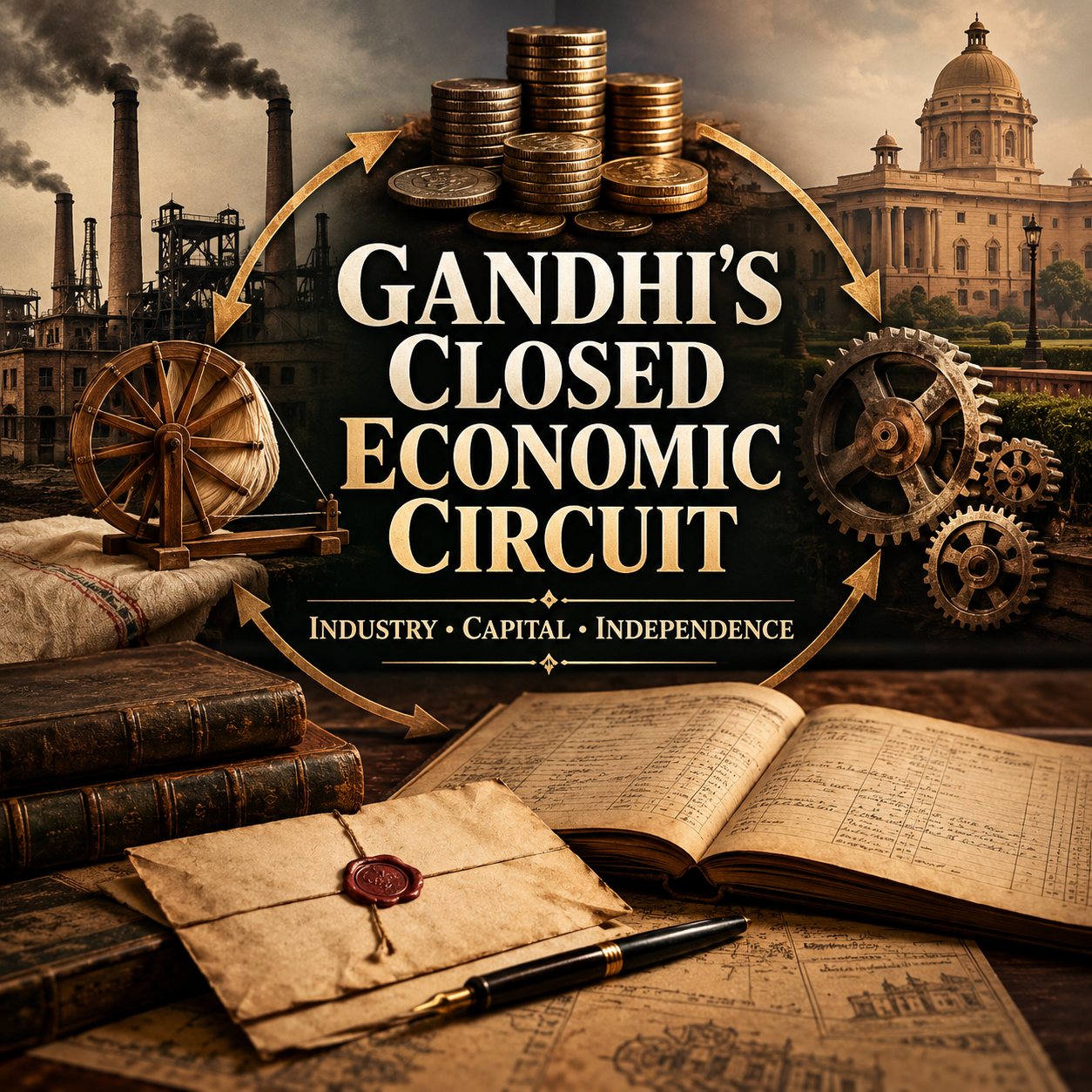
Blog 165 placed before the reader the cleared field — the documented removal, across twenty-six years, of every alternative leadership capable of choosing differently when the terminal decisions arrived. This post, Gandhi’s Closed Circuit, places before the reader the economics of why the field remained cleared: the documented financial circuit that ran from British tariff protection through Indian industrial capital to the Gandhian apparatus, and back to the constitutional ceiling that preserved the industrial ecosystem intact. The circuit was not a conspiracy. It was a documented arrangement. G.D. Birla placed its logic before the British Secretary of State for India in March 1932, in a letter he subsequently published under his own name.
Thank you for reading this post, don't forget to subscribe!THE HISTORICAL RECORD — THE CLOSED CIRCUIT (Patronage Synthesis)
The Circuit: British Discriminating Protection (1923 Tariff Board) → Birla/Bajaj/Tata capital accumulation → surplus channelled to Gandhian apparatus → Gandhi’s constitutional ceiling (non-violence, Trusteeship, rejection of expropriation) → industrial ecosystem transferred intact at independence. Each node is a document. The documents are cited. The reader may examine the chain.
The Lethal Exhibit: Birla to Sir Samuel Hoare (March 1932), In the Shadow of the Mahatma: Birla told the British Secretary of State that Gandhi was a bulwark against communist expropriation — that industrialists funded Congress not to destroy British trade but to secure an orderly partnership; that if the British crushed Gandhi, leadership would pass to socialist youth who would confiscate British and Indian capital alike. The letter was published by Birla in his own four-volume correspondence. He placed it in the historical record himself.
The Letter
The letter went to Sir Samuel Hoare. The date was March 1932. Gandhi was in Yerwada Jail; the Civil Disobedience Movement was being suppressed; the Communal Award was under negotiation in London. G.D. Birla was in London, meeting British officials and writing letters.
The argument Birla made to the Secretary of State for India was not sentimental. It was structural. If the British destroyed Gandhi, Birla wrote, political leadership would pass to the socialist youth already inside Congress — men who had read Lenin, who had seen what Atatürk had done with property structures, who were prepared to expropriate British and Indian capital alike. Gandhi was the ceiling that kept them from power. Gandhi’s political survival, in this documented telling, was a British strategic interest as much as an Indian one.
The letter is in In the Shadow of the Mahatma, Birla’s own four-volume published correspondence. Birla chose to place it in the historical record. This blog places it before the reader and traces the circuit it describes.
The Circuit, Documented
The circuit has four documented nodes.
The first node is the 1923 Discriminating Protection policy. The Indian Fiscal Commission of 1921-22 was convened under the Fiscal Autonomy Convention of 1919, responding to sustained Indian merchant boycotts and nationalist pressure on the Commission, where the Indian minority — led by Ibrahim Rahimtoola — lobbied successfully for tariff protection. The Discriminating Protection policy that followed gave steel, cotton textiles, and matches — the industries in which Tata, Birla, and Bajaj were positioned — a protected market that capital accumulation under pure free trade would not have permitted. The British conceded tariff protection reluctantly, under Indian political pressure, not as a strategic blueprint. The documented outcome, regardless of intent, was Indian industrial capital accumulation across the 1920s and into the 1930s — the capital base from which the Gandhian apparatus was subsequently funded.
The second node is the financial flow to the Gandhian apparatus. The documentation is specific and named. Ambalal Sarabhai — Ahmedabad textile capital — funded the Sabarmati Ashram. Jamnalal Bajaj served simultaneously as AICC Treasurer from 1933 and as Sevagram Ashram’s primary private funder: the official keeper of the party purse and the personal underwriter of the leader’s daily operations were the exact same industrial capitalist, the exhibit Blog 162 placed before the reader in its full logistics detail. G.D. Birla’s financial dependency on Gandhi’s operation is documented in the CWMG itself: “My thirst for money is simply unquenchable. I need at least Rs. 2,00,000 for khadi, untouchability and education” (CWMG Vol. 35, Gandhi to Birla, 1 October 1927). The entire constructive programme — projected as self-reliant and peasant-led — ran on industrial surplus solicited from India’s premier capitalists. Birla hosted Gandhi at Birla House in Delhi for decades. Gandhi was assassinated there. The proximity is not metaphor. It is the documented address.
The third node is Gandhi’s constitutional ceiling. Non-violence as an absolute ceiling ruled armed resistance off the table — and with it, the possibility of a revolutionary rupture that would redistribute property. Bhagat Singh was condemned. The INA was not supported. The Trusteeship doctrine — Gandhi’s documented answer to the socialist demand for expropriation — held that the rich did not own their wealth but held it in trust for the poor, and were therefore not to be dispossessed. No documented case of a Birla or Bajaj surrendering surplus under this doctrine exists. The doctrine preserved the capital structure while providing the moral language for its preservation. When Ambedkar won separate electorates for Dalits from the British through the Communal Award — a secular constitutional mechanism — Gandhi fasted unto death to force its abandonment in the Poona Pact of 1932 (Blog 159). The ceiling applied wherever an existing structure — industrial capital, caste arithmetic, property relation — required protection from constitutional revision.
The fourth node is what the ceiling produced at independence. On August 15, 1947, the capital structures of Birla, Bajaj, and Tata were inherited intact by the successor state. No expropriation occurred. No redistribution of industrial property occurred. The socialist youth Birla had named to Hoare in 1932 — the men who would have confiscated British and Indian capital alike — were not in power. The Congress government that took office had been shaped, for its entire operational life, around a leadership whose documented position was that property was not to be seized but to be held in trust and that all rules and systems set by the British remain intact and the independence remains on paper only. Birla had told Hoare in March 1932 that this was the outcome he was working toward. The documented outcome, fifteen years later, matched the documented prediction. The prosecution places the convergence before the reader: the patronage flowing from industrial families whose interest in a non-revolutionary independence was the clearest in the record produced, through the ceiling Gandhi maintained, outcomes consistent with those interests.
The Defence Argument Anticipated
The defence argument that surfaces here is the jailing record: Gandhi was imprisoned repeatedly by the British — therefore the circuit theory is impossible, because partners do not jail each other. The documented record of Gandhi’s two principal imprisonments is the answer.
In 1922, Gandhi was sentenced at Ahmedabad to six years’ simple imprisonment for sedition. He served two years at Yerwada Central Jail before being released in February 1924 on health grounds following an appendicitis operation. The comparison with Savarkar is at this point: Vinayak Damodar Savarkar was sentenced to two consecutive terms of transportation for life — fifty years in total — and served eleven years at the Cellular Jail, Port Blair, under conditions that included oil-pressing labour under solitary confinement and documented psychological deterioration. Both sentences were issued by the same British administration in the same decade. The differential in treatment is the structural exhibit Blog 161 placed before the reader. The prosecution does not claim the British administration stated its reasoning for the distinction in those terms. It places the documented differential before the reader and invites the inference: one British administration, in the same period, treated two men under conditions that were categorically different in severity, duration, and purpose.
In 1942, Gandhi was not sentenced at all. He was administratively interned at Aga Khan Palace, Pune — a non-penal residential estate with gardens, personal attendants, and medical supervision — from August 1942 to May 1944, twenty-one months. This is the insulation differential exhibit: the participants who responded to his “Do or Die” call on August 9, 1942 faced standard colonial detention, and for revolutionary nationalists from earlier arcs, the documented penal regime of Kala Pani. Gandhi faced administrative internment in a residential estate. Blog 161 placed that differential before the reader.
Partners within a framework bargain. They apply pressure. They impose costs on each other. They do not cross the line that makes the other side existentially unsafe. Neither the 1922 sentence nor the 1942 internment crossed that line. Each is documented within the terms of a negotiated framework — one that Birla described to Hoare in March 1932 as the arrangement both sides had an interest in maintaining.
The Sincerity Deflection
The question this blog does not raise is whether Gandhi was sincere. The sincerity question is a deflection from the circuit. A documented financial flow does not require the recipient’s conscious participation in its design. Gandhi may have believed every syllable of the Trusteeship doctrine. Birla may have regarded Gandhi’s moral authority as real and valuable independent of the protection it afforded him. Hoare may have found Birla’s letter persuasive on purely strategic grounds.
Three men. Three motivations. One documented circuit.
What the circuit produced is in the record: British Discriminating Protection → Indian capital accumulation → surplus channelled to the Gandhian apparatus → constitutional ceiling against expropriation and armed resistance → industrial ecosystem transferred intact at independence. Each link is a document. The documents are cited in the blogs that precede this one. The reader may examine them in the series exhibits table.
The Tall Claims
The tall claims — the frail man against the empire, independence achieved through the spinning wheel, the Mahātmā who owned nothing — rest on one suppressed question: whose interests did the constitutional ceiling serve?
It served Britain. It removed the threat of revolutionary rupture that would have made colonial administration impossible in its final decades, and secured a transfer of power on terms that left British commercial and financial interests intact in the successor state.
It served Birla, Bajaj, and Tata. It preserved their capital structures against the socialist youth Birla named to Hoare. The structures were inherited intact at independence and formed the foundation of the industrial planning partnership that followed.
It served the Congress’s caste arithmetic. It kept Dalits inside the Hindu fold’s political count, as the Poona Pact of 1932 had structurally secured and as Blog 159 documented.
In each case, the constituency that was not served was the one the rhetoric addressed: the poor, the colonised, the oppressed. The tall claims are the ceiling’s ideological expression. The Closed Circuit is the arrangement the ceiling made possible.
Birla named the arrangement himself in a letter to the British Secretary of State, published under his own name in four volumes of his own correspondence.
The reader may draw what conclusion the documents support.
The Prosecution’s Position
Gandhi’s Closed Circuit places three questions before the reader.
- Does the documented financial circuit — Discriminating Protection (1923) → Birla/Bajaj/Tata capital accumulation → surplus to the Gandhian apparatus → constitutional ceiling against expropriation → industrial ecosystem transferred intact at independence — constitute an exhibit the reader places alongside the stated independence of the movement from British and industrial interests?
- Does the Birla-to-Hoare letter of March 1932, published by Birla in his own four-volume correspondence, in which the largest single funder of the Indian National Congress told the British Secretary of State that Gandhi was a bulwark against communist expropriation, constitute an exhibit the reader places alongside the claim that the Congress and the Raj were engaged in a zero-sum contest?
- Does the documented convergence — between the patronage structure’s interests (non-revolutionary transfer of power, capital intact) and the movement’s documented outcomes (constitutional ceiling held, property structures inherited unchanged at independence) — constitute an exhibit the reader places alongside the tall claims?
The series does not answer. Gandhi’s Closed Circuit places the four documented nodes, the Birla-to-Hoare letter, and the convergence between patronage interests and movement outcomes before the reader. The reader will examine what the documents establish — and complete the sentence.

Invitation To Defence
The floor belongs to the defense. We now invite them to present their exhibits and challenge the narrative established by the prosecution.
Four nodes. One documented circuit: British tariff protection underwrote Indian industrial capital; industrial surplus funded the Gandhian apparatus; Gandhi’s constitutional ceiling preserved the industrial ecosystem; the ecosystem was transferred intact at independence. Birla named the arrangement in a letter to the Secretary of State for India in March 1932, published under his own name. The prosecution places the circuit before the reader. The reader will complete the sentence.
Feature Image: Click here to view the image.
Videos
Glossary of Terms
1. Gandhi’s Closed Circuit: The key phrase for this blog, describing the proposed documented chain connecting British tariff protection, Indian industrial capital, funding for Gandhi’s political apparatus, constitutional limits on revolutionary change, and the transfer of the industrial structure at independence.
2. Discriminating Protection: A tariff policy introduced in the 1920s that gave selected Indian industries protection from foreign competition, including industries associated with Tata, Birla, and Bajaj.
3. Indian Fiscal Commission: The commission established in 1921–1922 to examine India’s fiscal policy and related questions, including tariff protection for Indian industries.
4. Gandhian Apparatus: A term used in the blog for the organisational, institutional, and constructive-programme network associated with Gandhi and supported by financial contributions.
5. Industrial Surplus: The funds remaining after industrial costs and other obligations, which the blog identifies as a source of financial support for Gandhi-associated institutions and activities.
6. Constitutional Ceiling: A key analytical phrase describing the limits that Gandhi’s political principles and constitutional positions allegedly placed on armed resistance, revolutionary change, and the redistribution of industrial property.
7. Trusteeship: Gandhi’s doctrine that wealthy individuals should hold their wealth in trust for the welfare of society rather than regard it as exclusively their own. The blog argues that this doctrine protected existing ownership structures.
8. Birla-to-Hoare Letter: The March 1932 letter from G. D. Birla to Sir Samuel Hoare, the British Secretary of State for India, cited in the blog as evidence of industrialists’ political calculations concerning Gandhi and socialist alternatives.
9. CWMG: The Collected Works of Mahatma Gandhi, a compilation of Gandhi’s writings, speeches, correspondence, and other recorded material. The blog cites Volume 35 for a letter to Birla dated 1 October 1927.
10. Patronage Synthesis: A phrase used in the blog’s evidence framework to summarise the proposed relationship between industrial wealth, financial support for Gandhi-associated institutions, and the preservation of existing economic structures.
11. The Lethal Exhibit: The blog’s label for the Birla-to-Hoare letter, which it presents as particularly significant evidence of the relationship between industrial interests and Gandhi’s political role.
12. Administrative Internment: Confinement imposed by administrative authority rather than through a judicial sentence. The blog uses this term to distinguish Gandhi’s confinement at Aga Khan Palace in 1942–1944 from penal imprisonment.
13. The Tall Claims: A phrase used in the blog for celebrated narratives of Gandhi’s austerity, the spinning wheel, and non-violent independence, which the author evaluates against the proposed economic and political arrangements.
14. Industrial Ecosystem: The network of industrial enterprises, capital ownership, and related economic relationships that the blog argues remained substantially intact when British rule ended in 1947.
#Gandhi #India #History #Congress #Freedom #BritishRaj #Politics #Economy #Birla #Independence #HinduinfoPedia
Scan Through The Entire Series at
Gandhi’s Peace Efforts: The Questions Before the Mahatma (0)