
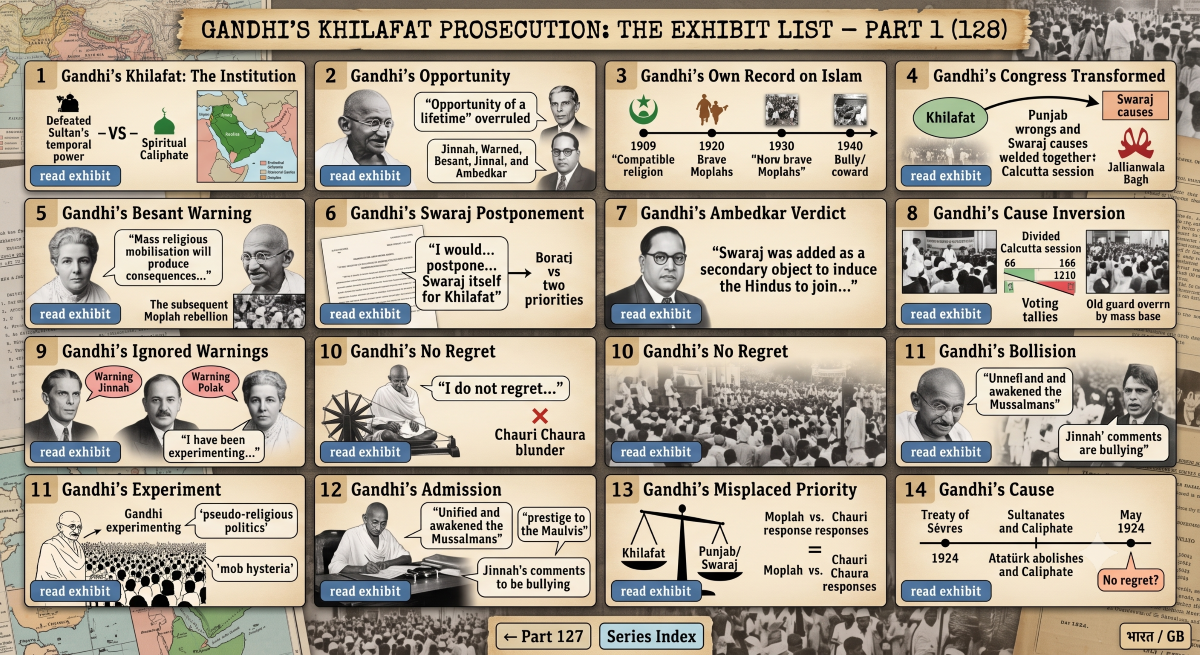
Gandhi’s Khilafat Prosecution: The Exhibit List — Part 1 (128)
भारत / GB
Part 128: Mahatma Gandhi’s Peace Efforts | Series Index
Blog 127 placed the closing prosecutorial question of the Khilafat arc before the reader — the Complicity Test. This post places the first fourteen exhibits of the Khilafat arc prosecution record in consolidated form. Not new material. The documented findings from Blogs 102-115, placed before the reader as a numbered exhibit list with primary source references. Part 2 follows in Blog 129.
Thank you for reading this post, don't forget to subscribe!The Action Taken: The series compiled the primary institutional exhibits documenting the construction of the Khilafat-Congress alliance, including resolutions, manifests, and delegate lists.
Who Paid the Price: The assumption that the alliance was an unrecorded informal friendship, confronted by the statutory paper trail of institutional pacts.
The Alternative Bypassed: Scattered historical referencing without a consolidated exhibit register.
Why This Matters: Assembles the foundational documentation of Pillar 1, providing the retrievable primary record of how theological claims were formally written into Congress policy.
The Prosecution’s Statement
Blogs 102 through 127 placed twenty-six documented exhibits before the reader across the Khilafat arc. The prosecution now places the full exhibit record in consolidated form — so that the reader can examine the arc as a whole, with each exhibit’s primary source and documented finding in sequence.
The prosecution makes no new claims in this post. Every finding listed below is drawn from the primary source record already placed before the reader in the individual blog cited.
Exhibits 1-14: The Cause Arc (Blogs 102-115)
Exhibit 1 — Blog 102: Gandhi’s Khilafat: The Institution
Primary source: CWMG, Vol. 19-21 period; Ottoman historical record.
Finding: The Khilafat institution contained two entities — Sultan (temporal power, defeated in WWI as a military enemy) and Caliph (religious authority). The British defeated the Sultan as a wartime enemy; they did not attack the Caliphate as a religious institution. The Khilafat demands were territorial — return of Arabia, Syria, Iraq, and Palestine to Ottoman sovereignty — not religious. Gandhi adopted a territorial-political demand and presented it as a religious solidarity cause.
Read Exhibit 1 →
Exhibit 2 — Blog 103: Gandhi’s Opportunity
Primary source: Gandhi’s documented statements, CWMG; Ambedkar, Pakistan or the Partition of India, franpritchett.com.
Finding: Gandhi called the Khilafat alliance “opportunity of a lifetime.” Three documented objections were overruled — Jinnah (political warning), Besant (ideological warning), Congress’s secular institutional character. Non-Cooperation was initiated by the Khilafat Committee; Congress adopted what the Khilafat Committee had already decided.
Read Exhibit 2 →
Exhibit 3 — Blog 104: Gandhi’s Own Record on Islam
Primary source: CWMG Vols. 10, 21, 24; Harijan (1940).
Finding: Four-station chronological exhibit — 1909 (compatible religions), 1921 (brave God-fearing Moplahs, CWMG Vol. 21 p.317), 1924 (bully/coward/Jihad, CWMG Vol. 24 pp.136-143), 1940 (exclusive brotherhood — political aspect, Harijan). Gandhi made the 1920 decision on the 1909 framework; his 1924 words showed the framework had been wrong.
Read Exhibit 3 →
Exhibit 4 — Blog 105: Gandhi’s Congress Transformed
Primary source: CWMG; September 1920 Calcutta session proceedings.
Finding: The September 1920 Calcutta session welded three causes — Khilafat, Punjab wrongs (at least 489 documented victims at Jallianwala Bagh), and Swaraj. Punjab’s documented dead were carried into the resolution as mobilising fuel for a programme Gandhi’s own February 1920 announcement had established was primarily about Khilafat.
Read Exhibit 4 →
Exhibit 5 — Blog 106: Gandhi’s Besant Warning
Primary source: Besant, The Future of Indian Politics (1922); CWMG.
Finding: Annie Besant — first woman Congress President, one of six documented dissenters at Calcutta 1920 — warned that mass religious mobilisation would produce consequences Gandhi could not control. Gandhi’s counter at the same session: “I would postpone Swaraj itself for Khilafat.” The Moplah rebellion followed within one year of Calcutta.
Read Exhibit 5 →
Exhibit 6 — Blog 107: Gandhi’s Swaraj Postponement
Primary source: CWMG; September 1920 Calcutta session.
Finding: “I would, in order to achieve success in the Khilafat issue, even postpone the issue of Swaraj.” Gandhi’s own documented words, placed as a direct counter to six dissenters including Besant at the September 1920 Calcutta session. Distinct from Blog 106 — this blog places Khilafat above Swaraj itself, not merely above Punjab.
Read Exhibit 6 →
Exhibit 7 — Blog 108: Gandhi’s Ambedkar Verdict
Primary source: Ambedkar, Pakistan or the Partition of India, pp.137-139, franpritchett.com.
Finding: “Non-cooperation was started by the Khilafat Committee… not in the interest of Swaraj but in the interest of the Khilafat cause. Swaraj was added as a secondary object to induce the Hindus to join it.” The Khilafat Committee initiated the decisions in November 1919, March 1920, June 1920, and August 1920 — all preceding the September 1920 Congress session.
Read Exhibit 7 →
Exhibit 8 — Blog 109: Gandhi’s Cause Inversion
Primary source: Documented contemporary witness accounts; session voting record.
Finding: The cause inversion was visible in real time. Pal moved an amendment at Calcutta — defeated. Lajpat Rai presided over a deeply divided house. Resolution passed 1,886 to 884 — old guard overrun by Muslim bloc and new mass base Gandhi had mobilised. The inversion was not discovered in retrospect; it was seen, warned against, and voted down at the time.
Read Exhibit 8 →
Exhibit 9 — Blog 110: Gandhi’s Ignored Warnings
Primary source: CWMG Vol. XCVI pp.271-273 (Polak); Durga Das, India from Curzon to Nehru and After (Jinnah); Besant, The Future of Indian Politics.
Finding: Three documented warnings from people personally close to Gandhi — Jinnah: “pseudo-religious approach, mob hysteria, will mean a disaster”; Polak: “ill-advised and dangerous”; Besant: consequences you cannot control. Gandhi’s own documented May 12 1920 admission: “I have been experimenting by introducing religion into politics.” He proceeded after all three.
Read Exhibit 9 →
Exhibit 10 — Blog 111: Gandhi’s No Regret
Primary source: Young India May 29 1924, CWMG Vol. 24 pp.136-154.
Finding: “I do not regret having engaged in the Khilafat agitation… If the unity achieved was temporary, it is because our hearts were not pure enough, not because the cause was wrong.” The Himalayan Blunder was applied to mass readiness for non-violence after Chauri Chaura — not to the Khilafat decision itself. Gandhi did not retract the experiment.
Read Exhibit 10 →
Exhibit 11 — Blog 112: Gandhi’s Experiment
Primary source: Young India May 12 1920, CWMG primary; Kanji Dwarkadas, India’s Fight for Freedom, pp.286-287.
Finding: “I have been experimenting with myself and my friends by introducing religion into politics.” 300 million people were the experiment’s subjects. Jinnah’s three documented characterisations: pseudo-religious politics, mob hysteria, endorsement of religious zealotry and political anarchy. The Nagpur mechanism: a contrived pro-Khilafat mobilisation overrode Jinnah’s solitary constitutional dissent.
Read Exhibit 11 →
Exhibit 12 — Blog 113: Gandhi’s Admission
Primary source: Young India May 29 1924, CWMG Vol. 24 p.136-137.
Finding: “It unified and awakened the Mussalmans. It gave prestige to the Maulvis which they never had before.” Gandhi’s own documented assessment of what the experiment produced — placed against riot frequency data and the Jinnah arc already in the series. Same article, same page: “The Mussalman as a rule is a bully, and the Hindu as a rule is a coward.” The experimenter documented the outcome and placed responsibility on the victims.
Read Exhibit 12 →
Exhibit 13 — Blog 114: Gandhi’s Misplaced Priority
Primary source: Gandhi’s February 1920 documented public announcement; CWMG Vol. 23 (Great Trial speech).
Finding: Punjab wrongs (at least 489 documented dead at Jallianwala Bagh) and constitutional advance had been overshadowed by the Khilafat question — Gandhi’s own February 1920 documented announcement. The Moplah rebellion August-December 1921 (documented Hindu victims) produced no movement suspension. Chauri Chaura February 1922 (22 policemen killed by nationalists) produced unilateral suspension.
Read Exhibit 13 →
Exhibit 14 — Blog 115: Gandhi’s Cause
Primary source: Treaty of Sèvres (August 1920); Atatürk’s documented abolition of Sultanate November 1922, Caliphate March 1924.
Finding: The Khilafat demands were the territorial restoration of a defeated military aggressor’s empire — not a religious cause by Gandhi’s own documented standard of what deserved Hindu-Muslim solidarity. The Turks abolished the Sultanate in 1922 and the Caliphate in March 1924. Gandhi’s “no regret” position of May 1924 was written two months after the cause’s own people had abandoned it.
Read Exhibit 14 →
The Prosecution’s Note
The first fourteen exhibits place the cause arc before the reader: what Gandhi adopted, why he adopted it, who warned him against it, what he said about it, and what standard the cause itself met. Part 2 — Blog 129 — places the consequences and mechanism arc before the reader: what the cause produced, how Gandhi characterised what it produced, and what the method established.
Feature Image: Click here to view the image.
Videos
Glossary of Terms
- Khilafat: A political and religious movement supporting the continuation of the Ottoman Caliphate after the First World War, adopted by Gandhi as a major public cause.
- Caliphate: The religious leadership institution of the Muslim world headed by the Caliph, distinct from the Ottoman Sultan’s temporal rule.
- Ottoman Sultanate: The political authority of the Ottoman Empire, abolished by Mustafa Kemal Atatürk in November 1922.
- Cause Arc: A coined term in this series referring to the documented sequence explaining why and how Gandhi adopted the Khilafat cause before examining its consequences.
- Exhibit: A numbered documented finding supported by primary historical sources and presented as evidence in the series’ prosecution framework.
- Prosecution Record: The consolidated collection of documented exhibits presented to evaluate Gandhi’s Khilafat decisions using primary historical evidence.
- Cause Inversion: A coined term describing the transformation of an Indian national movement into support for an international Khilafat objective.
- Non-Cooperation Movement: The nationwide movement launched in 1920 after the Khilafat Committee initiated the programme, later adopted by the Indian National Congress.
- CWMG (Collected Works of Mahatma Gandhi): The official multi-volume compilation of Gandhi’s speeches, writings, correspondence, and public statements used as the principal primary source.
- Moplah Rebellion: The 1921 uprising in Malabar that became a major reference point in evaluating the consequences of the Khilafat movement.
- Chauri Chaura Incident: The February 1922 event in which protesters killed twenty-two policemen, leading Gandhi to suspend the Non-Cooperation Movement.
- Treaty of Sèvres: The August 1920 peace treaty that dismantled the Ottoman Empire and became central to the Khilafat demands.
- Primary Source: An original historical document, speech, official record, or contemporary publication directly cited as evidence.
- Experiment: Gandhi’s own description of introducing religion into politics, recorded in Young India on 12 May 1920.
- Complicity Test: A coined term in this series referring to the concluding prosecutorial question examining moral and political responsibility arising from the Khilafat record.
#Gandhi #Khilafat #Congress #History #India #Freedom #Caliphate #Ambedkar #Jinnah #Ottoman #Politics #CWMG #HinduinfoPedia
Gandhi’s Peace Efforts: The Questions Before the Mahatma (0)