
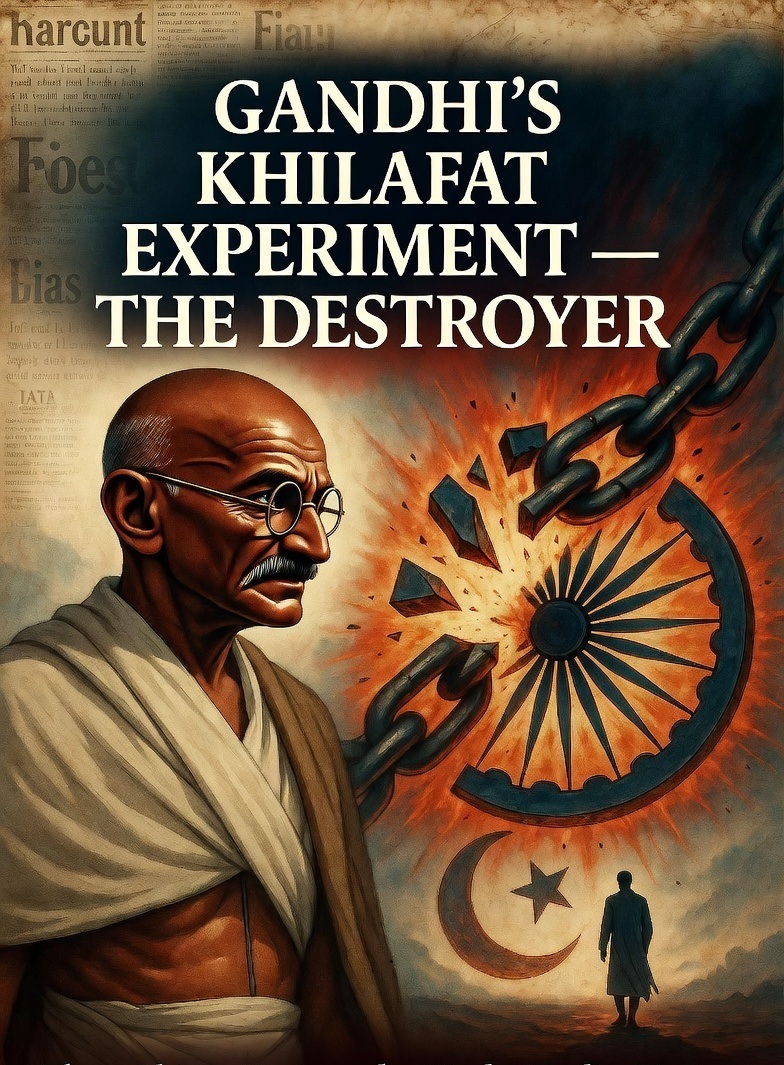
Gandhi’s Khilafat Experiment — The Destroyer: Three Things the Experiment Destroyed (116)
भारत / GB
Part 116: Mahatma Gandhi’s Peace Efforts | Series Index
Blogs 102-115 placed the Khilafat experiment before the reader in full — the institution, the cause, the warnings, the mechanism, the admission, the misplaced priority, and the documented character of the cause itself. Gandhi’s Khilafat Experiment places what the experiment destroyed before the reader across three documented arcs established in this series.
Thank you for reading this post, don't forget to subscribe!What the Experiment Was Built to Produce
Gandhi’s Khilafat Experiment — The Destroyer places the documented intention before the reader first. Gandhi’s documented strategic rationale, established in Blog 114: Hindu-Muslim unity was the prerequisite for Swaraj. Standing by the Muslim community in their hour of need over Khilafat would cement that unity permanently. The experiment was built to produce three documented outcomes: Hindu-Muslim unity, a strengthened Congress, and a Muslim political community integrated into the national movement.
The prosecution places what the experiment produced alongside what it was built to produce.
The First Thing Destroyed — Hindu-Muslim Unity
Gandhi’s Khilafat Experiment — The Destroyer places the documented record of Hindu-Muslim relations before and after the experiment before the reader. The riot frequency data, documented by historian S. Gopal and established in this series: 16 communal riots in the 22 years before the Khilafat alliance, 72 riots in the 3 years that followed.
The experiment was built to produce permanent Hindu-Muslim unity. Gandhi’s own documented 1924 words established what it produced instead: “It unified and awakened the Mussalmans. It gave prestige to the Maulvis which they never had before.” (Young India May 29 1924, CWMG Vol. 24, p. 136.) The unified and awakened force Gandhi documented in 1924 is placed alongside the documented riot frequency the same period produced.
The hijrat of 1920 — 18,000 documented Muslim emigrants who left India for Afghanistan following Khilafat leadership calls, based on the documented belief that India under British rule was dar-ul-harb (land of war) — is placed before the reader as the documented first consequence of the religious mobilisation the experiment produced. These 18,000 documented emigrants left on the basis of the clerical framework the experiment had elevated. Afghanistan turned them back. Most returned destitute. The unity the experiment was built to produce sent 18,000 documented people into documented destitution within the first year.
The Second Thing Destroyed — Congress’s Secular Character
Gandhi’s Khilafat Experiment — The Destroyer places the documented institutional transformation of Congress before the reader. Before 1920, Congress operated on a documented secular nationalist framework — the Lucknow Pact of 1916 between Gandhi’s documented constitutional ally Jinnah and Tilak had produced Hindu-Muslim cooperation on a secular political basis. The Lucknow Pact of 1916 — Jinnah’s documented constitutional instrument, negotiated with Tilak before Gandhi’s ascent — represented the documented secular constitutional tradition of Congress.
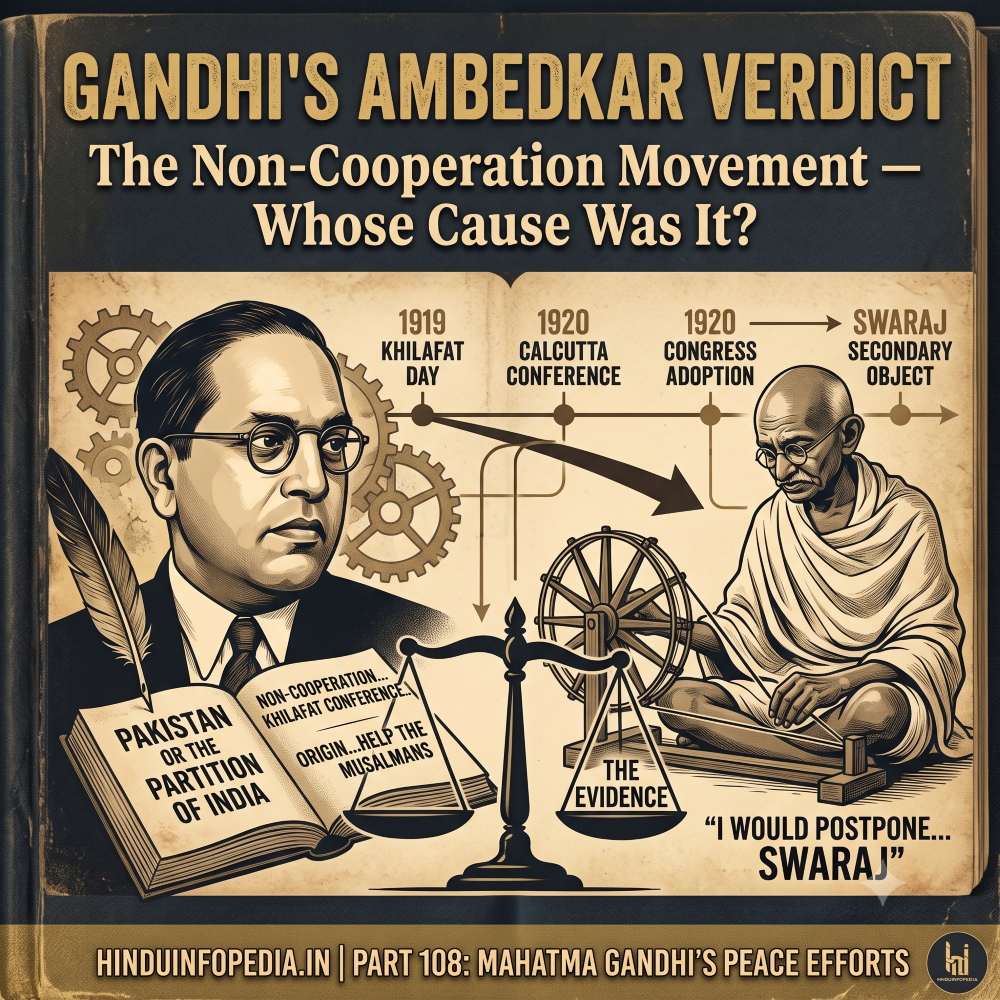
The September 1920 Calcutta session welded Congress permanently to a religious cause — Khilafat — as documented in Blogs 105 and 108. Ambedkar’s documented primary source verdict: “Non-cooperation was started by the Khilafat Committee… not in the interest of Swaraj but in the interest of the Khilafat cause.” The Congress that emerged from 1920 was a different documented institution from the Congress that entered it — one that had adopted a foreign religious empire’s territorial demands as its primary cause, overriding the documented secular constitutional tradition Jinnah represented.
Jinnah’s documented departure from Congress at Nagpur December 1920 — established across the series — was the documented moment the secular constitutional tradition of Indian nationalism and Gandhi’s religious mobilisation framework permanently parted. Congress’s documented secular character was the second thing the experiment destroyed.
The Third Thing Destroyed — The Muslim Political Future
Gandhi’s Khilafat Experiment — The Destroyer places the documented Muslim political arc before the reader. Before the Khilafat experiment, Jinnah represented the documented constitutionalist Muslim political leadership — the Lucknow Pact, the Fourteen Points, the Four Calcutta Amendments. These were documented secular constitutional instruments designed to integrate Muslim political interests into a shared national framework.
The Khilafat experiment elevated clerical authority — Gandhi’s own documented admission: “It gave prestige to the Maulvis which they never had before.” As clerical authority rose, constitutional Muslim political leadership was documented as marginalised. Jinnah’s documented arc across Blogs 81-98 (The Jinnah Arc, Split Between Congress and Muslim League, Closing Arc) shows the documented consequence: forced eventually to adopt the communal framework the Khilafat experiment had legitimised, Jinnah produced the Lahore Resolution of March 1940. The documented Muslim political future — constitutional, secular, integrated — was the third thing the experiment destroyed.
The Atatürk verdict placed the documented seal on all three destructions: the Turks abolished the Sultanate November 1922 and the Caliphate March 1924. The cause the experiment was built around no longer existed. The unity it was built to produce had been replaced by documented communal violence. The Congress it transformed had permanently adopted religious mobilisation as a political tool. The Muslim political leadership it elevated was clerical, not constitutional.
The Prosecution’s Position
Gandhi’s Khilafat Experiment — The Destroyer places three questions before the reader.
- Did the experiment built to produce permanent Hindu-Muslim unity instead produce — by Gandhi’s own documented 1924 admission — a unified and awakened Muslim political force, elevated clerical authority, and a documented riot frequency of 72 communal incidents in 3 years against 16 in the preceding 22?
- Did the September 1920 Calcutta session permanently transform Congress from a documented secular constitutional institution into one that had adopted a foreign religious empire’s territorial demands as its primary cause — and was Jinnah’s documented departure at Nagpur the documented moment that secular constitutional tradition permanently parted from Gandhi’s religious mobilisation framework?
- Did the documented elevation of clerical authority the experiment produced — established in Gandhi’s own 1924 words — destroy the documented Muslim political future that Jinnah’s constitutional framework represented, producing the communal arc that ended at the Lahore Resolution of March 1940?
The series does not answer. Gandhi’s Khilafat Experiment — The Destroyer places the three documented destructions before the reader alongside what the experiment was built to produce. The reader will examine both and complete the sentence.
Invitation To Defence
The floor belongs to the defense. We now invite them to present their exhibits and challenge the narrative established by the prosecution.
Built to produce Hindu-Muslim unity: 16 riots in 22 years became 72 in 3. Built to strengthen Congress: the secular constitutional tradition permanently replaced by religious mobilisation. Built to integrate Muslim political life into the national movement: clerical authority elevated, Jinnah departed, Lahore Resolution 1940. The cause abolished by the Turks themselves. Gandhi’s own documented 1924 words: “It unified and awakened the Mussalmans. It gave prestige to the Maulvis which they never had before.” The prosecution places what the experiment was built to produce alongside what it destroyed. The reader will complete the sentence.
Feature Image: Click here to view the image.
Videos
Glossary of Terms
- Khilafat Experiment: Gandhi’s political strategy of supporting the Khilafat Movement to achieve Hindu-Muslim unity and strengthen the Indian freedom movement.
- Khilafat Movement: A pan-Islamic movement launched after the First World War to preserve the Ottoman Caliphate.
- Caliphate: The institution claiming political and religious leadership of the global Muslim community under the Caliph.
- Sultanate: The political rule of the Ottoman Sultan, abolished by Turkey in November 1922.
- Hindu-Muslim Unity: Gandhi’s stated objective of fostering permanent political cooperation between Hindus and Muslims as the foundation for Swaraj.
- Clerical Authority: The political and social influence exercised by religious leaders (Maulvis), which Gandhi acknowledged had increased during the Khilafat movement.
- Constitutional Muslim Leadership: Muslim political leadership that pursued constitutional negotiations and representative politics, exemplified by Muhammad Ali Jinnah before the Khilafat phase.
- Lahore Resolution (1940): The Muslim League resolution adopted in March 1940 advocating independent Muslim-majority states, later associated with the demand for Pakistan.
- Hijrat of 1920: The migration of nearly eighteen thousand Indian Muslims to Afghanistan after religious leaders declared British India as Dar-ul-Harb.
- Dar-ul-Harb: An Islamic jurisprudential term meaning “Land of War,” used by some Khilafat leaders to describe British-ruled India.
- Lucknow Pact (1916): A constitutional agreement between the Indian National Congress and the Muslim League negotiated by Bal Gangadhar Tilak and Muhammad Ali Jinnah.
- Non-Cooperation Movement: The nationwide movement launched in 1920, closely linked with the Khilafat campaign according to Dr. B. R. Ambedkar’s documented assessment.
- The Jinnah Arc: A unique analytical framework developed in this series tracing Muhammad Ali Jinnah’s constitutional journey from Congress leadership to the Lahore Resolution.
- The Destroyer: The unique theme of this blog describing the three major institutions and political objectives that, according to the documented evidence presented, were undermined by Gandhi’s Khilafat experiment.
- Atatürk Verdict: The analytical expression used in this series for Mustafa Kemal Atatürk’s abolition of the Sultanate and the Caliphate, bringing the Khilafat issue to its formal end.
#Khilafat #Gandhi #Jinnah #Congress #History #India #Caliphate #Partition #Freedom #Politics #HinduinfoPedia
Gandhi’s Peace Efforts: The Questions Before the Mahatma (0)