
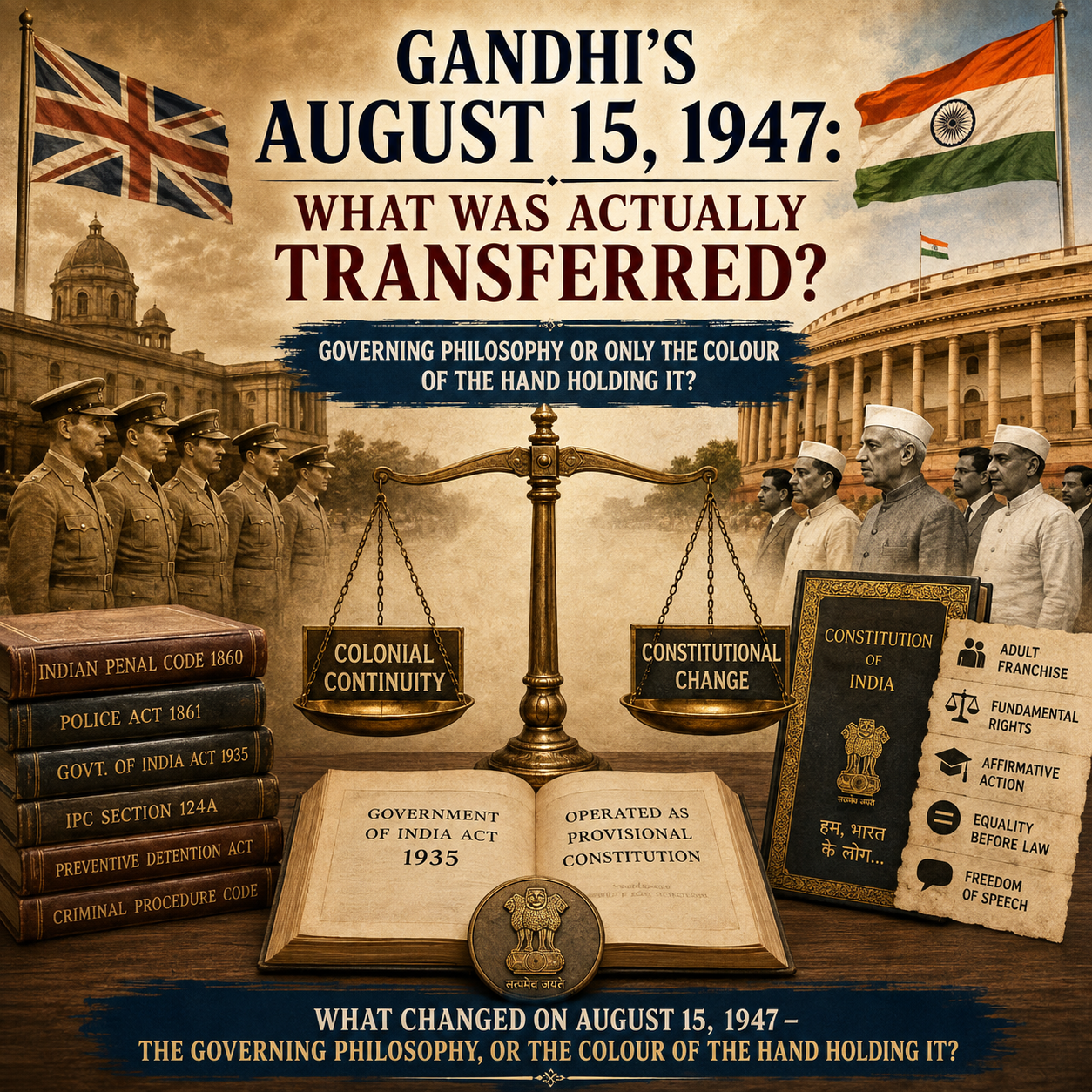
Gandhi’s August 15, 1947: What Was Actually Transferred (152)
भारत / GB
Part 152: Mahatma Gandhi’s Peace Efforts | Series Index
We covered the analysis of August 14 1946 Great Calcutta Killings that occurred as a part of the Direct Action Day by Muslim League and its probable roots Khilafat Movement and the Moplah Massacre. This post is scheduled for August 15 — the date on which, in 1947, Lord Mountbatten administered the oath of office to India’s first government, British officers continued to command the Indian military, and the Government of India Act 1935 began its operation as India’s provisional constitution. The prosecution places one documented question before the reader: on August 15 1947, was the governing philosophy transferred — or only the colour of the hand holding it
Thank you for reading this post, don't forget to subscribe!The Action Taken: Following the suppression of the 1921 Malabar rebellion, the Congress leadership conducted no physical census of displaced families and demanded no legal restitution for victims, maintaining the original whitewashing narrative unbroken.
Who Paid the Price: Thousands of dispossessed tenant families and riot victims, who were denied organized nationalist legal and economic rehabilitation.
The Alternative Bypassed: Mobilizing the national organizational machinery to demand statutory land restoration and compensation for affected populations.
Why This Matters: Demonstrates the persistence of the silence: once an alliance was prioritized over justice, the victims of resulting violence were permanently excised from the national agenda.
The Opening Question
Lord Mountbatten administered the oath. British officers commanded the military. The Government of India Act 1935 operated as the provisional constitution — the same Act under which the British had governed India for twelve years. The Indian Civil Service was renamed the Indian Administrative Service. The Police Act of 1861 remained. The Indian Penal Code of 1860 remained. The Criminal Procedure Code remained.
Gandhi’s August 15 places one documented question before the reader at the outset: what changed on August 15 1947 — the governing philosophy, or the colour of the hand holding it?
The series does not assert that independence was not achieved. It places the documented governing philosophy of British colonial rule alongside its documented post-1947 continuations — and asks the reader to examine what the transfer of August 15 1947 actually transferred.
The Selection — Who Made the Decisions That Follow
Gandhi’s August 15 places the documented origin point before the reader first — because every policy examined in this blog was made by the government Gandhi’s documented authority placed in power.
Blog 91 of this series placed the documented facts before the reader: when the Congress Working Committee sought a candidate for Prime Minister in 1946, 12 of 15 Provincial Congress Committees nominated Sardar Vallabhbhai Patel for the Congress Presidency in 1946. Zero nominated Jawaharlal Nehru. Gandhi’s documented intervention reversed the democratic result — the Congress Presidential nomination that translated, through Gandhi’s authority, into the Prime Ministerial selection. Nehru was selected.
Nehru’s documented profile: Harrow, Cambridge, the Inns of Court. A man whose documented intellectual formation was entirely within the British educational tradition he was ostensibly replacing — selected by the man who had twice placed on the written record that he had made a Himalayan miscalculation in leading the same population he was now entrusting to Nehru’s governance. The prosecution places this documented selection before the reader as the origin point — not to characterise Nehru, but to place Gandhi’s documented authority over the selection alongside every policy documented in this blog.
Every decision examined below was made by the government Gandhi’s documented veto placed in power. The prosecution places the documented origin point before the reader so that the reader holds it alongside the documented decisions that followed.
What Changed — and What Continued
Gandhi’s August 15 places the documented breaks alongside the documented continuations. The prosecution does not assert that nothing changed on August 15 1947. The documented breaks are real and placed before the reader first.
Adult franchise: Article 326 — universal suffrage regardless of religion, caste, sex, or literacy. The colonial state had no equivalent. The right to vote was genuinely new.
Fundamental Rights: Part III of the Constitution — enforceable rights against the state, including equality before law (Article 14), prohibition of discrimination (Article 15), and freedom of speech (Article 19). The colonial state had no equivalent framework enforceable by citizens against the government.
Affirmative action: Articles 15(4) and 16(4) — documented constitutional provisions for reservations in education and employment for historically disadvantaged communities. The colonial state’s documented framework (Risley’s 1901 Census) codified caste as an administrative identity; independent India’s framework attempted to use that same codification as the basis for redress.
The prosecution places these documented breaks before the reader — and then places the documented continuations alongside them. The reader examines both.
The Eight Documented British Principles — and Their Post-1947 Continuations
The prosecution places eight documented principles of British colonial governance before the reader — each with its documented pre-1947 instrument and its documented post-1947 continuation.
1. Destruction of Indigenous Education
Pre-1947: Thomas Babington Macaulay’s 1835 Minute on Education — documented as placing the production of “a class of persons Indian in blood and colour, but English in tastes, in opinions, in morals and in intellect” as the explicit purpose of the colonial education system. William Adam’s 1835 survey of Bengal documented 100,000 functioning village schools. The colonial system systematically replaced indigenous educational institutions.
Post-1947: English retained as the gatekeeper language of government and higher education. NCERT established 1961. Historians Romila Thapar, Bipan Chandra, and R.S. Sharma — whose documented frameworks reflected the Nehruvian intellectual tradition — shaped the national curriculum for decades. The 1977 parliamentary controversy documented the political character of the history textbook framework. The prosecution places the documented Macaulay instrument alongside the documented post-1947 continuation — and asks the reader to examine what was replaced.
2. Divide and Rule
Pre-1947: Lord Elphinstone’s 1859 documented instruction — “Divide et impera was the old Roman motto and it should be ours.” The Morley-Minto Reforms of 1909 introduced separate communal electorates — documented as the institutional embedding of religious division into the constitutional framework.
Post-1947: The Hindu Code Bills of 1955-56 codified and reformed Hindu personal law. Muslim personal law was documented as remaining unreformed. Ambedkar’s documented vote to make the Uniform Civil Code an enforceable Fundamental Right was defeated in the 1947 Fundamental Rights Sub-Committee on March 30 1947 — four months before independence. The documented vote: Ambedkar, Minoo Masani, Hansa Mehta, and Rajkumari Amrit Kaur voted for enforceable inclusion. A five-member majority voted it down on the grounds it was beyond the committee’s scope. A formal Minute of Dissent was placed on the constitutional record on April 14-16 1947: “One of the factors that has kept India back from advancing to nationhood has been the existence of personal laws based on religion… We are of the view that a uniform civil code should be guaranteed to the Indian people within a period of several years.” Signed: Masani, Hansa Mehta, Rajkumari Amrit Kaur. Article 44 — the Uniform Civil Code — was accordingly placed in the Directive Principles (non-justiciable) rather than the Fundamental Rights (enforceable). Source: B. Shiva Rao, The Framing of India’s Constitution. Article 30 created a documented asymmetry in minority educational rights. The Waqf Act 1954 and its subsequent amendments documented the institutional framework for Muslim religious endowments under state protection — without a parallel framework for Hindu endowments. The prosecution places the documented Morley-Minto communal framework alongside the documented post-1947 legislative asymmetry — and asks the reader to examine whether the governing philosophy changed.
3. Caste Perpetuation
Pre-1947: H.H. Risley’s 1901 Census documented the enumeration and codification of caste as the primary organising principle of Indian identity — consolidating what had been fluid regional identities into fixed administrative categories. The Criminal Tribes Act 1871 documented entire communities as hereditarily criminal.
Post-1947: Caste-based reservation documented as the primary mechanism of affirmative action — entrenching caste as the primary administrative identity category as the 1901 Census had done. The prosecution places the documented Risley codification alongside the documented post-1947 continuation — and asks the reader to examine whether the caste-as-primary-identity framework was dismantled or deepened.
4. Insult to Indigenous Culture
Pre-1947: Macaulay’s 1835 documented statement: “a single shelf of a good European library was worth the whole native literature of India and Arabia.” James Mill’s History of British India (1817) documented as the standard colonial history text — written without Mill visiting India, framing Indian civilisation as primitive and requiring British civilisational intervention.
Post-1947: Nehru’s Discovery of India — written in prison, 1944 — documented as the intellectual framework for the new nation’s self-understanding. Its documented relationship to the Macaulay tradition: Nehru wrote in English, placed Indian civilisation within a progressive-secular framework, and produced a document whose intellectual architecture was formed within the tradition it ostensibly critiqued.
5. Destruction of Temples and Religious Institutions
Pre-1947: Documented destruction of temples and Hindu religious institutions across the colonial period — some pre-dating British rule, some continuing under British administration.
Post-1947: Hindu temples placed under state government control through Hindu Religious and Charitable Endowments Acts across multiple states. Mosques and churches documented as exempt from equivalent state control. The Places of Worship (Special Provisions) Act 1991 froze the religious character of all places of worship as of August 15 1947 — documented in the Act’s own text. The prosecution places the Act’s documented August 15 1947 benchmark before the reader and asks one question: does a benchmark that freezes the religious character of all places of worship as of August 15 1947 — the date on which pre-independence alterations to places of worship had already occurred — constitute a legislative instrument whose documented terms warrant examination alongside the colonial and pre-colonial record? The prosecution does not answer. It places the documented Act and its documented benchmark before the reader.
6. Destruction of Indigenous Legal Systems
Pre-1947: The Indian Penal Code 1860, the Code of Criminal Procedure, and the Police Act 1861 — documented as instruments designed by the colonial administration to govern a subject population. Section 124A of the IPC — Sedition — documented as the instrument used against Tilak, Gandhi, and the independence movement.
Post-1947: The Government of India Act 1935 operated as the provisional constitution. The IPC 1860 remained. The Police Act 1861 remained. Section 124A remained. The Preventive Detention Act 1950 — documented as the successor instrument to the Rowlatt Act Gandhi had launched a Satyagraha against — was passed by the first Indian Parliament. The First Amendment of 1951 introduced documented restrictions on free speech. The prosecution places the documented colonial legal apparatus alongside its documented post-1947 continuation — and asks the reader to examine whether the governing legal philosophy was dismantled.
7. Economic Extraction
Post-1947: The documented continuation of centrally planned resource allocation, documented zamindari abolition alongside documented continuation of revenue extraction frameworks, and the documented terms of the partition — including the Radcliffe Line’s documented withholding until August 17 1947, two days after independence, preventing the governments of India and Pakistan from planning the administrative consequences.
8. Consent Manufacture
Pre-1947: Macaulay’s 1833 documented House of Commons speech: Indians were “not yet ready for self-government.” The documented colonial argument: British rule was temporary, preparing India for eventual self-governance, requiring the continuation of British authority in the meantime. The consent manufactured: British rule as a service to India rather than an extraction from it.
Post-1947: The prosecution places the documented “not yet ready” argument alongside its documented post-1947 continuations — the argument that India was not yet ready for a Uniform Civil Code (1947-present), not yet ready for full religious equality (documented through the Article 44 placement), not yet ready for the dismantling of the reservation framework it was simultaneously being told it needed. The prosecution places the documented colonial consent-manufacture framework alongside its documented post-1947 structural parallels — and asks the reader to examine whether the argument changed its name.
Feature Image: Click here to view the image.
Videos
Glossary of Terms
- Governing Philosophy: The underlying principles, assumptions, and methods by which a state exercises political, legal, administrative, and social authority.
- Documented Continuation: The recorded continuation of an institution, law, policy, or governing practice after a major political transition.
- Adult Franchise: The right of adult citizens to vote without exclusion based on religion, caste, sex, or literacy.
- Fundamental Rights: Constitutionally guaranteed rights enforceable against the state, including equality before law, freedom from discrimination, and freedom of speech.
- Affirmative Action: Measures intended to provide representation and opportunities to historically disadvantaged communities, including reservations in education and employment.
- Morley-Minto Reforms: The 1909 constitutional reforms that introduced separate communal electorates and institutionalized religious representation within the colonial political system.
- Uniform Civil Code (UCC): A common civil-law framework intended to apply uniformly to citizens in matters traditionally governed by separate religious personal laws.
- Hindu Code Bills: A group of laws enacted in 1955-56 to codify and reform Hindu personal law.
- Risley Census: The 1901 Census associated with H. H. Risley, which classified and codified caste as a major administrative category of Indian identity.
- Places of Worship Act: The 1991 law that fixed the religious character of places of worship as it existed on August 15, 1947, subject to the Act’s specified provisions.
- Indian Penal Code (IPC): The principal criminal law enacted in 1860 under colonial rule and retained after independence for decades.
- Preventive Detention Act: The 1950 Indian law permitting preventive detention, presented in the blog as a post-independence continuation of the coercive legal tradition represented by the Rowlatt Act.
- Drain Theory: Dadabhai Naoroji’s economic theory that substantial Indian wealth was systematically transferred to Britain during colonial rule.
- Consent Manufacture: A distinctive analytical phrase used in the blog for presenting continued political authority as necessary or beneficial to the governed rather than as external domination or extraction.
- Documented Benchmark: A distinctive analytical phrase used in the blog for a legally or historically fixed date, condition, or standard used as a reference point for subsequent evaluation.
- SEO
#Gandhi #India #1947 #Independence #Nehru #Patel #History #Constitution #BritishRule #HinduinfoPedia
Gandhi’s Peace Efforts: The Questions Before the Mahatma (0)
Refer to Various Arks Referred to in the Blog