
Gandhi’s Nehru Selection: What Gandhi Did With His Unchallengeable Authority (91)
भारत / GB
Part 91: Mahatma Gandhi’s Peace Efforts | Series Index
Blog 90 documented Azad’s observation that Congress leadership generally subordinated their judgments to Gandhi’s stance — and his specific attribution of the 1937 UP decision to Nehru. This post examines the documented record of how Gandhi used his authority over Congress succession — placing Nehru over stronger candidates on multiple documented occasions.
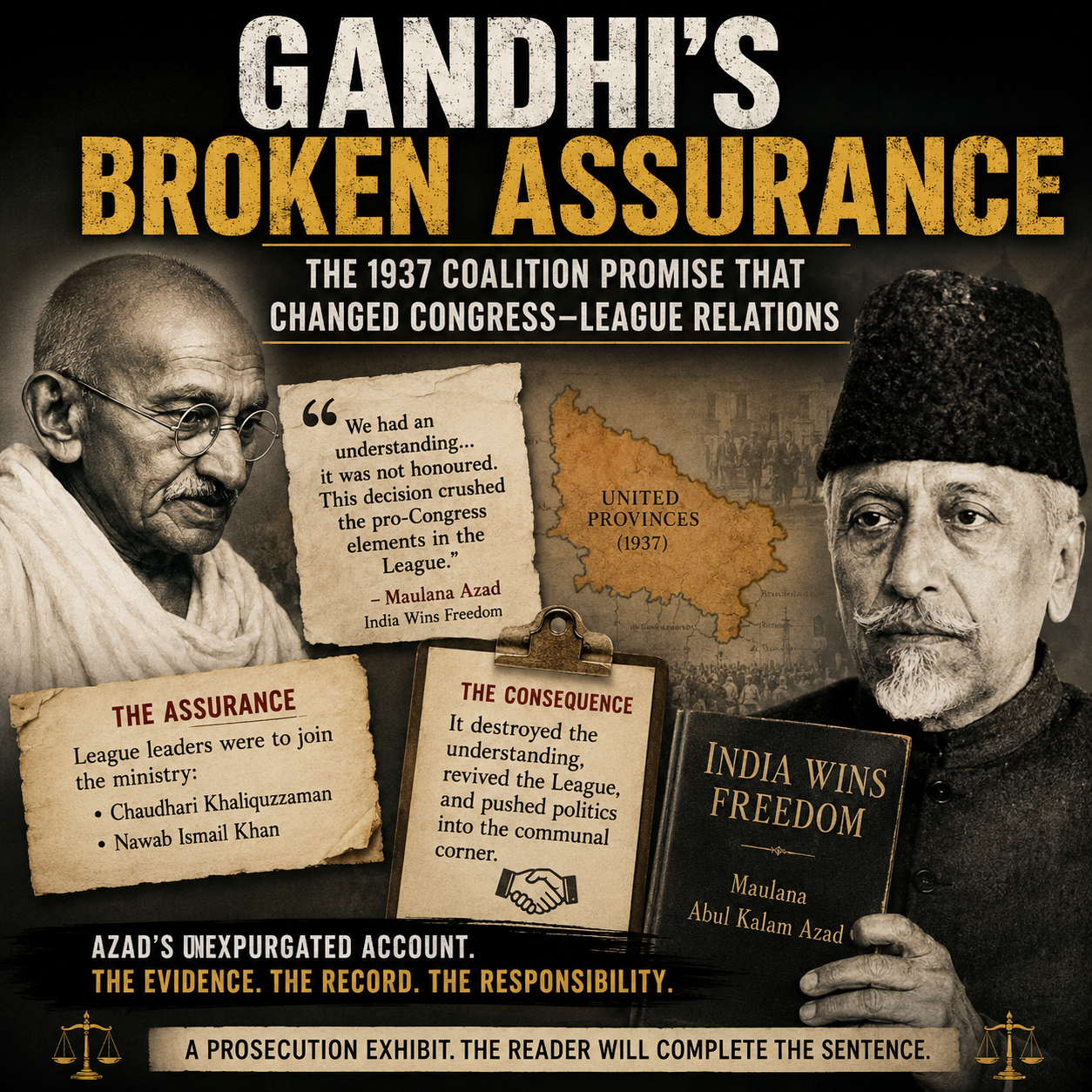
Thank you for reading this post, don't forget to subscribe!The Action Taken: Gandhi backed Jawaharlal Nehru to direct provincial ministry strategy and reject cross-community coalition terms, endorsing his ideological insistence that only two forces counted in India: Congress and the British Raj.
Who Paid the Price: Moderate Muslim leadership within the nationalist fold, whose warnings against polarising provincial governance were dismissed.
The Alternative Bypassed: Empowering regional Congress leaders (such as Vallabhbhai Patel) who favored pragmatic provincial power-sharing arrangements with regional parties.
Why This Matters: Bypassed collective party pragmatism in favor of personal patronage, embedding an uncompromising unitary policy that directly stimulated minority political separatism.
The 1929 Selection — Documented
Gandhi’s Nehru Selection places the documented 1929 Congress presidency before the reader.
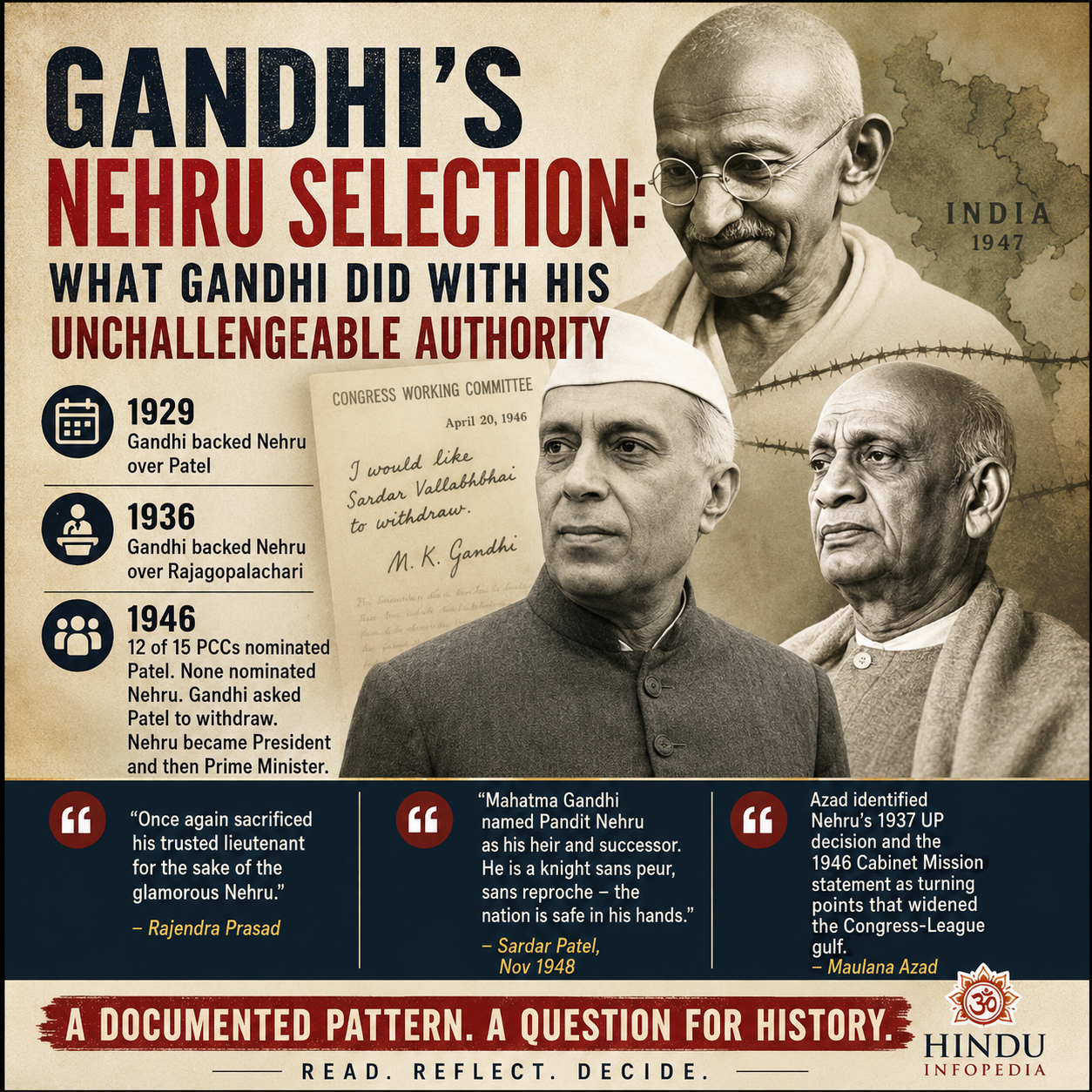
In 1929, Gandhi threw his weight behind Jawaharlal Nehru for the Congress presidency at the Lahore session. Nehru was forty years old. Patel was fifty-four. The 1929 selection established a documented pattern — Gandhi’s intervention in Congress presidential succession at the expense of stronger internal candidates. Nehru’s Lahore presidency was the session at which Purna Swaraj — complete independence — was first formally adopted as Congress’s goal. Gandhi chose Nehru specifically to lead that declaration.
Rajmohan Gandhi’s documented biography Patel: A Life (1991) records a striking parallel across Gandhi’s interventions: on both the 1929 and 1946 occasions Gandhi threw his weight behind Nehru at the expense of Patel.
The 1946 Selection — Documented
Gandhi’s Nehru Selection places the 1946 documented episode before the reader with full precision.
The last date for nominations for Congress President — who would become India’s first Prime Minister — was April 29 1946. Gandhi had already made his preference for Nehru known. Despite this, twelve of fifteen Pradesh Congress Committees nominated Sardar Patel. No Pradesh Congress Committee nominated Nehru on the last day of filing nominations.
JB Kripalani nominated Nehru at a Congress Working Committee meeting following Gandhi’s April 20 1946 letter to Azad. Gandhi asked Patel to withdraw. Patel withdrew. Nehru became Congress President and subsequently Prime Minister.
Rajendra Prasad’s documented lament: Gandhi had “once again sacrificed his trusted lieutenant for the sake of the glamorous Nehru” and feared Nehru “would follow the British ways.”
Patel’s own documented assessment, November 1948: “Mahatma Gandhi named Pandit Nehru as his heir and successor. He is a knight sans peur, sans reproche — the nation is safe in his hands.”
The documentation is precise: Gandhi named Nehru his heir. This was Gandhi’s documented choice, made against the preference of twelve of fifteen Pradesh Congress Committees and against the documented judgment of Rajendra Prasad.
The Documented Connection to “Gandhi’s Broken Assurance”
Gandhi’s Nehru Selection places the documented connection to Blog 90, Gandhi’s Broken Assurance, before the reader.
Blog 90 documented Azad’s attribution of the 1937 UP coalition decision — and its consequence of crushing pro-Congress elements in the Muslim League — to Nehru specifically. By 1939 the documented record shows a wide and deep divide between Congress and India’s Muslims, the same divide Gandhi had pursued the Khilafat alliance two decades earlier believing it would produce unity instead. Azad identified two Nehru decisions as turning points widening the Congress-League gulf. Both decisions were made by the man Gandhi had placed in the Congress presidency. Azad identified two Nehru decisions as the turning points that widened the Congress-League gulf: the 1937 UP decision and Nehru’s 1946 Cabinet Mission statement.
Gandhi’s Nehru Selection places the documented succession record before the reader across three episodes — 1929, 1936, and 1946. Each episode is documented from independent sources. The pattern is consistent across seventeen years: Gandhi intervened to place Nehru over candidates with stronger internal support. The series places this documented pattern before the reader alongside the documented consequences of Nehru’s decisions — the 1937 UP coalition failure, the 1946 Cabinet Mission statement — both attributed by Azad as turning points toward Partition. The prosecution does not assert that Gandhi intended those consequences. It places the documented succession choices and the documented consequences of the positions those choices filled before the reader as a connected sequence.
The Prosecution’s Position
Gandhi’s Nehru Selection places three questions before the reader.
- Did Gandhi, on documented multiple occasions — 1929, 1936, and 1946 — place Nehru in the Congress presidency over stronger internal candidates, including Patel who received twelve of fifteen Pradesh Congress Committee nominations in 1946?
- Did the decisions Azad documented as widening the Congress-League gulf — and directly contributing to Partition — occur in positions Gandhi had specifically chosen Nehru to hold?
- Does the documented pattern — Gandhi’s unchallengeable authority over succession, Nehru placed in position, Nehru’s documented decisions attributed by Azad as turning points toward Partition — establish something about how Gandhi’s authority over Congress succession operated in practice?
The series does not answer. The documented selections are on record. Rajmohan Gandhi’s Patel: A Life, Rajendra Prasad’s documented lament, Patel’s own documented statement, and Azad’s documented attribution are placed before the reader. The reader will examine the succession pattern — three documented interventions across seventeen years, against stronger candidates each time, with the man Gandhi chose making the decisions Azad attributed as turning points toward Partition — and complete the sentence.
Invitation To Defence
We now invite the defence to present its exhibits to the reader, contesting the evidence laid bare in the prosecution’s case.
1929 — Gandhi placed Nehru over Patel. 1936 — Gandhi placed Nehru over Rajagopalachari. 1946 — twelve of fifteen Pradesh Congress Committees nominated Patel. No committee nominated Nehru. Gandhi asked Patel to withdraw. Nehru became Prime Minister. Azad documented Nehru’s decisions as the turning points that widened the Congress-League gulf. Gandhi’s Nehru Selection places the documented succession pattern before the reader. The reader will complete the sentence.
Feature Image: Click here to view the image.
Videos
Glossary of Terms
- Purna Swaraj: The Congress declaration of complete independence as India’s national objective, formally adopted at the Lahore Session of 1929.
- Congress Presidency: The elected leadership position within the Indian National Congress that often carried major influence over party direction.
- Pradesh Congress Committee (PCC): A state-level unit of the Indian National Congress responsible for organizational and electoral functions.
- Congress Working Committee (CWC): The principal executive decision-making body of the Indian National Congress.
- Cabinet Mission Plan: The 1946 British proposal intended to facilitate the transfer of power and preserve a united India through a federal structure.
- Partition: The 1947 division of British India into the sovereign states of India and Pakistan.
- Lahore Session: The 1929 annual Congress session where Purna Swaraj was adopted as the party’s objective.
- Succession Pattern: A recurring theme in this series referring to Gandhi’s role in influencing Congress leadership selections.
- Congress-League Gulf: A phrase describing the widening political divide between the Indian National Congress and the Muslim League.
- UP Coalition Decision: The 1937 United Provinces government formation episode discussed by Maulana Azad as a significant political turning point.
- Muslim League: The political organization that later led the movement for the creation of Pakistan.
- Unchallengeable Authority: A recurring phrase in this series describing Gandhi’s extraordinary influence within Congress decision-making.
- Documented Attribution: Assignment of responsibility or interpretation explicitly recorded by a historical source.
- Series Prosecution: A narrative device used throughout the series to present evidence and questions for reader evaluation.
- Patel: A Life: Rajmohan Gandhi’s biography of Sardar Patel, cited in the article as a source regarding Congress leadership decisions.
#Gandhi #Nehru #Patel #Congress #Partition #IndiaHistory #FreedomMovement #IndianPolitics #MahatmaGandhi #SardarPatel #JawaharlalNehru #History #CongressParty #Independence #HinduinfoPedia
Gandhi’s Peace Efforts: The Questions Before the Mahatma (0)