Gandhi’s Key Admission: The Statement That Named the Causal Chain (64)
भारत / GB
Part 64: Mahatma Gandhi’s Peace Efforts | Series Index
Blog 63 documented Gandhi’s uninvited career — forty years of action without British permission — against the one documented exception: Malabar, where he waited for an invitation that did not come. This post examines what Gandhi’s statement on the Ali Brothers reveals about his own knowledge of the causal chain the series has documented across the Moplah arc.
Thank you for reading this post, don't forget to subscribe!The Action Taken: In a public address, Gandhi asserted that if the colonial government permitted him and the Ali brothers to enter Malabar, they would restore peace and bring the Moplahs to order immediately.
Who Paid the Price: The rule of law and civic security, which were treated as dependent on personal clerical influence rather than institutional civil governance.
The Alternative Bypassed: Demanding that all political and religious cadres submit unconditionally to statutory civil law and disarm.
Why This Matters: A documented admission of operational influence: by claiming the Ali brothers held the key to pacifying the uprising, the leadership acknowledged that the forces driving the rebellion were linked to its own alliance partners.
The Statement — What Gandhi Said About the Ali Brothers
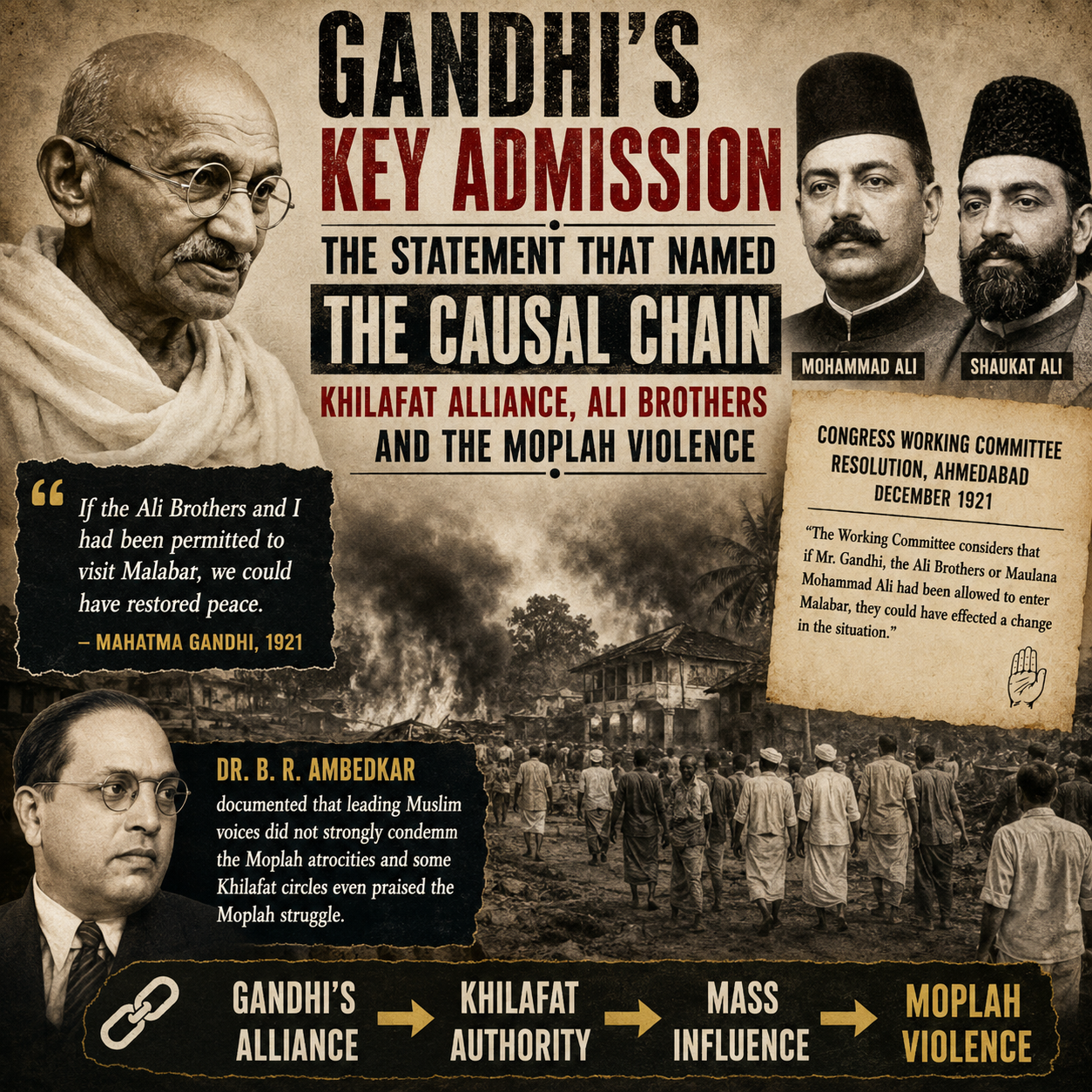
Gandhi’s Key Admission is built on one documented claim that Gandhi made in September 1921 — while the Moplah massacre was ongoing — and formalised in the Congress Working Committee resolution at Ahmedabad in December 1921.
Gandhi stated that the British Government bore responsibility for the violence because they had failed to invite the Ali Brothers and Gandhi himself to enter Malabar and restore calm. The Congress resolution passed at Ahmedabad in December 1921 formalised this position: the disturbance could have been prevented had the government accepted the proffered assistance of the Khilafat leadership.
The statement’s surface purpose was to redirect responsibility from the Moplah perpetrators to the British administration. Blog 63 examined that deflection in full.
This post examines what the statement reveals beneath the deflection — what Gandhi’s own words establish about who held operational authority over Moplah Muslim conduct, and how they came to hold it.
What the Statement Admits
When Gandhi stated that the Ali Brothers’ presence could have restored calm in Malabar, he made four simultaneous admissions — none of which he appears to have intended as admissions:
First admission: The Ali Brothers held authority over the Moplah Muslim community’s conduct. Not the British district collector. Not the Indian civil administration. Not the Congress organisation. The Ali Brothers — the Khilafat leadership Gandhi had elevated to co-equal status in the national movement.
Second admission: Gandhi held authority alongside the Ali Brothers. He included himself in the statement — the Ali Brothers and Gandhi himself could have restored calm. Gandhi knew he possessed the authority to enter Malabar and alter the course of the massacre.
Third admission: This authority derived from the Khilafat alliance. The Ali Brothers held authority over Moplah conduct because they were the leaders of the Khilafat movement — the movement Gandhi had amplified and legitimised. The source of their authority over the Moplah community was precisely the alliance Gandhi had built.
Fourth admission: Gandhi knew all three of these things in September 1921 — while the massacre was ongoing. He stated them publicly. He placed them on record in the Congress resolution. He was not surprised by the nature of the authority the Khilafat leadership held. He was frustrated that the British had not invited that authority to be deployed.
What the Khilafat Leaders Actually Said About Moplah
Gandhi’s Key Admission requires one further documented fact — what the Ali Brothers and Khilafat leadership actually said and did about the Moplah massacre.
Ambedkar documented this precisely: “Not only have the Muslims not condemned these outrages but even Mr Gandhi has not called upon the leading Muslims to condemn them.”
The documented record confirms: certain Khilafat leaders passed resolutions of congratulations to the Moplahs on the brave fight they were conducting for the sake of religion.
The Ali Brothers — whose presence Gandhi stated could have restored calm in Malabar — did not condemn the massacre. Their leadership network congratulated the perpetrators. This is not the prosecution’s characterisation. It is Ambedkar’s documented record, placed before the reader while Gandhi was alive and the Congress was still operating under his authority.
Gandhi’s Key Admission therefore carries a second layer: Gandhi stated that the Ali Brothers’ presence could have restored calm. The documented conduct of the Ali Brothers during the massacre was to allow their network to celebrate it. The man Gandhi said held the key to restoration was the same man whose network was congratulating the killers.
The prosecution places both documented facts before the reader without characterisation.
The Causal Chain — Named by Gandhi Himself
The series has documented the causal chain across twelve Moplah arc blogs — from Gandhi’s Khilafat alliance in 1920 to the massacre in 1921. Gandhi’s key admission places that chain on the record in Gandhi’s own words.
The chain Gandhi’s statement confirms:
Gandhi built the Khilafat alliance. The alliance consolidated Muslim political identity under Khilafat leadership — the Ali Brothers at its centre. The Khilafat framework reached the Moplah community in Malabar and gave their agrarian rage a pan-Islamic theological foundation. Blog 56 documented that agrarian foundation. When the uprising began, the same authority structure that Gandhi had built — the Ali Brothers, the Khilafat network — held operational control over what the Moplah community did.
Gandhi knew this. He stated it publicly in September 1921. He placed it in a Congress resolution in December 1921.
The causal chain runs: Gandhi’s alliance → Khilafat authority over Moplah conduct → massacre. Gandhi’s own statement confirms the chain. He described it in order to deflect responsibility to the British. He placed it on record in order to argue the British should have invited the chain’s authority figures to de-escalate. In doing so, he documented precisely what the series has argued: the alliance he built held the key to the violence it produced.
The Prosecution’s Position
Gandhi’s Key Admission does not claim Gandhi intended the Moplah massacre. It claims that Gandhi’s own documented statement establishes the following — in Gandhi’s own words, not in the prosecution’s characterisation:
- The Ali Brothers held operational authority over Moplah Muslim conduct during the massacre.
- Gandhi held authority alongside the Ali Brothers through the same Khilafat alliance.
- Gandhi knew in September 1921 that this authority existed and that it could have been deployed to stop the massacre.
- Gandhi chose not to deploy that authority without a British invitation — for documented reasons examined in Blog 63.
The series does not need to assert that Gandhi was responsible for the massacre. Gandhi’s own statement asserts the causal chain. The prosecution places Gandhi’s words before the reader. The reader will complete the sentence.
Gandhi stated that his presence and the Ali Brothers’ presence could have restored calm in Malabar. He placed this on record while 2,500 Hindus were being killed. The statement confirms the causal chain in Gandhi’s own documented words: the alliance he built held the authority over the violence it produced. He knew. He stated it. He did not use it. The prosecution places Gandhi’s own admission before the reader.
Feature Image: Click here to view the image.
Videos
Glossary of Terms
- Ali Brothers: Mohammad Ali and Shaukat Ali, leading figures of the Khilafat Movement whom Gandhi allied with during the Non-Cooperation era.
- Khilafat Movement: A pan-Islamic political movement launched to defend the Ottoman Caliphate after World War I, later integrated by Gandhi into India’s anti-British movement.
- Moplah Massacre: The violent phase of the 1921 Malabar uprising in which large-scale killings, forced conversions, and attacks against Hindus were documented.
- Malabar: A region in present-day Kerala that became the center of the 1921 Moplah uprising.
- Congress Working Committee (CWC): The principal decision-making body of the Indian National Congress that formalized Gandhi’s political position on the Malabar events in December 1921.
- Operational Authority: A key phrase in this series referring to the recognized influence or movement-level authority capable of affecting collective political or social behavior.
- Causal Chain: A central phrase in this series describing the sequence linking Gandhi’s Khilafat alliance, Khilafat authority structures, and the Moplah violence.
- Pan-Islamic Theological Foundation: The religious-political framework through which local grievances were connected to the global Khilafat cause.
- Agrarian Rage: A phrase used in the series to describe underlying tenant-landlord tensions in Malabar that existed before Khilafat mobilization.
- Ahmedabad Resolution: The Congress resolution passed in December 1921 asserting that the Malabar violence could have been mitigated if Gandhi and the Khilafat leaders had been allowed to intervene.
- Dr. B. R. Ambedkar: Indian jurist, social reformer, and principal architect of the Indian Constitution who documented criticism of the Khilafat response to the Moplah violence.
- Prosecution’s Position: A recurring series phrase indicating that the blog presents an evidence-based prosecutorial argument rather than a neutral narrative account.
#Gandhi #Khilafat #Moplah #Malabar #Congress #Ambedkar #Kerala #History #India #HinduinfoPedia
Scan Through The Entire Series
Gandhi’s Peace Efforts: The Questions Before the Mahatma (0)
Read The Prosecution Exhibits Through Links