Gandhi’s Malabar Silence: The Agrarian Crisis He Did Not Address (56)
भारत / GB
Part 56: Mahatma Gandhi’s Peace Efforts | Series Index
Blog 55 documented why the massacre ran four months — Gandhi’s ceiling was unknown, the British used measured force, the communal damage ran to completion before decisive suppression arrived. This post asks the prior question: why was the agrarian rage available to be amplified in the first place? The instrument Gandhi chose to address it is the prosecution’s exhibit. The instrument he bypassed is the prosecution’s question.
Thank you for reading this post, don't forget to subscribe!The Action Taken: The national leadership ignored documented tenant grievances (75–80% rent extraction by janmis) that had caused 29 prior agrarian outbreaks, subordinating rural economic reform to the Khilafat cause.
Who Paid the Price: Malabar tenant cultivators whose economic grievances were subordinated to religious slogans, and the targeted landlords.
The Alternative Bypassed: Applying the Champaran investigation method to address structural tenancy reforms in Malabar.
Why This Matters: Documents how agrarian economic grievances were overlooked in favor of pan-Islamic religious mobilization, with catastrophic results for local communities.
What the Agrarian Crisis Was
Gandhi’s Malabar Silence begins with the documented facts of what the Moplah agrarian crisis was — before Gandhi arrived in Indian politics and before the Khilafat alliance.
The British extraction apparatus documented in the earlier series operated in Malabar through a specific mechanism — the colonial land revenue system. The British had codified the traditional jenmi landlord relationship with Moplah tenants in ways that stripped customary protections and gave landlords legal instruments of extraction they had not previously possessed.
Before the British arrived, the jenmi landlords had operated under a structural constraint that was not law but sovereign power. The Zamorin of Calicut and successive rulers of Malabar held the ultimate authority over all landholding. A jenmi landlord who rack-rented his Moplah tenants to breaking point risked complaint reaching the sovereign — whose intervention could revoke, punish, or redistribute. The check was not affection or principle. It was calculated self-preservation. The sovereign’s arbitrary power produced practical restraint.
The customary law that formalised this restraint was the janmi-kana-maryada — explicitly protecting Moplah tenants from eviction except for non-payment of rent, with the net produce of the land shared equally across three tiers: Jenmi, Kanamdar, and Verumpattamdar. Under Hindu rulers this customary protection was real, documented, and enforced through sovereign authority. No Jenmi could evict tenants under him except for non-payment. The three-tier produce-sharing system meant the Moplah tenant retained a documented share of what his land produced.
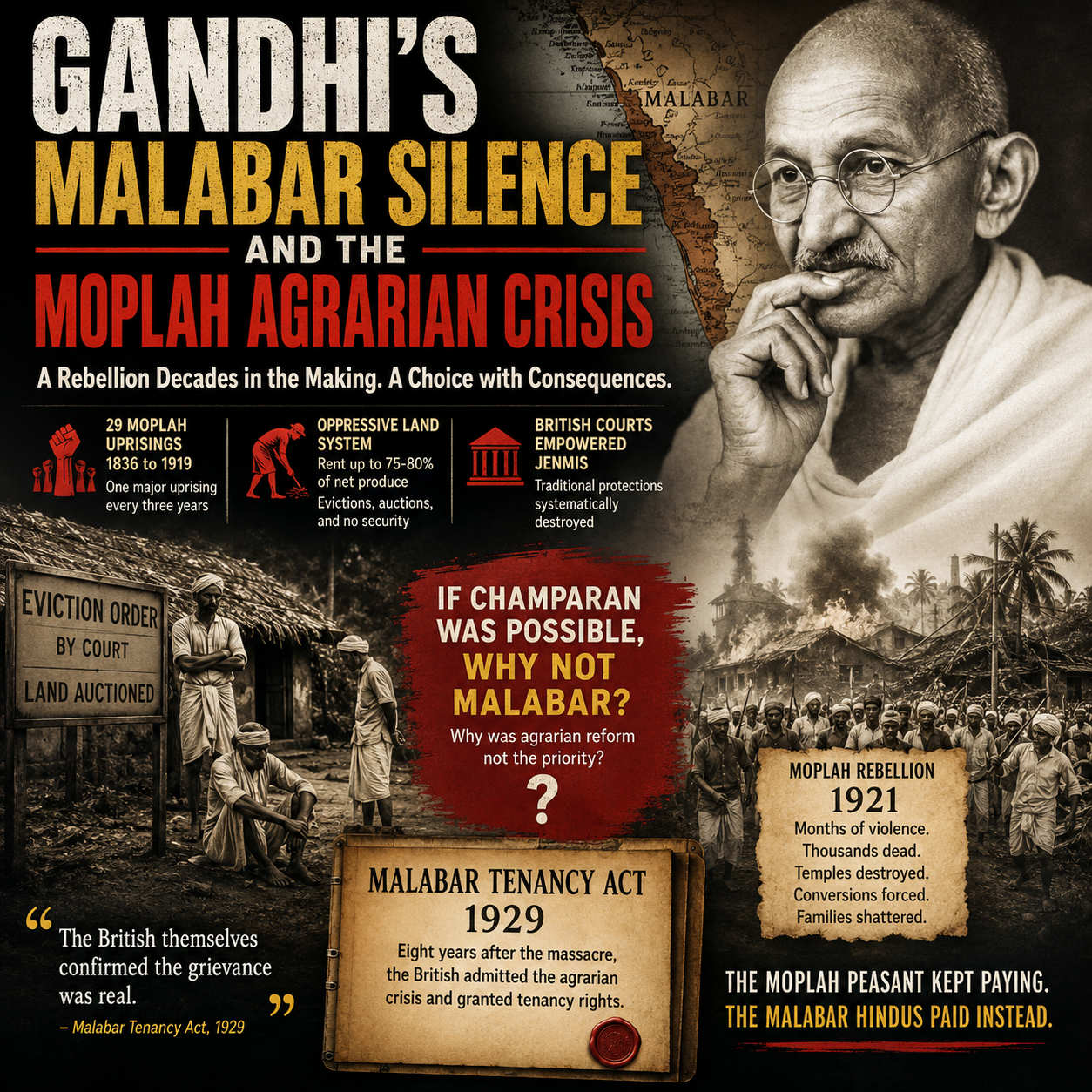
The British Permanent Settlement removed that check. It replaced sovereign power and customary law with codified absolute property rights — a Western juridical concept unknown in Malabar before 1792. Colonial civil courts enforced the jenmi’s right to evict, to auction kanam tenancies, to extract the maximum the market would bear. The janmi-kana-maryada — the unwritten customary law that had protected tenants — was dispersed by colonial courts. What replaced it was 75-80% rent extraction, enforced through those same courts, producing the documented pattern of 29 uprisings across 83 years.
The documented figures: rents running to 75-80% of net produce. Enforced through British colonial courts that recognised jenmi rights over tenant rights. Eviction without compensation — Moplah tenants could be removed from land their families had farmed for generations by a landlord with a British court order.
The consequence of this extraction was documented across eighty-three years — 29 Moplah uprisings between 1836 and 1919. Not one uprising per generation. Not occasional unrest. A sustained, recurring, documented pattern of agrarian rebellion — one uprising every three years on average — driven by the same structural grievance. The British colonial courts sustained the system. The jenmi landlords operated within it. The Moplah tenants paid for it.
The British themselves confirmed the grievance was real — the Malabar Tenancy Act of 1929, granting tenants the ownership rights they had been denied, was passed eight years after the massacre specifically because the colonial administration acknowledged that the agrarian conditions had produced the uprising.
What Gandhi Had Already Demonstrated Was Possible
Gandhi’s Malabar Silence is not a claim that agrarian reform was easy. It is a claim that Gandhi had already demonstrated a method for addressing agrarian grievance — and chose not to apply it in Malabar.
Champaran 1917 — Gandhi’s first major Indian campaign — was an agrarian intervention. The indigo planters of Champaran were extracting forced cultivation from peasants under the tinkathia system. Gandhi arrived, investigated, negotiated with the British administration, and produced a settlement. The tinkathia system was abolished. The indigo planters yielded — partially.
The Champaran method was available for Malabar. The agrarian grievance in Malabar was more severe than Champaran — 75-80% rent extraction versus forced indigo cultivation — and had been producing documented violence for eighty-three years versus Champaran’s more recent grievances. The method Gandhi had demonstrated could be applied. The British administration in Malabar could be negotiated with — as the 1929 Malabar Tenancy Act later proved.
Gandhi did not apply the Champaran method in Malabar. He did not investigate the jenmi-tenant system. He did not negotiate with the British administration for Moplah tenant rights. He did not make Malabar land revenue reform a demand — not in the Non-Cooperation Movement, not in the Khilafat alliance, not in his eleven demands to Lord Irwin in 1930.
There is a further exhibit within Champaran itself. What Gandhi secured at Champaran was the abolition of the tinkathia system — forced indigo cultivation. What he did not secure was the zamindari structure that had produced the tinkathia grievance. The indigo planters retained their land. The zamindars retained their structural authority over peasants. The colonial courts continued to enforce their rights. Gandhi addressed the symptom — forced indigo cultivation — declared victory, built his national fame on it, and left the structural cause — zamindari — entirely intact. The Champaran method was available for Malabar. Its limits were also visible from Champaran: Gandhi negotiated partial relief at the edges of the extraction system, never its structural dismantling.
What Gandhi Chose Instead
Instead of addressing the agrarian grievance that had been producing Moplah uprisings for eighty-three years, Gandhi offered the Moplah community the Khilafat cause.
The transaction was documented in its structural logic across Blog 44 — Gandhi needed Muslim numerical mass for the Non-Cooperation reservoir. The Khilafat movement provided it. In Malabar specifically, the Khilafat mobilisation reached a community that carried eighty-three years of agrarian rage — and gave that rage a pan-Islamic framework, an organisational structure, and the independence movement’s moral authority.
The instrument Gandhi chose served his numerical needs. It required no structural confrontation with British land revenue policy. It required no negotiation with the British administration over jenmi rights. It required only Gandhi’s moral authority — and it delivered Moplah Muslim mass participation in Non-Cooperation without forcing Gandhi to address the extraction system that was producing the agrarian crisis.
The extraction machine stood intact. The British kept their land revenue system. The Moplahs got the Khilafat cause.
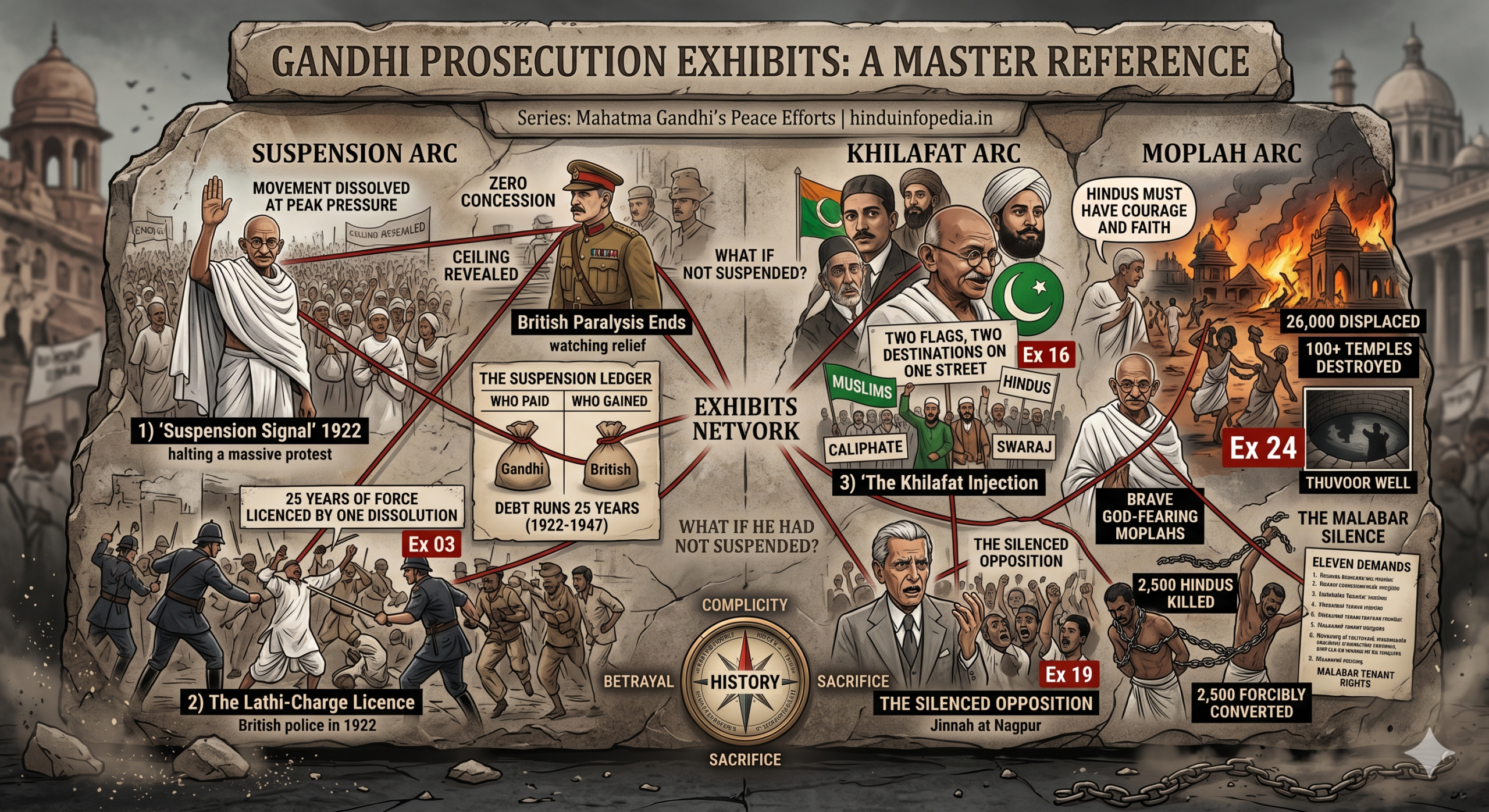
As the earlier Khilafat mobilisation blogs documented, the alliance had fused existing agrarian anger with pan-Islamic political mobilisation — the Moplah community’s eighty-three years of agrarian rage, now amplified by pan-Islamic energy and given the independence movement’s moral authority, expressed itself not against the British courts that had sustained the jenmi system but against the Hindu neighbours and landlords the Khilafat framework had positioned as the immediate adversary.
The Beneficiary Column — Applied to Malabar
Blog 52 placed the beneficiary column before the reader across five exhibits. Gandhi’s Malabar Silence adds a sixth application of the same column — specific to the Moplah agrarian question.
Who benefited from Gandhi choosing the Khilafat instrument over agrarian reform?
The British administration benefited — their land revenue system in Malabar was not challenged, not negotiated against, not made a demand of the independence movement. The Malabar Tenancy Act came in 1929 as an administrative response to violence — not as a concession to Gandhi’s political pressure.
The jenmi landlords benefited — their rights over Moplah tenants were not challenged by the most powerful political figure in Indian public life.
Gandhi benefited — he received Moplah Muslim mass participation in Non-Cooperation without the political cost of confronting the British administration on Malabar land revenue.
Who did not benefit?
The Moplah tenant — whose 75-80% rent extraction continued, whose agrarian grievance remained unaddressed, whose rage was redirected from the extraction system toward Hindu neighbours.
The Hindu landlords and peasants of Malabar — who paid for the redirection of Moplah agrarian rage with 2,500 lives, 2,500 forced conversions, 26,000 displacements, and 100 destroyed temples.
The Prosecution’s Position
Gandhi’s Malabar Silence does not claim Gandhi deliberately chose to sacrifice Malabar Hindus. It claims the documented arithmetic of his choice — instrument selected, instrument bypassed, beneficiary column reading the same — is consistent with the pattern the series has documented across fifty-four blogs.
The Champaran method addressed agrarian grievance at the cost of confronting the extraction system. Gandhi applied it once — partially, with a 25% not 50% settlement — and did not return to it. The extraction machine the series documented in Blog 13 was not dismantled by Gandhi’s campaigns. It was challenged symbolically — the salt march — and left structurally intact.
In Malabar, the structural challenge was available and documented. The Champaran precedent existed. The Malabar Tenancy Act of 1929 proved the British administration would yield on land revenue when forced to. Gandhi did not force them. He chose the Khilafat instrument instead.
The extraction machine kept running. The Moplah peasant kept paying 75-80% rent. The Hindu community of Malabar paid 2,500 lives for the energy Gandhi had amplified and redirected.

Gandhi’s Malabar Silence is the silence of a man who knew the agrarian crisis, knew the method for addressing it, and chose a different instrument — one that served his numerical needs without requiring him to confront the extraction system producing the crisis. The Champaran method was available. The eleven demands did not include Malabar tenant rights. The Khilafat alliance was chosen. The extraction machine stood intact. The Moplah peasant kept paying. The Malabar Hindus paid instead.
Feature Image: Click here to view the image.
Videos
Glossary of Terms
- Moplah Rebellion: The nineteen twenty one uprising in Malabar involving sections of the Moplah Muslim community, beginning amid Khilafat and Non Cooperation mobilisation and later expanding into large-scale violence, killings, forced conversions, and destruction in parts of Malabar.
- Malabar Agrarian Crisis: The long-running tenant distress in Malabar caused by colonial land revenue policies, high rent extraction, insecure tenancy, eviction practices, and unequal landlord-tenant relations under British administration.
- Jenmi System: A landholding structure in Malabar where jenmi landlords possessed extensive rights over land and tenants, especially after British courts strengthened landlord claims through colonial legal codification.
- Janmi Kana Maryada: A customary land arrangement in pre-colonial Malabar that limited arbitrary eviction and recognised layered sharing of agricultural produce between landlords and cultivators.
- Khilafat Movement: A political and religious mobilisation launched after the First World War to support the Ottoman Caliphate, later linked by Gandhi with the Non Cooperation Movement to expand anti-British mobilisation in India.
- Non Cooperation Movement: Gandhi-led political campaign launched in nineteen twenty encouraging boycott of British institutions, titles, schools, and goods as part of the freedom movement.
- Champaran Movement: Gandhi’s nineteen seventeen intervention in Bihar against forced indigo cultivation under the tinkathia system, often presented as his first major agrarian campaign in India.
- Tinkathia System: A colonial-era agricultural arrangement in Champaran requiring peasants to compulsorily cultivate indigo on part of their land for European planters.
- Malabar Tenancy Act of Nineteen Twenty Nine: A law introduced under British administration granting greater tenancy protections and ownership-related rights to cultivators in Malabar after decades of agrarian unrest.
- Extraction Machine: A recurring phrase in the series describing the wider British colonial economic system that extracted agricultural wealth, revenue, and resources from Indian society through taxation and land policies.
- Beneficiary Column: A key analytical phrase used in the series to examine which political, administrative, or social groups benefited from particular political decisions, movements, or outcomes.
- Pan-Islamic Mobilisation: Political mobilisation built around broader Islamic identity and solidarity across regions, particularly associated in the series with Khilafat-era political activism.
- Permanent Settlement: A British land revenue arrangement introduced in parts of India that formalised landlord rights and fixed state revenue demands, significantly reshaping traditional agrarian systems.
- Lord Irwin’s Eleven Demands: Gandhi’s nineteen thirty charter of political and economic demands presented before the Civil Disobedience Movement, referenced in the blog to highlight the absence of Malabar tenant reforms.
- Malabar: A historical region on the southwestern coast of India, largely corresponding to parts of present-day Kerala, central to the Moplah uprisings and agrarian disputes discussed in the blog.
#HinduinfoPedia #Gandhi #Moplah #Malabar #Khilafat #History #India #BritishRaj #Kerala #Champaran