
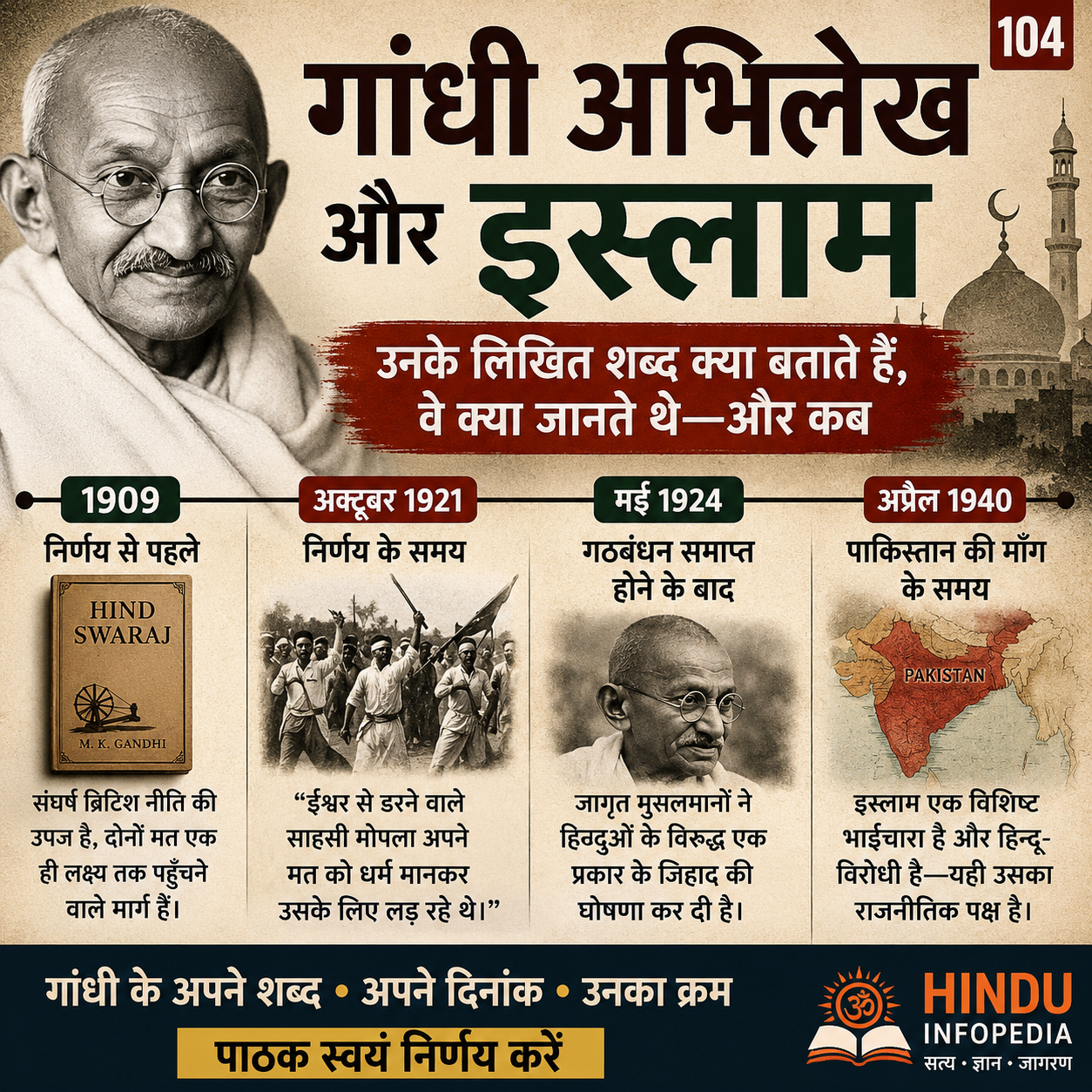
Gandhi’s Own Record on Islam: What His Documented Words Show He Knew — and When (104)
भारत / GB
Part 104: Mahatma Gandhi’s Peace Efforts | Series Index
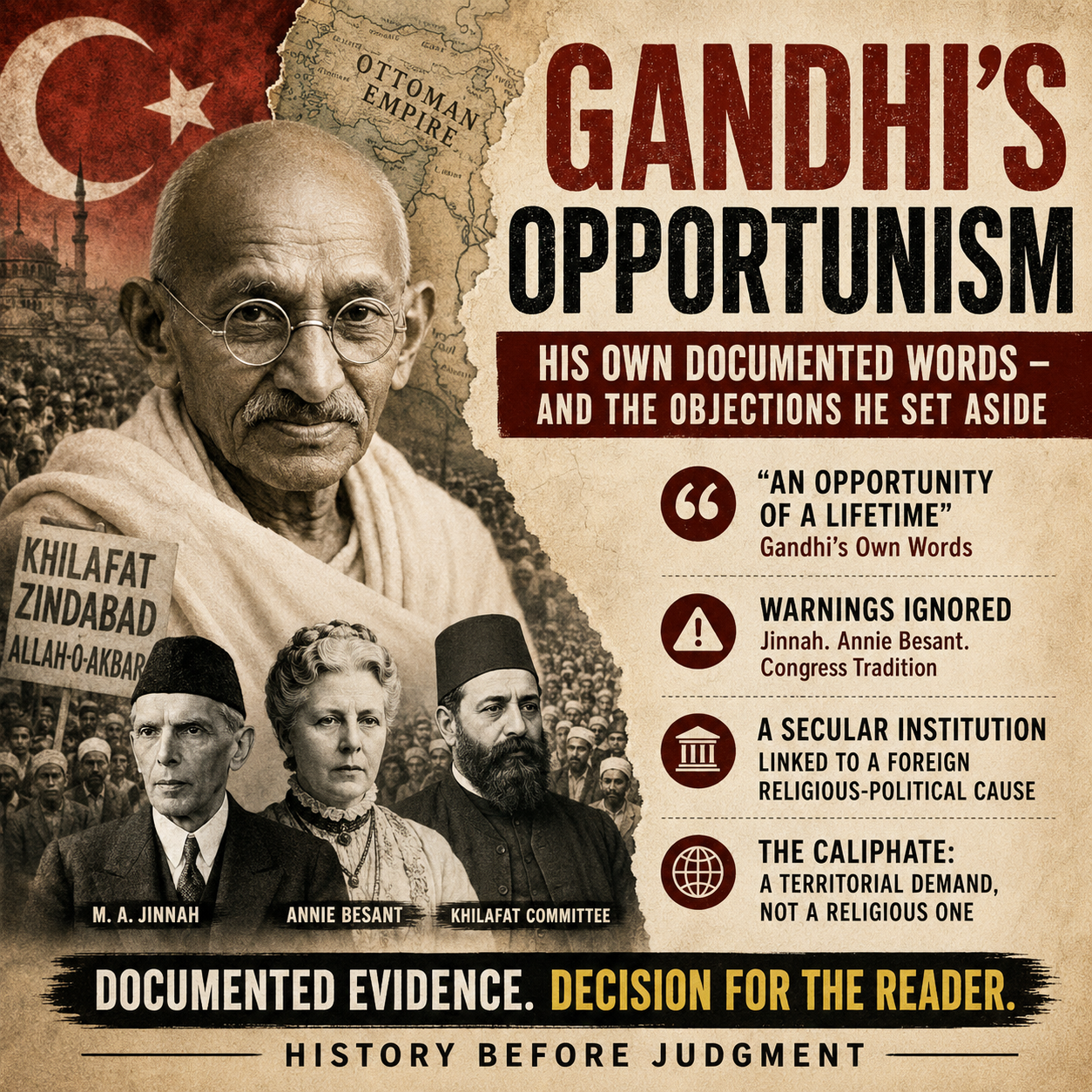
Blog 103 documented Gandhi’s “opportunity of a lifetime” — his own stated word for the Khilafat decision — and what he overruled to pursue it. This post places Gandhi’s own documented statements about Islam before the reader in chronological sequence: what he wrote before the Khilafat decision, what he wrote during it, and what he acknowledged after it.
Thank you for reading this post, don't forget to subscribe!The Action Taken: Gandhi established an intimate political alliance with Maulana Abdul Bari of Firangi Mahal, endorsing him as an architect of national unity while Bari openly declared jihad in defense of the Caliphate.
Who Paid the Price: The principle that anti-colonial struggle must adhere strictly to non-violent civic bounds, compromised by accommodating open preachings of armed jihad.
The Alternative Bypassed: Requiring that all allied religious scholars sign a binding declaration foreswearing violence and armed jihad.
Why This Matters: Documents the integration of radical clerical figures into the leadership core, validating theological declarations of holy war under the banner of non-violent non-cooperation.
Before the Decision — 1909
Gandhi’s Own Record on Islam places the earliest primary source first. In Hind Swaraj (1909), CWMG Vol. 10, Chapter X, Gandhi wrote his most sustained pre-Khilafat analysis of Hindu-Muslim relations. His documented position: the enmity between Hindus and Muslims was not inborn — it had been invented by their mutual enemy. He documented historical coexistence under Muslim sovereigns, argued that religions were different roads converging to the same point, and placed responsibility for communal conflict on British manipulation rather than on any inherent doctrinal difference between the two faiths.
This was Gandhi’s documented framework in 1909 — before he returned to India, before the Khilafat Movement, before the decision examined in Blog 103. He saw no inherent political character in Islam that would obstruct a shared Indian nationalist framework. That documented 1909 position is the starting point against which his later documented words are placed.
Gandhi’s Own Record on Islam places the prosecution’s core observation here, between the 1909 framework and the 1924 assessment: Gandhi made the Khilafat decision in 1920 on the basis of the 1909 framework — that the enmity was British-manufactured, that the religions were compatible, that the political obstacle could be overcome by unity. His own documented 1924 words placed the outcome of that decision on record. The reader will examine what Gandhi wrote in 1909, what he decided in 1920 on the strength of that framework, and what he documented in 1924 as the result.
During the Decision — October 1921
Gandhi’s Own Record on Islam places his documented response to the Moplah Rebellion before the reader. In August 1921, within one year of the Khilafat-Non-Cooperation merger, Khilafat mobilisation in the Malabar region produced a documented anti-Hindu rebellion — documented forced conversions, destruction of temples, killings. The documented scale and character of the rebellion are examined in a future Blog.
Gandhi’s own documented response appeared in Young India, October 20 1921, CWMG Vol. 21 p. 317: “And so I feel the Moplah revolt has come as a blessing to a system that is crumbling to pieces by the weight of its own enormity… What was more detestable, the ignorant fanaticism of the Moplah brother, or the cowardliness of the Hindu brother who helplessly muttered the Islamic formula or allowed his tuft of hairs to be cut or his vest to be changed?”
In a further documented statement, Gandhi described the Moplahs as “brave God-fearing Moplas who were fighting for what they consider as religion and in a manner which they consider as religious” (Young India, December 8 1921, CWMG Vol. 25). These are Gandhi’s own documented words, placed on record during the Khilafat period itself, in response to documented anti-Hindu violence produced by the mobilisation he had led.
After the Alliance Collapsed — May 1924
Gandhi’s Own Record on Islam places his most candid documented assessment before the reader. Young India, May 29 1924, CWMG Vol. 24 pp. 136-143, “Hindu-Muslim Tension: Its Cause and Cure” — Gandhi’s own documented analysis written after the Khilafat Movement had collapsed and communal riots had spread across India.
Three documented passages from the same article:
“My own experience but confirms the opinion that the Mussalman as a rule is a bully, and the Hindu as a rule is a coward… Where there are cowards, there will always be bullies.”
“You asked the Hindus to make common cause with the Mussalmans on the Khilafat question… It unified and awakened the Mussalmans… And now that the Khilafat question is over, the awakened Mussalmans have proclaimed a kind of Jihad against us Hindus.”
“Thirteen hundred years of imperialistic expansion has made the Mussalmans fighter as a body. They are therefore aggressive.” (CWMG Vol. 24, pp. 270-271)
These are Gandhi’s own documented words, published under his name, in his own journal. The series does not characterise them. It places them before the reader.
At the Pakistan Demand — April 1940
Gandhi’s Own Record on Islam places one further documented statement before the reader — from Harijan, April 1940, at the moment the Lahore Resolution was placing the Pakistan demand on the constitutional record. Gandhi wrote: “For at the bottom of the cry for partition is the belief that Islam is an exclusive brotherhood, and anti-Hindu… That is the political aspect of it.”
This is Gandhi’s own documented acknowledgement, in April 1940, that Islam carried a political dimension — the “exclusive brotherhood” — that produced the documented demand the series has tracked from Blog 81 through Blog 98 (The Jinnah Arc, Split Between Congress and Muslim League). The political character Gandhi acknowledged in 1940 is placed by the prosecution alongside the 1909 framework that attributed no such character to Islam, alongside the 1921 Moplah response, and alongside the 1924 candid assessment.
The Prosecution’s Position
Gandhi’s Own Record on Islam places three questions before the reader.
- Did Gandhi’s 1909 documented framework — attributing no inherent political character to Islam, treating communal conflict as British-manufactured — represent his documented understanding before the Khilafat decision, and does his own 1924 documented assessment represent what that framework produced when tested against the documented outcome?
- Did Gandhi’s own documented October 1921 response to the Moplah Rebellion — “brave God-fearing Moplas… fighting for what they consider as religion” — place on record his documented position during the Khilafat period itself, and does that position belong before the reader alongside the documented scale of what the rebellion produced?
- Did Gandhi’s own April 1940 documented acknowledgement — “Islam is an exclusive brotherhood, and anti-Hindu… that is the political aspect of it” — place on record what Gandhi himself identified as the political dimension of the faith whose restoration he had led as an opportunity in 1920?
The series does not answer. Gandhi’s Own Record on Islam places Gandhi’s own dated, sourced words — 1909, 1921, 1924, 1940 — before the reader in sequence. The reader will examine what Gandhi wrote and when he wrote it — and complete the sentence.
Invitation To Defence
The floor belongs to the defense. We now invite them to present their exhibits and challenge the narrative established by the prosecution.
1909: conflict is British-manufactured, religions are compatible paths. 1920: opportunity of a lifetime. October 1921: brave God-fearing Moplahs fighting for their religion. May 1924: the awakened Mussalmans have proclaimed a kind of Jihad against us Hindus. April 1940: Islam is an exclusive brotherhood, and anti-Hindu — that is the political aspect of it. Gandhi’s own words. Gandhi’s own dates. The prosecution places the chronological record before the reader. The reader will complete the sentence.
Feature Image: Click here to view the image.
Videos
Glossary of Terms
- Gandhi’s Own Record on Islam: The key phrase of this blog, referring to Mahatma Gandhi’s own dated and documented statements on Islam, presented in chronological order from 1909 to 1940.
- CWMG (Collected Works of Mahatma Gandhi): The official multi-volume compilation of Mahatma Gandhi’s writings, speeches, letters, and publications used as the primary documentary source.
- Hind Swaraj: Gandhi’s 1909 work outlining his political and civilizational ideas, including his early assessment of Hindu-Muslim relations.
- Khilafat Movement: A political movement launched after the First World War to support the Ottoman Caliphate, which Gandhi supported through the Non-Cooperation Movement.
- Non-Cooperation Movement: The nationwide movement led by Gandhi from 1920 encouraging Indians to withdraw cooperation from British institutions.
- Moplah Rebellion: The 1921 uprising in the Malabar region involving large-scale violence, forced conversions, killings, and destruction of temples, discussed as a turning point in Gandhi’s documented statements.
- Young India: Gandhi’s English-language weekly journal in which many of his political articles and responses were published.
- Harijan: Gandhi’s weekly journal that carried many of his later political and social writings, including his April 1940 observations.
- Lahore Resolution: The resolution adopted by the Muslim League in March 1940 that formally proposed separate states for Muslims, later associated with the Pakistan demand.
- Pakistan Demand: The constitutional demand advanced by the Muslim League for a separate Muslim homeland, examined through Gandhi’s documented responses.
- Jinnah Arc: A unique term in this series describing the chronological sequence of events tracing Muhammad Ali Jinnah’s constitutional and political journey from 1920 to the Pakistan demand.
- Split Between Congress and Muslim League: A recurring series term describing the widening political separation between the Indian National Congress and the All-India Muslim League.
- Chronological Record: A documentary method used throughout this series in which historical statements are presented strictly according to their dates without reinterpretation.
- Exclusive Brotherhood: Gandhi’s phrase in April 1940 describing the belief underlying the demand for partition, as recorded in Harijan.
- Political Aspect of Islam: A key phrase from Gandhi’s April 1940 statement referring to what he described as the political dimension associated with the Pakistan demand.
#Gandhi #Islam #Khilafat #History #India #Pakistan #Jinnah #Congress #Freedom #HinduinfoPedia
Gandhi’s Peace Efforts: The Questions Before the Mahatma (0)