
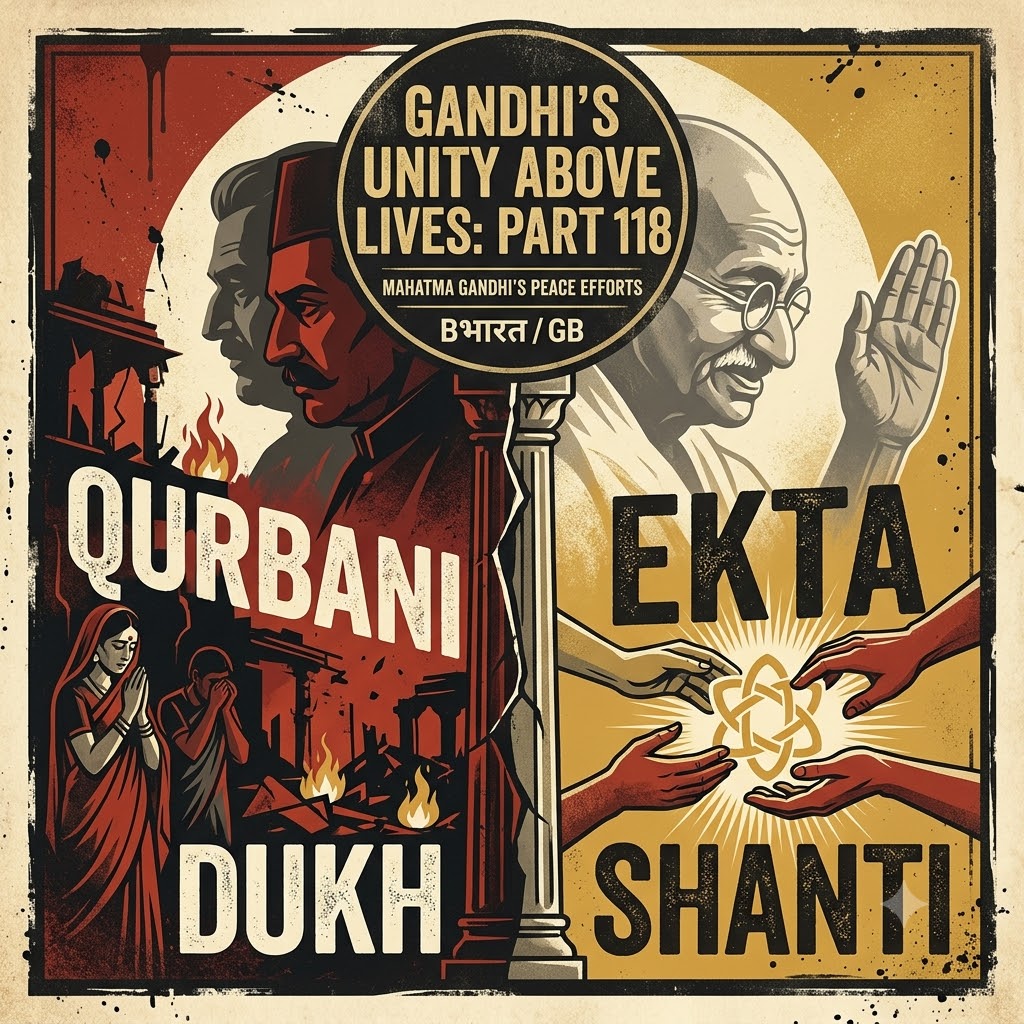
Gandhi’s Unity Above Lives: Pattern of What Gandhi Placed Above Hindu Deaths (118)
भारत / GB
Part 118: Mahatma Gandhi’s Peace Efforts | Series Index
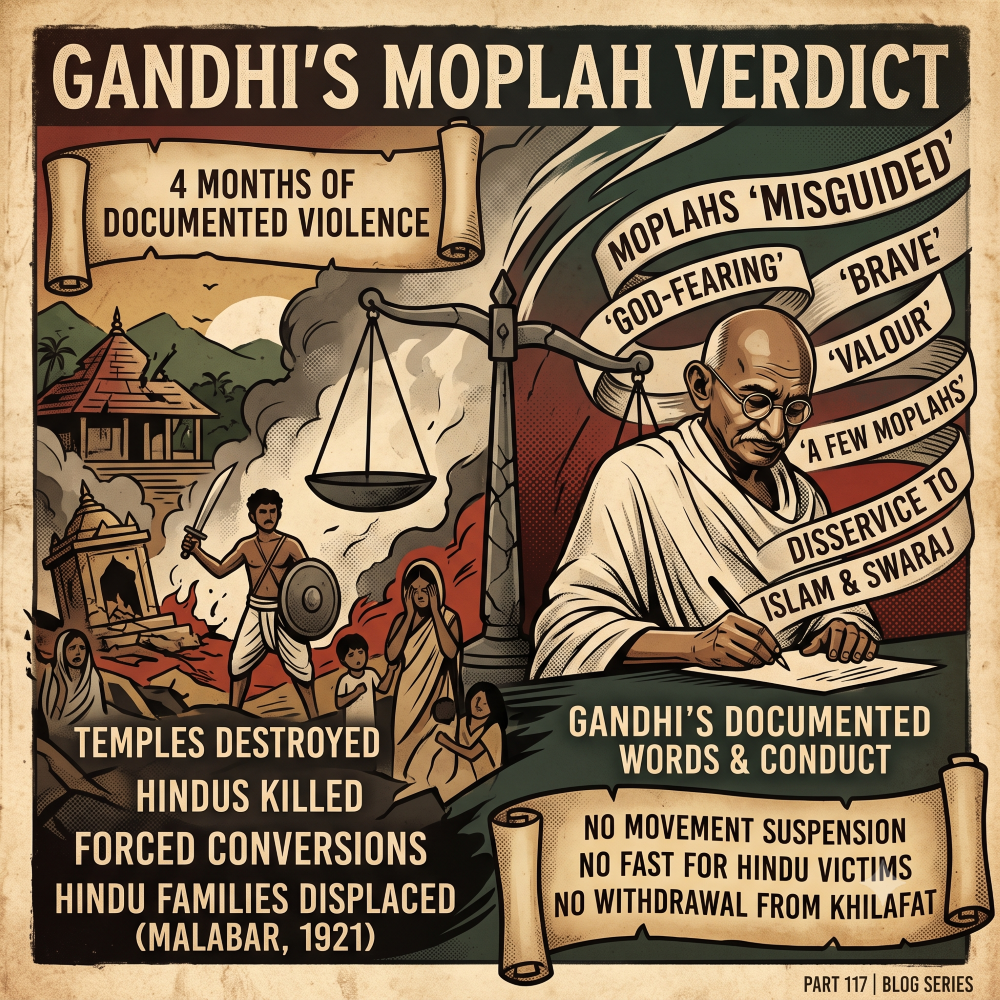
Blog 117 placed Gandhi’s documented verdict on the Moplah perpetrators before the reader — “God-fearing,” “brave,” “valour.” This post places a second documented instance of the same pattern before the reader — a named Hindu leader, a named Muslim killer, and Gandhi’s own documented language in response to each.
Thank you for reading this post, don't forget to subscribe!The Action Taken: Between 1922 and 1927, British India witnessed an unprecedented wave of 91 major communal riots (including Multan, Saharanpur, Kohat, Delhi, Lucknow, and Allahabad), resulting in hundreds of deaths.
Who Paid the Price: Vulnerable urban and rural populations across five major provinces, who suffered recurrent arson, desecration, and loss of life.
The Alternative Bypassed: Formulating a comprehensive, enforceable national communal pact backed by strict legal and political penalties against instigators.
Why This Matters: Documents the statistical reality of the post-suspension period: the collapse of the Khilafat movement did not lead to national peace, but to the most violent decade of communal rioting in colonial history.
The Documented Pattern — Established Across the Series
Gandhi’s Unity Above Lives places the documented pattern before the reader at the outset. The Moplah rebellion of 1921 produced Gandhi’s documented language for perpetrators: “God-fearing,” “brave,” “valour,” “a few Moplahs,” “misguided disservice to Islam and Swaraj.” The documented Hindu victims of four months of documented killing, forced conversions, and temple desecrations were not named in Gandhi’s documented statements with equivalent specificity. The prosecution places one documented question before the reader: was the Moplah a single documented instance, or part of a documented pattern?
December 23 1926 places a named individual before the reader.
Swami Shraddhanand — The Documented Victim
Gandhi’s Unity Above Lives places Swami Shraddhanand’s documented identity before the reader. Born Munshi Ram, 1856. Arya Samaj sannyasi. Indian independence activist. A man who had walked alongside Gandhi in the Non-Cooperation Movement — who had addressed the historic mosque congregation at Delhi’s Jama Masjid in 1919 as a Hindu swami, invited by the Khilafat leadership in a documented moment of Hindu-Muslim cooperation Gandhi himself had celebrated. A man Gandhi knew personally — documented in Gandhi’s own Young India essay of December 30 1926 (CWMG Vol. 32, p. 457): “Swamiji passed a day or two at the Satyagraha Ashram at Sabarmati, now about six months ago, and told me, in the course of his conversations, that he often received letters threatening his life.”
Gandhi had been warned. Shraddhanand had told him personally, six months before the murder, that his life was under threat.
On December 23 1926, Abdul Rashid entered Shraddhanand’s room while the Swami lay ill in bed and shot him dead.
Gandhi’s Documented Response — Guwahati Congress Session 1926
Gandhi’s Unity Above Lives places Gandhi’s own documented response before the reader. Gandhi was on his way to the Guwahati Congress session when the murder occurred. At that session, Gandhi paid documented tribute to Shraddhanand — called him a martyr and a reformer. This is documented and accurate.
Gandhi also said — documented at CWMG Vol. 32, pp. 461-62, Congress session Guwahati 1926:
“Now you will, perhaps, understand why I have called Abdul Rashid a brother, and I repeat it, I do not even regard him as guilty of Swamiji’s murder. Guilty, indeed, are all those who excited feelings of hatred against one another.”
Gandhi’s own documented words placed before the reader precisely. Not “Abdul did nothing wrong” — that formulation is documented as a fabrication by fact-checkers and is not carried here. What Gandhi documented: he called Abdul Rashid his brother, he repeated it, and he documented that he did not regard Abdul Rashid as guilty of the murder. Guilty were those who had excited hatred — the educated class, the polemical writers, the atmosphere of communal tension.
Gandhi’s Young India essay December 30 1926, CWMG Vol. 32, p. 457, placed the same documented position on the written record: “It is, therefore, we the educated and the semi-educated class that are responsible for the hot fever, which possessed Abdul Rashid.”
The Documented Parallel — Placed Before the Reader
Gandhi’s Unity Above Lives places the documented parallel across the two incidents before the reader.
Moplah 1921: documented killings, forced conversions, temple desecrations across Malabar. Gandhi’s documented language for perpetrators: “God-fearing,” “brave,” “valour.” Gandhi’s documented assignment of responsibility: “we must see clearly that it would be dishonourable to show any approval of the violence” — a disservice to Islam and Swaraj, not to the Hindu victims. Gandhi’s documented description of the rebellion’s scale: “a few Moplahs.”
Shraddhanand 1926: a named Hindu leader, personally known to Gandhi, murdered in his sickbed by a named Muslim individual. Gandhi’s documented language for the killer: “my brother.” Gandhi’s documented position on guilt: Abdul Rashid was not guilty — those who had excited hatred were guilty.
The prosecution places the two documented patterns before the reader without characterisation: in both cases, the documented Hindu victims (unnamed Moplah Hindus, named Shraddhanand) were placed within a framework that located guilt elsewhere. In both cases, Gandhi’s documented language for the Muslim actors involved (“God-fearing Moplahs,” “my brother Abdul Rashid”) placed them within Gandhi’s documented moral vocabulary of closeness.
The 1946 Documented Layer — Direct Action Day and Bihar
Gandhi’s Unity Above Lives places a third documented instance of the same pattern before the reader — twenty years after Moplah, twenty years after Shraddhanand.
August 16 1946: Direct Action Day. Jinnah’s documented call, the Muslim League’s documented organisation, 4,000 to 10,000 documented dead in Calcutta in four days — the documented death toll varying across sources but the documented event and its documented origin in the Muslim League’s Direct Action call are established. Gandhi was at Sevagram ashram. His documented response: he called it “senseless violence that prolonged British rule.” No fast. No fast threat. No documented call for the Muslim League to withdraw the call that had produced the documented killing.
August 17-19 1946: Hindu retaliation began. Gandhi’s documented writing of August 19 1946: “They can retaliate or refrain. Refraining is easy and simple, if there is the will. Retaliation is complicated.” At a prayer meeting: Gandhi said the community must “unlearn the habit of retaliation in every shape and form” — not merely in action but, more importantly, in thought. (CWMG Vol. 98.)
October-November 1946: Bihar riots. Hindu mobs attacked Muslims in documented retaliation for Calcutta and Noakhali. Gandhi’s documented response: he threatened to fast unto death if the violence in Bihar did not stop within 24 hours. The threat was broadcast nationally by Congress leader Rajendra Prasad.
The prosecution places the documented sequence of the three 1946 responses before the reader alongside the 1921 and 1926 instances already established. The trigger killing (Direct Action Day): “senseless violence.” The Hindu retaliation: “retaliation is complicated,” “unlearn the habit in thought.” The Hindu violence against Muslims (Bihar): fast threatened within 24 hours. The prosecution places the documented language and the documented instrument across all three 1946 responses before the reader without characterisation.
What Savarkar Documented
Gandhi’s Unity Above Lives places one further documented observation before the reader. Savarkar’s documented response, recorded in the Shraddhanand journal dated November 16 1929: Savarkar wondered why Gandhi could not address a Hindu freedom fighter who had been praised across India as “Martyr Jatin” or “Brave Jatin” or even “Brother Jatin” — in the way Abdul Rashid had been called “my brother” by Gandhi. The documented asymmetric treatment of Hindu martyrs and Muslim perpetrators was noted and documented by Savarkar at the time — not by later historians in retrospect.
The Prosecution’s Position
Gandhi’s Unity Above Lives places three questions before the reader.
- Did Gandhi’s own documented words at the Guwahati Congress session 1926 — “I have called Abdul Rashid a brother, and I repeat it, I do not even regard him as guilty of Swamiji’s murder” (CWMG Vol. 32, pp. 461-62) — place on primary source record Gandhi’s documented language for the man who murdered a named Hindu leader Gandhi had personally known and personally warned about death threats?
- Did Gandhi’s documented Young India essay of December 30 1926 place responsibility for the murder on “the educated and semi-educated class that are responsible for the hot fever which possessed Abdul Rashid” — locating guilt in the communal atmosphere rather than in the documented act of the named killer — in the same documented pattern as Gandhi’s 1921 framing of the Moplah rebellion?
- Does the documented pattern across three instances — “God-fearing” Moplahs (1921), “my brother” Abdul Rashid (1926), “senseless violence” for Direct Action Day and “retaliation is complicated” for Hindu response (1946), fast threatened within 24 hours for Hindu violence against Muslims in Bihar (1946) — constitute a documented pattern that belongs before the reader alongside Gandhi’s documented commitment to Hindu-Muslim unity as the overriding framework?
The series does not answer. Gandhi’s Unity Above Lives places the named victim, the named killer, and Gandhi’s own documented language for each before the reader from verified primary sources. The reader will examine what Gandhi called Shraddhanand — martyr, reformer, Karmaveer — and what Gandhi called the man who murdered him — brother, not guilty — and complete the sentence.
Invitation To Defence
The floor belongs to the defense. We now invite them to present their exhibits and challenge the narrative established by the prosecution.
Moplah 1921: “God-fearing.” “Brave.” “Valour.” Shraddhanand 1926: “My brother Abdul Rashid. I do not even regard him as guilty.” CWMG Vol. 32, pp. 461-62. Direct Action Day August 1946: “senseless violence that prolonged British rule.” Hindu retaliation August 1946: “Refraining is easy and simple. Retaliation is complicated.” Bihar October 1946 — Hindu violence against Muslims: fast threatened within 24 hours, broadcast nationally. The prosecution places Gandhi’s documented language for each documented event — and Gandhi’s documented instrument deployed for each — before the reader in sequence. The reader will complete the sentence.
Feature Image: Click here to view the image.
Videos
Glossary of Terms
- Gandhi’s Unity Above Lives: A key phrase in this series describing the documented pattern that Gandhi placed Hindu-Muslim unity above responses to Hindu deaths, based on his recorded statements.
- Moplah Rebellion: The 1921 uprising in Malabar marked by killings, forced conversions, and temple desecrations, extensively debated in Indian history.
- Swami Shraddhanand: Arya Samaj leader, freedom activist, and social reformer assassinated by Abdul Rashid on 23 December 1926.
- Abdul Rashid: The individual who assassinated Swami Shraddhanand and whom Gandhi referred to as “my brother” in his documented response.
- Young India: Gandhi’s English-language weekly journal in which many of his political and social views were officially published.
- CWMG (Collected Works of Mahatma Gandhi): The official compilation of Gandhi’s speeches, writings, letters, and articles, widely used as a primary historical source.
- Guwahati Congress Session (1926): Indian National Congress session where Gandhi publicly responded to the assassination of Swami Shraddhanand.
- Direct Action Day: The Muslim League’s call on 16 August 1946 that resulted in large-scale communal violence in Calcutta.
- Muslim League: Political organization led by Muhammad Ali Jinnah that demanded Pakistan and organized Direct Action Day.
- Sevagram Ashram: Gandhi’s residence in Wardha from where he issued several public statements during the final phase of British rule.
- Rajendra Prasad: Senior Congress leader and later the first President of India, who publicized Gandhi’s Bihar fast warning.
- Savarkar’s Shraddhanand: Publication in which Vinayak Damodar Savarkar commented on Gandhi’s description of Abdul Rashid and contrasted it with Gandhi’s references to Hindu revolutionaries.
- Documented Pattern: A recurring series concept referring to conclusions drawn only from authenticated primary historical records without introducing new interpretation.
- Documented Language: Another key phrase in this series referring exclusively to Gandhi’s own recorded words preserved in primary historical sources.
- Prosecution Case: The recurring framework of this series in which historical evidence is presented before readers while leaving the final judgment to them.
#Gandhi #MahatmaGandhi #History #India #Congress #Partition #Savarkar #Moplah #Calcutta #Bihar #Politics #HinduinfoPedia
Gandhi’s Peace Efforts: The Questions Before the Mahatma (0)