
Gandhi’s Nehru Choice: Patel Had the Votes, Gandhi Had the Word To Override (157)
भारत / GB
Part 157: Mahatma Gandhi’s Peace Efforts | Series Index
Blog 156 placed Ganesh Shankar Vidyarthi before the reader — the man who practised what Gandhi prescribed, from presence rather than distance, and died doing it. This post, Gandhi’s Nehru Choice, places Gandhi’s final act of unilateral authority before the reader: the documented overriding of the democratic verdict on Congress succession in 1946, and what that single decision installed in independent India for the next seven decades.
Thank you for reading this post, don't forget to subscribe!The Action Taken: Between the signing of the Delhi Pact on March 5, 1931, and the executions on March 23, Gandhi held peak negotiating leverage with Viceroy Irwin, but declined to make the commutation of Bhagat Singh, Sukhdev, and Rajguru’s death sentences a condition of the settlement.
Who Paid the Price: Bhagat Singh, Sukhdev, and Rajguru, and the revolutionary nationalist youth whose mass momentum was discharged by the truce.
The Alternative Bypassed: Condition the signing or continuation of the Delhi truce on unconditional political clemency and commutation of capital sentences.
Why This Matters: Replayed the 1920 Savarkar precedent: armed revolutionaries operating outside his personal doctrine were excluded from the leadership’s non-negotiable legal protections.
The Documented Democratic Verdict
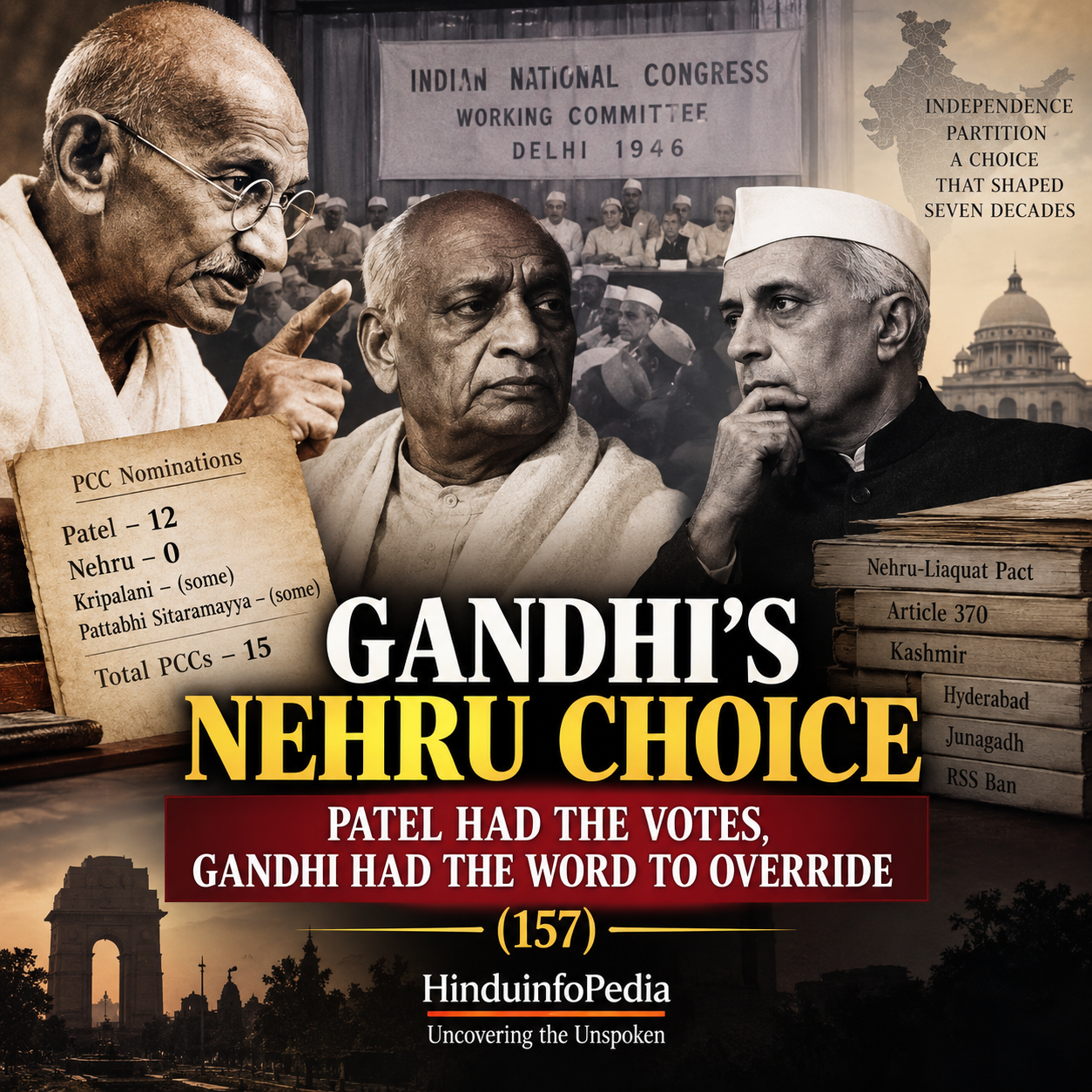
Gandhi’s Nehru Choice places the 1946 Congress succession before the reader. In the Congress presidential succession of 1946 — the process that would determine who led Congress into independence negotiations — nominations closed on April 29 1946 with 12 of 15 Provincial Congress Committees backing Patel, with some support for Kripalani and Pattabhi Sitaramayya. Not a single PCC had proposed Nehru’s name. Patel had the mandate of the organisation’s own constituencies. At Gandhi’s indication, Kripalani formally proposed Nehru’s name from the CWC in Delhi. He then handed Patel a withdrawal slip. Patel signed it once Gandhi made his preference clear. Nehru officially assumed the Congress presidency in July 1946. This is not a contested historical claim. It is established in Maulana Azad’s India Wins Freedom, in the PCC nomination records, and in the accounts of Congress leaders present. Established in Blog 25 and Blog 91 of this series.
The Documented Stakes
Gandhi’s Nehru Choice places the stakes of that choice before the reader. Patel’s strengths at the moment of the 1946 succession: organisational command of the Congress machinery, a pragmatic framework for dealing with the communal landscape of 1946-47, and a relationship with Hindu nationalist organisations that Nehru did not share. His administrative capabilities — later demonstrated in Junagadh (late 1947) and Hyderabad (1948) — were not yet on the record at the time of the succession, but his organisational authority within Congress was well established. Nehru’s position: Gandhi’s chosen heir, a socialist framework, and a relationship with Jinnah that had fractured beyond repair — established in Blog 87 of this series. The succession was determined in April-May 1946 — three months before Direct Action Day, fifteen months before Partition. Nehru became Congress president and Prime Minister. The communal violence that produced the Great Calcutta Killings, Noakhali, and Partition was already building.
What the Documented Choice Installed
Gandhi’s Nehru Choice places what the choice installed before the reader. Nehru as Prime Minister brought a governing framework whose consequences are part of the historical record: the Nehru-Liaquat Pact, Article 370, the Kashmir question, and the post-Gandhi assassination ban on the RSS. Patel’s position on key questions diverged from Nehru’s at critical junctures: Patel favoured a harder stance on Pakistan during the Kashmir war, and managed Hyderabad and Junagadh with decisive action where Nehru’s approach differed. The question the prosecution places before the reader is not whether Patel would have been a better Prime Minister — that is a counterfactual the series cannot carry. The question is narrower: Gandhi overrode 12 of 15 PCC nominations through personal intervention. The authority that overrode the Congress organisation’s own nomination process is the same unchallengeable authority the series has placed before the reader in Blogs 21–22.
The Documented Unelected Succession
Gandhi’s Nehru Choice places one observation before the reader. Gandhi was not the elected leader of Congress in 1946. He held no constitutional authority over Congress presidential succession. He was the moral sovereign — the authority whose preference shaped institutional outcomes because no institutional mechanism could challenge it — established in Blog 22 of this series. The sequence the documented record places before the reader: nominations arrived with 12 of 15 PCCs backing Patel and zero proposing Nehru. Gandhi’s preference for Nehru was known. Additional proposers were found for Nehru from the CWC. Kripalani handed Patel a withdrawal slip. Patel signed it. The documented sequence is placed before the reader without characterisation. The reader will examine what it established about the relationship between Gandhi’s preference and Congress outcomes.
The Collapsed Distinction
Gandhi’s Nehru Choice places one further observation before the reader. The documented constitutional framework of 1946-47 did not require a separate democratic election for Prime Minister. Whoever led Congress led the government. Gandhi’s preference determined Congress president. The Congress president became Prime Minister.
One act collapsed the distinction between party presidency and interim national leadership. There was no general election for Prime Minister at independence — India’s first general election came in 1951-52. The Constituent Assembly, functioning as the provisional Parliament from August 15 1947, did subsequently work with Nehru as Prime Minister — with Patel, Ambedkar, and Syama Prasad Mookerjee in the Cabinet alongside him. But who entered that provisional framework as Prime Minister was determined not by a democratic mandate from the Indian people but by Gandhi’s preference in April-May 1946 — fifteen months before independence.
If Patel had become Congress president, who would have become Prime Minister is a question the documented record cannot answer. It could have been Patel, or Nehru through a separate process, or Kripalani, or someone else entirely. The prosecution does not carry that counterfactual. It carries only what the documented record shows: one preference, one act, one outcome — and no separate democratic process standing between them.
The Documented Dynasty
Gandhi’s Nehru Choice places the downstream record before the reader — not as assertion of causation but as the record of what followed the choice. 1947-1964: Jawaharlal Nehru, Prime Minister. 1966-1977, 1980-1984: Indira Gandhi, Prime Minister — Nehru’s daughter. 1984-1989: Rajiv Gandhi, Prime Minister — Nehru’s grandson. 2004-2014: Sonia Gandhi, Congress President — Nehru’s granddaughter-in-law. 2017-present: Rahul Gandhi, Congress leader — Nehru’s great-grandson. The chronology that followed the 1946 succession is placed before the reader. The prosecution places this documented record before the reader alongside Gandhi’s documented personal intervention overriding 12 of 15 documented PCC nominations — and asks the reader to examine what the documented chain from one documented personal fiat to seven documented decades of one documented family’s documented political dominance established.
The Prosecution’s Position
Gandhi’s Nehru Choice places three questions before the reader.
- Does Gandhi’s personal intervention overriding 12 of 15 PCC nominations — the Congress organisation’s own nomination process — constitute an exhibit the reader places alongside Gandhi’s claim that Congress represented the democratic will of India?
- Does the unelected moral sovereign’s final act — installing an unelected successor by personal fiat over the Congress organisation’s own nomination — constitute an exhibit the reader places alongside the Authority Arc established in Blogs 21–22 of this series?
- Does the chronology — the 1946 succession followed by the Nehru family’s presence across seven decades of independent India’s political life — constitute an exhibit the reader places alongside Gandhi’s role as Father of the Nation?
The series does not answer. Gandhi’s Nehru Choice places the documented democratic verdict, the documented personal intervention, the documented installation, and the documented downstream chain before the reader. The reader will examine what the documented choice established — and complete the sentence.
Invitation To Defence
The floor belongs to the defense. We now invite them to present their exhibits and challenge the narrative established by the prosecution.
April-May 1946: 12 of 15 PCCs backed Patel. Zero proposed Nehru. Gandhi’s preference was known. Proposers were found. Patel signed a withdrawal slip. Nehru assumed the Congress presidency July 1946, then became Prime Minister. The documented chronology that followed: 1966 Indira Gandhi, 1984 Rajiv Gandhi, 2004 Sonia Gandhi, 2017 Rahul Gandhi. The prosecution places the sequence before the reader. The reader will complete the sentence.
Feature Image: Click here to view the image.
Videos
Glossary of Terms
- Gandhi’s Nehru Choice: The term used in this blog for Gandhi’s documented intervention in the 1946 Congress succession that resulted in Jawaharlal Nehru becoming Congress president despite Patel receiving the support of 12 of 15 Provincial Congress Committees.
- Provincial Congress Committees (PCCs): Regional Congress organizational bodies whose nominations formed the documented basis of the 1946 Congress presidential succession process.
- Congress Working Committee (CWC): The central working body of the Indian National Congress involved in the 1946 succession process and from which Nehru’s name was formally proposed.
- Congress President: The organizational head of the Indian National Congress. In the 1946 context described in the blog, the Congress president became the leader who subsequently headed the government.
- Democratic Verdict: The blog’s term for the documented nomination outcome in which 12 of 15 PCCs supported Vallabhbhai Patel and no PCC proposed Jawaharlal Nehru.
- Unilateral Authority: The authority exercised by Gandhi through personal intervention rather than through a formal constitutional or electoral mandate.
- Moral Sovereign: A term used in the series for Gandhi’s exceptional moral authority, which the blog argues could shape institutional outcomes despite his lack of formal constitutional authority.
- Unelected Succession: The blog’s description of the 1946 transition in which Gandhi’s preference influenced the Congress succession without Gandhi himself being an elected Congress leader.
- Direct Action Day: The political action called by the Muslim League for August 1946, followed by major communal violence, including the Great Calcutta Killings.
- Interim National Leadership: The provisional national governing arrangement that operated before India’s first general election and in which Nehru served as Prime Minister after independence.
- Constituent Assembly: The body that framed India’s Constitution and also functioned as the provisional Parliament after August 15, 1947.
- Counterfactual: A hypothetical historical question about what might have happened under a different decision, such as what would have happened if Patel had become Congress president.
- Documented Political Dynasty: The term used in the blog for the subsequent political presence of the Nehru-Gandhi family across several decades of independent India’s political life.
- Proof of Concept: The phrase used in the series to describe the Nehru choice as an illustration of how an unelected authority could override an organizational decision.
- Prosecution’s Position: The series’ presentation of documented facts, chronology, and questions for examination without claiming to resolve the counterfactual questions raised by the record.
#Gandhi #Nehru #Patel #Congress #India #History #Politics #Independence #Partition #HinduinfoPedia
Scan Through The Entire Series at
Gandhi’s Peace Efforts: The Questions Before the Mahatma (0)