
Gandhi’s Radcliffe Boundary Partition: The Date That Was Not Postponed (170)
भारत / GB
Part 170: Mahatma Gandhi’s Peace Efforts | Series Index
Blog 169 placed before the reader the Governor-General’s Other Appointment — the one hundred and fifty-two days from August 15, 1947 to January 16, 1948, in which India’s constitutional head was a serving British officer, a coup in Gilgit was followed by a British decoration, the Khan of Kalat’s offer of accession to India was refused, and the Kashmir question was referred to the United Nations against Sardar Patel’s documented advice. This post places before the reader the compression that made each of those outcomes possible: the Gandhi’s Radcliffe Boundary Partition — the acceleration of India’s independence from the British Cabinet’s announced deadline of June 1948 to August 15, 1947, who proposed it, who accepted it, and what the nearly ten months of administrative preparation surrendered.
Thank you for reading this post, don't forget to subscribe!THE HISTORICAL RECORD — THE DATE THAT WAS NOT POSTPONED
The Pattern: On February 20, 1947, Prime Minister Clement Attlee announced to the House of Commons that British power in India would be transferred no later than June 1948 — providing nearly ten months of additional preparation time beyond what the acceleration allowed. On June 3, 1947, Lord Mountbatten announced the acceleration: independence would take place on August 15, 1947, less than eleven weeks away. The British Cabinet had offered June 1948. The acceleration surrendered what remained of it. The Gandhi’s Radcliffe Boundary Partition is the compression: the deliberate narrowing of the window in which boundaries were drawn, administrative structures separated, armies divided, and populations warned. Four exhibits carry the prosecution’s case.
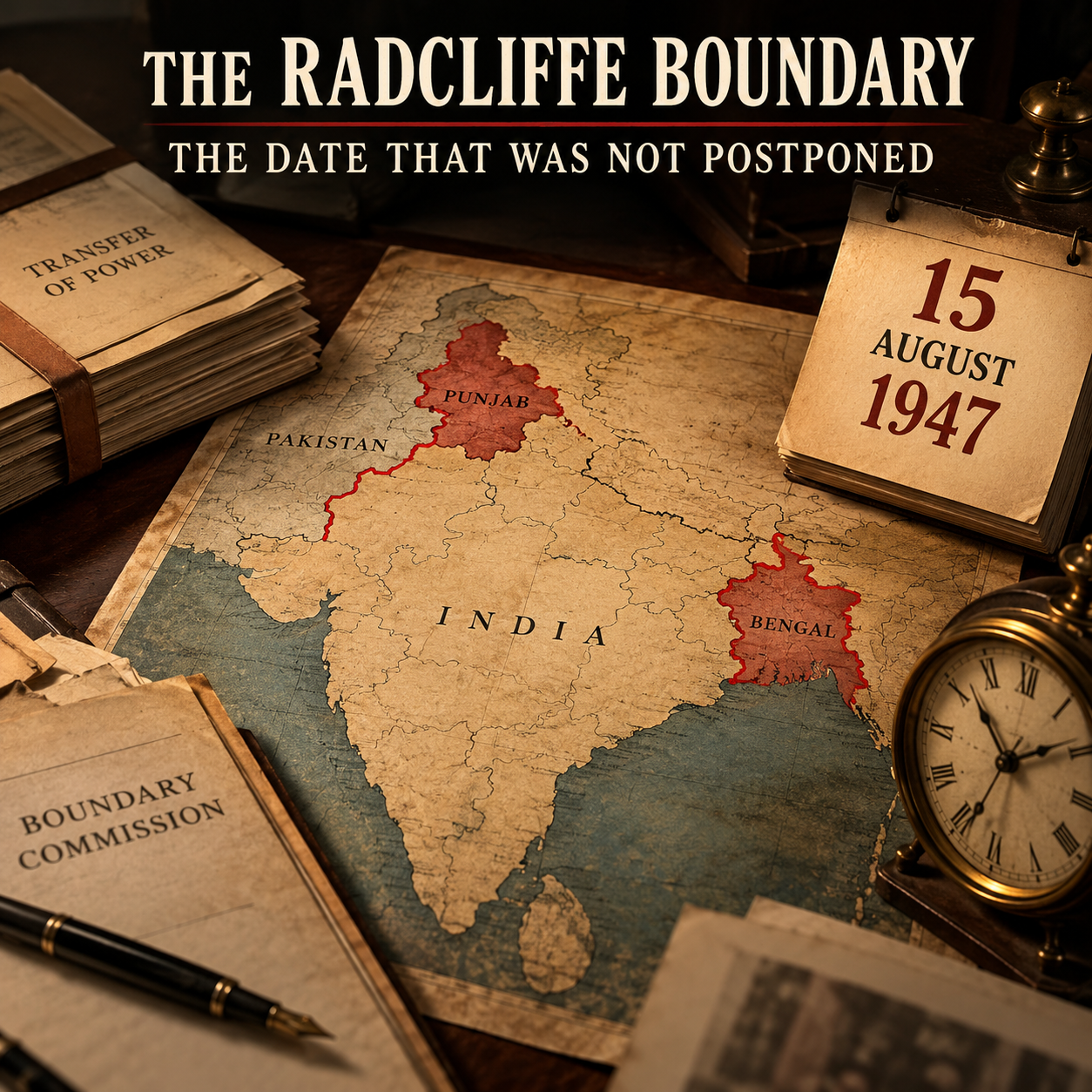
The Lethal Exhibit: Sir Cyril Radcliffe arrived in India on July 8, 1947. He submitted his boundary awards on August 12–13 — five weeks after his arrival. He had never visited India before. He drew the boundaries of Punjab and Bengal — 450,000 square kilometres, 88 million people, canal headworks, railway lines, village contiguities — from district census percentages alone, in a room in New Delhi. The Gandhi Gandhi’s Radcliffe Boundary Partition produced what follows: the Punjab of 1947.
Why it matters: The date that was not postponed is not an administrative footnote. It is the load-bearing structure of the Settlement That Never Closed. The Gilgit coup was possible because the British administrative apparatus remained in place while the new Indian state had no time to install its own. The NWFP referendum was lost because eleven weeks left no time for a campaign that could contest the League’s position. The Radcliffe line produced the displacement of twelve to fourteen million people and the deaths of up to one million because the man drawing it had five weeks. The Indian Independence Act was a British Parliamentary act because India had no constitutional framework of its own ready for August 15. Each of these outcomes traces to a single variable: the preparation time that was available and was not used.
The Deadline That Was Offered
On February 20, 1947, Prime Minister Clement Attlee rose in the House of Commons to announce the most consequential withdrawal in British imperial history. His statement was precise on the one figure that mattered most: British power in India would be transferred to Indian hands not later than June 1948.
The date was not arbitrary. It reflected the genuine administrative complexity of what transfer required — the separation of the Indian Civil Service, the division of the Indian Army, the demarcation of the new boundaries, the negotiation of the princely states, the construction of two functional governments where one imperial administration had stood. June 1948 was a floor, not a ceiling. The preparation the British Cabinet considered adequate for the task was fifteen months from the date of announcement — February 1947 to June 1948. The British government put that figure on record in the House of Commons. It is in Hansard.
August 15, 1947 is not June 1948. The prosecution places the distance between the two dates before the reader: the nearly ten months between them, formally offered by the British Cabinet and formally surrendered by the acceleration that followed.
The Plan That Came First
Mountbatten arrived in India as Viceroy on March 22, 1947. He had been given a mandate to implement transfer of power by June 1948. What he found — communal violence escalating, the Congress-League deadlock producing no constitutional settlement — persuaded him that the original plan, partition into one successor state, was unworkable, and that partition into two was unavoidable.
The acceleration was his proposal. In May 1947, Mountbatten presented the June 3 Plan to the Indian leaders: partition into two dominions, independence on August 15, 1947. The date he chose — August 15 — was the second anniversary of Japan’s formal surrender to him as Supreme Allied Commander, South-East Asia, in 1945. It was a date of personal significance to Lord Mountbatten. Its adoption as the independence date of the Indian subcontinent was not driven by administrative readiness.
Nehru and Patel accepted the June 3 Plan. The prosecution does not claim they had no reason to: three years of the Cabinet Mission’s negotiations had produced nothing, the violence of Direct Action Day in August 1946 had demonstrated the cost of continued deadlock, and the Congress leadership may have calculated that the certainty of a date was worth the loss of preparation time. Their acceptance is in the institutional record. So is what the acceptance surrendered.
Five Weeks, 450,000 Square Kilometres
The boundary between India and Pakistan in Punjab and Bengal was drawn by a five-man boundary commission. Its chairman was Sir Cyril Radcliffe — a distinguished London barrister who had never visited India before his appointment. He arrived in New Delhi on July 8, 1947. He submitted his boundary awards on August 12–13, 1947. He worked for five weeks.
The commission had no power to conduct ground surveys. It had no time to visit the territories it was dividing. Radcliffe worked from district-level census returns — Muslim-majority versus non-Muslim-majority districts — and drew lines between them.
The prosecution places the Radcliffe commission before the reader as a surgeon who did not know the body he was cutting. A competent surgeon requires anatomy — the location of arteries, the pathways of nerves, the interdependencies that make a living system function. Radcliffe had none of this. He did not know where the headworks of the Ferozepur canal system sat in relation to the fields they watered. He did not know which railway junctions controlled the lines on either side. He did not know which villages shared wells across the district boundaries his census tables showed him. He had a map and a percentage. He drew lines through tissue whose anatomy he had never been shown — and the haemorrhage that followed was not the failure of the scalpel. It was the consequence of operating without ever having studied the body.
The boundary awards were submitted on August 12–13. They were not published until August 17 — two days after independence. The populations of Punjab and Bengal did not know, at the moment of independence, which country they were in. The violence of the Punjab partition — twelve to fourteen million displaced, estimates of up to one million dead — was already underway before the line was published. The Gandhi’s Radcliffe Boundary Partition was not a failure of cartography. It was the direct administrative consequence of the compression. Ten months would not have made it perfect. But June 1948 was what the British Cabinet had offered — and five weeks was what Cyril Radcliffe was given.
The Referendum Without a Campaign
The North-West Frontier Province presented Mountbatten and the Congress leadership with a specific problem. It was a Muslim-majority province governed by a Congress ministry under Dr Khan Sahib, whose brother Khan Abdul Ghaffar Khan — the Frontier Gandhi — had built one of the independence movement’s most disciplined popular organisations among the Pashtun people.
The June 3 Plan required a referendum: India or Pakistan. The referendum was held July 6–17, 1947 — on a date set six weeks after the Plan was announced. Khan Abdul Ghaffar Khan and the Congress leadership called a boycott. Their position was that the binary denied the Pashtun people the option they had earned: independence, or a separate Pashtunistan. The boycott was a rejection of the question, not a concession of it.
On a turnout of fifty-one percent, the result was a majority for Pakistan. The Frontier Gandhi’s organisation — built over decades, loyal to Congress — was handed to the state it had not sought. The prosecution does not claim the result would have been different with more time. It places before the reader what more time would have required: a campaign sufficient to contest the League’s position, a turnout reflecting the province’s actual political engagement rather than a boycott’s arithmetic. Eleven weeks provided none of these.

The Prosecution’s Position
Gandhi’s Thirty Years places the compression before the reader with three questions.
- Does the documented record — Attlee’s announced June 1948 deadline, Mountbatten’s June 3 Plan advancing it by nearly ten months, and the administrative consequences that followed — constitute an exhibit the reader places alongside the claim that the acceleration served Indian interests?
- Does the Gandhi’s Radcliffe Boundary Partition — the line submitted five weeks after a barrister who had never visited India arrived in New Delhi, published two days after independence, drawn through canal networks and railway systems across 450,000 square kilometres — constitute an exhibit the reader places alongside the claim that the partition’s violence was unavoidable rather than a function of the time that was surrendered?
- Does the NWFP referendum — held on eleven weeks’ notice, on a binary that denied the province’s dominant political organisation its preferred option, producing a fifty-one percent turnout and a result the Frontier Gandhi’s movement rejected — constitute an exhibit the reader places alongside the claim that the province’s absorption into Pakistan reflected its democratic will?
The series does not answer. Gandhi’s Thirty Years places the Date That Was Not Postponed before the reader — June 1948, formally offered by the British Cabinet, and August 15, 1947, accepted in its place. The reader will place the Gandhi’s Radcliffe Boundary Partition, the NWFP referendum, and the Settlement That Never Closed against that distance — and complete the sentence.
Invitation To Defence
The floor belongs to the defense. We now invite them to present their exhibits and challenge the narrative established by the prosecution.
The British Cabinet offered June 1948. Mountbatten proposed August 15, 1947. Nehru and Patel accepted. Cyril Radcliffe drew the line between two nations in five weeks from a room in New Delhi, from census tables, having never seen the ground. The boundary awards were published two days after independence. The NWFP referendum was held on eleven weeks’ notice, on a question the province’s dominant movement refused to accept. The date was not postponed. The prosecution places the distance between June 1948 and August 15, 1947 before the reader — and the record of what it was not used for. The reader will complete the sentence.
Feature Image: Click here to view the image.
Videos
Glossary of Terms
- Radcliffe Boundary Partition: The division of Punjab and Bengal between India and Pakistan in 1947, undertaken by a boundary commission chaired by Sir Cyril Radcliffe.
- Clement Attlee: British Prime Minister who announced on February 20, 1947, that British power in India would be transferred no later than June 1948.
- Lord Mountbatten: The last Viceroy of British India, who proposed advancing the independence date to August 15, 1947.
- June 3 Plan: The plan announced by Mountbatten in 1947 for partitioning British India into two dominions and transferring power on August 15.
- Sir Cyril Radcliffe: The British barrister appointed to chair the boundary commissions responsible for determining the borders between India and Pakistan in Punjab and Bengal.
- Boundary Awards: The official boundary decisions submitted by Radcliffe on August 12–13, 1947, and published on August 17, two days after independence.
- Indian Civil Service (ICS): The administrative service of British India that required division and reorganisation during the transfer of power.
- Princely States: Territories ruled by hereditary Indian princes under British paramountcy, whose political future had to be addressed during independence.
- North-West Frontier Province (NWFP): A Muslim-majority province in British India where a July 1947 referendum offered voters a choice between India and Pakistan.
- Khan Abdul Ghaffar Khan: A Pashtun independence leader known as the Frontier Gandhi, who opposed the NWFP referendum because it excluded independence and a separate Pashtunistan.
- Pashtunistan: The proposed independent or separate political homeland for the Pashtun people, which was not offered as an option in the NWFP referendum.
- Partition Displacement: The mass movement of people across the newly established India–Pakistan border in 1947, involving an estimated twelve to fourteen million displaced people.
- Administrative Compression: A phrase used in this series to describe the drastic reduction in the time available to prepare boundaries, divide institutions, and establish functioning governments before independence.
- The Date That Was Not Postponed: A phrase coined for this article to emphasise that the original June 1948 deadline was replaced by the earlier date of August 15, 1947.
- The Settlement That Never Closed: A recurring analytical phrase in the series referring to the unresolved institutional and political consequences of the transfer of power and Partition.
#India #Gandhi #Partition #RadcliffeLine #Mountbatten #IndianHistory #Independence #Pakistan #HinduinfoPedia
Scan Through The Entire Series at
Gandhi’s Peace Efforts: The Questions Before the Mahatma (0)