
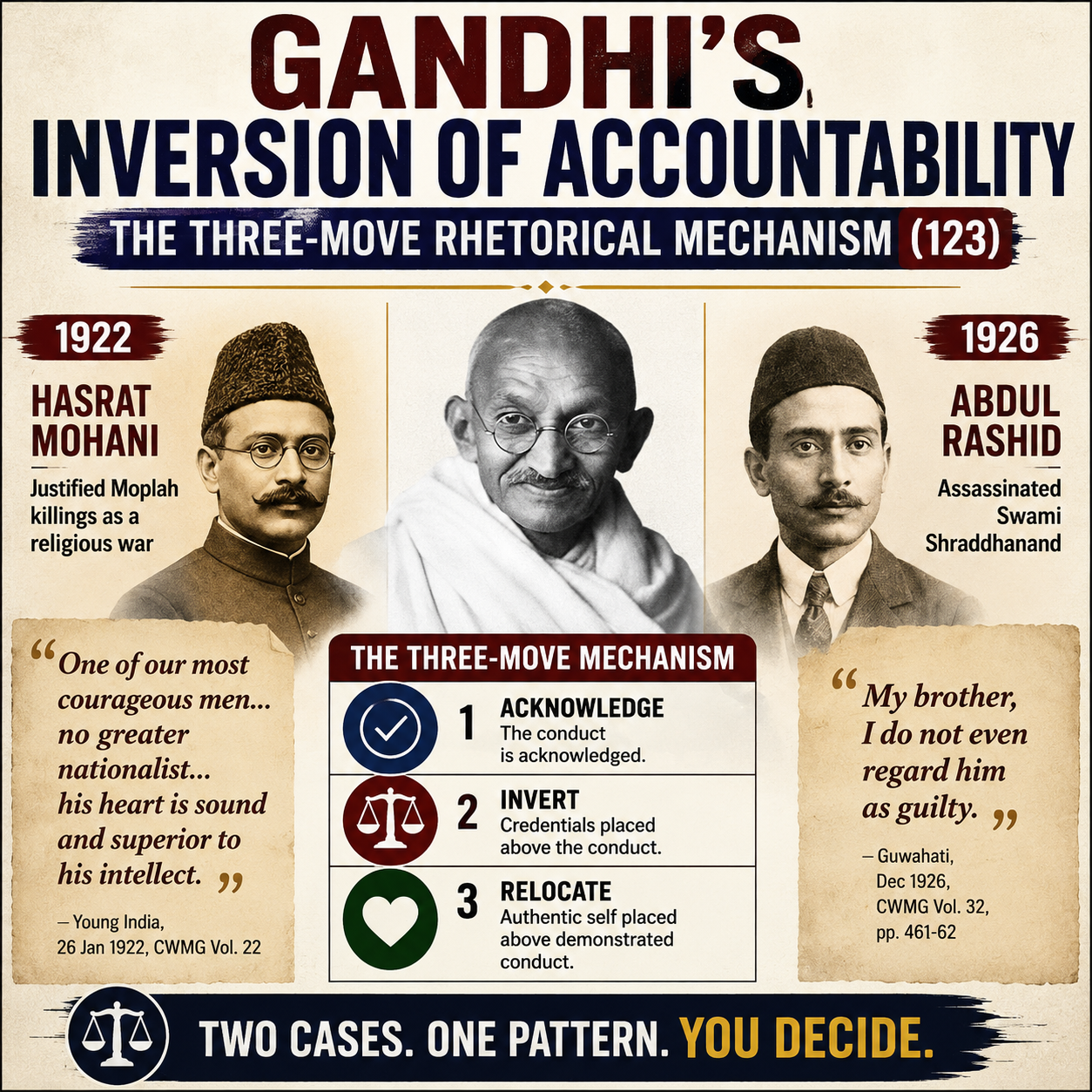
Gandhi’s Inversion of Accountability: Playing With Words — The Three-Move Rhetorical Mechanism (123)
भारत / GB
Part 123: Mahatma Gandhi’s Peace Efforts | Series Index
Blogs 107-109 (117, 118, 119) placed the cause inversion before the reader — Khilafat above Swaraj, established from Gandhi’s own words and Ambedkar’s primary source verdict. This post places Gandhi’s Inversion of Accountability before the reader: not institutional but personal, not about the priority of causes but about the hierarchy of accountability. The exhibit is a single documented passage from Young India, January 26 1922, CWMG Vol. 22.
Thank you for reading this post, don't forget to subscribe!The Action Taken: When appointed to prepare an inquiry report on Kohat alongside senior colleagues, Gandhi refused to sign a joint assessment that attributed primary responsibility to local Muslim mobs, issuing a separate statement.
Who Paid the Price: Institutional unity and transparent reporting within Congress, as the leadership failed to issue a unanimous finding on the frontier massacres.
The Alternative Bypassed: Endorsing the factual findings compiled by his senior political peers regarding organized incitement in Kohat.
Why This Matters: Documents the internal divergence: senior colleagues directly recorded the organized aggression, while Gandhi issued a dissenting evaluation that mitigated the aggressors’ responsibility.
The Primary Source — January 26 1922
Young India, January 26 1922, CWMG Vol. 22. Gandhi’s own words on Maulana Hasrat Mohani:
“Maulana Hasrat Mohani is one of our most courageous men… In spite of his amazingly crude views about religion, there is no greater nationalist nor a greater lover of Hindu-Muslim unity than the Maulana. His heart is sound and superior to his intellect.”
Gandhi’s Inversion of Accountability places the question of what Mohani had done before the reader first — so that Gandhi’s documented response can be assessed against the documented conduct it was responding to.
What Mohani Had Done
Hasrat Mohani had publicly justified the Moplah killings and forced conversions of 1921 as a legitimate religious war. The Moplah rebellion — established in this series across Blogs 54-68 (Group 7, Moplah Unrest, Moplah Conclusions) and returned to in Blogs 117-119 (117, 118, 119)— produced documented killings, forced conversions, and temple desecrations across Malabar. Mohani’s documented public position: these were the acts of men fighting for their religion, and as such were defensible.
Gandhi wrote the passage above in January 1922 — five months after the Moplah rebellion had commenced, while its consequences were still unfolding across Malabar.
The Three-Move Mechanism
Gandhi’s Inversion of Accountability places the documented structure of Gandhi’s response before the reader. The passage operates in three documented moves:
Move 1 — Acknowledge: “In spite of his amazingly crude views about religion.” Gandhi does not deny Mohani’s position. He places it on record — crude views, acknowledged. This is not evasion. It is the rhetorical ground-clearing that makes the inversion possible.
Move 2 — Invert the hierarchy: “there is no greater nationalist nor a greater lover of Hindu-Muslim unity than the Maulana.” The nationalist credential and the unity credential are placed above the crude views. The hierarchy is now: credentials above conduct. The man’s political value to Gandhi’s project is placed in a superior position to his documented position on the Moplah killings.
Move 3 — Relocate the true self above the demonstrated conduct: “His heart is sound and superior to his intellect.” The heart — Gandhi’s category for the authentic self, the moral core — is placed above the intellect. The intellect produced the crude views and the public justification of violence. The heart is sound. The authentic Mohani is the one with the sound heart. The Mohani who justified the Moplah killings is the one whose inferior intellect spoke — not the authentic Mohani whose superior heart Gandhi vouches for.
The prosecution places the documented three-move mechanism before the reader precisely: acknowledge the conduct, invert the hierarchy so that credentials rank above conduct, relocate the authentic self above the demonstrated conduct. The result: Mohani’s public justification of documented violence against Hindus is acknowledged, absorbed, and placed below his nationalist credentials and his sound heart — all in four documented sentences.
What This Is Distinct From
Gandhi’s Inversion of Accountability places one observation before the reader about what this blog carries that the existing series does not.
The cause inversion blogs (117, 118, 119) carry the institutional priority inversion — Gandhi placed Khilafat above Swaraj at the level of Congress policy and documented stated priority. That is an institutional exhibit.
This blog carries a personal moral inversion — Gandhi placed Mohani’s credentials and heart above Mohani’s documented conduct at the level of individual characterisation. The mechanism is different: not priority of causes but hierarchy of accountability.
The Shraddhanand murder exhibit (Blog 118) carries the same three-move mechanism applied to a different actor: Abdul Rashid called “my brother, I do not even regard him as guilty” (CWMG Vol. 32, pp. 461-62). The guilt was relocated onto those who had created the atmosphere of hatred. The authentic Abdul Rashid — the brother — was placed above the Abdul Rashid whose intellect had been possessed by a hot fever. The pattern is the same. The actors differ.
The Documented Pattern Placed Before the Reader
Gandhi’s Inversion of Accountability places the two documented instances of the three-move mechanism before the reader in sequence.
Mohani — publicly justified Moplah killings as a religious war. Gandhi’s three-move response: crude views acknowledged, nationalist credentials placed above them, heart placed above intellect. Mohani: “most courageous man,” “no greater nationalist,” “heart is sound.”
Abdul Rashid — shot Swami Shraddhanand dead in his sickbed, December 23 1926. Gandhi’s three-move response: the guilt acknowledged as existing in the atmosphere, the fraternal credential placed above the act, the authentic self (the brother) placed above the demonstrated conduct. Abdul Rashid: “my brother, I do not even regard him as guilty.”
The prosecution places both documented instances before the reader alongside one question: is the three-move mechanism — acknowledge, invert, relocate — a documented rhetorical pattern Gandhi applied consistently to Muslim actors whose demonstrated conduct involved harm to Hindus?
The Prosecution’s Position
Gandhi’s Inversion of Accountability places three questions before the reader.
- Did Gandhi’s January 26 1922 Young India passage (CWMG Vol. 22) — written five months into the Moplah rebellion while Mohani’s public justification of the killings was on the record — operate through a three-move mechanism: acknowledge crude views, place nationalist credentials above them, place the heart above the intellect?
- Does the same three-move mechanism appear in Gandhi’s documented December 1926 Guwahati response to the Shraddhanand murder — acknowledge the act (relocated into atmospheric guilt), place fraternal credential above it, locate the authentic self (the brother) above the demonstrated conduct?
- Does the documented pattern of this mechanism — applied to Mohani in 1922 and to Abdul Rashid in 1926, both in the context of documented harm to Hindus — constitute a rhetorical framework that the prosecution places before the reader as distinct from the cause inversion established in Blogs 107-109 (117, 118, 119)?
The series does not answer. Gandhi’s Inversion of Accountability places the documented primary source, the three-move mechanism, and its two documented instances before the reader. The reader will examine whether this constitutes a pattern — and complete the sentence.
Invitation To Defence
The floor belongs to the defense. We now invite them to present their exhibits and challenge the narrative established by the prosecution.
January 26 1922, Young India, CWMG Vol. 22. Hasrat Mohani — who publicly justified the Moplah killings as a religious war — “one of our most courageous men… no greater nationalist… his heart is sound and superior to his intellect.” December 1926, Guwahati: Abdul Rashid — who shot Swami Shraddhanand dead in his sickbed — “my brother, I do not even regard him as guilty.” Acknowledge. Invert. Relocate. The prosecution places the three-move mechanism and its two documented instances before the reader. The reader will complete the sentence.
Feature Image: Click here to view the image.
Videos
Glossary of Terms
- Gandhi’s Inversion of Accountability: A key phrase coined in this series describing a documented rhetorical mechanism in which acknowledged conduct is subordinated to moral character or political credentials.
- Three-Move Mechanism: The analytical framework identified in this blog consisting of three steps—acknowledging the conduct, inverting the hierarchy of evaluation, and relocating the authentic self above the demonstrated conduct.
- Hasrat Mohani: Indian nationalist, poet, and Khilafat leader whose public defence of the 1921 Moplah violence is examined alongside Gandhi’s documented response.
- Young India: Weekly journal edited by Mahatma Gandhi in which many of his political writings and public statements were originally published.
- CWMG (Collected Works of Mahatma Gandhi): The official multi-volume compilation of Gandhi’s writings, speeches, correspondence, and published articles used as the primary documentary source.
- Moplah Rebellion: The 1921 uprising in the Malabar region involving documented killings, forced conversions, and widespread violence that forms a central historical context in this series.
- Abdul Rashid: The assassin who shot Swami Shraddhanand on 23 December 1926, discussed as the second documented instance in the three-move mechanism.
- Swami Shraddhanand: Arya Samaj leader and social reformer assassinated in December 1926, whose murder is examined through Gandhi’s documented response.
- Documented Conduct: The recorded actions of an individual established through historical evidence and primary sources rather than later interpretation.
- Authentic Self: The moral identity that Gandhi’s statements place above an individual’s documented conduct, as analysed in this blog.
- Cause Inversion: A key phrase developed earlier in this series describing the documented prioritisation of the Khilafat cause above Swaraj in Gandhi’s stated political approach.
- Hierarchy of Accountability: The order in which conduct, character, political credentials, and moral responsibility are evaluated, forming the central analytical theme of this blog.
- Nationalist Credentials: A person’s recognised contribution to the nationalist movement, presented in this blog as being placed above documented conduct.
- Rhetorical Pattern: A recurring documented structure of expression identified across multiple Gandhi statements rather than a single isolated quotation.
#Gandhi #MahatmaGandhi #History #India #Khilafat #Moplah #Shraddhanand #Congress #Politics #HinduinfoPedia
Gandhi’s Peace Efforts: The Questions Before the Mahatma (0)
Refer to Various Arks Referred to in the Blog
HinduinfoPedia, Gandhi, Mahatma Gandhi, Hasrat Mohani, Abdul Rashid, Swami Shraddhanand, Moplah Rebellion, Khilafat Movement, Young India, CWMG, Inversion of Accountability, Three-Move Mechanism, Cause Inversion, Hierarchy of Accountability, Nationalist Credentials, Primary Sources, Malabar, Historical Analysis, accountability, Gandhi, Mohani, Rashid, documented, mechanism
HinduinfoPedia, गांधी, महात्मा गांधी, हसरत मोहानी, अब्दुल रशीद, स्वामी श्रद्धानन्द, मोपला विद्रोह, खिलाफत आंदोलन, यंग इंडिया, सीडब्ल्यूएमजी, उत्तरदायित्व उलटाव, तीन-चरणीय तंत्र, कारणों का उलटाव, प्राथमिक स्रोत, मालाबार, ऐतिहासिक विश्लेषण, हृदय, बुद्धि, राष्ट्रवादी, आचरण, प्रलेखित, व्यक्ति