
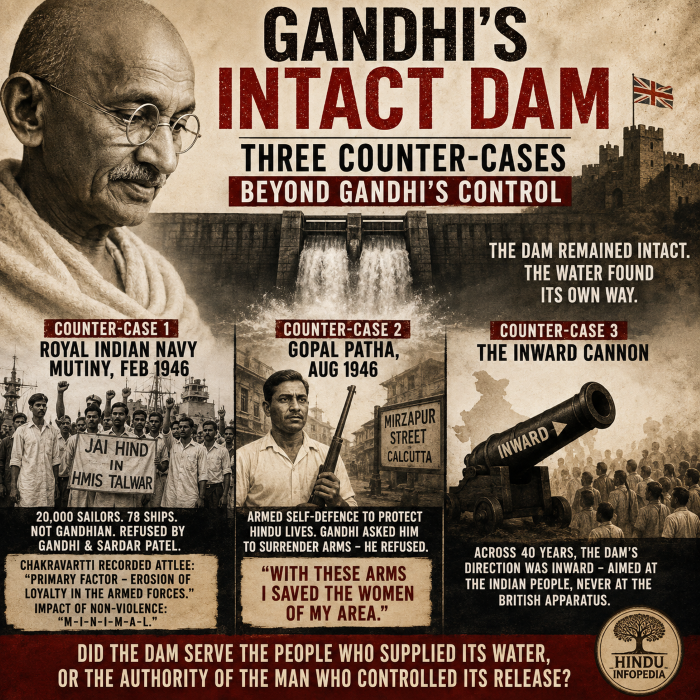
Gandhi’s Intact Dam: Three Counter-Cases Beyond Gandhi’s Control (146)
भारत / GB
Part 146: Mahatma Gandhi’s Peace Efforts | Series Index
Blogs 136-145 ( The 1922 Suspension Analysis, The Settlement Arithmetic) placed the DAM ARC before the reader — the South Africa lesson, the three acts of assembled reservoirs, the empty chair, the structural trap, the sharpening stone, the class ceiling, the Champaran arithmetic, the switch, and the consistent arithmetic across forty years. This post, “Gandhi’s Intact Dam,” places the closing DAM ARC exhibit before the reader: three documented instances where the dam was refused — where the water found its own way — and what those three instances established about whose interests the dam had always served.
Thank you for reading this post, don't forget to subscribe!The Action Taken: The colonial government permitted Gandhi to transform his prison yard into an active political headquarters, holding press conferences and negotiating the Poona Pact with national leaders.
Who Paid the Price: Standard prison regulations and statutory legal procedures, which were suspended to facilitate the coercive settlement against Ambedkar.
The Alternative Bypassed: Conducting national constitutional negotiations through open, representative public committees outside prison walls.
Why This Matters: Exceptional administrative accommodation: the Raj granted extraordinary communication privileges inside prison to facilitate a settlement that neutralized separate electorates for Dalits.
The Dam’s Documented Purpose
Gandhi’s Intact Dam places one documented observation before the reader at the outset. Gandhi’s documented dam — the unchallengeable unilateral authority to start and stop the movement — worked by controlling the water he had organised to fill the dam, releasing it in managed quantities, ensuring the British forts remained intact. The three documented instances placed before the reader in this blog are instances where the water operated outside the dam’s documented control. The three documented instances placed before the reader in this blog are instances where Gandhi’s documented authority was applied to water he had not organised — and where the dam was refused.
Counter-Case 1 — The Royal Indian Navy Mutiny, February 1946
Gandhi’s Intact Dam places the Royal Indian Navy Mutiny before the reader as the first documented counter-case.
February 18-23 1946: Ratings across dozens of ships and shore establishments — from Bombay to Karachi and Calcutta — mutinied. Estimates of participants run to approximately 20,000 naval ratings, spreading from HMIS Talwar on February 18 1946 across ships and shore bases over several days. They were not Gandhian. They had not been organised by Congress. They had not been mobilised through satyagraha. They acted on documented grievances: racial discrimination, inadequate food, differential pay between British and Indian naval ratings.
The documented response of Gandhi and Nehru: both moved to contain the mutiny rather than support it. Gandhi’s documented response — dated Poona, February 26 1946, printed in Harijan, March 3 1946 — placed his position on record: “A combination between Hindus and Muslims and others for the purpose of violent action is unholy and will lead to and probably is a preparation for mutual violence.” Sardar Patel negotiated the documented surrender. Nehru also urged the ratings to stand down.
The documented outcome: the mutiny was contained within five days. But the documented British response to the mutiny — and to the documented loyalty crisis it revealed in the Indian armed forces — is recorded by Chakravartti from his 1956 conversation with Attlee.
When Acting Governor of West Bengal and Chief Justice P.B. Chakravartti discussed Britain’s departure with Clement Attlee during Attlee’s post-retirement visit to Calcutta in 1956, Chakravartti later recorded Attlee as stating: the primary factor was the erosion of loyalty in the Indian armed forces — specifically the INA trials and the Royal Indian Navy mutiny. When pressed on the impact of Gandhi’s non-violent movement, Chakravartti recorded Attlee as spelling out his assessment: its impact was “m-i-n-i-m-a-l.” Gandhi’s movement was, in the assessment Chakravartti recorded, a secondary factor.
Gandhi’s Intact Dam places the documented sequence before the reader: 20,000 sailors, 78 ships, not Gandhian, refused by Gandhi and Sardar Patel — operated outside the dam’s documented framework. The transfer of power followed eighteen months later. The sequence is documented.
Counter-Case 2 — Gopal Patha, August 1946
Gandhi’s Intact Dam places Gopal Patha before the reader as the second documented counter-case.
August 16-19 1946: the Great Calcutta Killings — to be examined in detail later in this series. Gandhi was at Sevagram when the killings began. He arrived in Calcutta after the documented death toll had accumulated.
In Mirzapur Street, Calcutta: Gopal Chandra Mukherjee — documented as Gopal Patha — organised documented armed Hindu self-defence in his area. His documented methods were not Gandhian. He used documented armed resistance to protect the documented Hindu population of his neighbourhood. Gopal Patha documented his claim: the women of Mirzapur Street were protected. The prosecution carries this as his documented claim and as local memory — not as a controlled comparison with the city’s documented death toll, which remained catastrophic across Calcutta.
Gandhi toured Bengal in 1947. He visited Gopal Patha. Gandhi’s documented request: surrender the arms. Gopal’s documented response: he refused twice. The third meeting — Gopal Patha’s documented words, placed on the record: *”With these arms I saved the women of my area.”*
The dam was not applied. The water found its own channel.
Gandhi’s Intact Dam places the documented exchange before the reader: Gandhi’s documented request to surrender arms — the same documented framework the series has established across forty years, the same documented inward application of the dam — refused by a man who had documented evidence that the arms had saved documented lives.
Gandhi’s documented request in 1947 was to surrender the arms — the same documented discipline the series has placed before the reader across forty years, now applied to an individual who had used arms for documented self-defence. Here the dam encountered documented refusal — and a documented reason: the arms had worked in Mirzapur Street.
Counter-Case 3 — The Inward Cannon
Gandhi’s Intact Dam places the third documented counter-case before the reader — not a single documented incident but a documented structural observation about the direction in which Gandhi’s dam was consistently aimed.
Blogs 136-145 of this series ( The 1922 Suspension Analysis, The Settlement Arithmetic) have established the documented pattern across six documented instances: South Africa, Champaran, Rowlatt, Non-Cooperation, Civil Disobedience, Consistent Arithmetic. In each documented instance, the dam was applied to the documented mass movement — to the documented pressure the Indian population had assembled against the British colonial apparatus.
After independence — documented August 15 1947 — the partition violence of 1947-48 produced documented mass communal killing across Punjab and Bengal. Gandhi’s documented response: fasts, prayer meetings, appeals for non-violence. The dam’s documented direction: inward — applied to documented Hindu retaliation against documented communal violence, not outward — never applied to the documented British apparatus that had left without resolving the documented communal question.
The prosecution places one documented observation before the reader: across forty years of documented mass movements, Gandhi’s documented dam was consistently aimed at the documented water — the Indian population, the documented participants, the documented mass — rather than at the documented British forts the water had been assembled to reach.
The documented direction of the controlled release — toward the Indian population rather than the British forts — is placed before the reader as a documented pattern across the series. The dam remained intact. The authority was preserved.
What the Three Counter-Cases Establish
Gandhi’s Intact Dam places the three documented counter-cases before the reader as a single consolidated exhibit.
Counter-Case 1 — the Royal Indian Navy Mutiny: water Gandhi had not organised reached the British forts through documented armed resistance. The assessment Chakravartti recorded from Attlee treated the loyalty crisis in the armed forces as the primary factor alongside which mass non-violence was recorded as secondary. Gandhi’s documented authority refused the mutiny. Chakravartti recorded Attlee as ranking the loyalty crisis the mutiny revealed as the primary factor in the transfer of power — with forty years of satyagraha ranked as secondary.
Counter-Case 2 — Gopal Patha: water Gandhi’s documented authority tried to remove from a documented individual’s hands — through three documented requests to surrender arms — was refused by documented individual agency on the basis of documented evidence that the arms had saved documented lives. The dam was refused by one man who had documented proof it should be refused.
Counter-Case 3 — the inward cannon: the documented direction of the dam across forty years — consistently aimed at the documented Indian population, never at the documented British apparatus — placed before the reader as the series’ documented structural observation.
The Prosecution’s Closing Statement on the DAM ARC
The prosecution’s documented closing statement on the ten-blog DAM ARC is placed before the reader.
The DAM ARC has placed before the reader: the South Africa lesson that the British respond to structural threat not moral appeal. Three documented acts of assembled reservoirs — Champaran, Non-Cooperation, Civil Disobedience. The empty chair in London. The structural trap of the Irwin Pact. The sharpening stone of four documented suspensions across forty years. The class ceiling of elite nationalist leadership reasserting control over autonomous mass participation. The Champaran arithmetic of who the settlements protected and who they left behind. The switch — Gandhi’s demonstrated operational control of the movement. And the consistent arithmetic of forty years — three outputs, four instances, one pattern.
The three counter-cases place one documented closing question before the reader: did the dam serve the documented water — the Indian population, the documented participants, the documented mass — or did the dam serve the documented authority of the man who held it?
The series does not answer. The three documented counter-cases, and the documented direction of the dam’s controlled release, are placed before the reader. The reader will examine what forty years of assembled reservoirs and refused forts established — and complete the sentence.
Invitation To Defence
The floor belongs to the defense. We now invite them to present their exhibits and challenge the narrative established by the prosecution.
February 1946: 78 ships, 20,000 sailors, not Gandhian, refused by Gandhi — coincided with the documented transfer of power eighteen months later — a sequence Chakravartti recorded Attlee as assessing in terms of military loyalty rather than mass non-violence. Chakravartti recorded Attlee as saying it. August 1946: Gopal Patha, three documented requests to surrender arms, three documented refusals, documented reason: “With these arms I saved the women of my area.” After independence: the cannon aimed inward — at documented Hindu retaliation, not at the documented British apparatus. The dam remained intact. The documented direction of the controlled release ran toward the Indian population rather than the British colonial apparatus. The water did not reach the British forts through Gandhi’s documented channels. When the water operated outside the dam — the RIN Mutiny, Gopal Patha — the documented outcomes were different from those the dam had produced. The prosecution closes the DAM ARC. The reader will complete the sentence.
Feature Image: Click here to view the image.
Videos
Glossary of Terms
- Gandhi’s Intact Dam: The central analytical phrase of the blog, describing Gandhi’s retained authority to start, control, and stop mass movements while directing their pressure.
- DAM ARC: A coined series term referring to the analytical sequence examining Gandhi’s control over organised mass movements, their suspension, settlement, direction, and outcomes.
- Counter-Case: A documented instance in which action occurred outside Gandhi’s organised movement and therefore outside his established control.
- Royal Indian Navy Mutiny: The February 1946 revolt by Indian naval ratings across ships and shore establishments, involving approximately 20,000 sailors and 78 ships.
- HMIS Talwar: The naval establishment in Bombay from which the Royal Indian Navy Mutiny began on February 18, 1946.
- Loyalty Crisis: The documented crisis in the loyalty of Indian armed forces that Chakravartti recorded Attlee as considering a primary factor in Britain’s decision to transfer power.
- INA Trials: The trials of personnel of the Indian National Army, identified in Chakravartti’s account of Attlee’s assessment as an important factor in the erosion of loyalty within the Indian armed forces.
- Gopal Patha: The documented name of Gopal Chandra Mukherjee, who organised armed Hindu self-defence in Mirzapur Street, Calcutta, during the 1946 communal violence.
- Great Calcutta Killings: The August 16-19, 1946 communal violence in Calcutta, presented in the blog as the setting for the Gopal Patha counter-case.
- Inward Cannon: A unique analytical phrase in the blog describing the claimed direction of Gandhi’s control toward the Indian population rather than toward the British colonial apparatus.
- Assembled Reservoirs: A DAM ARC metaphor for mass movements organised and accumulated as political pressure against the British colonial apparatus.
- British Forts: A central metaphor in the DAM ARC representing the British colonial apparatus and the structures against which mass political pressure was assembled.
- The Switch: A unique DAM ARC analytical term referring to Gandhi’s demonstrated operational control over the movement and his ability to redirect or suspend its pressure.
- Sharpening Stone: A DAM ARC metaphor describing the effect of repeated suspensions across forty years in reinforcing the mechanism of Gandhi’s control.
- Class Ceiling: A DAM ARC term describing the limit imposed when elite nationalist leadership reasserted control over autonomous mass participation.
#Gandhi #GandhiHistory #IndianHistory #GandhiMovement #IndianIndependence #RINMutiny #GopalPatha #CalcuttaKillings #BritishIndia #Partition #Satyagraha #HinduinfoPedia
Gandhi’s Peace Efforts: The Questions Before the Mahatma (0)