
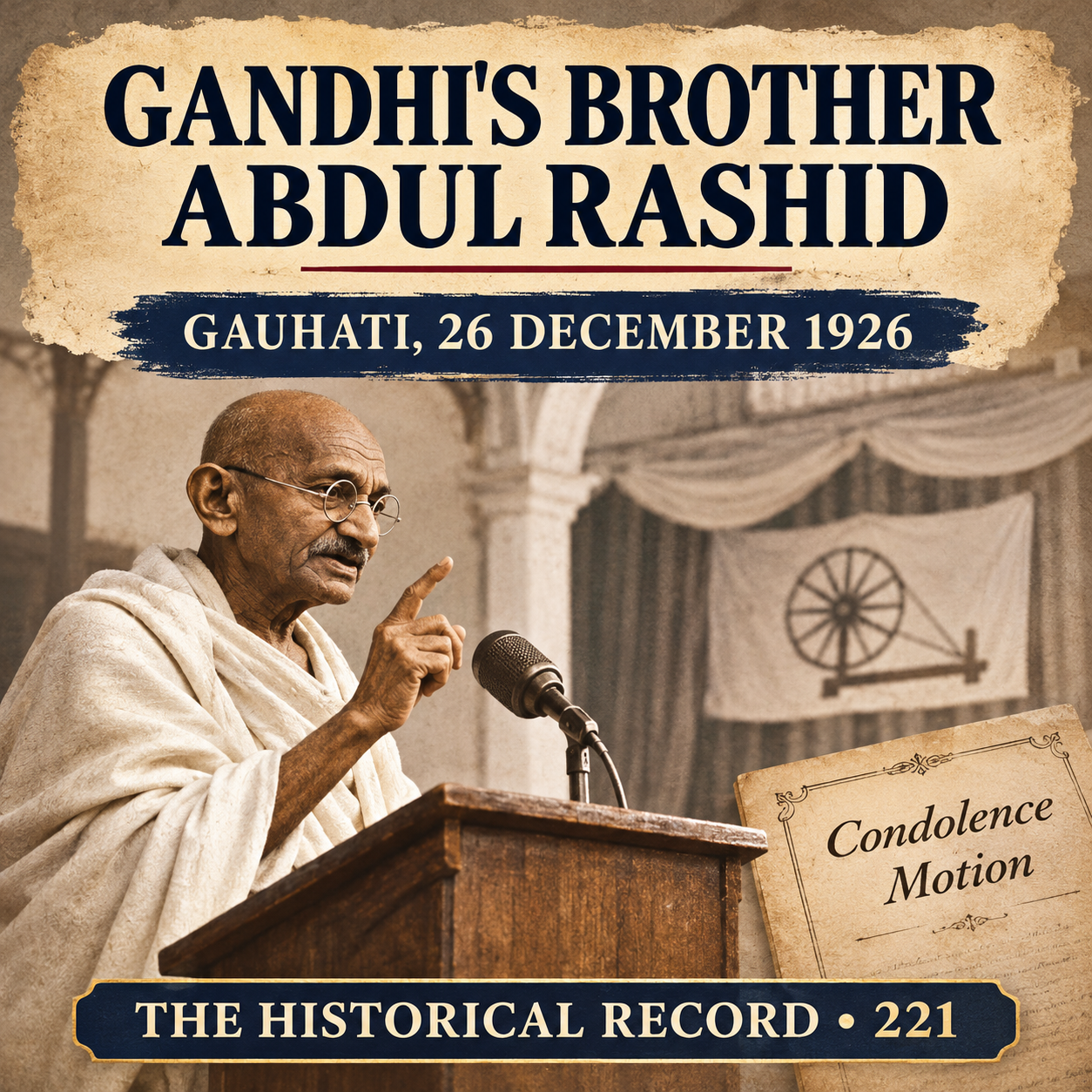
Gandhi’s Brother Abdul Rashid: Moral Inversion Institutionalised in Congress 1926 (221)
भारत / GB
Part 221: Mahatma Gandhi’s Peace Efforts (Replication Wave + Financial Audit) | Series Index
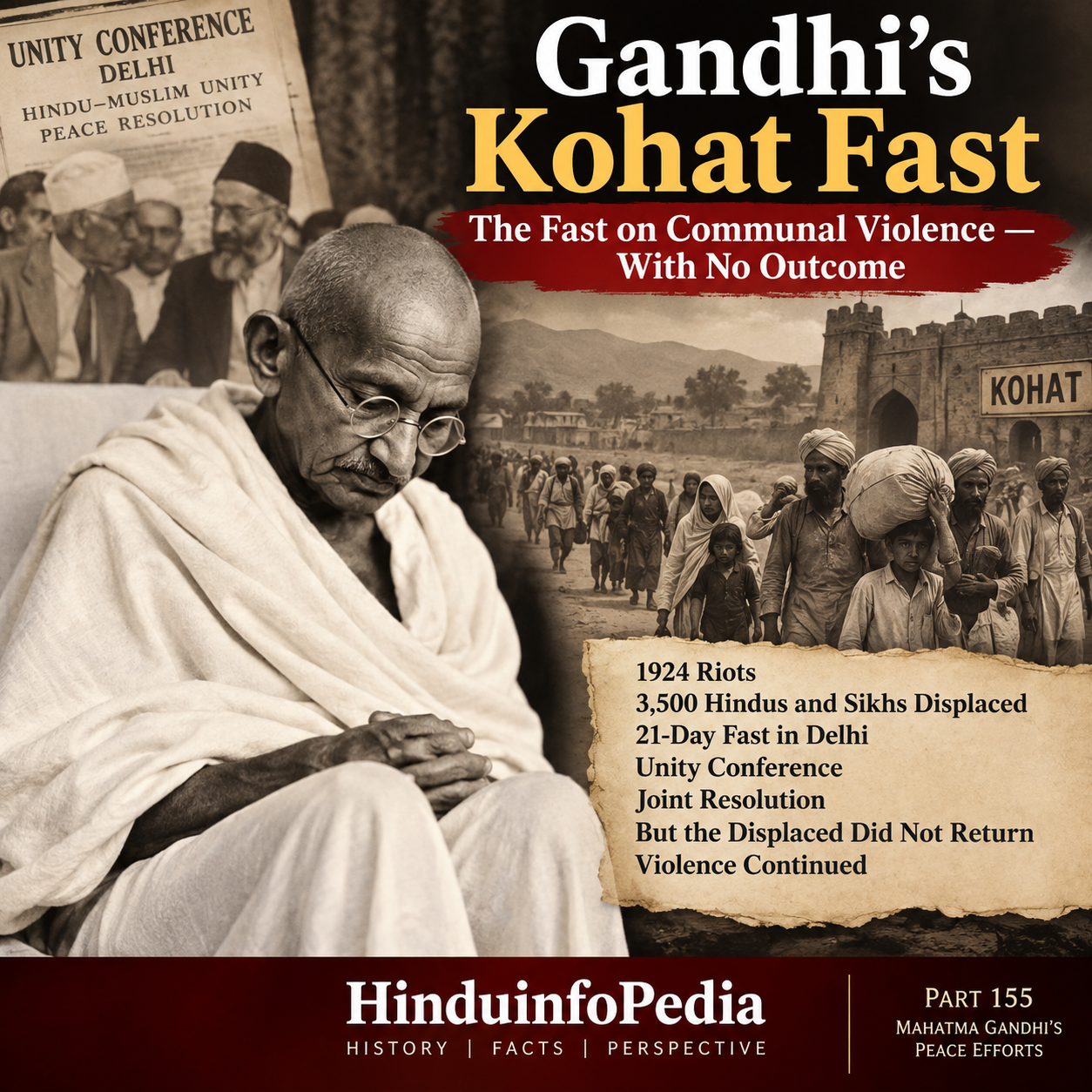
In Blog 220, we documented the murder of Swami Shraddhanand on 23 December 1926 — the man, his six-year record of warning Gandhi about Khilafat-era communal dangers, and the judicial record of his assassination by Abdul Rashid at his Delhi sickbed. Moving directly from the crime scene to the national political stage three days later, this instalment documents Gandhi’s response at the Gauhati Congress session on 26 December 1926 — specifically his public reference to the arrested assassin as “Brother Abdul Rashid” and his declaration that he did not even regard Rashid as guilty of the murder. The six-year causal chain behind Shraddhanand’s isolation is examined in a future Blog; the commercial and social fractures of the Khilafat period are in Blog 183; the three-tier transmission machine is in Blog 215; Gandhi’s Kohat fast is in Blog 155.
Thank you for reading this post, don't forget to subscribe!GANDHI’S GAUHATI ADDRESS — 26 DECEMBER 1926
The Action Taken: At the Gauhati Congress session on 26 December 1926, held three days after the murder of Swami Shraddhanand, Gandhi addressed the assembly while moving the condolence resolution and publicly referred to Abdul Rashid — the arrested assassin awaiting trial for shooting Shraddhanand at his sickbed — as “Brother Abdul Rashid,” adding that he did not even regard Rashid as guilty of the murder. While passing a formal condolence motion, the Congress session recorded no censure of the Tabligh incitement network and passed no resolution condemning targeted violence against Hindu reform leaders.
Who Paid the Price: The Hindu and Sikh communities whose most prominent national advocate — Swami Shraddhanand — had just been murdered, and who watched the Congress session at which Gandhi spoke use the occasion not to censure the incitement behind the killing, but to absolve the assassin of moral guilt while blaming Hindu critics and newspapers for exciting feelings of hatred.
Why This Matters: The documented phrase “Brother Abdul Rashid” and Gandhi’s accompanying refusal to hold Rashid guilty are undisputed in the Collected Works of Mahatma Gandhi (Vol. 32). What this speech reveals about Gandhi’s consistent pattern of response to communal violence directed at Hindus — prioritising Muslim political alliance over Hindu civic protection — is the subject of Blog 317. This instalment records only the documented facts: what Gandhi said, where, when, and what the Congress session did and did not do in response.
1. The Gauhati Congress: Setting and Timing
The Indian National Congress held its forty-first annual session at Gauhati (present-day Guwahati, Assam) from 26 to 28 December 1926. The session opened just three days after Swami Shraddhanand’s murder on 23 December 1926 — an act of violence against the most prominent Hindu reform leader in the country, committed at his Delhi sickbed, that had produced immediate public shock and nationwide grief across north India, without retaliatory communal violence from the Hindu public. The murder was not a distant or ambiguous event: Abdul Rashid had been arrested on the spot, the facts of the shooting were on the public record, and the Congress leadership was fully informed of both the murder and its communal context before the session convened.
The Gauhati session was therefore the first major institutional occasion at which the Congress — and Gandhi as its dominant moral authority — could respond formally to the killing of a Congress-allied leader. What Gandhi’s Brother Abdul Rashid speech delivered in that setting on 26 December 1926, and what the session recorded, is the subject of this instalment. The pattern-proof argument — what this response reveals about the structural logic of Gandhi’s communal politics — is reserved for Blog 317.
2. The Documented Phrase: “Brother Abdul Rashid”
Gandhi’s public address at Gauhati on 26 December 1926 (CWMG Vol. 32) included his explicit reference to Abdul Rashid as “Brother Abdul Rashid.” Speaking on the condolence resolution, Gandhi told the assembled delegates: “Now you will perhaps understand why I have called Abdul Rashid a brother and I repeat it. I do not even regard him as guilty of Swami’s murder. Guilty indeed are all those who excited feelings of hatred against one another.” The argument shifted moral culpability away from the man who had pulled the trigger and onto newspapers and Hindu critics, consistent with Gandhi’s established position across the previous six years of communal violence, from the Malabar rebellion through Kohat.
The specific wording is documented in the contemporaneous press record and in Gandhi’s own published writings. Gandhi’s Brother Abdul Rashid speech did not identify Shraddhanand as the target of a sustained campaign of Tabligh death threats. It did not acknowledge that at the December 1920 Nagpur Congress — attended by both Gandhi and Shraddhanand — Khilafat clerics had openly invoked Quranic verses against polytheists (including Surah 9:5) on the shared platform, or that Shraddhanand had spent six years warning Gandhi in writing about precisely this kind of escalation. Instead, Gandhi framed Abdul Rashid as a brother — a term of personal and moral solidarity — in an address delivered to the national Congress session three days after Rashid had shot dead the bedridden Hindu leader who had blown the whistle at Nagpur.
3. What the Congress Session Recorded — and Did Not Record
While the Gauhati Congress session of December 1926 passed a formal condolence motion mourning Swami Shraddhanand’s death, it passed no resolution censuring the Tabligh incitement campaign and no resolution condemning targeted communal violence against Hindu reform leaders. The session record contains no institutional rebuke of the ideological network that had celebrated or encouraged attacks on Shuddhi workers. The Congress, as an institution, used the occasion of its annual session — held three days after the most prominent communal murder of the year — to pair a grief resolution with Gandhi’s address absolving the assassin of moral guilt and to proceed with its regular business.
This is a documented institutional fact, not an interpretive claim. The Congress session proceedings for December 1926 are on the public record. The absence of any censure of the incitement network is verifiable against those proceedings. What that omission reveals about the Congress’s structural relationship to Hindu civic protection — and about the pattern Gandhi’s consistent framing had established across the decade — is the argument reserved for Blog 317. This instalment records only: what the session did, what it did not do, and what Gandhi’s Brother Abdul Rashid speech delivered as the dominant moral framing of the moment.
4. The Reactions: Hindu and Sikh Leaders on the Gauhati Response
The documented reactions to Gandhi’s Brother Abdul Rashid framing among Hindu and Sikh public figures were immediate and sharp. Lala Lajpat Rai — one of Gandhi’s sharpest critics on Khilafat and communal appeasement, who had already dismantled Gandhi’s Khilafat thesis in The Hindu-Muslim Problem (1924) and broken with the Swarajist–Gandhian Congress line in 1926 to co-found the Independent Congress Party with Madan Mohan Malaviya — rejected the moral relativism in his published writings and press commentary. The Arya Samaj leadership, the Hindu Mahasabha, and Sikh organisations whose members had been Shraddhanand’s primary constituency all registered public protest against calling the assassin a brother while blaming Hindu writers for the climate of hatred.
The documented record of those reactions is part of the historical evidence for what Gandhi’s Brother Abdul Rashid speech was understood to mean by the communities most directly affected by the murder. The specific content of Lajpat Rai’s documented response, and the institutional consequences of Gandhi’s framing for Hindu and Sikh political organisation in the period 1926–1930, are part of the carry-forward record for the 300-series analysis. This instalment records the fact of those reactions and their documented source — not their interpretive significance, which is reserved for Blog 317.
Modern Parallel
When a political leader publicly frames an arrested assassin as a brother — and declares him not guilty while blaming the victim’s community and press — at a national assembly three days after the killing, the framing is not merely personal. It is institutional: it tells the assembly, the press, and the country what moral register applies to this act. Gandhi’s Brother Abdul Rashid speech did exactly this. The documented phrase “Brother Abdul Rashid” was not a private expression of spiritual forgiveness. It was a public address at the Indian National Congress, the dominant political institution of the independence movement, delivered to the assembled delegates of that institution three days after the most prominent communal murder of 1926. That institutional setting is what makes the Gauhati address a matter of historical record rather than personal biography.
Invitation To Defence
CWMG Vol. 32, the Gauhati Congress session proceedings of 26–28 December 1926, and the contemporaneous press record are established sources. The defence is invited to produce any primary document showing that Gandhi’s Gauhati address held the Tabligh incitement network morally responsible for Abdul Rashid’s act, that the Congress session passed a resolution censuring the threats directed at Shuddhi reformers, or that Gandhi at any point between December 1926 and his death retracted his statement that Abdul Rashid was not guilty of Swami Shraddhanand’s murder.
At the Gauhati Congress session on 26 December 1926, three days after Swami Shraddhanand was shot dead at his Delhi sickbed, Gandhi publicly referred to the arrested assassin as “Brother Abdul Rashid” and declared that he did not even regard him as guilty of the murder. The Congress session passed no censure of the incitement behind the killing. Gandhi’s Brother Abdul Rashid speech, as a documented event, closes the arc from the 1920 duty mandate to the 1926 murder: the same framing, the same institutional setting, the same unanswered record.
Feature Image: Click here to view the image.
Videos
Glossary of Terms
1. Gauhati Congress Session: The forty-first annual session of the Indian National Congress, held at Gauhati (present-day Guwahati, Assam) from 26 to 28 December 1926, three days after Swami Shraddhanand’s assassination.
2. Gandhi’s Brother Abdul Rashid: The key phrase of this blog, referring to Gandhi’s public description of Abdul Rashid as “Brother Abdul Rashid” during his Gauhati address on 26 December 1926, despite Rashid being arrested for Swami Shraddhanand’s murder.
3. CWMG (Collected Works of Mahatma Gandhi): The published collection of Gandhi’s writings, speeches, letters and other documents. Volume 32 contains the documented text of Gandhi’s Gauhati address.
4. Condolence Motion: A formal resolution expressing grief following a person’s death. At the Gauhati Congress session, a condolence motion was passed following Swami Shraddhanand’s assassination.
5. Tabligh: An Islamic religious propagation and outreach activity. In this blog, the term appears in the context of the religious mobilisation and incitement discussed in relation to the Shuddhi movement and the events preceding the assassination.
6. Shuddhi Movement: A reform and reconversion movement associated with the Arya Samaj, particularly prominent in the Hindu reform activities and religious debates of the 1920s.
7. Khilafat Movement: A political and religious mobilisation in India during the early 1920s concerning the Ottoman Caliphate, in which Gandhi and the Congress leadership participated in an alliance with Khilafat leaders.
8. Moral Inversion: A central interpretive expression in this blog’s title, describing the perceived reversal of moral responsibility when attention shifts from the arrested perpetrator towards those who criticised or opposed the surrounding climate of incitement.
9. Institutional Framing: The way a political institution or its leadership publicly defines an event, assigns responsibility and establishes the moral interpretation presented to its members and the wider public.
10. Incitement Network: The term used in the blog for the religious and political influences alleged to have encouraged hostility towards Hindu reform leaders and Shuddhi activities.
11. Nagpur Congress 1920: The December 1920 Congress session attended by Gandhi and Swami Shraddhanand, which the blog identifies as an important earlier episode in the development of the Khilafat-era political and religious tensions.
12. Arya Samaj: A Hindu reform organisation founded by Swami Dayanand Saraswati, associated with educational, social and religious reform, including the Shuddhi movement.
13. Hindu Mahasabha: A Hindu political organisation that participated in public and political debates concerning Hindu interests and communal relations during the period discussed.
14. Independent Congress Party: The political organisation co-founded by Lala Lajpat Rai and Madan Mohan Malaviya in 1926, following their differences with the prevailing Swarajist–Gandhian Congress line.
15. Modern Parallel: A section of the blog examining how the public framing of an act of violence by political leadership can influence institutional accountability, public understanding and the treatment of affected communities.
#Gandhi #AbdulRashid #IndianHistory #Congress #FreedomMovement #History #Politics #SwamiShraddhanand #Khilafat #India #HinduinfoPedia
Scan Through The Entire Series at