
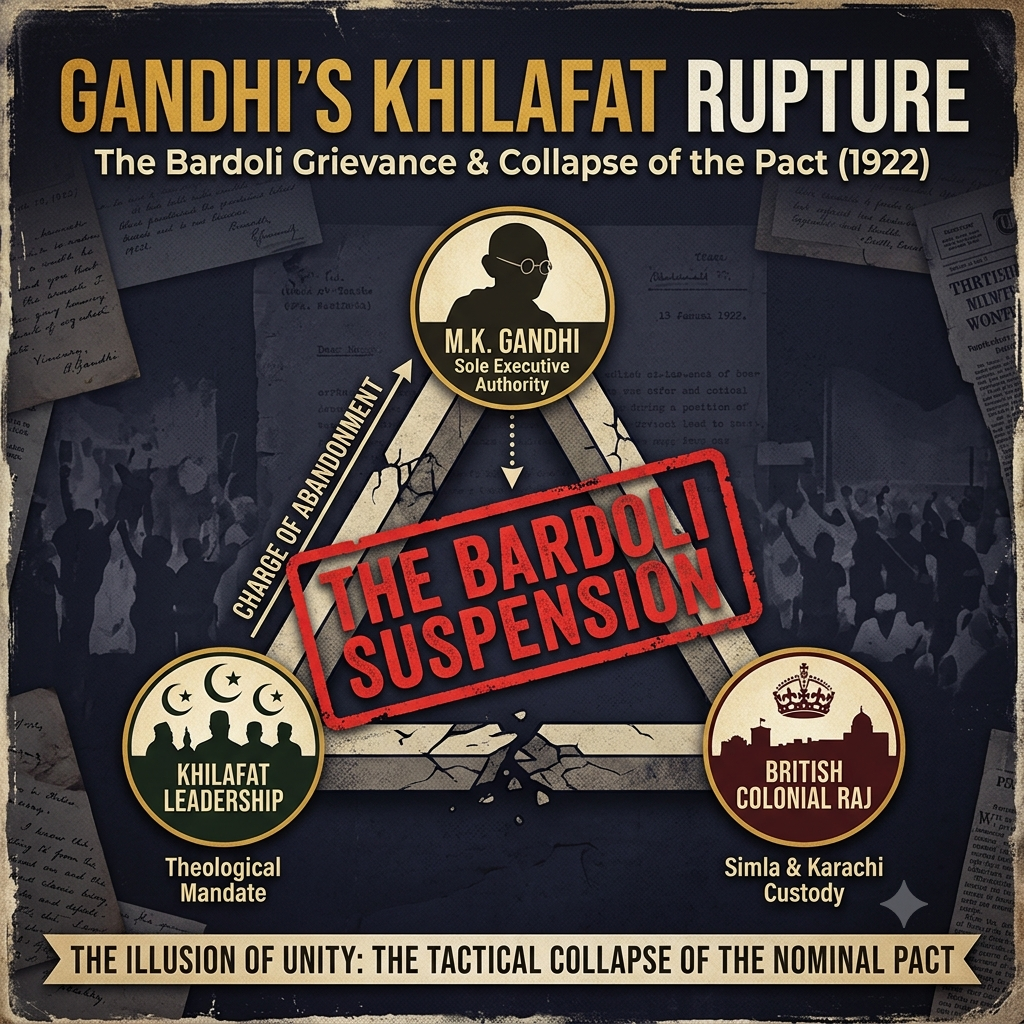
Gandhi’s Khilafat Rupture: Khilafat Leaders’ Charge and the Tactical Collapse (206)
भारत / GB
Part 206: Mahatma Gandhi’s Peace Efforts | Series Index
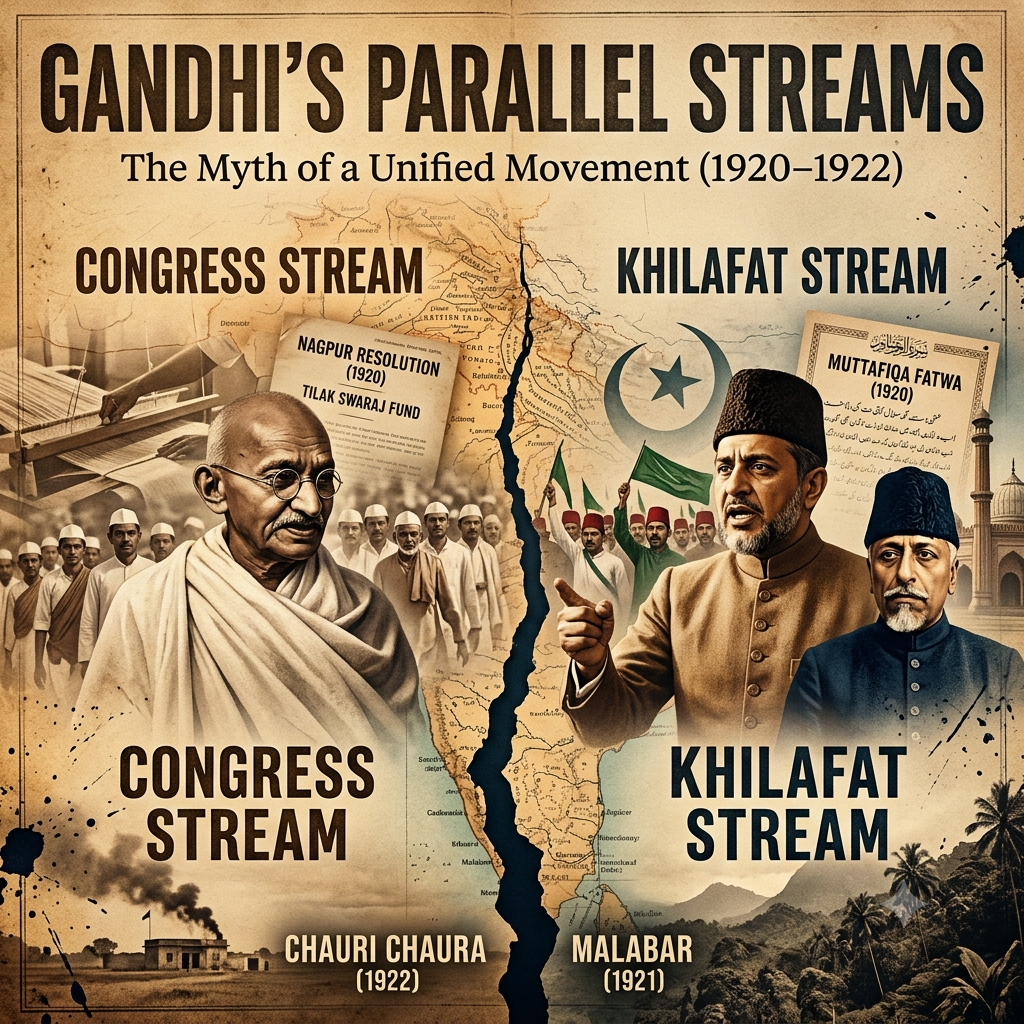
Blog 205 documented Gandhi’s parallel streams — establishing that Congress Non-Cooperation and the Khilafat agitation were always two separate machines: separate launches, mandates, treasuries, and volunteer corps, with Non-Cooperation functioning in ways more than one as subservient to the Khilafat cause. Between February 1922 and late 1923, that nominal pact dissolved — not through a genuine rupture of allies, but through explicit indictments and formal disengagements once each side’s utility was fulfilled.
Thank you for reading this post, don't forget to subscribe!THE ARITHMETIC OF THE RUPTURE
The Action Taken: On 12 February 1922, Gandhi unilaterally suspended Non-Cooperation by personal decree, with the Congress Working Committee serving merely as nominal signatory. Neither the Khilafat Working Committee, the Jamiat Ulema-e-Hind, nor the jailed Ali Brothers were consulted. Persistent Indian Khilafat interference in Turkey’s governance subsequently forced Mustafa Kemal Atatürk to abolish the Caliphate in March 1924.
Who Paid the Price: Having mobilised under the Muttafiqa Fatwa, the Khilafat Working Committee denounced Bardoli as unilateral abandonment, Jamiat clerics refused to halt, and the Ali Brothers discarded even the pretence of Congress alignment upon release in late 1923. Replicating its Congress-backed infrastructure across India, the Khilafat stream unleashed thirty to forty communal riots between Malabar (1921) and Kohat (1924).
Why This Matters: Gandhi’s Khilafat rupture exposes that the seeming breach was not a true rupture at all: the Khilafatists used Congress support to advance their theological mandate, while Gandhi used the Khilafat alliance to fool the Indian public into believing in a unified national movement.
The Ali Brothers in Custody: What Bardoli Interrupted
To understand Gandhi’s Khilafat rupture, the custodial context is essential. By the time Gandhi issued the Bardoli suspension on 12 February 1922, the most prominent Khilafat leaders — Mohamed Ali and Shaukat Ali — were already inside Karachi Central Jail, where the Karachi Sedition Trial had commenced in November 1921. Their exclusion from the Bardoli decision was no oversight; under the separate command architecture documented in Blog 205, Congress held neither the obligation nor the mechanism to consult the Khilafat leadership before acting.
From Simla Impunity to Karachi Custody: The Unchecked Pattern
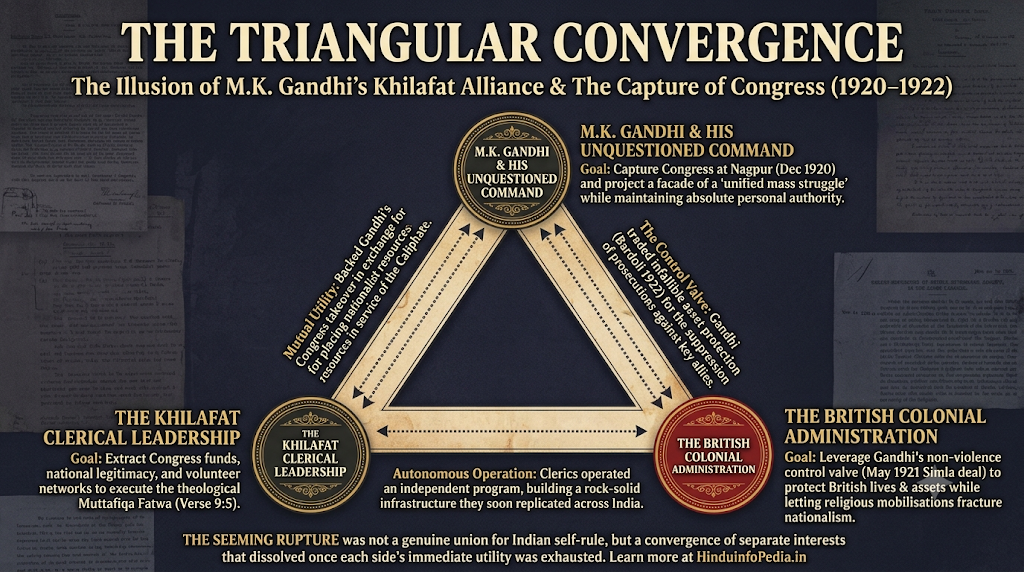
The Ali Brothers’ presence in Karachi Central Jail when Bardoli struck stemmed directly from Gandhi’s May 1921 Simla bargain with Viceroy Lord Reading. During six days of talks, Gandhi shielded Mohamed Ali and Shaukat Ali from prosecution through a narrow admission of guilt from the Ali Brothers paired with Gandhi’s own infallible assurance to the British against violence toward British lives and assets — an ironclad commitment he demonstrated on 11–12 February 1922 at Bardoli — while leaving their religious-separatist mobilisation and the rising Khilafat militancy in Malabar completely unrestrained. Escaping prosecution, the Ali Brothers immediately escalated that exact line at the July 1921 Karachi Khilafat Conference, passing an independent resolution declaring British Indian Army service religiously unlawful for Muslims.
That escalation triggered their arrest and the Karachi Sedition Trial of November 1921. By February 1922, the very leaders Gandhi had rescued at Simla were jailed for pursuing an autonomous Khilafat agenda in total variance to Gandhi’s agenda of Non-Cooperation and Non-Violence, leaving the Khilafat Working Committee free to reject Gandhi’s unilateral Bardoli halt when he honoured his Simla commitment to protect British assets after Chauri Chaura.
The Bardoli Suspension: No Consultation, No Warning
The Chauri Chaura incident of 4 February 1922 — in which a Congress-Khilafat volunteer procession in Gorakhpur district, UP, turned on the Chauri Chaura police thana in reaction to police firing on unarmed marchers and killed twenty-two colonial policemen — provided Gandhi with the stated ground for the Bardoli suspension. On 12 February 1922, eight days after the Chauri Chaura incident, Gandhi suspended the Non-Cooperation Movement across India by personal decree, with the Congress Working Committee acting merely as a nominal signatory to the Bardoli Resolution.
The resolution was a unilateral exercise of Mahatma Gandhi’s unquestionable executive authority, as vested in him under Item 2 of the Ahmedabad Congress resolution of December 1921. No Khilafat Working Committee session was convened, no Jamiat Ulema-e-Hind leadership was consulted, and no communication with the jailed Ali Brothers was made. That Congress acted alone reflected the underlying asymmetry already established: although Congress had been placed in service of the Khilafat cause as Gandhi himself headed the Khilafat platform, his Ahmedabad executive authority bound only the Congress Working Committee, never the autonomous Khilafat bodies. Derived from the Muttafiqa Fatwa rather than Congress resolutions, the Khilafat stream had never agreed that Congress possessed the authority to initiate or suspend its agitation.
The Khilafat Indictment: Abdul Bari, Hasrat Mohani, and the Charge of Abandonment
The Khilafat leadership’s response to Bardoli is routinely mislabelled as a “rejection” of Congress discipline — a framing that obscures the structural reality. The Khilafat stream was never pursuing Congress Non-Cooperation; it was executing the Muttafiqa Fatwa, a clerical obligation grounded in the defence of the Caliphate. Constitutional Muslim leaders who might have participated in a civic, nationalist Non-Cooperation programme — figures such as Muhammad Ali Jinnah — had already been driven out of the Congress by Gandhi’s supporters and Muslim leaders at Nagpur in December 1920. Those who remained operated strictly under clerical mandate. Consequently, when Bardoli was announced, they did not “reject” a binding directive; they indicted Gandhi for adopting their cause, mobilising their networks, and unilaterally withdrawing mid-stream without consultation.
Maulana Abdul Bari of Farangi Mahal — one of the principal theological architects of the Muttafiqa Fatwa — attacked the suspension on precisely those grounds. Because the Muttafiqa Fatwa had declared the struggle a religious duty under clerical authority, no Congress resolution could suspend or rescind it. Gandhi had stepped onto the Khilafat stage to lead their agitation and mobilise people under a religious vow, only to walk off unilaterally mid-way — leaving them bound by a clerical obligation he had neither the will nor the authority to undo. Crucially, even while presiding over the Khilafat platform himself, Gandhi never suspended the Muttafiqa Fatwa or the religious injunction of Tark-e-Mawalat, confining his suspension strictly to the Congress machinery.
Hasrat Mohani — sitting simultaneously inside the Congress Working Committee and the Khilafat leadership — exposed an even deeper structural fault line. After constitutional Muslims like Muhammad Ali Jinnah were driven out of Congress at Nagpur in December 1920, the vacuum inside Congress leadership was filled by dual-hatted Khilafat insiders like Mohani. Unlike external clerics who extracted Congress funds and cadres from the outside, Mohani operated from within the Congress Working Committee itself to subordinate Congress policy directly to the Khilafat agenda — moving the formal Purna Swaraj resolution at the Ahmedabad Congress of December 1921 (opposed by Gandhi at the time) to sever all constitutional restraint and lock Congress permanently into confrontation. When Gandhi abruptly halted the agitation at Bardoli, Mohani publicly indicted the suspension as a betrayal of the Khilafat mobilisation, exposing the hollowness of the “Hindu-Muslim unity” claim.
The Khilafat Working Committee met and formally declared that the Bardoli Resolution had no bearing on its programme — the first institutional act of what became Gandhi’s Khilafat rupture. The clerical network — the Friday khutbas, the itinerant maulvis, the mosque committees — continued operating under the original Muttafiqa Fatwa mandate while the Khilafat machinery pressed ahead without him.
The Ali Brothers: Formalising the Breach
The Ali Brothers — Mohamed Ali and Shaukat Ali — were released from custody in late 1923 after serving their sentences from the Karachi Sedition Trial. They returned to a transformed landscape: Non-Cooperation stood suspended, and Gandhi himself was serving a six-year sentence at Yerwada following his 18 March 1922 sedition conviction at Ahmedabad. Meanwhile, Khilafatists — having already absorbed Congress’s national amplification and resources — had been strengthened to carry forward their resolve in a far more assertive manner under the theological mandate of the Muttafiqa Fatwa.
Upon release, Mohamed Ali made the breach explicit. He publicly characterised the Bardoli suspension as Gandhi’s abandonment of the Khilafat cause after the clerical network had committed its theological authority, mosque infrastructure, and volunteer corps to pursue the Muttafiqa Fatwa. Yet the ground record shows that the Khilafatists had scarcely been associated with Congress Non-Cooperation at all; they had been pursuing the Khilafat cause alone, giving support to and taking support from Congress machinery strictly where it served that goal. With Congress stepping back, the Ali Brothers discarded even the pretence of alignment, and the autonomous Khilafat volunteer corps — well trained, strengthened, organised, and enabled from 1921 onwards — dropped the nominal Congress coordination label altogether.
The Caliphate Abolished: Interference Provokes Extinction
The final blow to the Khilafat cause was provoked by the Indian Khilafat leadership itself. By continually attempting to interfere in the governance and constitutional affairs of the new Turkish state — pressuring Ankara from abroad over the retention of the Caliphate’s authority — Gandhi’s Khilafat allies forced Mustafa Kemal Atatürk’s hand. On 3 March 1924, to end foreign clerical interference in running his state, Atatürk and the Turkish Grand National Assembly abolished the Caliphate outright. Yet Turkish abolition removed only the seemingly stated cause of the agitation. Territorial nationalism was never — and could never be — a legitimate cause for Muslims under their theological mandate. The real foundation lay in doctrinal principles Khilafat leaders had already recited openly at Nagpur in December 1920 — including Verse 9:5 — and field-tested on a massive scale in Malabar in August 1921, without a single word of regret from any Khilafat leadership.
Far from dissolving, the organisational infrastructure forged in the name of Khilafat — mosque committees, itinerant clerical networks, volunteer cadres, and madrasa channels — had been built rock-solid and stood ready to replicate the Malabar learnings across India. And replicated it was. Having absorbed Congress support during its formative period, the Khilafat stream turned those capabilities outward across the subcontinent. Between the suppression of the 1921 Malabar uprising and the September 1924 Kohat massacre, India was engulfed by roughly thirty to forty distinct communal riots — beginning with Multan, Lahore, and Wadhwan in 1922; escalating to between eleven and twenty major outbreaks in 1923 across Amritsar, Multan, Moradabad, Meerut, Allahabad, Saharanpur, Panipat, Agra, Shahjahanpur, Gonda, Rae Bareli, Jabalpur, and Ajmer; and culminating in eighteen disturbances across 1924 in Delhi, Gulbarga, Lucknow, Nagpur, Bhagalpur, Kankinara, and Kohat. The Congress-Khilafat label ended, while the well-built Khilafat machinery carried its programme based on the Malabar experience through internal consolidation and street mobilisation.
What the Rupture Reveals
Gandhi’s Khilafat rupture reveals that the seeming breach of 1922–23 was not a rupture in any true sense. Because the two machines had always been separate — separate commands, separate mandates, separate treasuries — neither was breaking a binding constitutional partnership. When Congress acted unilaterally at Bardoli, the Khilafat stream had already extracted what it needed and concentrated on deploying the mobilisation model it had built and field-tested during the years of Congress support.
The alliance had never been a genuine union for Indian self-rule. The Khilafat leadership used Congress’s alliance for their theological cause; Gandhi used the Khilafat alliance — to capture the Indian National Congress with Khilafat backing at Nagpur in December 1920 — to fool the Indian public into believing in a unified mass struggle. Behind that facade operated an even wider convergence of interests in which the British colonial administration, the Khilafat leadership, and Gandhi’s unquestioned command each advanced their own objectives — a triangular dynamic examined separately in the next part of this record. Gandhi’s Khilafat rupture did not shatter a working partnership; it merely removed the curtain once each side’s immediate utility was exhausted.
Modern Parallel
The structural anatomy of Gandhi’s Khilafat rupture — a political formation that strengthens sectarian privileges for electoral convenience, only to discover that the parallel religious network recognises no civic authority to roll back those concessions — recurs in contemporary battles over Waqf laws. For decades, successive governments fortified special Waqf statutes that enabled unchecked expansion and illegitimate occupation of vast properties across the country, drawing widespread celebration within that constituency. Yet the moment the state moved to rationalise Waqf laws and restore legal accountability, the parallel street machinery erupted in coordinated violence in Murshidabad and elsewhere, displacing thousands of residents. Just as in 1922, the civic establishment discovered that while it could empower and inflate a parallel power structure, it held no authority to restrain or reverse it once those privileges were touched.

Invitation To Defence
Every primary record of Gandhi’s Khilafat rupture — the Karachi Sedition Trial custody following Gandhi’s May 1921 Simla bargain, the unilateral Bardoli Resolution of 12 February 1922, the Khilafat Working Committee’s indictment of abandonment under the Muttafiqa Fatwa, the Ali Brothers’ late-1923 disengagement, and Atatürk’s 3 March 1924 abolition provoked by Indian Khilafat interference — stands in the record. The defence is invited to identify any primary source establishing that Congress possessed the authority to suspend the Khilafat agitation, or that the Khilafat Working Committee ever accepted the Bardoli Resolution as binding on its programme.
The Khilafat stream was not consulted before Bardoli. Its leaders were in custody, its theological mandate could not be rescinded by Congress resolution, and it indicted the suspension as abandonment. The Ali Brothers discarded even the pretence of alignment upon release, while Indian Khilafat interference forced Atatürk to abolish the Caliphate in 1924 — leaving intact a replicated Khilafat infrastructure that fuelled dozens of riots from Malabar to Kohat. Gandhi’s Khilafat rupture did not break an alliance; it exposed that no binding alliance had ever existed.
Feature Image: Click here to view the image.
Videos
Glossary of Terms
1. Khilafat Rupture: The breakdown of the nominal political alignment between Gandhi’s Congress-led Non-Cooperation Movement and the Khilafat leadership between 1922 and 1923, exposing their separate organisational structures, objectives, and religious mandates.
2. Muttafiqa Fatwa: A collective religious ruling issued by Islamic clerical authorities that declared the Khilafat struggle a religious obligation and provided the theological mandate for mobilisation independent of Congress resolutions.
3. Bardoli Resolution: The resolution of 12 February 1922 through which Gandhi suspended the Non-Cooperation Movement following the Chauri Chaura incident, without consulting the Khilafat Working Committee or its principal religious leadership.
4. Tark-e-Mawalat: A religious injunction advocating the severance of cooperation or relations with authorities considered unacceptable under the relevant Islamic interpretation. In the blog, it refers to the religious obligation that Gandhi did not formally suspend when halting Congress Non-Cooperation.
5. Karachi Sedition Trial: The legal proceedings initiated in November 1921 against Mohamed Ali and Shaukat Ali following their activities and statements associated with the Khilafat movement, resulting in their imprisonment until late 1923.
6. Simla Bargain: The May 1921 understanding between Gandhi and Viceroy Lord Reading, involving an admission of guilt by the Ali Brothers and Gandhi’s assurance against violence towards British lives and property, which the blog identifies as central to the subsequent political developments.
7. Congress Working Committee (CWC): The principal executive body of the Indian National Congress, which formally endorsed Gandhi’s Bardoli decision but did not exercise authority over the independently organised Khilafat institutions.
8. Khilafat Working Committee: The executive body responsible for directing the Khilafat agitation, operating under its own religious mandate, leadership, and organisational structure rather than the authority of Congress.
9. Dual-Hatted Leadership: A political arrangement in which an individual simultaneously occupies positions in two separate organisations. The blog uses this expression for leaders such as Hasrat Mohani, who operated within both Congress and Khilafat leadership structures.
10. Purna Swaraj: Complete independence or full self-rule, expressed as the political objective of ending British authority in India. Hasrat Mohani moved the formal resolution at the Ahmedabad Congress in December 1921, despite Gandhi’s opposition at the time.
11. Clerical Mandate: An obligation or directive derived from religious scholars and institutions rather than a political organisation. In this blog, it describes the authority under which Khilafat mobilisation continued independently of Congress decisions.
12. Itinerant Clerical Networks: Mobile networks of religious preachers and scholars who travelled between communities, delivering religious messages and facilitating organisational mobilisation. The blog identifies these networks as part of the Khilafat infrastructure.
13. Autonomous Volunteer Corps: An independently organised body of volunteers operating under its own leadership and objectives rather than the command of another political organisation. The blog uses this term for the Khilafat volunteer structure.
14. Structural Asymmetry: An imbalance between organisations in terms of authority, obligations, institutional control, and decision-making powers. In the blog, it describes the fundamental difference between Congress’s political authority and the Khilafat leadership’s independent religious mandate.
15. Triangular Dynamic: A coined analytical expression describing the convergence of interests among three separate actors: the British colonial administration, the Khilafat leadership, and Gandhi’s political command, each advancing its own objectives despite their apparent political alignment.
#Gandhi #Khilafat #NonCooperation #IndianHistory #MahatmaGandhi #FreedomStruggle #Congress #AliBrothers #BritishIndia #IndianPolitics #KhilafatMovement #Bardoli #Malabar #Caliphate #HinduinfoPedia
Scan Through The Entire Series at