
Gandhi’s Poona Pact: The Fast That Blockaded Ambedkar’s Award (159)
भारत / GB
Part 159: Mahatma Gandhi’s Peace Efforts | Series Index
Blog 158 placed the eighteen days before the reader — Gandhi’s maximum leverage, Bhagat Singh in the condemned cell, the condition not made. This post places a different instrument before the reader: the same fast that Gandhi refused to deploy for Bhagat Singh’s life was deployed eighteen months later to block Dalit political independence. The instrument, the target, and the outcome are placed before the reader.
Thank you for reading this post, don't forget to subscribe!Author’s Note: The examination of these events does not constitute an endorsement of either Ramsay MacDonald’s Communal Award or Gandhi’s coercive fast. Both the British award and Gandhi’s intervention are treated strictly as historical exhibits on record, without alignment with either position.
The Action Taken: Following the democratic election of Subhas Chandra Bose, Gandhi directed twelve members of the Working Committee to resign en masse and refused to suggest replacement names under the Pant Resolution, completely paralyzing the administration until Bose was forced to resign.
Who Paid the Price: Subhas Chandra Bose, the democratic constitution of the Congress, and the delegates who had voted for an assertive anti-colonial policy.
The Alternative Bypassed: Assisting the elected president in forming a composite Working Committee representing all internal party factions.
Why This Matters: Internal democracy nullified: an open presidential election victory was overturned through coordinated executive non-cooperation, proving that democratic ballots were discarded when they diverged from personal moral authority.
The Communal Award
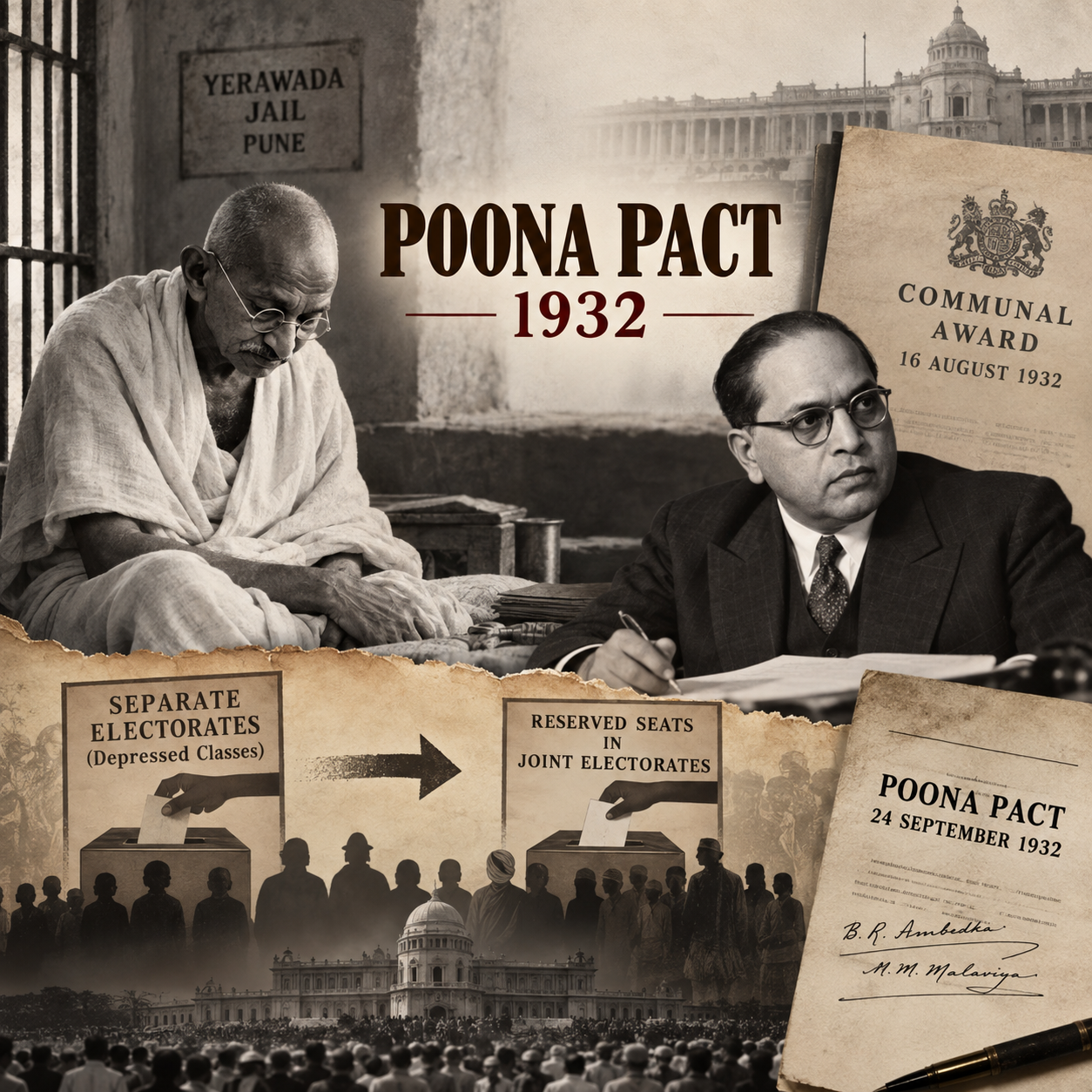
Gandhi’s Poona Pact places the documented context before the reader. On August 16 1932, British Prime Minister Ramsay MacDonald announced the Communal Award — the British government’s determination of separate electorates for various communities in India including Muslims, Sikhs, and the Depressed Classes.
For the Depressed Classes, the Communal Award granted a dual vote: one vote in a separate Dalit constituency electing Dalit representatives exclusively, and a second vote in the general constituency. This dual vote mechanism was why Gandhi regarded it as creating a permanent statutory partition of the Hindu fold — and why Ambedkar regarded it as superior leverage, giving the Depressed Classes independent political representation while retaining participation in the general electorate. Ambedkar had negotiated this at the Second Round Table Conference 1931 — established in Blog 153 of this series. It was the structural constitutional protection the Depressed Classes had sought. Contemporary estimates of the Depressed Classes population ranged from the mid-40s to higher figures in different contexts. The series carries the constitutional mechanism — the structural political right at stake — not a single contested population figure.
Gandhi’s documented position: he would fast unto death if the British granted separate electorates to Dalits.
The Fast — September 20 1932
On September 20 1932, while interned in Yerawada Jail, Pune, Gandhi began his fast unto death against the Communal Award’s provision of separate electorates for the Depressed Classes.
The documented mechanism — examined in the Fast Arc later in this series: a 62-year-old national figure, the Father of the Nation, fasting to near-death inside jail. The guilt complex activated. The countdown began. Political leaders across India scrambled. The British government indicated it would modify the Award if both Ambedkar and Gandhi agreed.
Ambedkar’s documented position: he was being coerced. The fast was a weapon — Gandhi’s documented instrument deployed against the constitutional protection of the Depressed Classes. Ambedkar documented his anguish: if Gandhi died, the blame would fall on Dalits and the consequences for the Dalit community across India would be severe.
The Poona Pact — September 24 1932
After six days of Gandhi’s fast, the Poona Pact was signed on September 24 1932. Ambedkar signed for the Depressed Classes. Madan Mohan Malaviya signed for caste Hindus. Gandhi himself was not a signatory — he was the instrument of coercion, not the documented party to the agreement.
The Poona Pact was submitted to and accepted by the British government as an amendment to the Communal Award — not a replacement of it. Under the amended Award, separate electorates for the Depressed Classes were replaced with reserved seats in joint electorates — seats in which only Depressed Classes candidates could stand but in which all voters, including caste Hindus, could vote. The number of reserved seats was increased from 71 to 148 as compensation.
Gandhi broke his fast.
What the Pact Traded
Gandhi’s Poona Pact traded structural political independence for numerical compensation.
Under the Communal Award: Dalit voters would elect Dalit representatives from a Dalit electorate. A Dalit candidate’s survival in office would depend on Dalit constituencies. Dalit political independence — the ability to hold Dalit representatives accountable to Dalit voters — was structurally guaranteed.
Under the Poona Pact: a two-tier system was established for a period of ten years. In the primary election, Depressed Class voters exclusively selected a panel of four Dalit candidates for each reserved seat. In the general election, all voters — caste Hindus and Dalits together — chose among those four nominated candidates. Ambedkar negotiated the primary tier as a filtering mechanism to prevent mere rubber-stamps. But the final selection remained with a general electorate in which caste Hindu voters formed the majority — giving caste Hindus the ultimate veto over which of the four Dalit candidates won. The reserved seat guaranteed Dalit candidates on the ballot. It did not guarantee a Dalit voice independent of caste Hindu approval.
Ambedkar’s documented assessment: the Poona Pact destroyed Dalit political independence. A Dalit representative elected by a joint electorate dominated by caste Hindu voters was accountable to those voters — not to the Dalit community. The structural guarantee was replaced with a numerical compensation that left Dalit political representation dependent on caste Hindu goodwill.
The series places Ambedkar’s documented assessment before the reader as a contemporary witness to Gandhi’s instrument and its consequences — not as an endorsement of Ambedkar’s broader political positions or legacy, which are examined separately.
The Instrument and the Target
Gandhi’s Poona Pact carries the instrument deployment alongside the series’ established record.
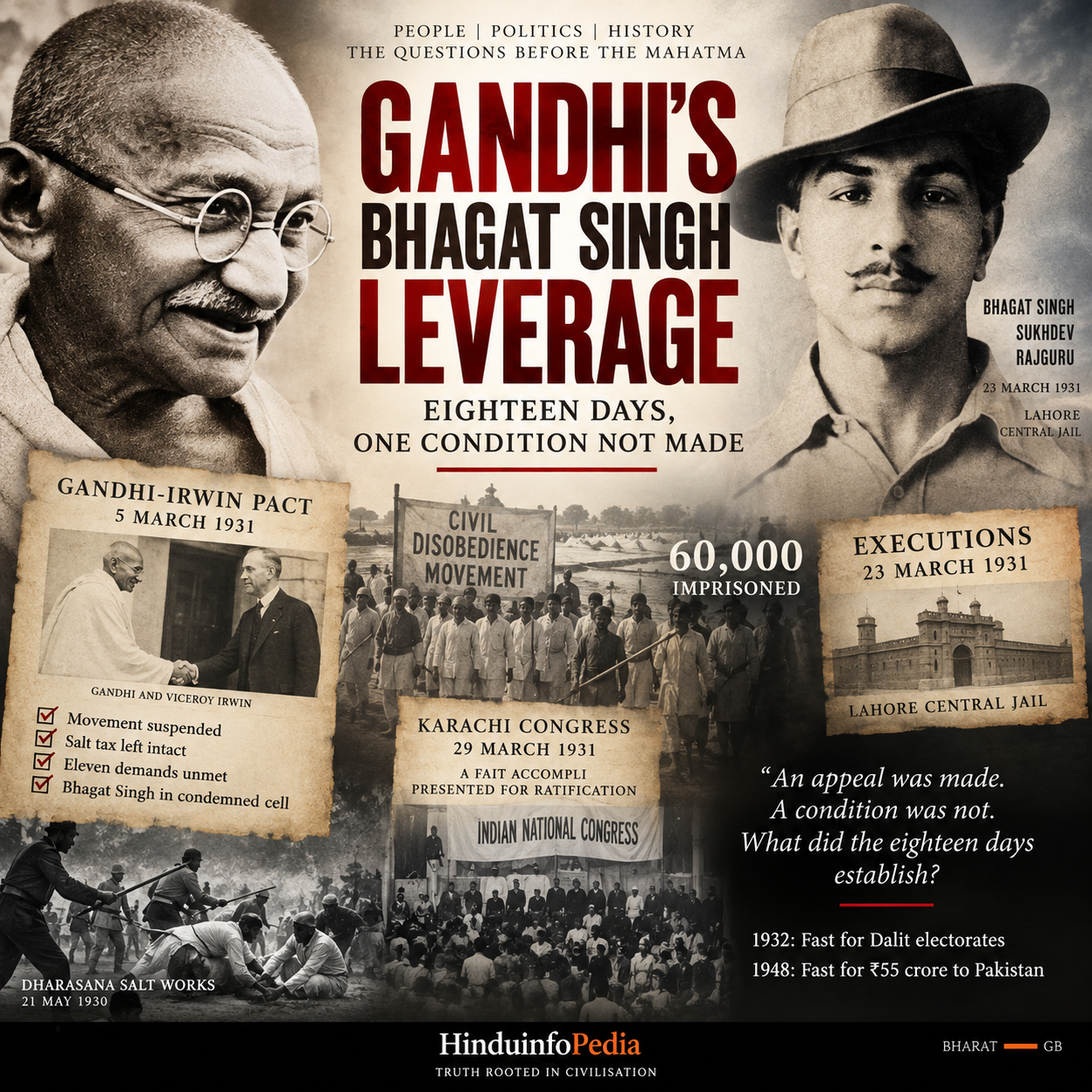
Blog 157 placed the eighteen days before the reader: Gandhi held maximum leverage in March 1931. He did not fast for Bhagat Singh’s life. He wrote a private letter on the morning of the hanging.
The fast ledger examined later in this series records: Gandhi fasted for ₹55 crore to Pakistan in 1948. He did not fast for Bhagat Singh’s life in 1931.
Gandhi fasted for Dalit separate electorates in September 1932. The documented instrument — the fast unto death — deployed against the constitutional protection of the Depressed Classes.
The instrument Gandhi refused to deploy for a documented revolutionary freedom fighter’s life was deployed to block a constitutional provision for the Depressed Classes. The reader will examine what the documented pattern of instrument deployment established.
The Documented Position and the Documented Descent
One further observation follows. In March 1931, Gandhi signed the Gandhi-Irwin Pact directly with Viceroy Irwin — peer to peer with the Crown’s representative. He did not sign with fellow Indian leaders as equals. In September 1932, Gandhi fasted to produce the Poona Pact — but did not sign it. Malaviya signed for caste Hindus. Ambedkar signed for the Depressed Classes. Gandhi operated from above, not as a documented party.
The question: Gandhi placed himself above ordinary Indians — signing with Viceroys, not with Indian leaders, operating through moral sovereignty no constitutional framework could define. If Gandhi was above Indians, the constitutional position of the Depressed Classes was not his documented business. He had no elected mandate from them. He had no constitutional authority over them. He was not their documented representative.
Yet he descended — specifically, precisely, with his documented instrument at full deployment — to remove the structural political independence the Depressed Classes had negotiated for themselves. Not to fight for them. Not alongside them as an equal. Against their negotiated position, from above, without signing the agreement his fast produced.
The prosecution does not answer what brought Gandhi down from his documented position above specifically to intervene against Dalit political independence. It places the documented position alongside the documented descent — and asks the reader to examine what the combination established.
The Prosecution’s Position
Gandhi’s Poona Pact places three questions before the reader.
- Does Gandhi’s fast unto death against Dalit separate electorates — the constitutional protection Ambedkar had negotiated for the Depressed Classes at the Second Round Table Conference — constitute an exhibit the reader places alongside Gandhi’s claim at the London table that Congress would protect Dalit interests?
- Does the documented mechanism of the Poona Pact — reserved seats in joint electorates where caste Hindu voters form the majority — placed alongside the Communal Award’s separate electorates, constitute an exhibit the reader places alongside Ambedkar’s documented assessment that Dalit political independence was destroyed by the pact?
- Does the documented pattern — the fast not deployed for Bhagat Singh’s life in March 1931, the fast deployed against Dalit political independence in September 1932 — constitute an exhibit the reader places alongside the series’ full documented record of Gandhi’s instrument deployment?
The series does not answer. Gandhi’s Poona Pact places the Communal Award, the fast, the pact, and the instrument pattern before the reader. The reader will examine what the deployment of Gandhi’s instrument against the Depressed Classes established — and complete the sentence.
Invitation To Defence
The floor belongs to the defense. We now invite them to present their exhibits and challenge the narrative established by the prosecution.
August 16 1932: Communal Award grants Dalits separate electorates — structural political independence for the Depressed Classes. Gandhi: fast unto death against it. September 24 1932: Ambedkar signs the Poona Pact. Separate electorates replaced with reserved seats in joint electorates dominated by caste Hindu voters. Dalit political independence traded for numerical compensation. March 1931: Gandhi wrote a private letter for Bhagat Singh on the morning of the hanging. September 1932: Gandhi fasted for six days against the political independence of the Depressed Classes. The prosecution places the instrument and its targets before the reader. The reader will complete the sentence.
Feature Image: Click here to view the image.
Videos
Glossary of Terms
- Communal Award: The British government’s 1932 scheme that provided separate electorates for several communities, including the Depressed Classes.
- Depressed Classes: The historical term used in the source for communities later commonly described as Dalits.
- Separate Electorates: An electoral system in which members of a designated community elect their representatives through a separate electorate.
- Dual Vote: The voting arrangement under the Communal Award in which Depressed Classes voters had one vote in a separate electorate and another in the general electorate.
- Poona Pact: The September 1932 agreement that replaced separate electorates for the Depressed Classes with reserved seats in joint electorates.
- Joint Electorates: Electoral constituencies in which all eligible voters, including caste Hindus and Depressed Classes voters, participate in choosing representatives.
- Reserved Seats: Legislative seats reserved for candidates from the Depressed Classes while allowing the wider electorate to vote for those candidates.
- Primary Election: The first stage created by the Poona Pact in which Depressed Classes voters selected a panel of four candidates for each reserved seat.
- Constitutional Protection: The formal political safeguards intended to protect the independent representation and political interests of the Depressed Classes.
- Dalit Political Independence: The capacity of Dalit representatives to remain politically accountable primarily to Dalit voters rather than to the wider electorate.
- Fast Unto Death: A form of political protest involving refusal of food until death or an agreed settlement, used by Gandhi against the separate-electorate provision.
- Instrument Deployment: The series’ analytical term for the use of a particular political or moral instrument, especially Gandhi’s fast, toward a specific objective.
- Documented Position: The series’ term for a political position established through recorded statements, agreements, actions, or other historical evidence.
- Documented Descent: The series’ analytical phrase describing Gandhi’s movement from his documented political position to direct intervention against the political arrangement negotiated by the Depressed Classes.
- Gandhi-Irwin Pact: The March 1931 agreement Gandhi signed directly with Viceroy Irwin during the negotiations between the Indian National Congress and the British government.
#Gandhi #Ambedkar #PoonaPact #Dalits #IndiaHistory #IndianHistory #Congress #BritishIndia #HinduinfoPedia
Scan Through The Entire Series at
Gandhi’s Peace Efforts: The Questions Before the Mahatma (0)