
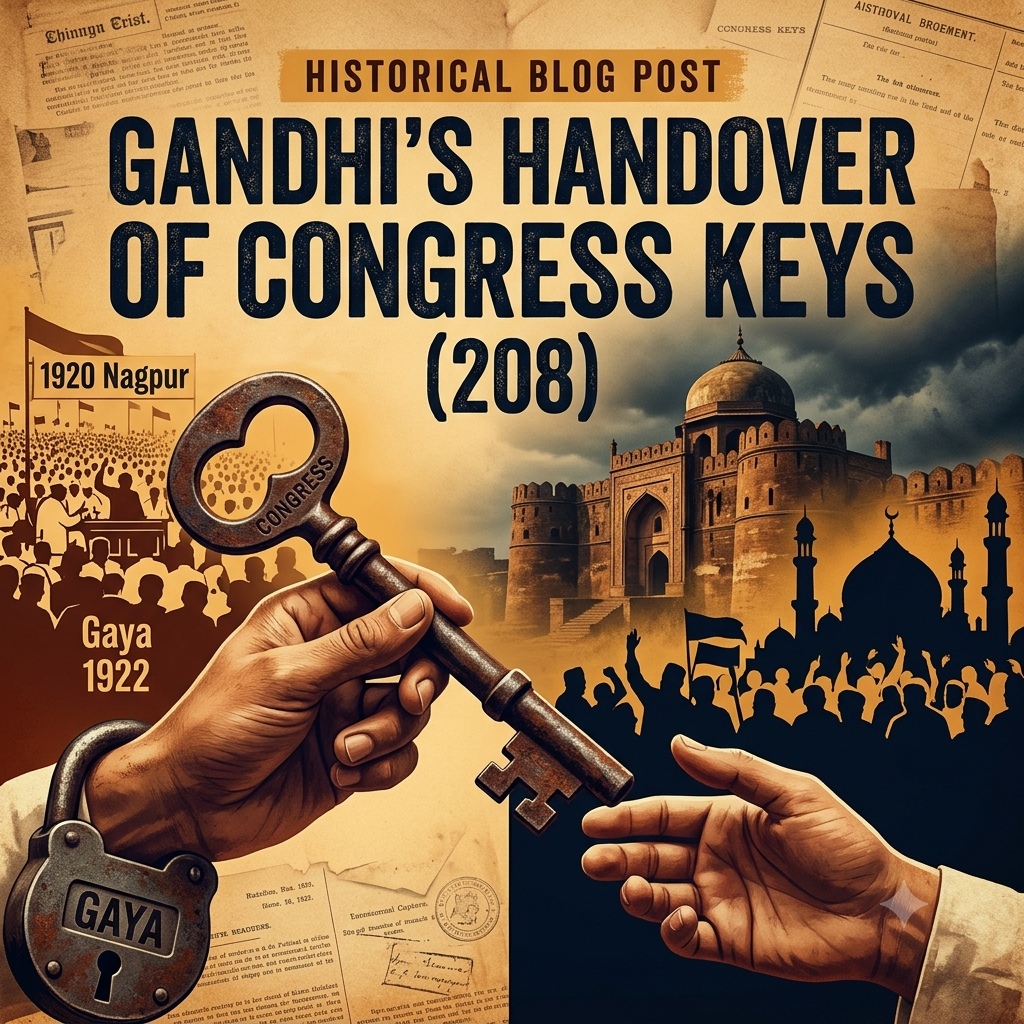
Gandhi’s Handover of Congress Keys: Non-Cooperation Ended, Khilafat Still Drove Congress (208)
भारत / GB
Part 208: Mahatma Gandhi’s Peace Efforts | Series Index
Blog 207 documented Gandhi’s Swaraj Party divergence — the Gaya Congress of December 1922 where C.R. Das moved council entry and lost by 1,740 votes to 890, forcing the Swaraj Party’s formation on 1 January 1923. That blog documented the fracture. This exhibit exposes how Gandhi handed over the constitutional keys of Congress to the Khilafatists in December 1920 and locked in an automated session synchronisation — allowing the parent Khilafat movement to keep overwhelming the Congress floor at Gaya even after Gandhi terminated Non-Cooperation at Bardoli and went to Yerwada Prison.
Thank you for reading this post, don't forget to subscribe!THE ARITHMETIC OF THE HANDOVER
The Action Taken: At Gaya in December 1922, the All-India Khilafat Conference (presided over by Dr. M.A. Ansari) and the Jamiat Ulama-i-Hind met concurrently in the same city and reaffirmed that council entry was religiously forbidden. Khilafat and ulama representatives holding accredited Congress seats carried that ruling onto the Congress floor, voting alongside C. Rajagopalachari’s No-Changers to defeat C.R. Das by 1,740 votes to 890.
Who Paid the Price: C.R. Das, the sitting Congress president, was voted down on his own presidential policy by a pre-wired coalition of No-Changers enforcing an aborted boycott and Khilafat delegates obeying a fatwa issued at a parallel religious session.
Why This Matters: Gandhi’s handover of Congress keys is the name the prosecution assigns to this structural transfer. Installed by the December 1920 Nagpur Constitution and reinforced by co-located annual sessions, it placed Congress’s membership rolls, delegate quotas, and floor majorities in Khilafat hands — so that even after Gandhi terminated Non-Cooperation, Khilafat still held the keys inside Congress.
Pillar One: The Nagpur Constitutional Mechanism
The Nagpur Congress of December 1920 did not merely vest Gandhi with personal authority; it replaced Congress’s older rules — which had allowed any province to send unlimited delegates for a ten-rupee fee — with a new constitution built on three structural changes.
First, it introduced four-anna (one-quarter rupee) mass membership with no educational or property qualification. Second, it reorganised Provincial Congress Committees on a linguistic basis and allocated session delegate quotas strictly by provincial population — one delegate per fifty thousand inhabitants. Third, it concentrated executive control in a compact fifteen-member Working Committee.
Local Khilafat committees and ulama networks possessed mosque, madrasa, and taluka-level infrastructure to enrol four-anna members at a scale the professional Congress class could not match. That mobilisation produced the Nagpur peak of 14,582 registered delegates — including 1,050 Muslim delegates — and seated Khilafat-aligned committee members inside provincial delegate electorates.
In Bombay on 14–15 June 1921, the Congress Working Committee reinforced this integration by instructing Provincial and District Congress Committees to ensure adequate Muslim representation across executive committees and delegate electorates (recorded in Indian National Congress 1920 to 1923, Allahabad, 1924). Together, the Nagpur Constitution and the June 1921 directive completed Gandhi’s handover of Congress keys to the Khilafat apparatus.

The Delegate Trajectory: Nagpur to Gaya
The session attendance record between 1918 and 1923 tracks the handover’s peak and subsequent collapse:
| Session | Year | Registered Delegates | Structural Significance |
|---|---|---|---|
| Delhi | Dec 1918 | 4,868 | Pre-Khilafat; professional-class Congress |
| Amritsar | Dec 1919 | 8,126 | Ali Brothers arrive from jail; Khilafat agitation begins |
| Nagpur | Dec 1920 | 14,582 | Highest in Congress history; 1,050 Muslim delegates; new Constitution passed |
| Ahmedabad | Dec 1921 | 4,728 | Concurrent Khilafat Conference and Jamiat session; thousands in jail |
| Gaya | Dec 1922 | 3,848 | 2,630 voted on council entry (1,740 to 890); Gandhi in Yerwada; ulama fatwa enforced |
| Cocanada | Dec 1923 | 1,661 | Sharp collapse after Khilafat mobilisation evaporated |
The drop in Congress delegates attending the annual plenary from 14,582 at Nagpur in 1920 to 1,661 at Cocanada in 1923 proves that the 1920 surge was Khilafat mobilisation — driven by Gandhi’s Khilafat presidency and channelled through Congress’s new constitutional rules — rather than organic party growth. Following the Ottoman Sultanate’s abolition in November 1922, the Caliphate’s final abolition in March 1924, and the collapse of the Khilafat agitation, Congress’s four-anna base vanished with it. By March 1923, total primary membership across sixteen of twenty reporting provinces had fallen to 106,046 — less than one-third of the United Provinces’ July 1921 total alone.
Pillar Two: Concurrent Sessions and the Unrevoked Fatwa at Gaya
Although Gandhi and the Congress Working Committee had terminated Congress’s political Non-Cooperation campaign at Bardoli in February 1922, neither Gandhi nor Congress possessed the religious authority to revoke Tark-i-Muwalat — the Islamic injunction of non-cooperation governed by the Muttafiqa Fatwa of the ulama. As long as that fatwa remained in force, Tark-i-Muwalat stayed active inside the Khilafat Committee and bound Khilafat’s representatives sitting inside Congress by paying four annas.
Because Nagpur’s fixed provincial quotas barred unaccredited crowds from voting, the Khilafat bloc enforced that unrevoked decree at Gaya through pre-wired session synchronisation. In the final week of December 1922 — a venue invited a year earlier at Ahmedabad by Bihar’s staunch No-Changer leadership under Rajendra Prasad — four bodies met simultaneously in the same host city: the thirty-seventh Indian National Congress (presided over by C.R. Das), the All-India Khilafat Conference on 27 December (presided over by Dr. M.A. Ansari), the Jamiat Ulama-i-Hind annual session, and the All-India Trade Union Congress.
At the Khilafat and Jamiat sessions, the ulama majority reaffirmed that entering colonial councils remained haram or mamnun under the Muttafiqa Fatwa. While a handful of dual-hatted national leaders like Hakim Ajmal Khan favoured council entry alongside Das and Motilal Nehru, Dr. M.A. Ansari and the orthodox ulama aligned ahead of the vote with C. Rajagopalachari’s No-Changers. Once the religious prohibition was confirmed in the Khilafat-Jamiat pandal, the rank-and-file Khilafat representatives seated inside Congress — enrolled via the four-anna drive specifically to carry Khilafat’s mandate onto the Congress floor — voted in obedience to a religious decree that Gandhi’s Bardoli resolution had neither touched nor possessed the jurisdiction to lift.
Pillar Three: The Floor Arithmetic
Of the 3,848 registered delegates at Gaya — reduced sharply from 14,582 at Nagpur due to mass Non-Cooperation imprisonments across the provinces — only 2,630 voted on C.R. Das’s council-entry resolution, leaving 1,218 registered attendees unrecorded on the division. Those voting split 1,740 against to 890 in favour, an 850-vote margin delivered by C. Rajagopalachari’s No-Changers and the Khilafat representatives seated inside Congress.
While regular Congress committees had been hollowed out by arrests and demoralised by the Bardoli suspension, the Khilafat and Jamiat ulama networks operated through permanent mosque and madrasa infrastructure that preserved their accredited delegate turnout and enforced bloc discipline through a religious fatwa. Even though Gandhi had terminated Non-Cooperation nine months earlier, pleaded guilty to sedition in March 1922, and remained locked inside Yerwada Prison, Gandhi’s handover of Congress keys ensured that the Khilafat bloc still controlled the floor and defeated the sitting Congress president in his own house.
Pillar Four: The Naming Irony and Special Trains
When C.R. Das and Motilal Nehru launched their breakaway party on 1 January 1923, they still titled it the Congress-Khilafat Swaraj Party — an admission that Khilafat-aligned committees held too much institutional weight inside provincial Congress structures to be repudiated openly. Congress did not reverse the Gaya vote until the September 1923 Delhi Special Congress presided over by Abul Kalam Azad — himself a staunch Khilafat leader who had issued the 1920 Hijrat fatwa and led the Hijrat Movement — and only after the Jamiat ulama softened their council-boycott fatwa. Strategic Congress policy waited on a clerical fatwa revision.
This also explains the contrast in transport logistics. At Calcutta (September 1920) and Nagpur (December 1920), Shaukat Ali’s Central Khilafat Committee ran “Khilafat Special” trains to pack open plenary floors and pass the Nagpur Constitution. By December 1922 — when The Behar Herald and P.C. Bamford’s Histories of the Non-Co-operation and Khilafat Movements (1925) noted 20,000 to 25,000 visitors in Gaya with special trains only for specific regional gatherings — special trains were no longer needed to pack the vote. Those holding the keys were already seated inside the hall.
The New Avatar of Congress
Gandhi’s handover of Congress keys did not produce a temporary tactical alliance; it created the permanent new avatar of the Indian National Congress. First, the December 1920 Nagpur Constitution embedded a clerical-Khilafat voting apparatus directly inside Congress’s provincial and national machinery. Second, co-located annual sessions created a self-executing synchronisation that kept governing Congress even after Gandhi terminated Non-Cooperation and went to Yerwada Prison. Third, reversing Congress’s Gaya verdict required a clerical fatwa modification in September 1923 — ratified under Khilafat and Hijrat leader Abul Kalam Azad — rather than an instruction from Gandhi.
Modern Parallel
Gandhi’s handover of Congress keys is the direct historical blueprint for how modern political parties in India are captured from within and locked into permanent minority appeasement. Whenever a party lowers membership barriers to run unverified mass-enrolment drives, hands bloc representation quotas to mosque- and cleric-linked networks inside its district committees, and then extends religion-based reservations in state jobs, contracts, and educational institutions across opposition-ruled states, it reproduces the exact 1920 Nagpur–1921 Bombay formula. Once those bloc networks hold accredited seats inside the party’s candidate-selection and policy committees, the leadership can no longer reverse course on its own — party policy remains permanently bound by external religious decrees and bloc vetoes long after any individual leader steps aside.
Invitation To Defence
The December 1920 Nagpur Constitution, the 14–15 June 1921 Bombay Working Committee resolution on Muslim representation, the co-located Gaya sessions of December 1922, the 1,740-to-890 floor vote, the 1 January 1923 Congress-Khilafat Swaraj Party title, and the September 1923 Delhi ratification following the ulama’s fatwa revision are all in the record. The record of Gandhi’s handover of Congress keys is complete. The defence is invited to produce any primary source showing that the 1,740 majority at Gaya was achieved without the accredited Khilafat-ulama bloc installed at Nagpur, or that the September 1923 reversal occurred before the clerical fatwa on council entry was modified.
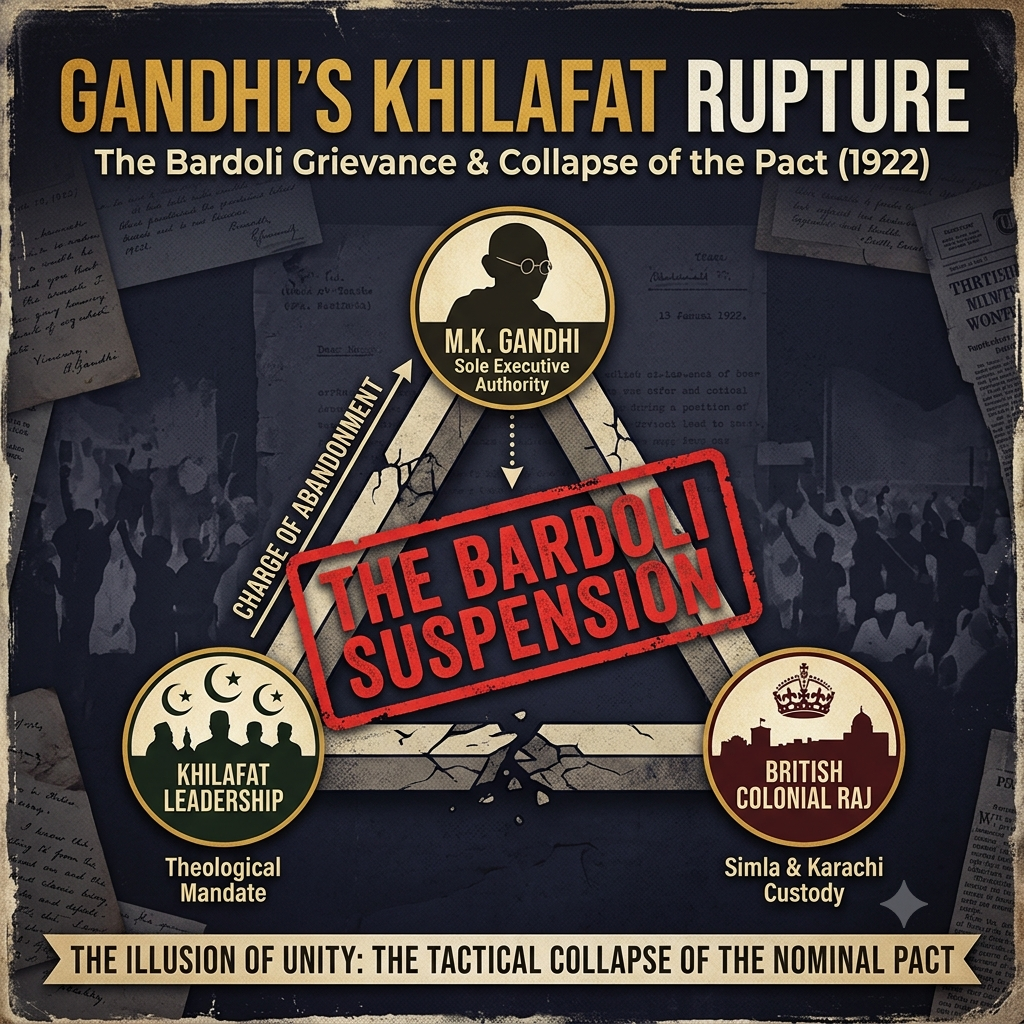
Gandhi was in Yerwada Prison, his Non-Cooperation movement had been terminated at Bardoli nine months earlier, and his nominal Khilafat alliance had ruptured. Yet the Gaya Congress of December 1922 defeated the sitting Congress president by 1,740 votes to 890. Through Gandhi’s handover of Congress keys in December 1920 and the automated synchronisation of co-located sessions, Non-Cooperation ended — yet its parent Khilafat movement still held the keys inside Congress.
Feature Image: Click here to view the image.
Videos
Glossary of Terms
1. Gandhi’s Handover of Congress Keys: A term coined in this blog to describe the structural transfer of Congress’s membership mechanisms, delegate quotas, and voting majorities into the hands of Khilafat-aligned representatives through the constitutional changes introduced in December 1920.
2. Nagpur Constitutional Mechanism: The organisational framework established at the December 1920 Nagpur Congress session, introducing four-anna mass membership, population-based delegate quotas, linguistic provincial committees, and a fifteen-member Working Committee.
3. Four-Anna Mass Membership: A low-cost Congress membership system introduced at Nagpur in 1920, requiring a contribution of four annas, or one-quarter of a rupee, without educational or property qualifications.
4. Khilafat Apparatus: The network of Khilafat committees, religious institutions, mosque-based organisations, and ulama networks that mobilised members and delegates and secured institutional influence within Congress.
5. Accredited Delegates: Representatives officially recognised under Congress’s constitutional rules and entitled to participate in proceedings and voting at annual Congress sessions.
6. No-Changers: The Congress faction led by C. Rajagopalachari and other leaders who opposed entering colonial legislative councils and favoured continuing the existing programme of non-cooperation.
7. Tark-i-Muwalat: An Islamic injunction of non-cooperation with colonial authorities, governed in the context of this blog by the Muttafiqa Fatwa of the ulama.
8. Muttafiqa Fatwa: A collective religious ruling issued by the ulama concerning non-cooperation with colonial authority, including the prohibition on entering colonial legislative councils as described in the blog.
9. Co-Located Annual Sessions: The simultaneous organisation of different political and religious conferences in the same host city, creating opportunities for coordinated proceedings and the transfer of decisions between organisational platforms.
10. Floor Arithmetic: The numerical distribution of votes within a legislative or organisational assembly. In the Gaya Congress, 1,740 delegates opposed council entry while 890 supported it, producing an 850-vote margin.
11. Clerical-Khilafat Voting Apparatus: A distinctive term used in this blog to describe the institutional arrangement through which religious networks and Khilafat-aligned representatives influenced Congress voting through accredited membership and organised bloc participation.
12. Congress-Khilafat Swaraj Party: The name adopted by C.R. Das and Motilal Nehru for their breakaway political organisation formed on 1 January 1923, reflecting the continuing institutional significance of Khilafat within Congress structures.
13. Hijrat Fatwa: The religious ruling associated with Abul Kalam Azad in 1920 that supported the Hijrat Movement, which encouraged migration from British India on religious grounds.
14. Hijrat Movement: A movement associated with the Khilafat period that encouraged Muslims to migrate from British India to Afghanistan, regarding British India as unsuitable for Muslim religious allegiance.
15. Permanent Minority Appeasement: A political expression used in the blog to describe a situation in which institutional arrangements and organised group influence constrain a political party’s ability to independently determine or reverse its policies.
#Gandhi #Congress #Khilafat #Swaraj #IndianHistory #NonCooperation #HinduHistory #FreedomMovement #PoliticalHistory #HinduinfoPedia
Scan Through The Entire Series at