
Gandhi’s Dominion Republic Partition: The Date That Wasn’t India’s (171)
भारत / GB
Part 171: Mahatma Gandhi’s Peace Efforts | Series Index
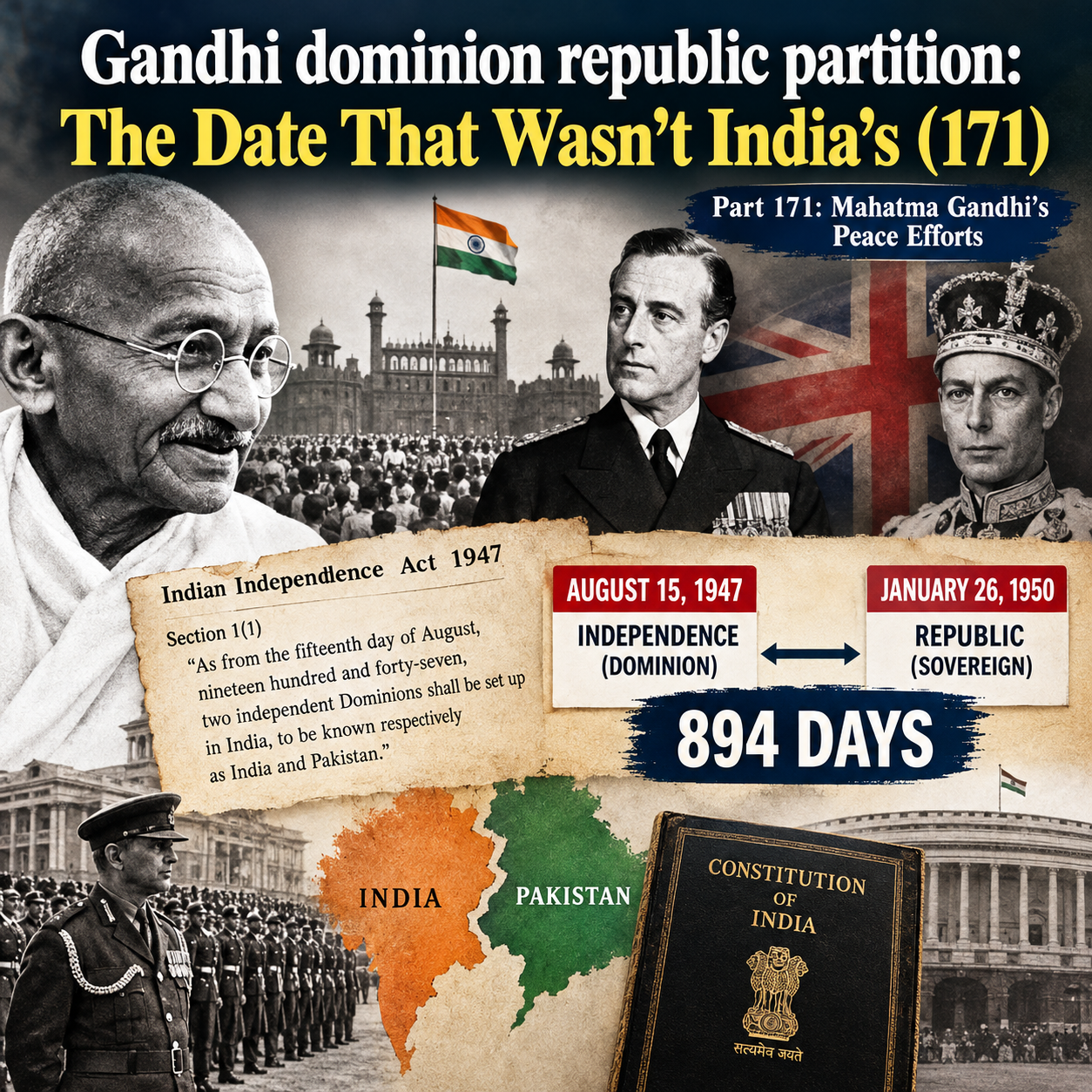
Blog 170 placed before the reader the Gandhi Radcliffe boundary partition — the acceleration of India’s independence from the British Cabinet’s announced deadline of June 1948 to August 15, 1947, who proposed it, who accepted it, and what the nearly ten months of administrative preparation surrendered. This post places before the reader what that acceleration produced in institutional terms: the Gandhi’s Dominion Republic Partition — the gap between the date India was declared independent and the date India became a sovereign republic. The gap was 894 days. This post examines what those days contained — and places before the reader the question the institutional record raises about August 15, 1947: whether the date India celebrates as Independence Day was, in constitutional terms, independence.
Thank you for reading this post, don't forget to subscribe!THE HISTORICAL RECORD — THE 894 DAYS OF THE KING
The Pattern: On August 15, 1947, India became an independent Dominion under the British Crown. King George VI remained head of state. Lord Mountbatten — a serving British officer — became Governor-General. The Indian Army remained under British Commanders-in-Chief. The Judicial Committee of the Privy Council in London remained India’s apex court until October 10, 1949 — twenty-five months into the Dominion period. The Gandhi’s Dominion Republic Partition — the distance between independence declared and sovereignty achieved — was 894 days: from August 15, 1947 to January 26, 1950, when the Constitution came into force and India became a republic.
The Lethal Exhibit: The British Cabinet’s announced transfer date was June 1948. January 26, 1950 — the date India achieved full constitutional sovereignty — fell nearly twenty months after June 1948. The Gandhi’s Dominion Republic Partition is therefore not simply the story of what August 15, 1947 was: it is the story of what it was not. The leadership that accepted an eleven-week compression in June 1947 did not secure sovereignty earlier than June 1948. It secured partition earlier — and deferred the republic by nearly twenty months past the date that had been offered.
Why it matters: The Indian Independence Act 1947 was a British Parliamentary act. It created two Dominions, not two republics. The constitutional framework under which India governed itself for 894 days was the amended Government of India Act 1935 — a colonial statute. Article 395 of the Indian Constitution, enacted in 1950, repealed both the Indian Independence Act and the Government of India Act. If India had been fully sovereign on August 15, 1947, there would have been nothing for a 1950 Parliament to repeal. The repeal clause is the Constitution’s own acknowledgement that sovereignty was not complete until January 26, 1950.
What the Indian Independence Act Created
The Indian Independence Act 1947 received royal assent on July 18, 1947 — four weeks before the independence it legislated. Its opening section, section 1(1), established the precise constitutional character of what was being created: “As from the fifteenth day of August, nineteen hundred and forty-seven, two independent Dominions shall be set up in India, to be known respectively as India and Pakistan.”
The word is Dominion, not republic. The Act created two states within the British Commonwealth framework — constitutional arrangements in which the Crown remained the formal head of state, represented by a Governor-General. For India, that Governor-General was Lord Mountbatten: a serving officer of the British armed forces, appointed to his position as Viceroy by the British government, now continuing in office as the first constitutional head of the Dominion declared independent on August 15, 1947.
King George VI did not merely remain a ceremonial figure. He was India’s head of state under the Act. His title changed — from Emperor of India to King — but his constitutional position did not. The Governor-General acted in his name. Officers held commissions under the Crown and recognised the King as the constitutional head of the Dominion. The apex court of India remained the Judicial Committee of the Privy Council in London until October 10, 1949. Section 8(2) of the Indian Independence Act stripped the Governor-General of the viceregal discretionary and veto powers that had existed before August 15 — he was bound to act on the advice of the Indian Cabinet. The prosecution places this on the record. The structural fact remains: the head of state was the British King, and his representative was a serving British officer.
The Commanders-in-Chief
The Indian Army on August 15, 1947 was commanded by General Sir Rob Lockhart — a British officer. He was succeeded in January 1948 by General Sir Roy Bucher — another British officer. India did not have an Indian Commander-in-Chief of its own army until General K.M. Cariappa assumed command on January 15, 1949 — seventeen months after the Dominion was declared.
The Pakistan Army’s Commander-in-Chief on August 15, 1947 was General Sir Frank Messervy — British. He was succeeded by General Sir Douglas Gracey — also British. Two nations declared independent in an eleven-week sprint were commanded by officers of the departing imperial power for the first year of their existence.
The gap is visible here in operational terms: the armed forces that had to manage the Punjab violence, the Kashmir crisis, and the Hyderabad and Junagadh integrations in the first eighteen months of the Dominion period were commanded at the apex by British officers whose institutional loyalties, professional networks, and career histories were with Whitehall. The documented record of that period — Gracey’s refusal to follow Jinnah’s orders on Kashmir, Bucher’s conduct during the Hyderabad operation, the absence of any counter-operation to recover Gilgit — is available for the reader to examine separately. This post places the structural fact before the reader: British officers commanded both armies.
The Repeal That Proves the Point
Article 395 of the Constitution of India, enacted on November 26, 1949 and brought into force on January 26, 1950, reads: “The Indian Independence Act, 1947, and the Government of India Act, 1935, together with all enactments amending or supplementing the latter Act, but not including the Abolition of Privy Council Jurisdiction Act, 1949, are hereby repealed.”
The Constitution repealed two statutes: the Indian Independence Act 1947 and the Government of India Act 1935. That gap is encoded in this clause. A sovereign state does not enact legislation to repeal its own founding statute three years after declaring independence — unless that statute was a colonial instrument that had governed the state in the interim and needed to be formally superseded. The repeal is not a formality. It is the Constitution’s own record that from August 15, 1947 to January 26, 1950, India was governed under a British Parliamentary act and its colonial predecessor.
If India had been fully sovereign on August 15, 1947, there would have been nothing for the 1950 Parliament to repeal.
The prosecution places one further date before the reader. Article 395 was enacted on November 26, 1949 — fifty-nine days before the Republic was proclaimed on January 26, 1950. The repeal of Westminster’s statutory authority over India occurred on November 26, 1949. The Constitution came into force on January 26, 1950. August 15, 1947 is the date called Independence Day. The reader will place all three dates in the record — and determine which one ended British constitutional authority over India.
The Arithmetic of What Was Surrendered
The British Cabinet’s announced transfer date was June 1948. The prosecution places the arithmetic before the reader plainly.
June 1, 1948 to January 26, 1950: nearly twenty months.
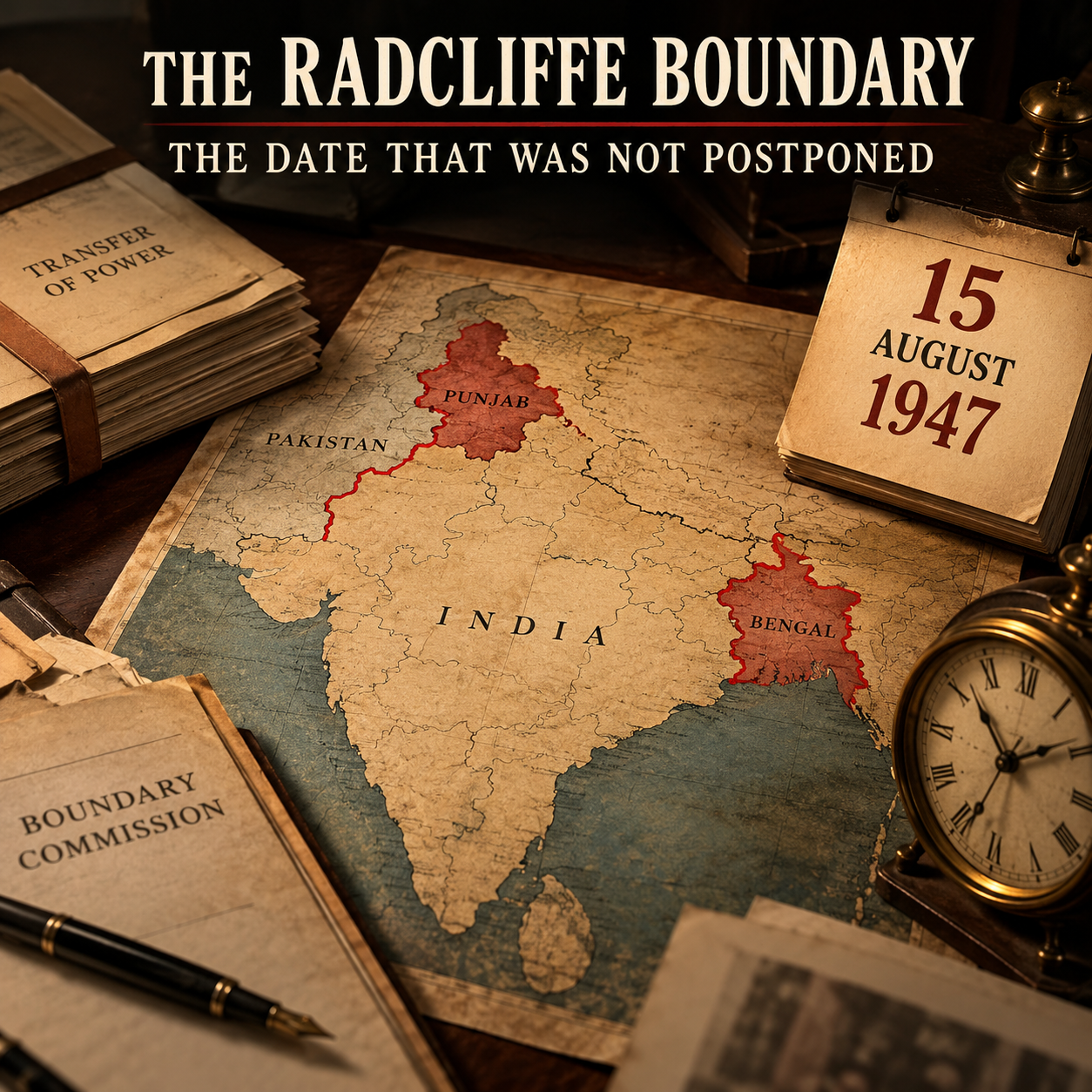
That is the distance between the date the British Cabinet formally offered — fifteen months of preparation from February 1947, documented in Hansard — and the date India achieved full constitutional sovereignty. The acceleration of August 15, 1947 did not bring full independence forward. It brought the partition of Punjab and Bengal forward — into five weeks of boundary-drawing by a London barrister who had never visited India. The Republic came when it came: January 26, 1950. The acceleration shifted the partition earlier by nearly ten months. It shifted the date India called its own independence earlier by the same period. It did not shift the Republic earlier by a single day. If anything, it shifted the Gandhi’s Dominion Republic Partition — the gap between the declaration and sovereignty — by placing India under Dominion status from a date of the Viceroy’s choosing rather than from a date the Cabinet had offered with fifteen months of preparation behind it. The Dominion gap existed regardless of whether independence was declared in August 1947 or June 1948. What the acceleration determined was the condition under which the partition was executed — not the date on which India became sovereign.
The comparator is instructive. The United States declared independence on July 4, 1776. The Treaty of Paris, which secured British recognition of that independence, was signed on September 3, 1783 — seven years later. The United States does not celebrate 1783. It celebrates the declaration. India celebrates August 15 — the declaration. But the legal infrastructure of sovereignty, as Article 395 records, was not complete until January 26, 1950.
The Anglo-Irish Treaty of December 1921 accepted Dominion status — creating the Irish Free State, complete with an Oath of Allegiance to the Crown and a Governor-General. The anti-Treaty faction rejected it; the resulting civil war (1922–1923) did not prevent implementation. The Irish Free State functioned as a Dominion for fifteen years. The Constitution of Ireland 1937 eliminated the Crown’s domestic executive authority. The Republic of Ireland Act 1948 formally severed all remaining ties, taking effect April 18, 1949. The structural parallel is exact: Ireland took twenty-six years to complete what India’s 894-day transition compressed. The Indian National Congress, whose declared objective since the Lahore session of 1929 had been Purna Swaraj — complete independence — accepted Dominion status in June 1947 without repealing or formally reconciling it with the mandatory terms of the 1929 Purna Swaraj declaration.
The date India celebrates as Independence Day — August 15 — was chosen by Lord Mountbatten. It was the second anniversary of Japan’s formal surrender to him as Supreme Allied Commander, South-East Asia, in 1945. It was a date of personal significance to the British Viceroy who presided over the transfer. The date India chose for itself — January 26, the anniversary of the 1930 Purna Swaraj declaration at the Lahore Congress — is called Republic Day. It marks the date the Constitution came into force: the date India became, in its own constitutional terms, fully sovereign. The reader will place the two dates alongside each other and note which one India selected, and which one was suggested to it.
The Pacing Paradox
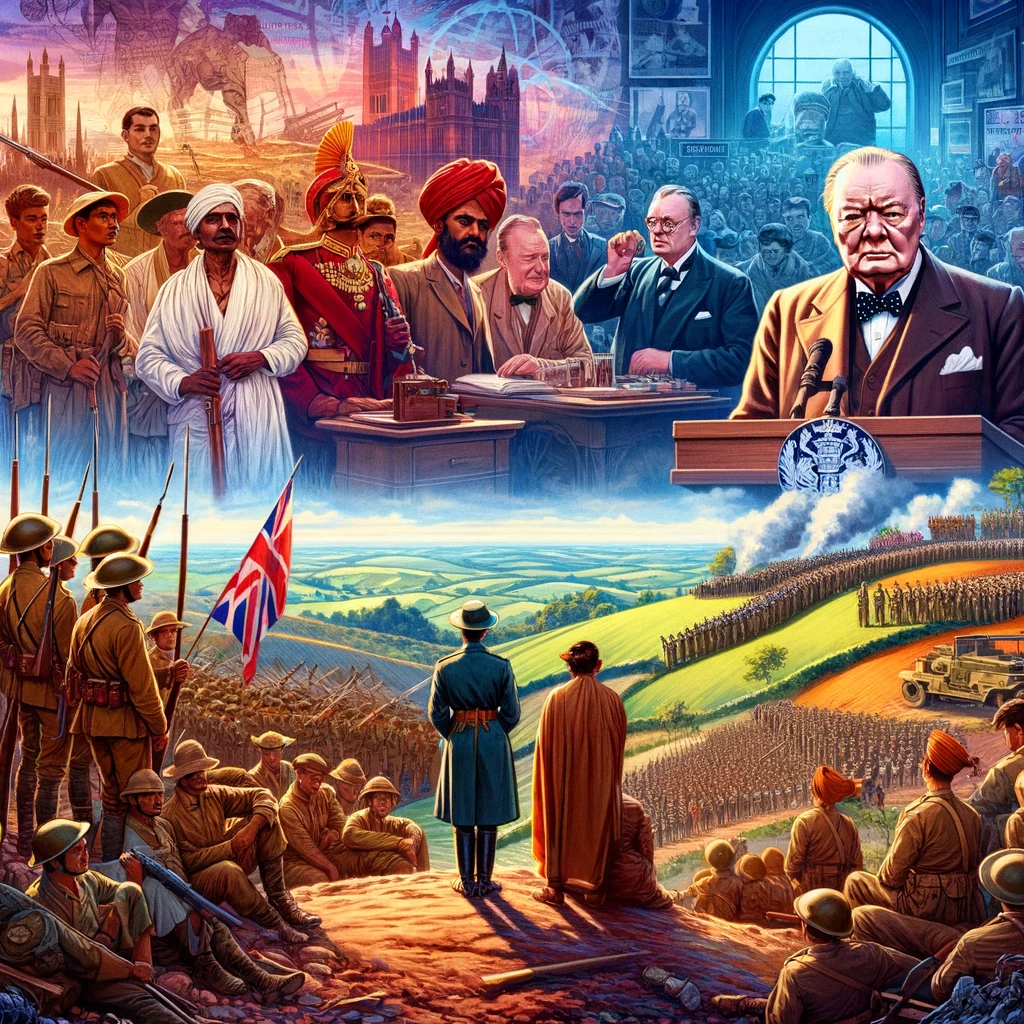
The 894-day Dominion period cannot be read in isolation from the thirty years that preceded it. Across three decisive moments of the independence movement, when organised mass pressure had the colonial administration under acute strain, the leadership chose withdrawal on grounds of unreadiness:
In April 1919, the Rowlatt Satyagraha was suspended eighteen days after it began. Gandhi called it a “Himalayan miscalculation” — the people were not morally prepared for civil disobedience. In February 1922, the Non-Cooperation Movement — the most pervasive mass mobilisation since 1857, with provincial administrations warning the Viceroy of imminent breakdown — was called off after Chauri Chaura. Subhas Chandra Bose called it “a national calamity.” C.R. Das, Motilal Nehru, and Lala Lajpat Rai lodged written protests. In March 1931, the Civil Disobedience Movement — which had paralysed salt revenue collection and filled sixty thousand political prisoners into jails — was suspended for a seat at the Round Table Conference, without a commitment on Dominion Status and without commutation of Bhagat Singh’s death sentence.
Each withdrawal was defended on grounds of insufficient preparation, moral unreadiness, or the need for more time.
In June 1947, when the British Cabinet had placed fifteen months of preparation time on the record in Hansard, the leadership accepted eleven weeks. The argument of readiness — deployed to abort mass action three times when the colonial state was under pressure — was not deployed when time was formally offered and the consequences of haste would fall on the populations of Punjab and Bengal.
The prosecution does not claim the decisions were equivalent. It places the sequence before the reader.
The Prosecution’s Position
Gandhi’s Thirty Years places three questions before the reader. Each question concerns the same claim: that August 15, 1947 was independence. The Gandhi’s Dominion Republic Partition is the prosecution’s exhibit.
- Does the documented record — King George VI as head of state, British Commanders-in-Chief commanding both armies, the Privy Council as India’s apex court until October 1949, and the Government of India Act 1935 as India’s governing statute for 894 days after the Dominion was declared — constitute an exhibit the reader places alongside the claim that August 15, 1947 was the achievement of full sovereignty?
- Does Article 395 of the Indian Constitution — repealing the Indian Independence Act 1947 and the Government of India Act 1935 in 1950, three years after the Dominion those acts created was declared — constitute an exhibit the reader places alongside the claim that the constitutional break with British authority was complete on August 15, 1947?
- Does the arithmetic — June 1948, formally offered by the British Cabinet as the transfer date, against January 26, 1950, the date full constitutional sovereignty was achieved, a gap of nearly twenty months — constitute an exhibit the reader places alongside the claim that the acceleration of August 15, 1947 delivered independence earlier than patience would have allowed?
The series does not answer. Gandhi’s Thirty Years places the Gandhi’s Dominion Republic Partition before the reader: 894 days from the declaration to the republic, and nearly twenty months between the date that was offered and the date that sovereignty was complete. The reader will place the Commanders-in-Chief, the repeal clause, and the arithmetic against the claim of independence — and complete the sentence.
Invitation To Defence
The floor belongs to the defense. We now invite them to present their exhibits and challenge the narrative established by the prosecution.
August 15 was Mountbatten’s date. It was the anniversary of Japan’s surrender to him in 1945. The date India celebrates as Independence Day was chosen by the British Viceroy who presided over the transfer. The date India chose for itself — January 26, the anniversary of the 1930 Purna Swaraj declaration — is called Republic Day. On August 15, 1947, King George VI was head of state. A British officer was Governor-General. British Commanders-in-Chief commanded both armies. Article 395 of the Constitution, enacted in 1950, repealed the Indian Independence Act. The prosecution places the two dates before the reader — and the record of what each one was. The reader will complete the sentence.
Feature Image: Click here to view the image.
Videos
Glossary of Terms
1. Dominion Status: A constitutional arrangement in which a country governs itself while retaining the British Crown as its formal head of state.
2. Gandhi’s Dominion Republic Partition: A phrase coined in this blog to describe the gap between India’s declaration of independence on August fifteenth, nineteen forty-seven, and its becoming a republic on January twenty-sixth, nineteen fifty.
3. Indian Independence Act 1947: An Act of the British Parliament that established the two independent Dominions of India and Pakistan from August fifteenth, nineteen forty-seven.
4. Government of India Act 1935: A British statute that provided the principal constitutional framework for governing India during the initial Dominion period, until the Constitution of India came into force.
5. Article 395: The article of the Constitution of India that repealed the Indian Independence Act 1947 and the Government of India Act 1935, subject to the exception specified in its text.
6. Constitutional Sovereignty: The authority of a state to govern itself under its own constitutional framework without remaining constitutionally subordinate to an external power.
7. Governor-General: The constitutional representative of the British Crown in a Dominion. Lord Mountbatten held this office in India after independence.
8. Privy Council: The British institution whose Judicial Committee continued to hear Indian appeals until October tenth, nineteen forty-nine.
9. Commanders-in-Chief: The senior military officers who held the highest command of the armed forces. British officers initially commanded the Indian and Pakistani armies after independence.
10. Boundary Commission: A body responsible for determining territorial boundaries. In nineteen forty-seven, Cyril Radcliffe led the boundary-drawing process for the partition of Punjab and Bengal.
11. Purna Swaraj: Meaning complete independence, this was the Indian National Congress’s declared objective associated with its Lahore session of nineteen twenty-nine.
12. Anglo-Irish Treaty: The December nineteen twenty-one agreement that established the Irish Free State as a Dominion within the British Commonwealth framework.
13. Hansard: The official record of debates and proceedings in the British Parliament, cited in the blog in connection with the announced timetable for transferring power.
14. Rowlatt Satyagraha: The protest movement launched in nineteen nineteen against the Rowlatt legislation, which Gandhi suspended eighteen days after it began.
15. Civil Disobedience Movement: A mass political movement associated with Gandhi that challenged British rule through non-violent resistance, including the Salt March and the refusal to comply with selected colonial measures.
#India #Gandhi #IndianHistory #Independence #RepublicDay #Constitution #Partition #BritishRaj #Dominion #HinduinfoPedia
Scan Through The Entire Series at
Gandhi’s Peace Efforts: The Questions Before the Mahatma (0)