
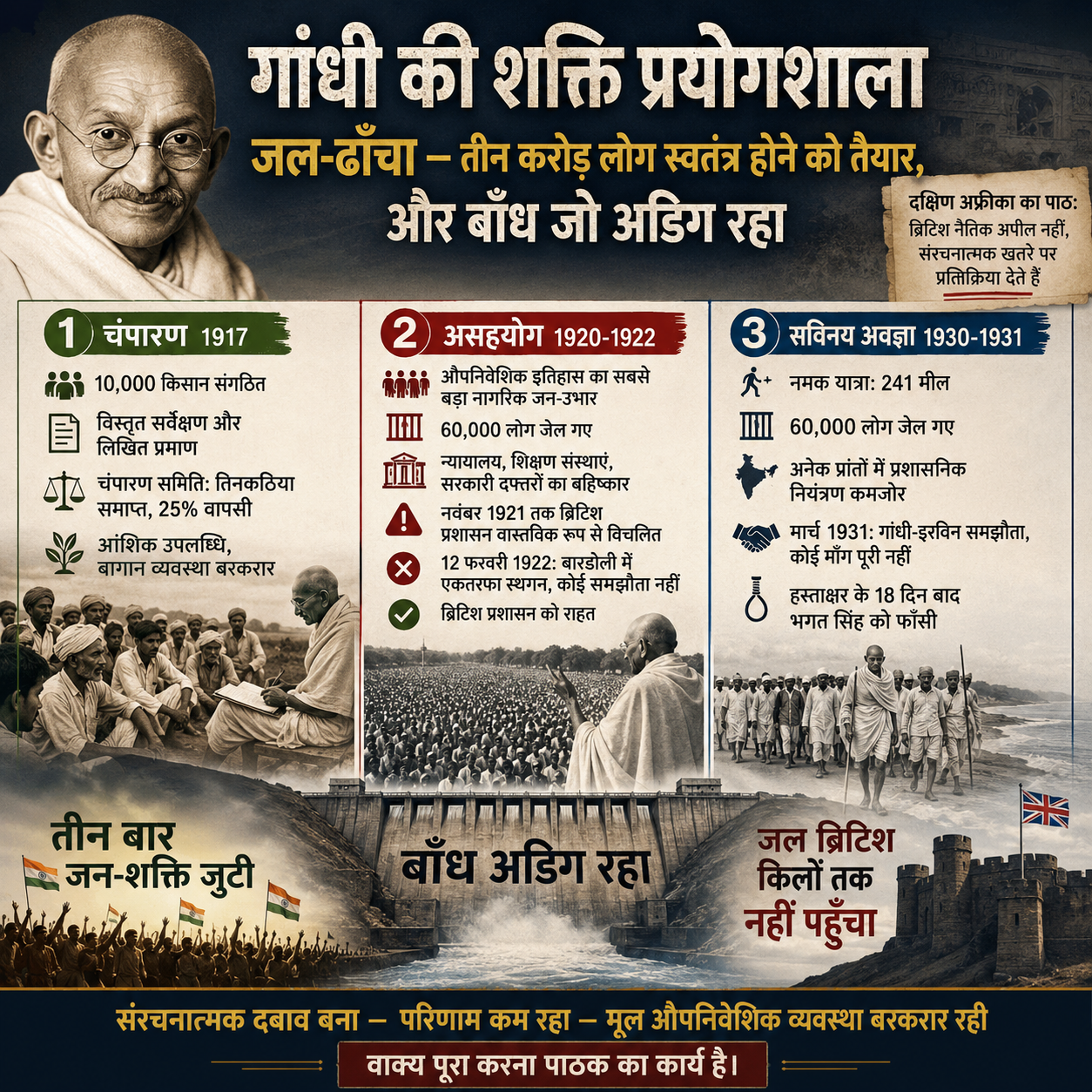
Gandhi’s Power Laboratory: The Water Frame — 300 Million People Ready to Be Free, and the Dam That Held (137)
भारत / GB
Part 137: Mahatma Gandhi’s Peace Efforts | Series Index
Blog 136 placed the South Africa lesson before the reader — Gandhi learned that the British respond to structural threat, not moral appeal. This post, Gandhi’s Power Laboratory”, places the Indian application of that lesson before the reader: three documented acts of mass mobilisation in which the reservoir was assembled, the structural pressure was built — and each time, the dam held. The water never reached the British forts.
Thank you for reading this post, don't forget to subscribe!The Action Taken: Champaran, Non-Cooperation, and Civil Disobedience each organised mass pressure and then stopped the flow.
Who Paid the Price: Volunteers and peasants who built the pressure and received no structural constitutional return when it was cut.
The Alternative Bypassed: Holding the third campaign until written terms were on the table.
Why This Matters: Records the three-stage pressure sequence, not the Belgaum spinning rule.
The Water Frame
Gandhi’s Power Laboratory places one documented observation before the reader at the outset. Gandhi did not build the water. 300 million people were ready to be free — the documented conditions of colonial extraction, documented across Blogs 9-16 of this series: 9.2 trillion dollars removed, life expectancy 27 years, literacy 12%, eleven demands whose delivery the British apparatus had calculated it could not survive.
The water existed. It had existed for decades before Gandhi arrived from South Africa in 1915. What Gandhi documented, across three acts of mass mobilisation, was an extraordinary capacity to find the water, channel it, organise it, and direct it toward the colonial apparatus. The prosecution places this documented capacity before the reader — and then places the documented outcome alongside it.
Each time the reservoir was assembled. Each time the dam held. The water never reached the British forts.
Act One — Champaran 1917
Gandhi’s Power Laboratory places Champaran before the reader as the first documented act of water-building in India.
10,000 farmers in the Champaran district of Bihar — documented as carrying the most rigorous ground-level documentation of Gandhi’s career. Gandhi arrived in April 1917 and conducted a systematic documented survey: farmer by farmer, grievance by grievance, the indigo plantation system’s documented exploitation placed on the written record with a precision Gandhi had not previously deployed in India.
The documented result: the Champaran Agrarian Inquiry Committee, the documented abolition of the tinkathia system requiring indigo cultivation, the documented 25% refund of illegal exactions. Partial delivery — as established in Blog 5 of this series. The plantation system’s structural framework remained intact.
Gandhi’s Power Laboratory places the documented Champaran sequence before the reader: 10,000 farmers organised, rigorous documentation assembled, structural pressure applied — partial delivery, structural framework intact, national fame built. The reservoir was assembled. The dam — partial settlement, structural continuity — held.
Act Two — Non-Cooperation 1920-1922
Gandhi’s Power Laboratory places the Non-Cooperation Movement before the reader as the second documented act — larger by orders of magnitude than Champaran, and more precisely documented in its approach to breaking point.
The largest civilian uprising in colonial history to that point. Sixty thousand Indians through British jails. The documented boycott of courts, educational institutions, and government offices bringing administrative machinery across multiple provinces to a standstill — established in Blog 133 of this series from Viceroy Lord Reading’s documented despatches to Secretary of State Edwin Montagu. By November 1921 — established in Blog 29 of this series — the British administration was by its own documented accounts genuinely shaken. The reservoir had never been fuller.
The documented result: February 12 1922, Bardoli. Gandhi suspended the movement unilaterally, without a vote, over the documented objections of Nehru, Bose, Das, and Lajpat Rai. No settlement. No prisoner release. No structural concession. The British administration’s documented reaction: relief. Gandhi’s arrest followed on March 10 1922.
Gandhi’s Power Laboratory places the documented Non-Cooperation sequence before the reader: the largest civilian uprising in colonial history assembled, genuine British alarm documented at the highest level, structural pressure at its documented maximum — unilateral suspension, no settlement, British relief. The reservoir was at its fullest. The dam — Gandhi’s own documented decision — held. The water did not reach the British forts.
Act Three — Civil Disobedience 1930-1931
Gandhi’s Power Laboratory places the Salt March and Civil Disobedience campaign before the reader as the third documented act.
241 miles. 60,000 jailed across India. Provinces documented as losing administrative control. The Salt March of March-April 1930 produced what Blog 8 of this series placed before the reader: the strongest hand any Indian leader had ever held — the documented moment at which the British administration’s economic and administrative apparatus was visibly strained by mass non-compliance at scale.
The documented result: the Gandhi-Irwin Pact of March 1931 — established in Blogs 17-20 of this series. Gandhi’s signature, without consulting the Congress Working Committee, without mandate from the Indian population. Not one of the eleven demands met in full. Bhagat Singh hanged eighteen days after signing. The documented British relief at the settlement was followed by the documented terms of the agreement — terms that delivered nothing measurable or enforceable.
Gandhi’s Power Laboratory places the documented Civil Disobedience sequence before the reader: 60,000 jailed, the strongest documented hand assembled, provinces losing control — Gandhi-Irwin Pact, nothing delivered in full, Bhagat Singh hanged. The reservoir was assembled. The dam — personal negotiation, moral authority, signature without mandate — held. The water did not reach the British forts.
The Pattern Placed Before the Reader
The documented pattern across the three acts is placed before the reader in sequence.
In each act: the reservoir was assembled. 10,000 Champaran farmers. The largest civilian uprising in colonial history. 60,000 jailed in Civil Disobedience. Each time the structural pressure reached a documented level that the British apparatus found genuinely threatening.
In each act: the settlement fell short of the structural threat the reservoir had assembled. Champaran — plantation framework intact. Non-Cooperation — unilateral suspension, no settlement. Civil Disobedience — Irwin Pact, nothing in full.
Blog 136 placed the South Africa lesson before the reader: the British respond to structural threat, not moral appeal. The three acts placed before the reader in this blog each assembled documented structural threat. Each time the documented outcome fell short of what the documented structural threat had made possible.
The prosecution places one documented question before the reader: did the dam that held in each of the three acts serve the structural threat the reservoir had assembled — or did it redirect that structural threat into a settlement framework that preserved the British apparatus’s essential continuity?

The Prosecution’s Position
Gandhi’s Power Laboratory places three questions before the reader.
- Do the three documented acts — Champaran 1917, Non-Cooperation 1920-1922, Civil Disobedience 1930-1931 — each show the documented assembly of structural pressure at a level the British apparatus found genuinely threatening, followed by a documented settlement that fell short of what the documented structural threat had made possible?
- Does the documented pattern across the three acts — reservoir assembled, dam held, water did not reach the British forts — belong before the reader alongside the South Africa lesson established in Blog 136: that the British respond to structural threat, not moral appeal?
- Does the gap between the documented structural pressure assembled in each act and the documented settlement that followed each act constitute an exhibit the reader places alongside Gandhi’s documented role as the movement’s unilateral decision-maker in each case?
The series does not answer. The three documented acts, their documented structural pressure, and their documented outcomes are placed before the reader. The reader will examine what the pattern of assembled reservoirs and held dams established — and complete the sentence.
Invitation To Defence
The floor belongs to the defense. We now invite them to present their exhibits and challenge the narrative established by the prosecution.
Champaran: 10,000 farmers, rigorous documentation, partial delivery, plantation framework intact. Non-Cooperation: the largest civilian uprising in colonial history, British genuinely shaken by November 1921, unilateral suspension February 1922, no settlement, British relief. Civil Disobedience: 60,000 jailed, provinces losing control, Irwin Pact, nothing in full, Bhagat Singh hanged. Three reservoirs assembled. Three times the dam held. The water did not reach the British forts. The prosecution places the documented pattern before the reader. The reader will complete the sentence.
Feature Image: Click here to view the image.
Videos
Glossary of Terms
- Water Frame: The central metaphor of the blog for the relationship between accumulated mass mobilisation, structural pressure, and the restraint or settlement that prevents that pressure from reaching the British colonial system.
- Reservoir: The blog’s metaphor for the accumulated mass strength available for political mobilisation, represented through farmers, participants, prisoners, and wider popular participation.
- Structural Threat: Pressure on the fundamental functioning of the British colonial apparatus, rather than merely a moral or political appeal.
- Structural Pressure: The organised pressure created when large-scale public mobilisation begins to affect the administrative and economic functioning of the colonial system.
- Dam: The blog’s metaphor for the decision, settlement, or mechanism that contained or redirected the structural pressure generated by mass mobilisation.
- British Forts: A metaphor used in the blog for the essential centres and structures of British colonial power that the accumulated mass pressure did not ultimately reach.
- Champaran Agrarian Inquiry Committee: The committee established following Gandhi’s 1917 Champaran campaign to investigate the grievances of farmers and the indigo plantation system.
- Tinkathia System: The plantation arrangement in Champaran that required farmers to cultivate indigo on part of their land; the system was abolished following the Champaran inquiry.
- Non-Cooperation Movement: Gandhi-led mass movement from 1920 to 1922 involving boycott of courts, educational institutions, and government offices, with large-scale imprisonment and growing pressure on British administration.
- Civil Disobedience Movement: The mass movement beginning in 1930 that included the Salt March and widespread refusal to comply with selected colonial laws, resulting in large-scale imprisonment and administrative pressure.
- Salt March: Gandhi’s 241-mile march in March-April 1930 against the British salt laws, which became the opening and major public symbol of the Civil Disobedience campaign.
- Gandhi-Irwin Pact: The March 1931 agreement between Gandhi and Viceroy Lord Irwin that ended the immediate phase of Civil Disobedience negotiations but did not fully satisfy any of Gandhi’s eleven demands.
- Structural Continuity: The continued existence of the essential framework of the British colonial system despite major episodes of mass mobilisation and political pressure.
- One-Sided Suspension: The unilateral decision by Gandhi to suspend the Non-Cooperation Movement at Bardoli on February 12, 1922, without a vote and despite opposition from several Congress leaders.
- Prosecution’s Position: The analytical framework of this series that places documented events, structural pressure, decisions, and outcomes before the reader as evidence for examining Gandhi’s role in the course of the movement.
#Gandhi #Champaran #NonCooperation #CivilDisobedience #SaltMarch #IndianHistory #BritishIndia #HinduinfoPedia