
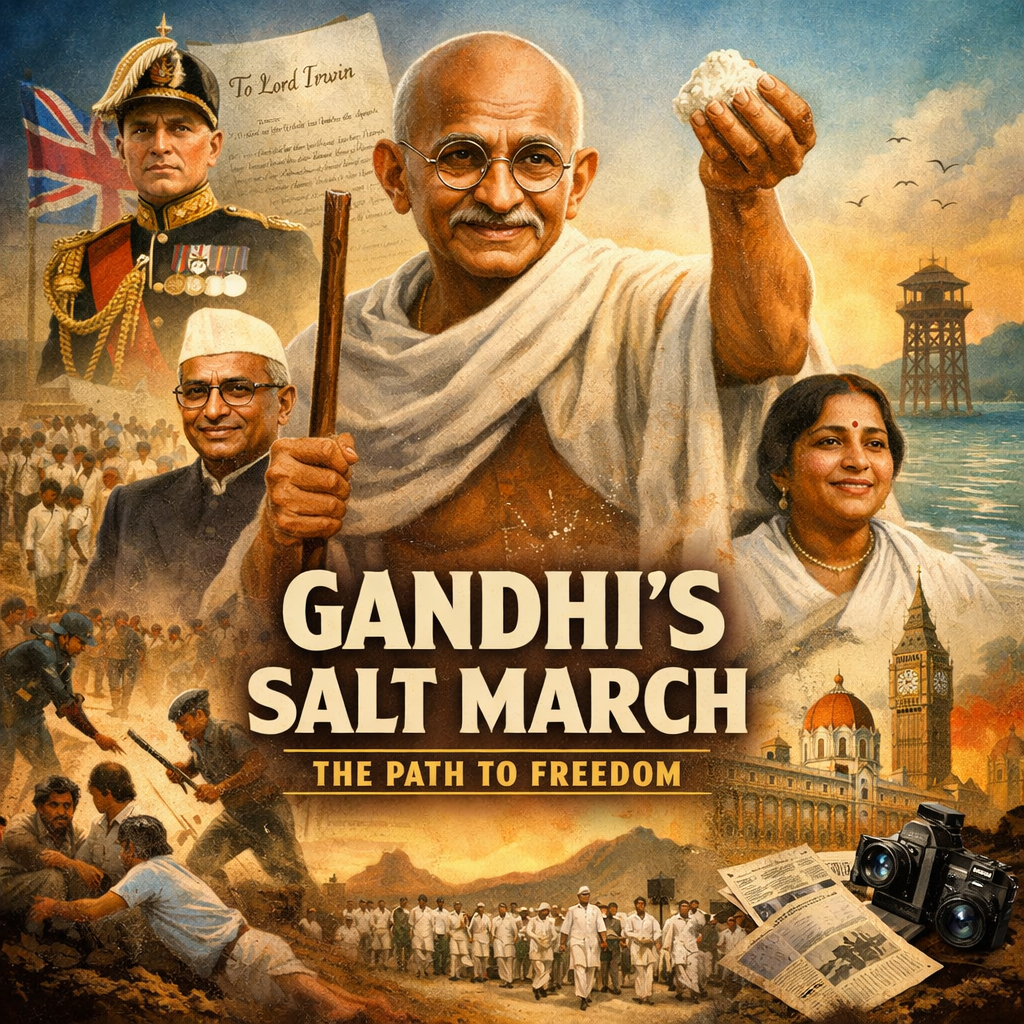
Gandhi’s Salt March: 241 Miles That Changed Everything (8)
भारत / GB
Part 8: Mahatma Gandhi’s Peace Efforts | Series Index
From Non-Cooperation to Gandhi’s Salt Satyagraha
From the forge of South Africa to the spinning wheel of Sabarmati, from the Pietermaritzburg night to the mass no of Non-Cooperation — Gandhi had built his method, his organisation, and his nation’s willingness to act. Eight years after Non-Cooperation was called off, he walked to the sea. Let us, now, understand how the Gandhi’s Salt Satyagraha transformed Gandhi and Indian freedom struggle.
Thank you for reading this post, don't forget to subscribe!The Action Taken: Gandhi focused national civil disobedience onto the universal salt monopoly, marching 241 miles to Dandi to stage the deliberate violation of colonial salt regulations.
Who Paid the Price: The 78 original marchers and tens of thousands of unarmed volunteers who joined subsequent coastal marches, facing severe police baton charges.
The Alternative Bypassed: Congress Working Committee discussions proposing nationwide industrial strikes or legislative boycotts.
Why This Matters: Concentrated nationwide resistance into an individual moral spectacle that built immense pressure, creating the leverage later discharged in bilateral negotiations.
The Target Nobody Expected
In early 1930, Gandhi’s close associates were expecting a confrontation with the British over land revenue, the forest laws, or the constitutional question of Dominion Status. What Gandhi chose for Gandhi’s Salt March instead was salt.
The choice was an act of strategic genius so precise that it took a moment to understand. Salt was not a luxury. It was not a political abstraction. Salt was what every Indian — literate or illiterate, rich or poor, Hindu or Muslim, from the Himalayas to Cape Comorin — put in food every single day. Britain’s Salt Act of 1882 prohibited Indians from collecting or producing salt independently and required them to buy it from the colonial monopoly at a heavily taxed price. The poorest Indian — the one who could least afford a tax — paid it most severely, because salt as a proportion of daily expenditure was highest at the bottom of the income ladder.
Gandhi had found a target that was universal, undeniable, and impossible to defend. No British official could stand before the world and explain why an empire was taxing a man’s right to season his food. Gandhi’s Salt March did not need to win a military engagement. It needed to make the moral case for independence visible to the entire world in a single walk.
The Letter Before the March
On March 2, 1930 — ten days before he set out — Gandhi wrote to Viceroy Lord Irwin. The letter was 2,700 words, handwritten, and carried by a personal emissary on foot to Delhi. It informed Irwin that Gandhi intended to break the Salt Laws on April 6 and offered to stop the march if the Viceroy would meet the Congress’s eleven demands — among them the abolition of the salt tax, reduction of land revenue, and release of political prisoners.
These eleven demands were a masterstroke of inclusivity. By grouping high-level constitutional changes with the abolition of the salt tax and the reduction of land revenue, Gandhi ensured that every layer of Indian society—from the wealthy industrialist to the debt-ridden peasant—had a personal stake in the movement. It wasn’t just a list of grievances; it was a national manifesto that the British could not dismiss as “fringe” interests.
Irwin sent a polite acknowledgement through his secretary and ignored the letter. Gandhi’s response was to begin walking.
The letter itself was a political masterstroke. It meant that when Gandhi picked up salt on the beach at Dandi, the world already knew the British had been warned and had refused to engage. The moral framing was complete before the first step was taken.
Gandhi’s Salt March: 241 Miles
The March Itself
On March 12, 1930, Gandhi walked out of Sabarmati Ashram with 78 carefully chosen volunteers — men from almost every region, caste, creed and religion of India. He was 61 years old. He carried a bamboo staff. He wore his loincloth. He intended to walk 241 miles to the coastal village of Dandi in Gujarat. He told his volunteers before they left: if he was arrested along the way, the march would continue without him.
The first day’s march of 21 kilometres ended at Aslali, where Gandhi spoke to a crowd of 4,000. Each subsequent day followed the same pattern — march, village, prayer meeting, speech, registration of new volunteers and resignations from local officials. The procession grew with every step. By Surat, 30,000 people lined the road. The march was also called the White Flowing River — because of the unbroken line of white khadi stretching for kilometres behind the old man with the staff.
The World Was Watching
Gandhi had planned the media campaign with the same precision as the route. The Congress Working Committee had contacted American, European, and Indian news media before the march began. Foreign journalists were invited to walk alongside. Three Bombay cinema companies shot newsreel footage. The New York Times wrote almost daily about Gandhi’s Salt March, including two front-page articles on April 6 and 7. Gandhi gave interviews to foreign correspondents along the way. He declared to the press: *”I want world sympathy in this battle of right against might.”*
He received it. By the end of 1930, Time magazine named Gandhi its Man of the Year. He was a 61-year-old man in a loincloth walking to the sea. He had made himself the most photographed political figure on earth.

Dandi: April 6, 1930
On April 5, Gandhi and his marchers reached Dandi. More than 50,000 people had gathered at the shore. The colonial police had forestalled Gandhi by crushing the salt deposits into the mud the night before. It did not matter. At 8:30 on the morning of April 6, Gandhi walked to the shoreline, bent down, and picked up a lump of salty mud.
The act was technically illegal. The British had called it a criminal offence. No arrests were made that morning. The British had calculated — correctly — that arresting Gandhi at the moment of the act would create a martyr image that would travel around the world within hours. So they watched. And in watching, they confirmed everything Gandhi had said about the moral bankruptcy of the empire.
700 telegrams were sent from the post office at Jalalpur that day. Nearly all of them were from journalists.
Gandhi’s Salt March: The Fire That Spread
What followed Dandi was beyond anything the British had planned for. Civil disobedience broke out across India simultaneously — not organised from above but ignited from below by the example of one old man bending to pick up mud. C. Rajagopalachari led a salt march in Tamil Nadu. Similar movements broke out in Bengal, Andhra, and across the subcontinent. Millions broke the salt laws by making their own salt or buying it illegally. By the end of 1930, 60,000 people were in jail.
Gandhi was arrested on May 5 — after informing Lord Irwin in advance of his intention to raid the Dharasana saltworks, exactly as he had informed Irwin of the march itself. The satyagraha continued without him. The mantle of leadership then fell to Sarojini Naidu. Her presence at the forefront of the Dharasana raid was a watershed moment for the movement. It signaled to the women of India that the struggle for Swaraj was as much theirs as the men’s. As she stood before the salt deposits, she famously told the satyagrahis, “You must not use any violence under any circumstances. You will be beaten, but you must not resist; you must not even raise a hand to ward off blows.” Her courage turned a local protest into a global symbol of dignified defiance.
On May 21, poet Sarojini Naidu led 2,500 marchers to the Dharasana saltworks. American journalist Webb Miller watched the British-led police beat peaceful marchers who did not raise a single hand in defence. He wrote: *”Not one of the marchers even raised an arm to ward off the blows. They went down like ten-pins.”* The dispatch went around the world.

What the Sea Gave Back
Gandhi’s Salt March did not end British rule. The Salt Laws were not immediately repealed. The Round Table Conference that followed produced no independence. By any narrow political measure, Gandhi’s Salt March achieved nothing permanent in 1930.
What it achieved was something the British had no defence against — it made the moral case for Indian independence undeniable to the watching world. A 61-year-old man walking 241 miles to pick up a handful of mud from a beach had humiliated the world’s largest empire without raising his voice. The image of Gandhi at Dandi — the loincloth, the bamboo staff, the bend toward the earth — became the visual vocabulary of nonviolent resistance that the entire twentieth century would borrow. Martin Luther King borrowed it. Nelson Mandela borrowed it. Every civil rights movement that came after borrowed it.
The sea did not move. What moved was the world’s understanding of what power looked like — and what it did not have to look like.
Part 9 will explore what the Salt Satyagraha brought to Gandhi and to the Indian freedom movement — the leadership it confirmed, the sacrifices it demanded, and the momentum it created for a nation on the edge of transformation.
Series Index
Feature Image: Click here to view the image.
Video
Glossary of Terms
- Salt Act (1882): British law prohibiting Indians from producing salt independently, forcing purchase from colonial monopoly at high tax.
- Satyagraha: Gandhi’s principle of nonviolent resistance, meaning “truth-force” — a disciplined moral struggle without violence.
- Sabarmati Ashram: Gandhi’s base in Gujarat, where he lived and organized campaigns before the Salt March.
- Dandi: Coastal village in Gujarat where Gandhi ended the Salt March by picking up salt.
- Civil Disobedience Movement: Mass protests across India in 1930, sparked by Gandhi’s Salt March, involving breaking colonial laws peacefully.
- Dominion Status: A constitutional demand for India to gain semi-independent status within the British Commonwealth.
- Dharasana Saltworks: Site of a major protest led by Sarojini Naidu after Gandhi’s arrest, where peaceful marchers were brutally beaten.
- Sarojini Naidu: Poet and political leader who led the Dharasana raid, symbolizing women’s leadership in India’s freedom struggle.
- Round Table Conference: Meetings in London (1930–32) between British officials and Indian leaders to discuss constitutional reforms.
- Non-Cooperation Movement: Gandhi’s earlier mass campaign (1920–22) urging Indians to boycott British institutions and goods.
- Gandhi’s Salt March (1930): A 241‑mile nonviolent protest led by Mahatma Gandhi from Sabarmati Ashram to Dandi, challenging the British Salt Act. By picking up salt at the shore, Gandhi made colonial rule’s moral weakness visible to the world.
Related Blogs
Scan Through The Entire Series at
Gandhi’s Peace Efforts: The Questions Before the Mahatma (0)
Previous Blogs on Mahatma Gandhi
- https://hinduinfopedia.in/martyrs-of-indian-independence-and-gandhis-influence/
- https://hinduinfopedia.in/rowlatt-act-and-gandhi/
- https://hinduinfopedia.in/gandhis-post-independence-actions-and-legacy/
- https://hinduinfopedia.in/gandhis-personal-ideologies-and-methodologies/
- https://hinduinfopedia.in/communal-relations-in-indian-history-gandhis-legacy/
- https://hinduinfopedia.in/ideological-divides-and-gandhis-leadership/
- https://hinduinfopedia.in/gandhis-post-independence-actions-and-legacy/
- https://hinduinfopedia.in/gandhi-revisited-a-critical-legacy/
- https://hinduinfopedia.in/indira-gandhis-actions-the-competition-terminator/
- https://hinduinfopedia.in/nonviolent-policy-and-making-of-gandhi-in-south-africa/
- https://hinduinfopedia.org/ambedkars-buddhist-political-move-divergence-from-gandhi-on-caste-issues/
- https://hinduinfopedia.org/mahatma-gandhi-and-nonviolence/
- https://hinduinfopedia.org/mahatma-gandhi-and-his-principles-analyzed/
- https://hinduinfopedia.org/subhash-chandra-bose-contrasting-strategies-with-gandhi/
- https://hinduinfopedia.in/on-this-day-5-march-2024-tuesday/
- https://hinduinfopedia.in/akshardham-temple-terror-attack-2002/
- https://hinduinfopedia.in/nathuram-godse-murderer-patriot-or-fractured-youth/
- https://hinduinfopedia.in/remembering-indian-freedom-struggle-of-february-5/
- https://hinduinfopedia.org/indias-freedom-struggle-and-quit-india-movement-ii/
- https://hinduinfopedia.org/indian-freedom-fighters-legacy-of-gopal-krishna-gokhale/
Follow us:
- English YouTube: https://www.youtube.com/@Hinduofficialstation
- Hindi YouTube: https://www.youtube.com/@HinduinfopediaIn
- X: https://x.com/HinduInfopedia
- Instagram: https://www.instagram.com/hinduinfopedia/
- Facebook: https://www.facebook.com/Hinduinfopediaofficial
- Threads: https://www.threads.com/@hinduinfopedia